


NFHS Hall of Famers: Multi-Sport Experience Makes Major Difference
By
The NFHS Voice
National Federation of State High School Associations
July 28, 2026
The theory that athletes in high school need to specialize in one sport in an out-of-school program to progress to the next level was not the theme from the five athletes inducted into the National High School Hall of Fame last month in Salt Lake City, Utah.
At a press conference preceding the 43rd Hall of Fame induction ceremony, five former extraordinary high school athletes – all of whom later excelled at the college, professional and for a few Olympic levels – delivered resounding messages about the importance of playing multiple sports within school-based programs.
Joe Carter, who was a four-sport standout in football, basketball, baseball and track at Millwood High School in Oklahoma City, Oklahoma, long before his stellar pro baseball career, said he might never have been a successful pro baseball player without his multiple sport career at Millwood.
“If I had played baseball all year long, I wouldn’t have been a professional baseball player because I would have burned out,” Carter said. “Coaches will tell you that if you don’t come out for football in the spring instead of playing another sport, you will be passed up. This is not the case because if you’re good they will find you. I will take an athlete who played two or three sports over an athlete who just played one sport because those guys know how to take advantage of a situation and know how to adjust.”
Jordan Larson, a three-sport participant at Logan View High School in Hooper, Nebraska, before settling into volleyball and leading the University of Nebraska to an NCAA championship and playing in four consecutive Olympics, also pointed to multiple sports as a reason for success.
“I can’t emphasize it enough – playing multiple sports helped me personally,” Larson said. “It helped me adapt and adjust as I got older. I can’t recommend it enough from a young age.
“Playing multiple sports helped shape me health-wise from a longevity standpoint. There’s something to be said for the mind. If you’re on the grind in the same sport, burnout will come.”
Another volleyball standout in the 2026 class was Alisha Glass Childress, who also played basketball at Leland (Michigan) High School and who would later lead Penn State University to three consecutive NCAA volleyball titles and team with Larson on the U.S. squad at the 2016 Olympics in Brazil.
“Playing for your high school team is so important – it’s such a different experience,” Childress said. “Being in the same program for four years and getting to know the athletes you’re with, I felt like it was family.
“High school was a beautiful time and the beginning of a love affair with sports. I fell in love with the sport of volleyball but also tried a lot of different sports. I played basketball as well. For me, high school is when you start to have an understanding of yourself – reflecting on who you want to be or what you want to achieve.
“The life lessons you learn along the way are so important. The majority of the athletes on our team did not continue on to play past high school. The life lessons you learn as a high school athlete – being a leader, accountability, goal-setting – carry with you the rest of your life.”
Patrick Willis was one of Tennessee’s top two-way football players at Hollow Rock-Bruceton Central High School who also played basketball and baseball before his hall of fame football career with the San Francisco 49ers.
“Coming from a small town with two red lights, I would say the most fun I had growing up was playing sports,” Willis said. “Life can throw a lot of things at you, and to be able to adjust is amazing. In sports, we’re able to learn these things – the discipline, the toughness, the perseverance. I wanted to be a representative that anything is possible, and it’s not just the ones from the big cities or towns, but ones from small towns also.”
Another proponent of playing multiple sports was Krissy Wendell Pohl, the most dominant player in girls ice hockey in Minnesota history and the national record-holder in goals scored in a season who went to a stellar career at the University of Minnesota and won a silver medal at the 2002 Olympics. In addition to her excellence in ice hockey, Wendell Pohl also played tennis, baseball and softball.
“It was so special for me to be able to play multiple sports,” said Wendell Pohl. “For me, playing baseball, softball and hockey, you had different groups of friends, different roles on different teams, and all of that had an impact and you don’t realize it until later.
“High school is the purest form of sport. What you learn in high school, as you’re learning and growing and developing, those things stay with you. The people who impact you in high school – you will never forget that.”
We urge coaches today to take the message from these five outstanding athletes about playing multiple sports to heart and make that option available to athletes in their schools.
These vital programs help to shape young student-athletes into successful parents, citizens and leaders of our nation for years to come.
Hastings' Life-Saving Response Reinforces Vital Importance of Being Prepared
By
Geoff Kimmerly
MHSAA.com senior editor
August 23, 2022
HASTINGS – Preseason silence, mixed with anticipation, made Hastings High School’s gym feel especially pristine last week.
 The raucousness is returning soon as the school’s volleyball teams are into their first matches of a new season, with winter sports bringing everyone inside in a few months. This is a place where big-game memories are made – but one from a scrimmage June 14 certainly will stick with many who were at Hastings High that day.
That evening, Potterville junior Da’Marion Hicks was playing in a basketball scrimmage when he suffered a heart attack due to a valve that later required open-heart surgery.
During a period of just a few minutes that could have meant his life, Hastings staff, students and a doctor who fortunately happened to be watching his son’s team from the stands, responded to assist Hicks before it was too late. In fact, he’s expected to be cleared to return this upcoming basketball season.
It’s a situation everyone hopes will never happen, but very occasionally it does. And when it did this time, Hastings – with crucial assistance coming out of the bleachers – showed what can be done to assure a best-possible result.
“We debriefed after this whole thing, and we actually had six people from our school (there) trained in CPR and AED use. Enough people felt comfortable enough to take some action to cause it to have a good outcome,” Hastings athletic director Mike Goggins said. “I think more times than not in a situation like this, bad results don’t come from people trying to help. Bad results come from people being afraid to help. What was great about this situation was … lots of people took the initiative to jump in.”
As another school year begins, Hastings’ ready response should continue to reinforce the importance of being prepared for the scariest of situations. (The Grand Rapids Press spoke with Hicks as he was beginning his recovery; click here to read.)
Emergency planning for sports venues has emerged as an important topic especially over the last decade, and the National Federation of State High School Associations (NFHS) and National Athletic Trainers’ Association (NATA) detail how these should work, with the “Anyone Can Save A Life” plan provided to all member schools by the MHSAA at the start of the 2015-16 school year.
Goggins said that while Hastings doesn’t necessarily have a “formal” plan like those linked above, what his department does is “saturate” his teams’ coaches and athletes with knowledge of where to find AEDs – and Hastings also has created a setup whereby a person is never more than one minute from an AED while on school property.
That evening, four boys basketball teams were playing on adjacent courts – including Potterville against Wyoming Tri-unity Christian. Goggins himself wasn’t at the school at the time (although he quickly arrived after being notified of the situation), but the following is the collection of information he has gathered over the last two months.
- Hicks had felt especially fatigued that evening and actually had mentioned to a few Hastings players during their scrimmage earlier that night that he was having a hard time catching his breath – definitely rare for a three-sport athlete who had run the 400 meters at an MHSAA Track & Field Finals a few weeks earlier.
- Hicks went to his bench for a break during the Tri-unity scrimmage, and laid down. Goggins said Potterville teammates thought Hicks was just gassed, but then noticed his eyes rolling back into his head. They started yelling for help.
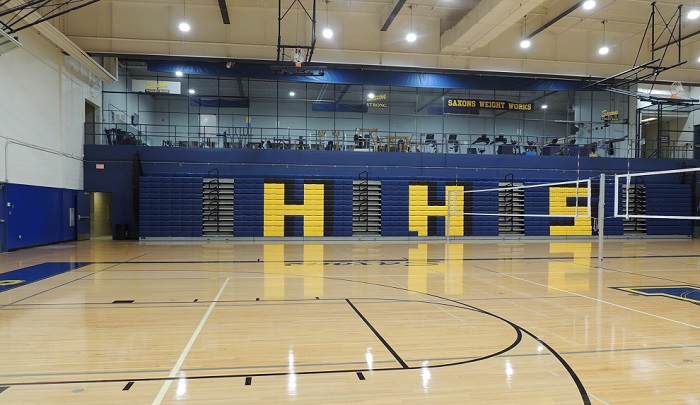
- Hastings boys basketball coach Rich Long sprang into action, running over to the Potterville bench and then calling into the crowd to see if anyone with medical expertise could help a student in distress. Meanwhile, Long was joined by Hastings’ strength coach (and U.S. Marine) James Avery – who was training athletes in the weight room in the balcony overlooking the gym – and Dr. Luke Van Klompenberg, an emergency medicine physician at Holland Hospital who was there watching his son play for Tri-unity.
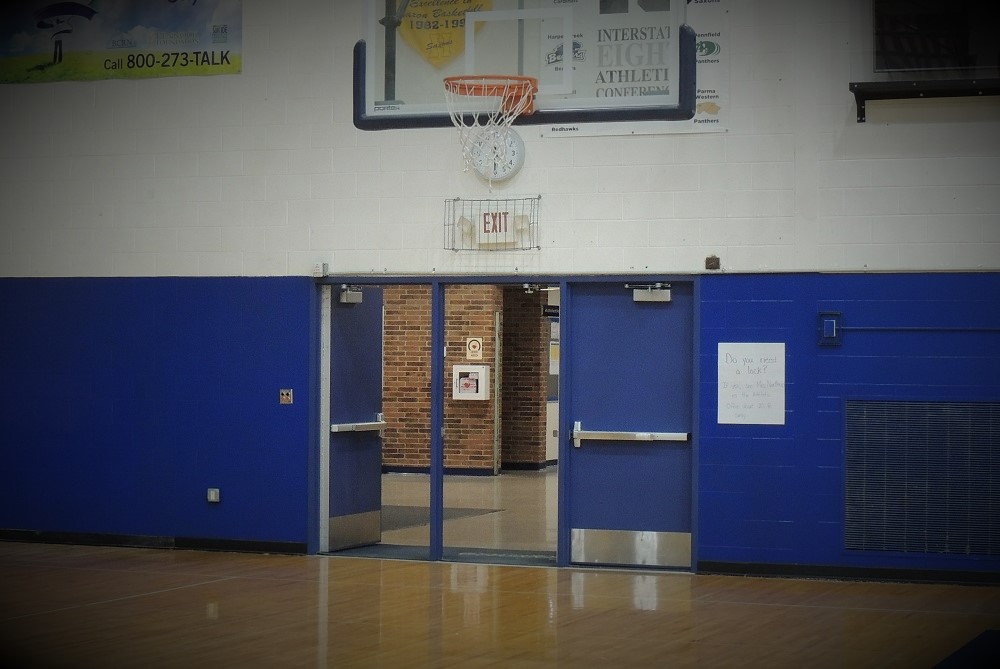
- Long sent an athlete to retrieve the closest AED, located on the wall just outside the gym doors. He also sent a parent to call 9-1-1, and Saxons boys track & field coach Lin Nickels sent multiple athletes to set up a relay near the school’s doors to direct paramedics when they arrived.
- Van Klompenberg, meanwhile, couldn’t find Hicks’ pulse, and the athlete’s breathing was shallow. Avery had begun chest compressions, the AED was used, and as the ambulance arrived Hicks was beginning to regain some consciousness. He was transported to the local Spectrum Health Pennock hospital, then to Helen DeVos Children's Hospital in Grand Rapids.
“It was one of those things where it just worked,” Goggins said. “My message, if nothing else, is we all practice it for a time that may never come – but the more you can saturate your people with the idea of A, being prepared, and B, don’t be afraid to take action … that’s really I think the key.”
 Beginning this year, the MHSAA is requiring all head coaches at the varsity, junior varsity and freshman levels to have CPR certification. That training almost always includes direction in the use of an AED.
Hastings has been on this track for a while. The MHSAA’s first CPR requirement for coaches was added for the 2015-16 school year, just for varsity head coaches – but Goggins made it a requirement for all of his coaches at all levels at that time.
Hastings also has taken AED prep to another level. There are 16 throughout the district – one each at the four elementary schools, two at the middle school and 10 at the high school – and they represent an even bigger investment in the life-saving technology as the district’s school board purchased those 16 a year ago to replace 12 that were nearing their expirations.
Goggins said doctors have told him that if Hicks had not received care for even 4-5 more minutes, he would not have survived because of the damage done to his heart and brain. Potterville athletic director and boys basketball coach Jake Briney said surgeons have broken things down to a 45-second window that made the difference between a good result and a sad one.
Coincidentally, Briney had scheduled a game this upcoming season against Wyoming Tri-unity Christian; Potterville should be tough, and Tri-unity is last season’s Division 4 runner-up. But the events of June 14 will make the events of this upcoming Jan. 14 much more meaningful.
Briney said Potterville also has formed a close relationship with Hastings. Multiple Saxons administrators have checked in, including Goggins almost daily during the first weeks after the incident.
Briney is filled with nothing but praise for Hastings’ preparation. And both athletic directors noted a similar effect at their schools as another school year begins.
“It really, really made the training, made you look at it through a different lens,” Briney said.
“Our fall coaches are now like, ‘You know, if Heather (Coipel, Hastings’ trainer) wanted to stop by and run through the AED procedure again, that would be great,’” Goggins said. “(Or) ‘Where is the AED? We have one at the fieldhouse, right? Where’s the closest one for me again?’ They’re just doublechecking.”
 Geoff Kimmerly joined the MHSAA in Sept. 2011 after 12 years as Prep Sports Editor of the Lansing State Journal. He is a senior editor of MHSAA.com's editorial content and has served as MHSAA Communications Director since January 2021. Contact him at [email protected] with story ideas for the Barry, Eaton, Ingham, Livingston, Ionia, Clinton, Shiawassee, Gratiot, Isabella, Clare and Montcalm counties.
PHOTOS (Top) An AED, located just outside the doors to Hastings’ gymnasium, was used to save Da’Marion Hicks’ life June 14. (Middle) Strength coach James Avery emerged from the balcony weight room to assist in Hicks’ care that evening. (Photos by Geoff Kimmerly.)