

NFHS Hall of Famers: Multi-Sport Experience Makes Major Difference
By
The NFHS Voice
National Federation of State High School Associations
July 28, 2026
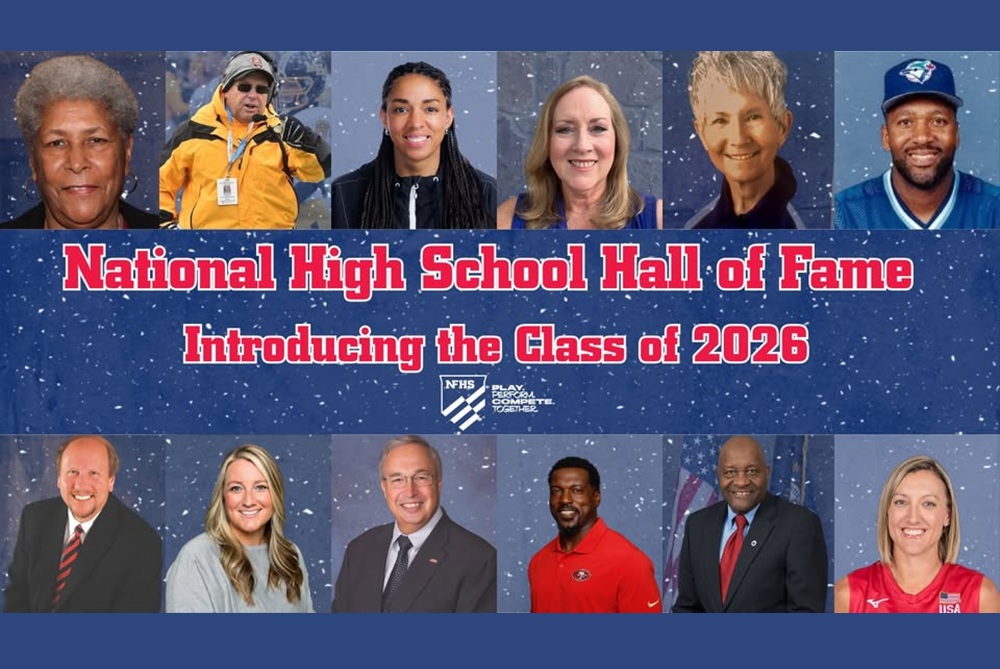
The theory that athletes in high school need to specialize in one sport in an out-of-school program to progress to the next level was not the theme from the five athletes inducted into the National High School Hall of Fame last month in Salt Lake City, Utah.
At a press conference preceding the 43rd Hall of Fame induction ceremony, five former extraordinary high school athletes – all of whom later excelled at the college, professional and for a few Olympic levels – delivered resounding messages about the importance of playing multiple sports within school-based programs.
Joe Carter, who was a four-sport standout in football, basketball, baseball and track at Millwood High School in Oklahoma City, Oklahoma, long before his stellar pro baseball career, said he might never have been a successful pro baseball player without his multiple sport career at Millwood.
“If I had played baseball all year long, I wouldn’t have been a professional baseball player because I would have burned out,” Carter said. “Coaches will tell you that if you don’t come out for football in the spring instead of playing another sport, you will be passed up. This is not the case because if you’re good they will find you. I will take an athlete who played two or three sports over an athlete who just played one sport because those guys know how to take advantage of a situation and know how to adjust.”
Jordan Larson, a three-sport participant at Logan View High School in Hooper, Nebraska, before settling into volleyball and leading the University of Nebraska to an NCAA championship and playing in four consecutive Olympics, also pointed to multiple sports as a reason for success.
“I can’t emphasize it enough – playing multiple sports helped me personally,” Larson said. “It helped me adapt and adjust as I got older. I can’t recommend it enough from a young age.
“Playing multiple sports helped shape me health-wise from a longevity standpoint. There’s something to be said for the mind. If you’re on the grind in the same sport, burnout will come.”
Another volleyball standout in the 2026 class was Alisha Glass Childress, who also played basketball at Leland (Michigan) High School and who would later lead Penn State University to three consecutive NCAA volleyball titles and team with Larson on the U.S. squad at the 2016 Olympics in Brazil.
“Playing for your high school team is so important – it’s such a different experience,” Childress said. “Being in the same program for four years and getting to know the athletes you’re with, I felt like it was family.
“High school was a beautiful time and the beginning of a love affair with sports. I fell in love with the sport of volleyball but also tried a lot of different sports. I played basketball as well. For me, high school is when you start to have an understanding of yourself – reflecting on who you want to be or what you want to achieve.
“The life lessons you learn along the way are so important. The majority of the athletes on our team did not continue on to play past high school. The life lessons you learn as a high school athlete – being a leader, accountability, goal-setting – carry with you the rest of your life.”
Patrick Willis was one of Tennessee’s top two-way football players at Hollow Rock-Bruceton Central High School who also played basketball and baseball before his hall of fame football career with the San Francisco 49ers.
“Coming from a small town with two red lights, I would say the most fun I had growing up was playing sports,” Willis said. “Life can throw a lot of things at you, and to be able to adjust is amazing. In sports, we’re able to learn these things – the discipline, the toughness, the perseverance. I wanted to be a representative that anything is possible, and it’s not just the ones from the big cities or towns, but ones from small towns also.”
Another proponent of playing multiple sports was Krissy Wendell Pohl, the most dominant player in girls ice hockey in Minnesota history and the national record-holder in goals scored in a season who went to a stellar career at the University of Minnesota and won a silver medal at the 2002 Olympics. In addition to her excellence in ice hockey, Wendell Pohl also played tennis, baseball and softball.
“It was so special for me to be able to play multiple sports,” said Wendell Pohl. “For me, playing baseball, softball and hockey, you had different groups of friends, different roles on different teams, and all of that had an impact and you don’t realize it until later.
“High school is the purest form of sport. What you learn in high school, as you’re learning and growing and developing, those things stay with you. The people who impact you in high school – you will never forget that.”
We urge coaches today to take the message from these five outstanding athletes about playing multiple sports to heart and make that option available to athletes in their schools.
These vital programs help to shape young student-athletes into successful parents, citizens and leaders of our nation for years to come.
How Can COVID-19 Impact Student-Athletes' Return-To-Play?
October 5, 2021

COVID-19 And Student Athletes: How Can the Virus Impact Return-To-Play?
The end of summer marked the start of the school year, and for student athletes, the kickoff of the fall sports season. For many, COVID-19 sidelined practices, team gatherings and games to some extent last year. And while there is still hope that young athletes will have more opportunity to play this season despite rising cases of the Delta variant, there are other factors causing concern among athletes and their parents.
According to Ramsey Shehab, M.D., a sports medicine physician for Henry Ford Health System, many athletes are concerned about reaching peak performance after a long time off or after they have recovered from a COVID diagnosis. He reassures students that the feeling of exhaustion or even underperformance compared to past years is to be expected when you take time off or after fighting an illness.
“When you are infected with a virus, it taxes your immune system, and all of your energy goes towards fighting off that infection,” says Dr. Shehab. “You’ll likely feel weak and more tired during this time.”
Fortunately, as the body begins to recover, you’ll start to feel more like yourself again as you get your energy back. But this doesn’t mean that you won’t lose some of that fitness and endurance you’ve built up.
“It only takes about a week of deconditioning to set you back from peak athletic abilities,” says Dr. Shehab. “It is completely expected that your body will need time to get back to performing at your best.”
Playing Sports After Recovering From COVID-19
The unfortunate news: COVID-19 affects people differently in the long term. Some people are able to recover and get back to their routine without delay, whereas others see further complications months after an infection.
Akshay Khandelwal, M.D., a cardiologist with Henry Ford Health System, breaks down some of the more serious findings regarding COVID-19 and your heart health.
“With COVID-19, there is a risk of direct injury like heart failure or an arrhythmia due to the stress your body is under while fighting off the virus,” says Dr. Khandelwal. “As a result, having the virus can cause inflammation of the heart, a condition called myocarditis.”
Because of this, talking to your doctor before returning to a sport is a must if you had COVID or are recovering from the virus. It is important to make sure there are no systemic changes to your body such as overall heart health and lung function. They will be able to rule out any long-term effects that could impact your fitness output.
Expert-Recommended Steps for Return-To-Play
As you get back to your game, both experts share their insights for a healthy recovery:
1. Take quarantine periods seriously. If you are sick, even if you don’t necessarily feel sick, make sure you are taking time to rest and recover properly. “Don’t try to push or overexert yourself,” says Dr. Khandelwal. “It could prolong your recovery.”
2. Get back to training slowly. “Start using low-exertion activities to get your body used to working out again,” says Dr. Shehab. “Once you are able to handle each activity, you can push ahead to something more challenging.” Realistically, it may take a couple of weeks before you are able to get back to your peak.
3. Listen to your body. If workouts seem increasingly difficult, talk with your doctor or trainer before pushing yourself further. You can also help your body recover by making healthy, thoughtful choices:
► Get plenty of sleep
► Warm up and cool down before and after workouts
► Stay hydrated
► Take breaks when you’re tired
► Practice injury prevention
► Make smart food choices
4. Get vaccinated. If medical or religious reasons, or age requirements aren’t stopping you from getting the vaccine, consider getting the shot for yourself and those around you. The Delta variant is highly transmittable, meaning that, it is much easier for it to spread to teammates and family members than the original strain of the virus. To learn more about the COVID-19 vaccine, visit our Vaccine FAQs page.
Talk to your doctor to learn more about safely returning to a sport. To find a doctor, visit henryford.com or call 1-800-436-7936.
Dr. Ramsey Shehab is the deputy chief of Sports Medicine at Henry Ford Health System. He sees patients at the Henry Ford Center for Athletic Medicine and Henry Ford Medical Center - Bloomfield Township.
Dr. Akshay Khandelwal is an interventional cardiologist who sees patients at Henry Ford Medical Center – Second Avenue.