


NFHS Hall of Famers: Multi-Sport Experience Makes Major Difference
By
The NFHS Voice
National Federation of State High School Associations
July 28, 2026
The theory that athletes in high school need to specialize in one sport in an out-of-school program to progress to the next level was not the theme from the five athletes inducted into the National High School Hall of Fame last month in Salt Lake City, Utah.
At a press conference preceding the 43rd Hall of Fame induction ceremony, five former extraordinary high school athletes – all of whom later excelled at the college, professional and for a few Olympic levels – delivered resounding messages about the importance of playing multiple sports within school-based programs.
Joe Carter, who was a four-sport standout in football, basketball, baseball and track at Millwood High School in Oklahoma City, Oklahoma, long before his stellar pro baseball career, said he might never have been a successful pro baseball player without his multiple sport career at Millwood.
“If I had played baseball all year long, I wouldn’t have been a professional baseball player because I would have burned out,” Carter said. “Coaches will tell you that if you don’t come out for football in the spring instead of playing another sport, you will be passed up. This is not the case because if you’re good they will find you. I will take an athlete who played two or three sports over an athlete who just played one sport because those guys know how to take advantage of a situation and know how to adjust.”
Jordan Larson, a three-sport participant at Logan View High School in Hooper, Nebraska, before settling into volleyball and leading the University of Nebraska to an NCAA championship and playing in four consecutive Olympics, also pointed to multiple sports as a reason for success.
“I can’t emphasize it enough – playing multiple sports helped me personally,” Larson said. “It helped me adapt and adjust as I got older. I can’t recommend it enough from a young age.
“Playing multiple sports helped shape me health-wise from a longevity standpoint. There’s something to be said for the mind. If you’re on the grind in the same sport, burnout will come.”
Another volleyball standout in the 2026 class was Alisha Glass Childress, who also played basketball at Leland (Michigan) High School and who would later lead Penn State University to three consecutive NCAA volleyball titles and team with Larson on the U.S. squad at the 2016 Olympics in Brazil.
“Playing for your high school team is so important – it’s such a different experience,” Childress said. “Being in the same program for four years and getting to know the athletes you’re with, I felt like it was family.
“High school was a beautiful time and the beginning of a love affair with sports. I fell in love with the sport of volleyball but also tried a lot of different sports. I played basketball as well. For me, high school is when you start to have an understanding of yourself – reflecting on who you want to be or what you want to achieve.
“The life lessons you learn along the way are so important. The majority of the athletes on our team did not continue on to play past high school. The life lessons you learn as a high school athlete – being a leader, accountability, goal-setting – carry with you the rest of your life.”
Patrick Willis was one of Tennessee’s top two-way football players at Hollow Rock-Bruceton Central High School who also played basketball and baseball before his hall of fame football career with the San Francisco 49ers.
“Coming from a small town with two red lights, I would say the most fun I had growing up was playing sports,” Willis said. “Life can throw a lot of things at you, and to be able to adjust is amazing. In sports, we’re able to learn these things – the discipline, the toughness, the perseverance. I wanted to be a representative that anything is possible, and it’s not just the ones from the big cities or towns, but ones from small towns also.”
Another proponent of playing multiple sports was Krissy Wendell Pohl, the most dominant player in girls ice hockey in Minnesota history and the national record-holder in goals scored in a season who went to a stellar career at the University of Minnesota and won a silver medal at the 2002 Olympics. In addition to her excellence in ice hockey, Wendell Pohl also played tennis, baseball and softball.
“It was so special for me to be able to play multiple sports,” said Wendell Pohl. “For me, playing baseball, softball and hockey, you had different groups of friends, different roles on different teams, and all of that had an impact and you don’t realize it until later.
“High school is the purest form of sport. What you learn in high school, as you’re learning and growing and developing, those things stay with you. The people who impact you in high school – you will never forget that.”
We urge coaches today to take the message from these five outstanding athletes about playing multiple sports to heart and make that option available to athletes in their schools.
These vital programs help to shape young student-athletes into successful parents, citizens and leaders of our nation for years to come.
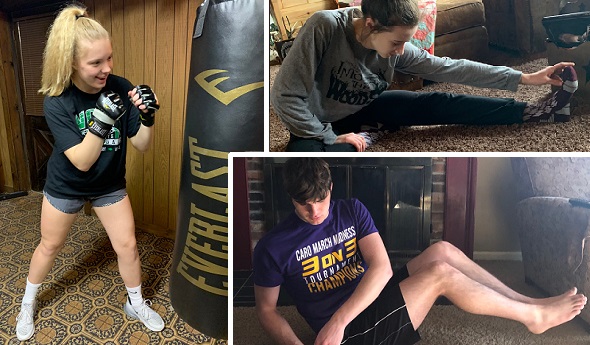
Adjust Your Workout When Gym Isn't Option
April 6, 2020

Henry Ford Health System
Feeling at a loss about not being able to stick to your normal workout routine? You’re not alone.
Social distancing during the COVID-19 outbreak has resulted in people all over the world having to adjust their schedules to accommodate working from home, schooling and caring for kids, and finding ways to maintain as much of a “normal” schedule as possible.
As a result, many people are struggling to figure out how to get a good workout in without the help of gym equipment or a personal trainer.
“Anxiety over the current situation can add to a lack of motivation to work out,” says Brianna Gauna, an athletic trainer for Henry Ford Health System. “But just remember how beneficial it is to move your body, even if it is just around the house.”
How a Routine Change Affects Your Body
If you are used to working out every day or going hard at the gym on a regular basis, a short rest period from your routine might have its advantages.
“Taking time to rest can actually be a really good thing because it allows your body to recover,” says Gauna. “You might even start to see more muscle tone set in as you give your body a break.”
On the other hand, if you usually work out a few times throughout the week and suddenly stop, the results may cause negative effects. You may experience:
- Increased resting heart rate
- Less energy
- Change in mood or emotions
- Loss of sleep
How to Work Out at Home
Being stuck at home is not an excuse to skip a daily workout. Everyone works out a little differently, and there are plenty of options for you to stay active and try out new forms of exercise.
“Whether you are used to strength training or cardio, think about what your fitness goals are and choose activities based on what you’d like to achieve,” says Gauna.
Here are some ideas to keep you and your family active:
1. Yoga. Practicing yoga requires a great deal of muscle strength and balance. It is best for a full body workout. Look to YouTube or free apps on your phone for beginner workout videos that you can follow along.
2. HIIT workouts. These workouts are best for getting your heart pumping and increasing your stamina. Try choosing four exercises from the following list. (Search YouTube or Google for examples if you are not sure what each of these entails.) Do one exercise at a time for 30 seconds and then give yourself 20 seconds of rest before moving on to the next exercise. After you get through one rotation of those exercises, repeat three more times.
- Squats
- Push-ups
- Lunges
- Burpees
- Mountain climbers
- Glute bridges
3. Running or walking. Many apps allow you to track your run on a map, so you can plan out your route in your own neighborhood. This allows you to adjust how far you run or how much time you have for a run. A brisk walk through the neighborhood also works.
4. Biking. Biking is a great low-impact workout that works to engage and tone leg muscles. (Remember to wear a helmet!)
5. Team sports. If you are looking for something to engage you and your family, team sports are the way to go. Kick a soccer ball around, try to race through an obstacle course while dribbling a basketball or take turns throwing a football. If you don’t have the equipment, try playing keep-away with a stuffed animal or set up a relay race.
Exercise by Age and Fitness Level
The younger you are, chances are you have a faster metabolism. If you can’t get to a gym, think about how active you usually are and gauge the length of your workout from there.
If you are using this time to get started on your fitness journey, use these recommendations as a starting point:
Ages 7-17: 1-2 hours. Athletes that are used to going to weekly practices may find that two-hour workouts are more suitable.
Ages 18-30: About an hour. Look for times throughout the day that you can squeeze in workouts. Maybe you do yoga in the morning, a HIIT workout in the afternoon and a walk after dinner.
Ages 31-49: About a half hour. If you have children or a pet, you may find that you are already spending more time being active than this!
Ages 50 and up: At least 10-15 minutes. Gauge this based on your own abilities. You may live a more active lifestyle that allows you to be very active throughout the day. If you find yourself struggling to meet this mark, consider a walk during the day or stretches in the morning.
Once you get a regular fitness routine in place, work your way up to longer or more intense workouts to keep yourself challenged.
Making Your Own Equipment
If you have a treadmill, stationary bike or elliptical machine at home, now is the time to clear off the laundry it may have been collecting. If you don’t have access to weights or other gym equipment, though, that doesn’t mean you have to miss out on a quality workout. Look for things around your house that you can use in their place – get creative!
- Bags of beans, rice or pet food as added weight for squats or lunges
- Old books/textbooks as dumbbells
- A chair for triceps dips, calf raises or for stability during yoga
- Stairs to run sprints or to help you stretch out leg muscles
When your day-to-day routine is shaken up, do what you can to create normalcy in your life. If you find you have more free time throughout the day, take that time to get moving – even if it’s running up and down the stairs or going for a walk around the block.
“Don’t worry about feeling silly for switching up your routine,” adds Gauna. “Whether that’s using a random object for added weight during a workout or trying to remember how to ride a bike again on your street, think about yourself and your fitness goals first. Don’t let thoughts of what other people think of you get in the way of you reaching your goals!”
Want to learn more? Henry Ford Health System sports medicine experts are treating the whole athlete, in a whole new way. From nutrition to neurology, and from injury prevention to treatment of sports-related conditions, they can give your athlete a unique game plan.
Visit henryford.com/sports or call (313) 972-4216 for an appointment within 24 business hours.
PHOTOS: (Clockwise from left) MHSAA Student Advisory Council members Abigail Pheiffer of Novi, Lydia Davenport of Ithaca and Trevin Phillips of Caro will be working to stay in shape while staying home these next many weeks.