

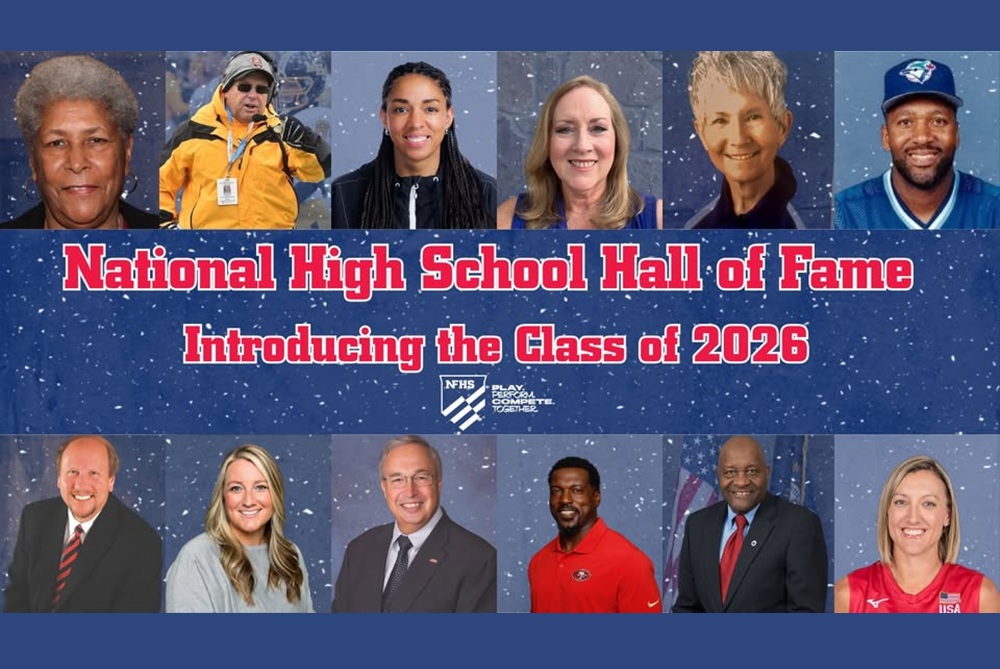
NFHS Hall of Famers: Multi-Sport Experience Makes Major Difference
By
The NFHS Voice
National Federation of State High School Associations
July 28, 2026
The theory that athletes in high school need to specialize in one sport in an out-of-school program to progress to the next level was not the theme from the five athletes inducted into the National High School Hall of Fame last month in Salt Lake City, Utah.
At a press conference preceding the 43rd Hall of Fame induction ceremony, five former extraordinary high school athletes – all of whom later excelled at the college, professional and for a few Olympic levels – delivered resounding messages about the importance of playing multiple sports within school-based programs.
Joe Carter, who was a four-sport standout in football, basketball, baseball and track at Millwood High School in Oklahoma City, Oklahoma, long before his stellar pro baseball career, said he might never have been a successful pro baseball player without his multiple sport career at Millwood.
“If I had played baseball all year long, I wouldn’t have been a professional baseball player because I would have burned out,” Carter said. “Coaches will tell you that if you don’t come out for football in the spring instead of playing another sport, you will be passed up. This is not the case because if you’re good they will find you. I will take an athlete who played two or three sports over an athlete who just played one sport because those guys know how to take advantage of a situation and know how to adjust.”
Jordan Larson, a three-sport participant at Logan View High School in Hooper, Nebraska, before settling into volleyball and leading the University of Nebraska to an NCAA championship and playing in four consecutive Olympics, also pointed to multiple sports as a reason for success.
“I can’t emphasize it enough – playing multiple sports helped me personally,” Larson said. “It helped me adapt and adjust as I got older. I can’t recommend it enough from a young age.
“Playing multiple sports helped shape me health-wise from a longevity standpoint. There’s something to be said for the mind. If you’re on the grind in the same sport, burnout will come.”
Another volleyball standout in the 2026 class was Alisha Glass Childress, who also played basketball at Leland (Michigan) High School and who would later lead Penn State University to three consecutive NCAA volleyball titles and team with Larson on the U.S. squad at the 2016 Olympics in Brazil.
“Playing for your high school team is so important – it’s such a different experience,” Childress said. “Being in the same program for four years and getting to know the athletes you’re with, I felt like it was family.
“High school was a beautiful time and the beginning of a love affair with sports. I fell in love with the sport of volleyball but also tried a lot of different sports. I played basketball as well. For me, high school is when you start to have an understanding of yourself – reflecting on who you want to be or what you want to achieve.
“The life lessons you learn along the way are so important. The majority of the athletes on our team did not continue on to play past high school. The life lessons you learn as a high school athlete – being a leader, accountability, goal-setting – carry with you the rest of your life.”
Patrick Willis was one of Tennessee’s top two-way football players at Hollow Rock-Bruceton Central High School who also played basketball and baseball before his hall of fame football career with the San Francisco 49ers.
“Coming from a small town with two red lights, I would say the most fun I had growing up was playing sports,” Willis said. “Life can throw a lot of things at you, and to be able to adjust is amazing. In sports, we’re able to learn these things – the discipline, the toughness, the perseverance. I wanted to be a representative that anything is possible, and it’s not just the ones from the big cities or towns, but ones from small towns also.”
Another proponent of playing multiple sports was Krissy Wendell Pohl, the most dominant player in girls ice hockey in Minnesota history and the national record-holder in goals scored in a season who went to a stellar career at the University of Minnesota and won a silver medal at the 2002 Olympics. In addition to her excellence in ice hockey, Wendell Pohl also played tennis, baseball and softball.
“It was so special for me to be able to play multiple sports,” said Wendell Pohl. “For me, playing baseball, softball and hockey, you had different groups of friends, different roles on different teams, and all of that had an impact and you don’t realize it until later.
“High school is the purest form of sport. What you learn in high school, as you’re learning and growing and developing, those things stay with you. The people who impact you in high school – you will never forget that.”
We urge coaches today to take the message from these five outstanding athletes about playing multiple sports to heart and make that option available to athletes in their schools.
These vital programs help to shape young student-athletes into successful parents, citizens and leaders of our nation for years to come.

This Week In High School Sports: 3/6/20
March 6, 2020
This week’s show features Clinton wrestling's championship run, presents Game Balls to Grandville Calvin Christian basketball's Brock Stevens and Springport basketball's Alana Nelson, explains the often-misunderstood basketball 3-second rule and recalls boys hoops scoring greats from the Upper Peninsula.
The 5-minute program, powered by MI Student Aid, leads off each week with feature stories from around the state from the MHSAA’s Second Half or network affiliates. "Be The Referee," a 60-second look at the fine art of officiating, comes in the middle of the show and is followed by a closing MHSAA "Perspective."
Listen to this week's show by Clicking Here.
Past editions
Feb. 28: Battle of the Fans IX champion, MHSAA Basketball Finals buzzer beaters - Listen
Feb. 21: Carson City-Crystal wrestler Jamison Ward, District basketball seeding - Listen
Feb. 14: Farmington United gymnast Elena Vargo, Kansas City multi-sport star Patrick Mahomes - Listen
Feb. 7: Trenton swimmer Michael Wolsek, need for women in leadership positions in athletics - Listen
Jan. 31: Utica Ford bowling's Kensington Holland, winter lessons on civility - Listen
Jan. 24 White Pigeon multi-sport standout Claycee West, 2020 Youth Football Forum - Listen
Jan. 17: Promoting and protecting youth football, amateurism in educational athletics - Listen
Jan. 10: Livonia Stevenson hockey's Seth Lause, multi-media and social media impacts - Listen
Dec. 27: Mona Shores "Sailor Nation" life-saving success - Listen
Dec. 20: Battle of the Fans IX, details on purchasing Finals broadcasts - Listen
Dec. 13: Port Huron United hockey, what matters most in high school sports - Listen
Dec. 6: Highlights from 2019 11-Player Football Finals, instant replay in review - Listen
Nov. 29: Highlights from 2019 8-Player Football, Girls Volleyball and Girls Swimming & Diving Finals - Listen
Nov. 22: Ida volleyball record-setter Taylor Wegener, new Football Finals video review - Listen
Nov. 15: Reading lineman Nick Affholter, coaches as leaders in sportsmanship - Listen
Nov. 8: Lower Peninsula Cross Country and Boys Soccer Finals highlights - Listen
Nov. 1: Muskegon Orchard View football, bolstered MHSAA broadcast schedule - Listen
Oct. 25: Grand Rapids NorthPointe Christian girls golf, MHSAA Football Playoff selection - Listen
Oct. 18: Mendon volleyball's title drive, recognition for longtime announcer Erik O. Furseth - Listen
Oct. 11: Negaunee cross country's Emily Paupore, MHSAA mental health awareness efforts - Listen
Oct. 4: South Lyon soccer's Josh Mason, improving youth football - Listen
Sept: 27: Utica Eisenhower golfer Ariel Chang, adult fan behavior - Listen
Sept: 20: Pinckney football inspiration, decisions made at the local level - Listen
Sept. 13: Muskegon's offensive line, soccer substitution rule change - Listen
Sept. 6: Jenison girls golf's inspiration, new football practice contact restrictions - Listen
Aug. 30: St. Johns quarterback-now-coach Andy Schmitt, benefits of a multi-sport experience - Listen