

NFHS Hall of Famers: Multi-Sport Experience Makes Major Difference
By
The NFHS Voice
National Federation of State High School Associations
July 28, 2026
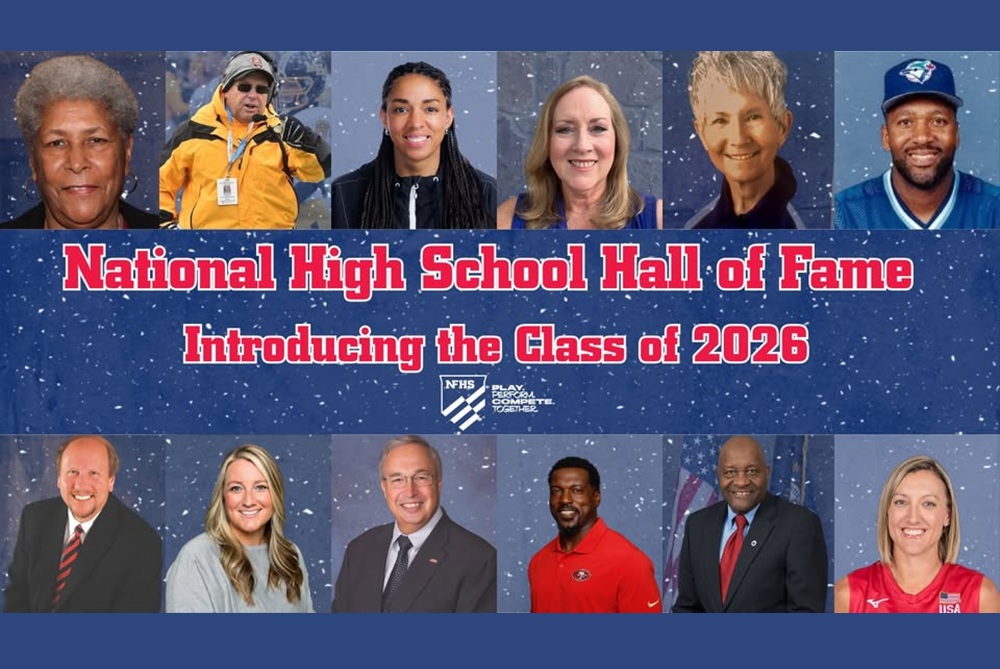
The theory that athletes in high school need to specialize in one sport in an out-of-school program to progress to the next level was not the theme from the five athletes inducted into the National High School Hall of Fame last month in Salt Lake City, Utah.
At a press conference preceding the 43rd Hall of Fame induction ceremony, five former extraordinary high school athletes – all of whom later excelled at the college, professional and for a few Olympic levels – delivered resounding messages about the importance of playing multiple sports within school-based programs.
Joe Carter, who was a four-sport standout in football, basketball, baseball and track at Millwood High School in Oklahoma City, Oklahoma, long before his stellar pro baseball career, said he might never have been a successful pro baseball player without his multiple sport career at Millwood.
“If I had played baseball all year long, I wouldn’t have been a professional baseball player because I would have burned out,” Carter said. “Coaches will tell you that if you don’t come out for football in the spring instead of playing another sport, you will be passed up. This is not the case because if you’re good they will find you. I will take an athlete who played two or three sports over an athlete who just played one sport because those guys know how to take advantage of a situation and know how to adjust.”
Jordan Larson, a three-sport participant at Logan View High School in Hooper, Nebraska, before settling into volleyball and leading the University of Nebraska to an NCAA championship and playing in four consecutive Olympics, also pointed to multiple sports as a reason for success.
“I can’t emphasize it enough – playing multiple sports helped me personally,” Larson said. “It helped me adapt and adjust as I got older. I can’t recommend it enough from a young age.
“Playing multiple sports helped shape me health-wise from a longevity standpoint. There’s something to be said for the mind. If you’re on the grind in the same sport, burnout will come.”
Another volleyball standout in the 2026 class was Alisha Glass Childress, who also played basketball at Leland (Michigan) High School and who would later lead Penn State University to three consecutive NCAA volleyball titles and team with Larson on the U.S. squad at the 2016 Olympics in Brazil.
“Playing for your high school team is so important – it’s such a different experience,” Childress said. “Being in the same program for four years and getting to know the athletes you’re with, I felt like it was family.
“High school was a beautiful time and the beginning of a love affair with sports. I fell in love with the sport of volleyball but also tried a lot of different sports. I played basketball as well. For me, high school is when you start to have an understanding of yourself – reflecting on who you want to be or what you want to achieve.
“The life lessons you learn along the way are so important. The majority of the athletes on our team did not continue on to play past high school. The life lessons you learn as a high school athlete – being a leader, accountability, goal-setting – carry with you the rest of your life.”
Patrick Willis was one of Tennessee’s top two-way football players at Hollow Rock-Bruceton Central High School who also played basketball and baseball before his hall of fame football career with the San Francisco 49ers.
“Coming from a small town with two red lights, I would say the most fun I had growing up was playing sports,” Willis said. “Life can throw a lot of things at you, and to be able to adjust is amazing. In sports, we’re able to learn these things – the discipline, the toughness, the perseverance. I wanted to be a representative that anything is possible, and it’s not just the ones from the big cities or towns, but ones from small towns also.”
Another proponent of playing multiple sports was Krissy Wendell Pohl, the most dominant player in girls ice hockey in Minnesota history and the national record-holder in goals scored in a season who went to a stellar career at the University of Minnesota and won a silver medal at the 2002 Olympics. In addition to her excellence in ice hockey, Wendell Pohl also played tennis, baseball and softball.
“It was so special for me to be able to play multiple sports,” said Wendell Pohl. “For me, playing baseball, softball and hockey, you had different groups of friends, different roles on different teams, and all of that had an impact and you don’t realize it until later.
“High school is the purest form of sport. What you learn in high school, as you’re learning and growing and developing, those things stay with you. The people who impact you in high school – you will never forget that.”
We urge coaches today to take the message from these five outstanding athletes about playing multiple sports to heart and make that option available to athletes in their schools.
These vital programs help to shape young student-athletes into successful parents, citizens and leaders of our nation for years to come.

NFHS Voice: Multi-Sport Paves QB's Way
February 10, 2020
By Karissa Niehoff
NFHS Executive Director
On football’s grandest stage earlier this month, its latest star attraction not only delivered another virtuoso performance but demonstrated the best career path to success.
In leading the Kansas City Chiefs to victory in Super Bowl LIV, quarterback Patrick Mahomes brought to an end another tremendous year of football at all levels and became the latest – and perhaps best – example of the benefits of playing multiple sports during high school.
In the week prior to the Super Bowl, Mahomes talked about his ascension to the top of the football world. Despite the opportunity to focus solely on baseball as his father had done, Mahomes rejected sport specialization. Instead, he spoke about how playing multiple sports in high school paved the way for his success.
The top performer on the grandest stage of the sport, Mahomes made it to the top of the football mountain by NOT playing football year-round. Had he chosen to specialize in one sport during his high school days in east Texas, Mahomes might never had made it to NFL since, as he noted in the week prior to the Super Bowl, he was “a baseball player that was playing football.”
Mahomes believes the skills he learned as a shortstop in baseball and as a point guard in basketball helped him more as a quarterback on the football field than if he had chosen to devote his entire energies to football.
His uncanny ability to throw passes from various angles unlike any of today’s perfect-form pocket quarterbacks? He gained those skills on the baseball field. His ability to throw lasers to his intended receivers without looking? He learned those skills on the basketball court at Whitehouse High School in Texas.
His trek to the top of the football world supports our belief that playing multiple sports within the education-based structure – as opposed to a single-sport focus in a non-school program – is the best route to future success.
Mahomes experienced the benefits of playing multiple sports – better leadership and teamwork skills from cross-training, reduced risk of burnout in one sport, a variety of experiences from involvement with different sports and teams, reduced risk of overuse injuries in one sport and exposure to a variety of coaching styles.
Many parents believe that in order for their son or daughter to earn a college scholarship and eventually play at the professional level, they have to specialize in one sport year-round. This pattern has led to the proliferation of non-school programs and coaches, many of which stray from the education-based focus of high school sports.
While there are a few who achieve elite status in a sport, the majority of people who participate do not. We believe the multiple-sport path demonstrated by Mahomes is the best route to attaining athletic success and lifelong enjoyment of sports.
Dr. Karissa L. Niehoff is in her second year as executive director of the National Federation of State High School Associations (NFHS) in Indianapolis, Indiana. She is the first female to head the national leadership organization for high school athletics and performing arts activities and the sixth full-time executive director of the NFHS, which celebrated its 100th year of service during the 2018-19 school year. She previously was executive director of the Connecticut Association of Schools-Connecticut Interscholastic Athletic Conference for seven years.