

NFHS Hall of Famers: Multi-Sport Experience Makes Major Difference
By
The NFHS Voice
National Federation of State High School Associations
July 28, 2026
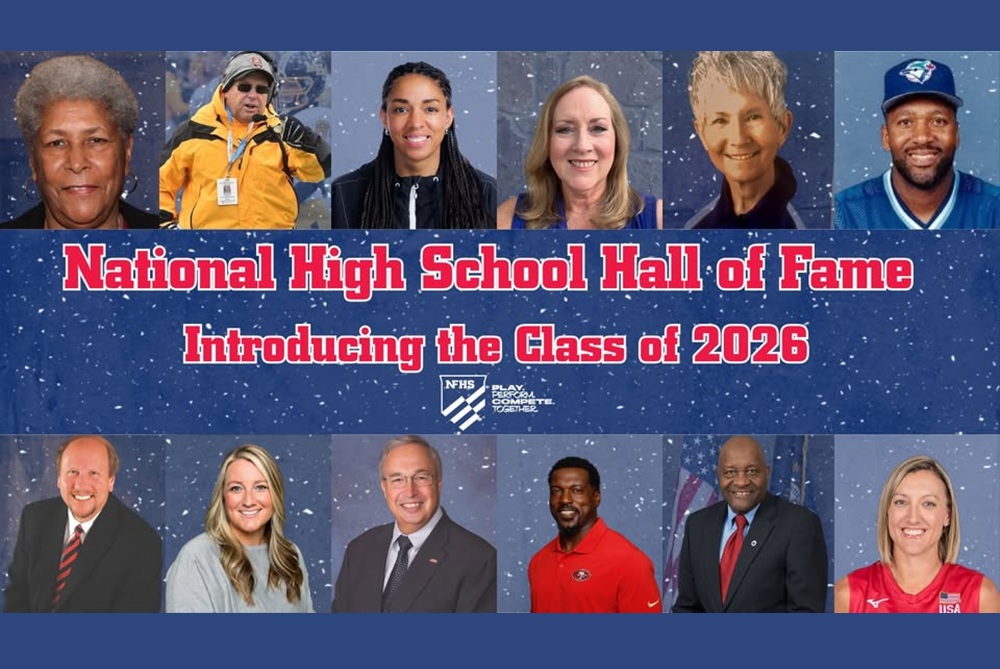
The theory that athletes in high school need to specialize in one sport in an out-of-school program to progress to the next level was not the theme from the five athletes inducted into the National High School Hall of Fame last month in Salt Lake City, Utah.
At a press conference preceding the 43rd Hall of Fame induction ceremony, five former extraordinary high school athletes – all of whom later excelled at the college, professional and for a few Olympic levels – delivered resounding messages about the importance of playing multiple sports within school-based programs.
Joe Carter, who was a four-sport standout in football, basketball, baseball and track at Millwood High School in Oklahoma City, Oklahoma, long before his stellar pro baseball career, said he might never have been a successful pro baseball player without his multiple sport career at Millwood.
“If I had played baseball all year long, I wouldn’t have been a professional baseball player because I would have burned out,” Carter said. “Coaches will tell you that if you don’t come out for football in the spring instead of playing another sport, you will be passed up. This is not the case because if you’re good they will find you. I will take an athlete who played two or three sports over an athlete who just played one sport because those guys know how to take advantage of a situation and know how to adjust.”
Jordan Larson, a three-sport participant at Logan View High School in Hooper, Nebraska, before settling into volleyball and leading the University of Nebraska to an NCAA championship and playing in four consecutive Olympics, also pointed to multiple sports as a reason for success.
“I can’t emphasize it enough – playing multiple sports helped me personally,” Larson said. “It helped me adapt and adjust as I got older. I can’t recommend it enough from a young age.
“Playing multiple sports helped shape me health-wise from a longevity standpoint. There’s something to be said for the mind. If you’re on the grind in the same sport, burnout will come.”
Another volleyball standout in the 2026 class was Alisha Glass Childress, who also played basketball at Leland (Michigan) High School and who would later lead Penn State University to three consecutive NCAA volleyball titles and team with Larson on the U.S. squad at the 2016 Olympics in Brazil.
“Playing for your high school team is so important – it’s such a different experience,” Childress said. “Being in the same program for four years and getting to know the athletes you’re with, I felt like it was family.
“High school was a beautiful time and the beginning of a love affair with sports. I fell in love with the sport of volleyball but also tried a lot of different sports. I played basketball as well. For me, high school is when you start to have an understanding of yourself – reflecting on who you want to be or what you want to achieve.
“The life lessons you learn along the way are so important. The majority of the athletes on our team did not continue on to play past high school. The life lessons you learn as a high school athlete – being a leader, accountability, goal-setting – carry with you the rest of your life.”
Patrick Willis was one of Tennessee’s top two-way football players at Hollow Rock-Bruceton Central High School who also played basketball and baseball before his hall of fame football career with the San Francisco 49ers.
“Coming from a small town with two red lights, I would say the most fun I had growing up was playing sports,” Willis said. “Life can throw a lot of things at you, and to be able to adjust is amazing. In sports, we’re able to learn these things – the discipline, the toughness, the perseverance. I wanted to be a representative that anything is possible, and it’s not just the ones from the big cities or towns, but ones from small towns also.”
Another proponent of playing multiple sports was Krissy Wendell Pohl, the most dominant player in girls ice hockey in Minnesota history and the national record-holder in goals scored in a season who went to a stellar career at the University of Minnesota and won a silver medal at the 2002 Olympics. In addition to her excellence in ice hockey, Wendell Pohl also played tennis, baseball and softball.
“It was so special for me to be able to play multiple sports,” said Wendell Pohl. “For me, playing baseball, softball and hockey, you had different groups of friends, different roles on different teams, and all of that had an impact and you don’t realize it until later.
“High school is the purest form of sport. What you learn in high school, as you’re learning and growing and developing, those things stay with you. The people who impact you in high school – you will never forget that.”
We urge coaches today to take the message from these five outstanding athletes about playing multiple sports to heart and make that option available to athletes in their schools.
These vital programs help to shape young student-athletes into successful parents, citizens and leaders of our nation for years to come.

Minding Our Business: Focus on Mental Health
December 30, 2019
By Mark Uyl
MHSAA Executive Director
For as long as I can remember, rules have played an important role in my life.
My father officiated high school and youth sports. So my brother and I did the same, and were fortunate enough to earn the right to work contests at the collegiate level. Today, my sons are officiating high school and youth sports.
I was hired by the MHSAA as an assistant director in large part due to my officiating background. Rules and regulations remain the backbone of athletics specifically, and society in general, as I learned more acutely when I entered the working world as a teacher and coach, then school administrator.
What also became abundantly clear to me within that framework was that it is our responsibility to provide our students not only the opportunity for competition, but also for our games and practices to take place under the safest conditions possible. From preseason physicals to equipment inventory and facility maintenance, a premium was placed on the well-being of participants and spectators.
Throughout my time at the MHSAA, various initiatives continued to target the growing list of health and safety concerns. My predecessor, Jack Roberts, often pointed to the “4 Hs” of the MHSAA’s health and safety campaign: Health Histories (Physicals), Heat and Hydration, Heads, and Hearts. Those pillars still hold the bulk of the content and resources on the Health & Safety resource pages of MHSAA.com. A few years ago, an extensive section promoting multi-sport participation was developed as an increasing amount of overuse injuries among single-sport athletes was being reported.
This fall, another section has been added as a sub-category to “Heads.” While attending an NCAA meeting in the summer of 2017, the topic of concussions came up, which I assumed to be the No. 1 issue concerning health and safety of student-athletes. It was quickly pointed out that student mental health – not concussions – had become the top health concern among our young people. That knocked me back.
Medical personnel have determined that depression, anxiety and other issues related to mental health are the No. 1 concern among adolescent-age children. There’s a real opportunity to provide some leadership and guidance in this area.
We need to offer resources on the subject, and also be prepared to provide guidance for our membership. The MHSAA has developed a Mental Health Speakers Bureau (please visit our Health & Safety page online). The first statewide Student Mental Health Summit scheduled for Lansing in October provided an opportunity for school principals, counselors, student leadership advisers and student leaders to convene on the topic.
The gathering was quickly sold out, indicating not only the growing nature of concern for this issue, but once again displaying the willingness of our educational leaders to recognize and react to another challenge.
This week, Second Half will publish the latest benchmarks report on the MHSAA’s mental health initiatives and those being undertaken by other states as well.