NFHS Hall of Famers: Multi-Sport Experience Makes Major Difference
By
The NFHS Voice
National Federation of State High School Associations
July 28, 2026
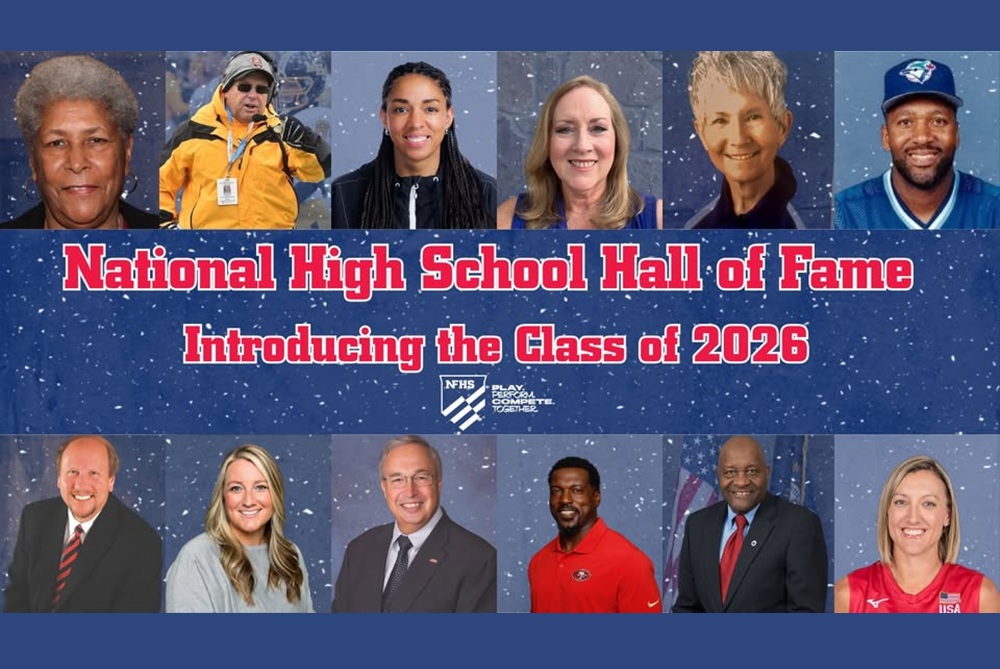
The theory that athletes in high school need to specialize in one sport in an out-of-school program to progress to the next level was not the theme from the five athletes inducted into the National High School Hall of Fame last month in Salt Lake City, Utah.
At a press conference preceding the 43rd Hall of Fame induction ceremony, five former extraordinary high school athletes – all of whom later excelled at the college, professional and for a few Olympic levels – delivered resounding messages about the importance of playing multiple sports within school-based programs.
Joe Carter, who was a four-sport standout in football, basketball, baseball and track at Millwood High School in Oklahoma City, Oklahoma, long before his stellar pro baseball career, said he might never have been a successful pro baseball player without his multiple sport career at Millwood.
“If I had played baseball all year long, I wouldn’t have been a professional baseball player because I would have burned out,” Carter said. “Coaches will tell you that if you don’t come out for football in the spring instead of playing another sport, you will be passed up. This is not the case because if you’re good they will find you. I will take an athlete who played two or three sports over an athlete who just played one sport because those guys know how to take advantage of a situation and know how to adjust.”
Jordan Larson, a three-sport participant at Logan View High School in Hooper, Nebraska, before settling into volleyball and leading the University of Nebraska to an NCAA championship and playing in four consecutive Olympics, also pointed to multiple sports as a reason for success.
“I can’t emphasize it enough – playing multiple sports helped me personally,” Larson said. “It helped me adapt and adjust as I got older. I can’t recommend it enough from a young age.
“Playing multiple sports helped shape me health-wise from a longevity standpoint. There’s something to be said for the mind. If you’re on the grind in the same sport, burnout will come.”
Another volleyball standout in the 2026 class was Alisha Glass Childress, who also played basketball at Leland (Michigan) High School and who would later lead Penn State University to three consecutive NCAA volleyball titles and team with Larson on the U.S. squad at the 2016 Olympics in Brazil.
“Playing for your high school team is so important – it’s such a different experience,” Childress said. “Being in the same program for four years and getting to know the athletes you’re with, I felt like it was family.
“High school was a beautiful time and the beginning of a love affair with sports. I fell in love with the sport of volleyball but also tried a lot of different sports. I played basketball as well. For me, high school is when you start to have an understanding of yourself – reflecting on who you want to be or what you want to achieve.
“The life lessons you learn along the way are so important. The majority of the athletes on our team did not continue on to play past high school. The life lessons you learn as a high school athlete – being a leader, accountability, goal-setting – carry with you the rest of your life.”
Patrick Willis was one of Tennessee’s top two-way football players at Hollow Rock-Bruceton Central High School who also played basketball and baseball before his hall of fame football career with the San Francisco 49ers.
“Coming from a small town with two red lights, I would say the most fun I had growing up was playing sports,” Willis said. “Life can throw a lot of things at you, and to be able to adjust is amazing. In sports, we’re able to learn these things – the discipline, the toughness, the perseverance. I wanted to be a representative that anything is possible, and it’s not just the ones from the big cities or towns, but ones from small towns also.”
Another proponent of playing multiple sports was Krissy Wendell Pohl, the most dominant player in girls ice hockey in Minnesota history and the national record-holder in goals scored in a season who went to a stellar career at the University of Minnesota and won a silver medal at the 2002 Olympics. In addition to her excellence in ice hockey, Wendell Pohl also played tennis, baseball and softball.
“It was so special for me to be able to play multiple sports,” said Wendell Pohl. “For me, playing baseball, softball and hockey, you had different groups of friends, different roles on different teams, and all of that had an impact and you don’t realize it until later.
“High school is the purest form of sport. What you learn in high school, as you’re learning and growing and developing, those things stay with you. The people who impact you in high school – you will never forget that.”
We urge coaches today to take the message from these five outstanding athletes about playing multiple sports to heart and make that option available to athletes in their schools.
These vital programs help to shape young student-athletes into successful parents, citizens and leaders of our nation for years to come.
Century of School Sports: Upper Peninsula Helps Makes Michigan's School Sports Story Unique
By
Geoff Kimmerly
MHSAA.com senior editor
May 27, 2025
From the parking lot of the MHSAA office in East Lansing, it’s a shorter drive to Kentucky than to Crystal Falls Forest Park High School on the far western border of the Upper Peninsula.
That little fun fact illustrates just a bit of what makes Michigan – made up of two large peninsulas surrounded by four of the world’s largest freshwater lakes and connected by one of its longest bridges – a fascinating place to live and serve as a statewide athletic association.
It also provides a little bit of context in explaining how Upper Peninsula athletics have occupied their own unique space both literally and figuratively in that statewide landscape dating back to well before the creation of the MHSAA in December 1924.
With time and technology, the world indeed has become smaller – and Michigan with it. And over the MHSAA’s 100-year history – with help from achievements like the Mackinac Bridge – the Upper and Lower Peninsulas have come to a place of competing together in most sports, during most of the same seasons, but still with some exceptions to accommodate notable differences that remain.
Consider first these two:
• There are 53 MHSAA-member high schools in the Upper Peninsula, located across roughly 16,000 square miles of land. That’s compared to 701 Lower Peninsula member high schools spread over about 40,000 square miles.
• There is only one high school with more than 1,000 students in the Upper Peninsula – Marquette, with an enrollment of 1,021 this school year to rank as the state’s 127th-largest overall. Escanaba, Sault Ste. Marie and Kingsford are the only other high schools with at least 500 students.
With those comparisons as conversation starters, it’s easy to understand how schools above the Bridge face increased travel time, distance and expenses compared to most of their downstate friends – during both the regular season and MHSAA postseason – and not to mention frequently shorter fall and spring outdoor sport seasons because of winters that start sooner and end later.
To make competition as equitable and worthwhile as possible amid those challenges, the MHSAA has settled on a mix of statewide and U.P.-only championships – and with the Upper Peninsula taking the lead on devising its championship schedules.
This week alone will see Boys Tennis, Girls & Boys Golf and Girls & Boys Track & Field Finals competed in U.P.-only divisions. Upper Peninsula girls tennis, girls and boys cross country, and girls and boys swimming & diving programs also operate their postseason tournaments separately from the Lower Peninsula.
Among other sports, boys basketball played separate tournaments by peninsula from 1932-47, wrestling was contended in separate tournaments from 1967-87, girls volleyball was separate from its first season of 1975-76 until unifying in 1999-2000, and girls gymnastics also was separated by peninsula from 1972-73 until unification in 2003-04.
The Upper Peninsula’s voice in these matters goes back to the MHSAA’s predecessor organizations – beginning in 1904 when Ironwood’s first superintendent Luther L. Wright served on the Michigan State Teacher’s Association’s Committee on High School Athletics. Howard S. Doolittle – formerly representing Saginaw Eastern before becoming principal of Calumet High School – played a major role in bringing Upper Peninsula schools (and the then-Upper Peninsula Association) into the fold with the Lower Peninsula schools under the MHSAA’s predecessor Michigan Interscholastic Athletic Association.
With the creation of the MHSAA and its Representative Council in 1924 came an elected member representing the Upper Peninsula – Escanaba superintendent R.E. Cheney during that first school year. A second representative was added a short time later so both the largest and smallest schools from that region had a vote. Gwinn’s Leo P. McDonald (1930-52) and Escanaba’s Dan Flynn (1988-2010) are among 11 Council members who have served at least 20 years, and as recently as 2014 the Council president hailed from just south of Lake Superior’s shores as Negaunee superintendent Jim Derocher finished his final term. Kingsford’s Chris Hartman and Calumet’s Sean Jacques currently serve as the U.P. reps.
The Upper Peninsula Association ceased when the MHSAA was created, but in 1933 the Council authorized the formation of the Upper Peninsula Athletic Committee, which from the start has taken a leading role in organizing the U.P.-only championships and continues as well to serve as an advisory board providing U.P. input on statewide topics of the day. Among its most memorable actions, the U.P. Athletic Committee played a large role in Upper Peninsula schools’ return to a statewide boys basketball tournament after 15 seasons of separation.
The most recent U.P. Athletic Committee meeting occurred April 24 and included members Hartman, Jacques, Mike Berutti (West Iron County), Vince Gross (Paradise Whitefish Township), Jack Kumpula (Lake Linden-Hubbell), Sam Larson (Menominee) and Paul Jacobson (Negaunee) along with Jim Bobula (Ontonagon), Don Gustafson (St. Ignace) and Dale Hongisto (Gladstone) in advisory roles.
They recommended and/or confirmed tournament sites for this spring’s Upper Peninsula Regional and Finals championships, some 2025-26 U.P. Finals and hosts for the U.P.’s Districts, Regionals and Quarterfinals in both girls volleyball this fall and girls and boys basketball for next winter. Committee members also discussed coaches education opportunities for this fall and the possibility of further U.P. involvement in future L.P.-only tournaments, among other topics.
Previous "Century of School Sports" Spotlights
May 20: From Nearly A to Z, Schools Repped by 221 Nicknames - Read
May 13: These Record-Setters were Nearly Impossible to Defeat - Read
May 6: 200+ Representatives Fill All-Time Council Roster - Read
April 29: MHSAA Programs Prioritize Health & Safety - Read
April 23: Patches Signify Registered Officials' Role in MHSAA Story - Read
April 16: Student Advisory Council Gives Voice to Athletes - Read
April 9: State's Storytellers Share Spring Memories - Read
April 2: Sharp Leadership Synonymous with MHSAA Success - Read
March 25: Athletic Directors Indispensable to Mission of School Sports - Read
March 18: 2025 Finals Begin Next Half-Century of Girls Hoops Championships - Read
March 11: Boys Basketball's Best 1st to Earn MHSAA Finals Titles - Read
March 5: Everything We Do Begins with Participation - Read
Feb. 25: Slogans & Logos Remain Unforgettable Parts of MHSAA History - Read
Feb. 19: MHSAA Tickets Continue to Provide Fan-Friendly Value - Read
Feb. 11: We Recognize Those Who Make Our Games Go - Read
Feb. 4: WISL Conference Continues to Inspire Aspiring Leaders - Read
Jan. 28: Michigan's National Impact Begins at NFHS' Start - Read
Jan. 21: Awards Celebrate Well-Rounded Educational Experience - Read
Jan. 14: Predecessors Laid Foundation for MHSAA's Formation - Read
Jan. 9: MHSAA Blazes Trail Into Cyberspace - Read
Dec. 31: State's Storytellers Share Winter Memories - Read
Dec. 17: MHSAA Over Time - Read
Dec. 10: On This Day, December 13, We Will Celebrate - Read
Dec. 3: MHSAA Work Guided by Representative Council - Read
Nov. 26: Finals Provide Future Pros Early Ford Field Glory - Read
Nov. 19: Connection at Heart of Coaches Advancement Program - Read
Nov. 12: Good Sports are Winners Then, Now & Always - Read
Nov. 5: MHSAA's Home Sweet Home - Read
Oct. 29: MHSAA Summits Draw Thousands to Promote Sportsmanship - Read
Oct. 23: Cross Country Finals Among MHSAA's Longest Running - Read
Oct. 15: State's Storytellers Share Fall Memories - Read
Oct. 8: Guided by 4 S's of Educational Athletics - Read
Oct. 1: Michigan Sends 10 to National Hall of Fame - Read
Sept. 25: MHSAA Record Books Filled with 1000s of Achievements - Read
Sept. 18: Why Does the MHSAA Have These Rules? - Read
Sept. 10: Special Medals, Patches to Commemorate Special Year - Read
Sept. 4: Fall to Finish with 50th Football Championships - Read
Aug. 28: Let the Celebration Begin - Read