

NFHS Hall of Famers: Multi-Sport Experience Makes Major Difference
By
The NFHS Voice
National Federation of State High School Associations
July 28, 2026
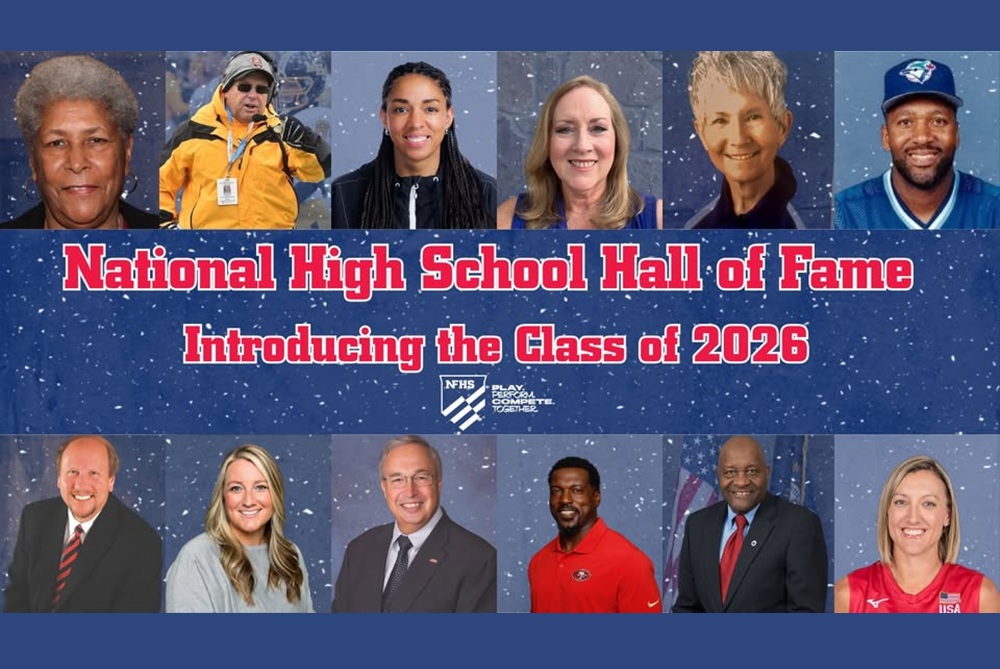
The theory that athletes in high school need to specialize in one sport in an out-of-school program to progress to the next level was not the theme from the five athletes inducted into the National High School Hall of Fame last month in Salt Lake City, Utah.
At a press conference preceding the 43rd Hall of Fame induction ceremony, five former extraordinary high school athletes – all of whom later excelled at the college, professional and for a few Olympic levels – delivered resounding messages about the importance of playing multiple sports within school-based programs.
Joe Carter, who was a four-sport standout in football, basketball, baseball and track at Millwood High School in Oklahoma City, Oklahoma, long before his stellar pro baseball career, said he might never have been a successful pro baseball player without his multiple sport career at Millwood.
“If I had played baseball all year long, I wouldn’t have been a professional baseball player because I would have burned out,” Carter said. “Coaches will tell you that if you don’t come out for football in the spring instead of playing another sport, you will be passed up. This is not the case because if you’re good they will find you. I will take an athlete who played two or three sports over an athlete who just played one sport because those guys know how to take advantage of a situation and know how to adjust.”
Jordan Larson, a three-sport participant at Logan View High School in Hooper, Nebraska, before settling into volleyball and leading the University of Nebraska to an NCAA championship and playing in four consecutive Olympics, also pointed to multiple sports as a reason for success.
“I can’t emphasize it enough – playing multiple sports helped me personally,” Larson said. “It helped me adapt and adjust as I got older. I can’t recommend it enough from a young age.
“Playing multiple sports helped shape me health-wise from a longevity standpoint. There’s something to be said for the mind. If you’re on the grind in the same sport, burnout will come.”
Another volleyball standout in the 2026 class was Alisha Glass Childress, who also played basketball at Leland (Michigan) High School and who would later lead Penn State University to three consecutive NCAA volleyball titles and team with Larson on the U.S. squad at the 2016 Olympics in Brazil.
“Playing for your high school team is so important – it’s such a different experience,” Childress said. “Being in the same program for four years and getting to know the athletes you’re with, I felt like it was family.
“High school was a beautiful time and the beginning of a love affair with sports. I fell in love with the sport of volleyball but also tried a lot of different sports. I played basketball as well. For me, high school is when you start to have an understanding of yourself – reflecting on who you want to be or what you want to achieve.
“The life lessons you learn along the way are so important. The majority of the athletes on our team did not continue on to play past high school. The life lessons you learn as a high school athlete – being a leader, accountability, goal-setting – carry with you the rest of your life.”
Patrick Willis was one of Tennessee’s top two-way football players at Hollow Rock-Bruceton Central High School who also played basketball and baseball before his hall of fame football career with the San Francisco 49ers.
“Coming from a small town with two red lights, I would say the most fun I had growing up was playing sports,” Willis said. “Life can throw a lot of things at you, and to be able to adjust is amazing. In sports, we’re able to learn these things – the discipline, the toughness, the perseverance. I wanted to be a representative that anything is possible, and it’s not just the ones from the big cities or towns, but ones from small towns also.”
Another proponent of playing multiple sports was Krissy Wendell Pohl, the most dominant player in girls ice hockey in Minnesota history and the national record-holder in goals scored in a season who went to a stellar career at the University of Minnesota and won a silver medal at the 2002 Olympics. In addition to her excellence in ice hockey, Wendell Pohl also played tennis, baseball and softball.
“It was so special for me to be able to play multiple sports,” said Wendell Pohl. “For me, playing baseball, softball and hockey, you had different groups of friends, different roles on different teams, and all of that had an impact and you don’t realize it until later.
“High school is the purest form of sport. What you learn in high school, as you’re learning and growing and developing, those things stay with you. The people who impact you in high school – you will never forget that.”
We urge coaches today to take the message from these five outstanding athletes about playing multiple sports to heart and make that option available to athletes in their schools.
These vital programs help to shape young student-athletes into successful parents, citizens and leaders of our nation for years to come.
Century of School Sports: Guided by 4 S's of Educational Athletics
By
Geoff Kimmerly
MHSAA.com senior editor
October 8, 2024
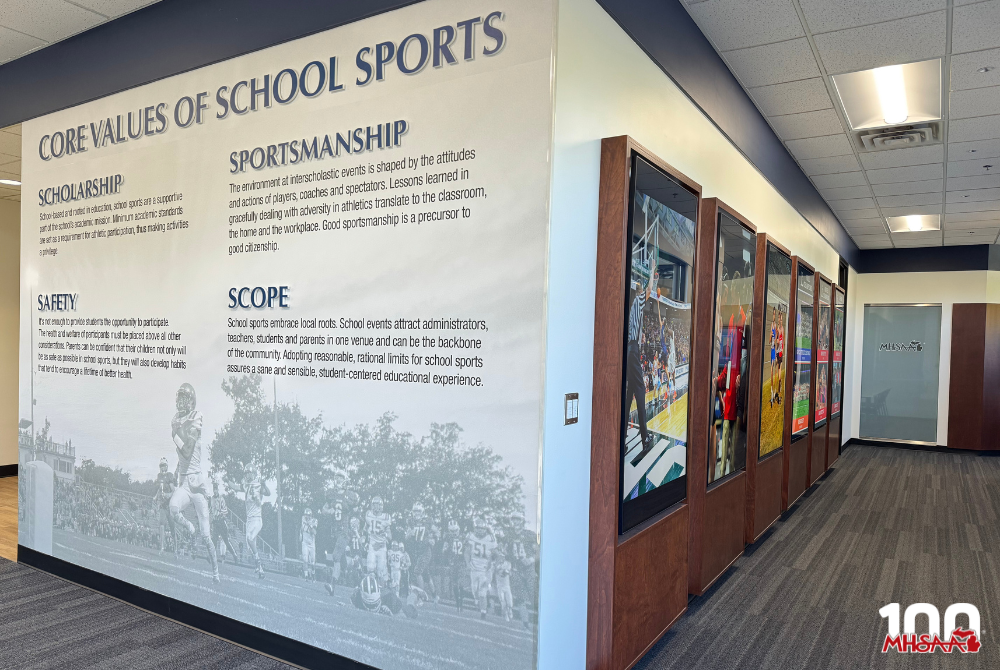
The display above greets visitors at the top of our staircase to the second floor at the MHSAA office in East Lansing – a group of guests that annually numbers well over a 1,000 administrators, student leaders, game officials and several others who are invested in school sports.
We hope these four core values – the MHSAA’s oft-referred to “four S’s” of educational athletics – also lead our guests’ interactions in school sports as they return home to their communities across the state.
They are as follows:
SAFETY
- It's not enough to provide students the opportunity to participate. The health and welfare of participants must be placed above all other considerations. Parents can be confident that their children not only will be as safe as possible in school sports, but they will also develop habits that tend to encourage a lifetime of better health.
SCHOLARSHIP
- School-based and rooted in education, school sports are a supportive part of the school's academic mission. Minimum academic standards are set as a requirement for athletic participation, thus making activities a privilege.
SPORTSMANSHIP
- The environment at interscholastic events is shaped by the attitudes and actions of players, coaches and spectators. Lessons learned in gracefully dealing with adversity in athletics translate to the classroom, the home and the workplace. Good sportsmanship is a precursor to good citizenship.
SCOPE
- School sports embrace local roots. School events attract administrators, teachers, students and parents in one venue and can be the backbone of the community. Adopting reasonable, rational limits for school sports assures a sane and sensible, student-centered educational experience.
These values were coined by John E. “Jack” Roberts, the fourth of now five full-time executive directors who have served the MHSAA during its 100-year history. He introduced them during his first days on the job in 1986 – and as he noted in an installment of his “From the Director” blog in 2015, they’ve stood the test of time.
They drove the Association’s work during his tenure, surely before it, and continue to do so today – and we will delve into all four as we continue our storytelling of a “Century of School Sports” during this 2024-25 school year.
Previous "Century of School Sports" Spotlights
Oct. 1: Michigan Sends 10 to National Hall of Fame - Read
Sept. 25: MHSAA Record Books Filled with 1000s of Achievements - Read
Sept. 18: Why Does the MHSAA Have These Rules? - Read
Sept. 10: Special Medals, Patches to Commemorate Special Year - Read
Sept. 4: Fall to Finish with 50th Football Championships - Read
Aug. 28: Let the Celebration Begin - Read
PHOTO A display on the second floor of the MHSAA office outlines the four core values of educational athletics: safety, scholarship, sportsmanship and scope.