

NFHS Voice: Coaches, ADs Keys to Success
December 3, 2019
By Karissa Niehoff
NFHS Executive Director
This fall, one school canceled the remainder of its football season after reports of hazing surfaced. There have been several incidents of high school student-athletes using racial slurs against members of the opposing teams. As we have noted previously, there have also been multiple reports of parents verbally and – in some cases – physically abusing officials, along with several cases of coaches allegedly running up scores. And then there was the bizarre case of a suspended player appearing in a game disguised as another player.
On the positive side, there was a cross country runner who stopped at the one-mile mark of a race to assist a competing runner who had collapsed and was unresponsive. He didn’t finish the race, but he saved the life of the competing runner.
After the completion of a recent football game, one player on the winning team found his friend on the other team who had just lost his mother to cancer to comfort and pray with him. There have also been cases of schools helping other schools that were hit with tragedies, such as the fires in California.
And earlier this year a high school golfer who, after signing her scorecard, noticed on the app that her partner had entered an incorrect score for her on one hole. She could have kept quiet and retained her top-10 finish, and most likely no one would have noticed. Instead, she reported the error and was disqualified. She later was honored by her school for doing the right thing.
Fortunately, there are far more good acts of sportsmanship that happen in high school athletics and activity programs; however, the unsportsmanlike displays tend to make more headlines and sometimes overshadow the great things that are occurring.
The key individuals in schools who are responsible for making education the central theme of the athletic program are the athletic directors and coaches. If coaches are more committed to helping student-athletes become responsible citizens than helping them perfect an athletic skill, and if athletic directors are committed to an education-based philosophy, the likelihood of unsportsmanlike incidents such as those mentioned above is minimal.
What’s the measure of success for a high school coach – winning 80 percent of the games, bringing home multiple state championships, being named coach of the year several times? As long as success on the fields or courts is done in accordance with an education-based philosophy, this would be an award-winning biographical sketch.
The win-loss record aside, however, how about also considering the consistent teaching of values, character and lifelong lessons that would place his or her teams in consideration for sportsmanship awards and his or her student-athletes on the paths to successful lives after high school?
The NFHS has several free online education courses to assist coaches and athletic directors in leading an effective education-based program. “Engaging Effectively with Parents,” “Sportsmanship” and “Bullying, Hazing and Inappropriate Behaviors” are among the many courses at www.NFHSLearn.com. In addition, “Fundamentals of Coaching” is the core course that every interscholastic coach should complete.
When a school district is looking to hire a high school athletic director or coach, we would suggest finding someone more committed to an education-based philosophy than hardware in the trophy case.
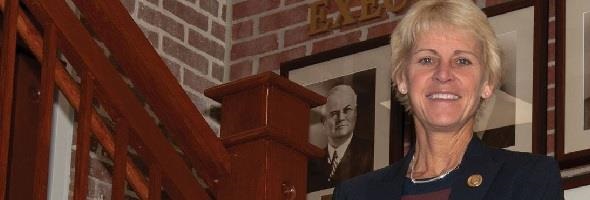
Dr. Karissa L. Niehoff is in her second year as executive director of the National Federation of State High School Associations (NFHS) in Indianapolis, Indiana. She is the first female to head the national leadership organization for high school athletics and performing arts activities and the sixth full-time executive director of the NFHS, which celebrated its 100th year of service during the 2018-19 school year. She previously was executive director of the Connecticut Association of Schools-Connecticut Interscholastic Athletic Conference for seven years.
NFHS Voice: Good Time to Appreciate Officials
April 9, 2020
By Karissa Niehoff
NFHS Executive Director
During this shutdown of normal life in our nation, we are learning to deal with a new challenge – how to handle the unexpected time on our hands at home. Simply keeping up with the days of the week is a major accomplishment!
While we anxiously await the re-opening of schools and a return of high school sports and performing arts, this down time can be used in positive ways to take advantage of educational opportunities. And kudos to some individuals who already are seizing those opportunities – men and women who officiate high school sports.
Two weeks ago, we began to offer the 11 officiating courses on the NFHS Learning Center free of charge, and the response has been nothing short of amazing. By the end of March – merely a week into this new opportunity – more than 5,200 courses had been taken.
In addition to veteran officials fine-tuning techniques in one or more of the seven sports featured in these courses, this has been a great opportunity for individuals interested in officiating to take a free course to determine their interest level.
Those of us in leadership positions are so appreciative of these individuals who give freely of their free time to officiate high school sports or adjudicate music contests. We would suggest that everyone – student-athletes, coaches, parents and other fans – use this down time to do the same.
At various times this year before the shutdown of schools, officials have been the victim of verbal and physical abuse. Inappropriate behavior by parents and other fans was causing officials to quit before they even reached two years on the job.
And yet, in the past three years, more than 35,000 individuals have signed up to become officials through the NFHS’ #BecomeAnOfficial campaign and 5,200 courses that have been taken in the past couple of weeks by men and women who want to give back to high school sports. These are good signs more people will continue to be involved in officiating when the games return.
But what about the parents and other fans in the stands? Will their behavior be changed upon return? The conclusion of the New Mexico Activities Association’s state basketball tournament last month provided an interesting perspective on the impact of fans to the atmosphere at high school sporting events.
After completing the first two days of its state tournament with fans in the stands, the NMAA conducted the final three days without fans because of concerns about the spread of the COVID-19 virus. Dana Pappas, commissioner of officials for the NMAA, noted the following about the final three days of competition:
“Officials would make a call and if coaches had a question about it, they asked – calmly and respectfully. In huddles during time-outs, coaches just talked to their players, without raised voices. The behavior of coaches on the sidelines from Thursday through Saturday was in stark contrast to what we witnessed on Tuesday and Wednesday. Perhaps they did not feel the need to be overly emotional for the benefit of their fans.
“My hope is that the absence of sport throughout the world gives us all a moment to gain perspective and do a ‘gut check’ as to the kind of fans we are at contests. If the quality of the game is unchanged (or even better) without fans there to scream at the coaches, officials and players, then is that behavior really necessary when the games resume?”
The message here is that while the games can continue without fans, the ideal situation is for stands full of fans positively cheering for their teams.
Dr. Karissa L. Niehoff is in her second year as executive director of the National Federation of State High School Associations (NFHS) in Indianapolis, Indiana. She is the first female to head the national leadership organization for high school athletics and performing arts activities and the sixth full-time executive director of the NFHS, which celebrated its 100th year of service during the 2018-19 school year. She previously was executive director of the Connecticut Association of Schools-Connecticut Interscholastic Athletic Conference for seven years.