

NFHS Voice: Security Wake-Up Call
December 4, 2019
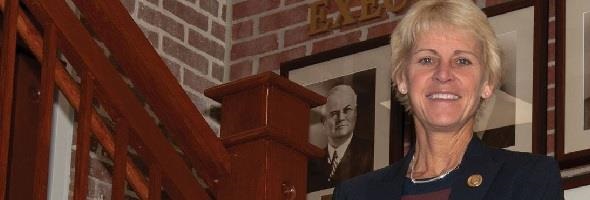
By Karissa Niehoff
NFHS Executive Director
Given the increase in school-related shootings since the Columbine massacre 20 years ago, perhaps it is not surprising that these acts of violence are no longer confined to regular school hours.
The tragic shooting – and eventual death of an innocent 10-year-old – at a New Jersey high school football game last month made headlines across the country and was a somber reminder that events occurring after school hours are subject to the same type of senseless violence.
This was not the first shooting at a high school sporting event this year – actually it was the 23rd according to the National Center for Spectator Sport Safety and Security (NCS4) – but the death of Micah Tennant and the eventual conclusion of the game five days later at the Philadelphia Eagles’ stadium drew nationwide coverage.
Camden High School and Pleasantville High School finished the playoff game at a nearly empty Lincoln Financial Field before a few hundred family members and friends as the stadium was closed to the public. Larry White, New Jersey State Interscholastic Athletic Association executive director, said the decision to finish the game was made by both schools “to provide closure and send a powerful message that acts of violence and those who perpetrate them will not win.”
High school sporting events traditionally have been safe gathering places for fans to attend and celebrate the accomplishments of high school student-athletes – particularly the sport of football. And we must do whatever is necessary to make sure these venues remain safe and secure.
Reports have been encouraging about attendance as state football playoffs have concluded in many states. In Indiana, about 20,000 people attended the Class 5A championship at Lucas Oil Stadium in Indianapolis on the day after Thanksgiving.
We want to ensure that our stadiums remain open for everyone to attend. The fans – students, parents, other family members, friends, community residents – are what make education-based athletics different from non-school sports.
More intense security plans have been in existence at college and professional sports venues for many years; it is essential that leaders in high school sports move after-school safety and security to the top of their priority lists.
In addition to school athletic events that typically start in early evening hours, security plans also should be in place for practices inside and outside the school building.
Many resources are available for high school athletic administrators to implement an after-school safety and security program, including the free online education course on the NFHS Learning Center at www.NFHSLearn.com. “Afterschool Security” provides practical strategies for developing and implementing a school safety team and an after-school activities supervision plan.
As was the case with increased security at airports after September 11, 2001, the results of heightened safety plans for after-school activities may be an inconvenience for some individuals. However, plans must be in place to ensure that high school stadiums and arenas remain open for the almost eight million participants in high school sports, as well as the estimated 350 million fans annually.
Dr. Karissa L. Niehoff is in her second year as executive director of the National Federation of State High School Associations (NFHS) in Indianapolis, Indiana. She is the first female to head the national leadership organization for high school athletics and performing arts activities and the sixth full-time executive director of the NFHS, which celebrated its 100th year of service during the 2018-19 school year. She previously was executive director of the Connecticut Association of Schools-Connecticut Interscholastic Athletic Conference for seven years.
Whymer Made Blue Water Moments into Memories
By
Paul Costanzo
Special for MHSAA.com
September 29, 2020
 When considering all the reasons Jim Whymer was a beloved and Hall of Fame sportswriter in the Thumb area, one stands out above the rest – he cared.
He cared about the quality of the sports section at the Times Herald in Port Huron. He cared about making sure the impossible task of covering schools and sports as equally as possible was accomplished. And he cared about what the newspaper meant to the community.
But most of all, he cared about the people he was writing about.
“He wasn’t going in it just to get a story – he cared about people,” said Shawn Sharrow, a 1994 Marine City graduate who coached basketball at Marine City and St. Clair. “He cared about relationships. As much as he liked sports, he liked people and building those relationships over the years. After he did an interview with you, he would stand there and talk with you for another half hour. He just wanted to develop those friendships.”
Whymer, who worked at the Times Herald from 1978 through 2012, died this past Thursday of metastatic melanoma. He was 64.
He is survived by his wife, Patty, his children Traci Whymer (Tyson Connolly), Kyle (Amanda) Whymer and Joel (Rachel) Whymer, and his grandson, Finn; and by his mother Teresa, sister Michele Seif and brother Bill (Pattie).
He also is survived by the countless yellowing press clippings with his byline that can be found in hundreds of scrapbooks throughout homes in the Blue Water Area. Clippings that no doubt made special memories that much more special for those holding onto them.
 “I think like no other person I’ve been around, he made kids feel special,” Port Huron Northern boys basketball coach Brian Jamison said. “He had an amazing ability to make kids feel special. It was in his articles and how long he would take to talk to a kid. He would know the kid’s uncle and their cousin, and he would talk to them about that. I think kids genuinely felt better after talking to him.”
Whymer won several awards for his journalism, including a spot in the Basketball Coaches Association of Michigan Hall of Honor and the Port Huron Sports Hall of Fame.
Good luck finding those awards displayed anywhere, though. Whymer was more interested in making sure the athletes and coaches were getting proper recognition.
“He was really thorough and really interested in what we were doing, even in little old Deckerville when he had Port Huron and Port Huron Northern in his backyard,” Deckerville football coach Bill Brown said. “He’d come up to Deckerville, he’d even go to playoff games – we'd play across the state and he was there. Then after the game, he would just ask you respectful questions. It’s just too bad, because he’s definitely going to be missed. Everybody looked forward to seeing him. He was more than welcome here; he probably could have stayed overnight at someone’s house if he needed to.”
Brown, Jamison and Sharrow had interactions with Whymer as players and coaches. Brown also got to see Whymer as an official, as Whymer worked for more than three decades officiating basketball, baseball, softball and football games throughout the area.
“You can’t even get mad at the guy because he’s such a good guy,” Brown said with a laugh. “He was always square with you.”
Jamison also coached both of Whymer’s sons, and currently has Kyle as his junior varsity basketball coach at Northern. All of the Whymer children played sports at Northern, with Traci being part of an MHSAA title-winning tennis team and Joel setting records on the basketball court and earning a scholarship at Lake Superior State University. (He would later transfer to Grand Valley State.)
 “Jim’s always been more like family to me,” Jamison said. “I think everyone feels that way about him. He’s like your fun uncle that you love to talk to. Jim always did a nice job of keeping the story separate from him being the dad. In that respect, he made it easy on me. He was very, very supportive of his children. That’s something – as special as other people felt – that guy was truly all in for all three of his kids when it came to sports and school. I think he was an ultra-professional, and he didn’t want to overwrite about his kids.”
After leaving the Times Herald, Whymer began working in the athletic department at St. Clair County Community College, where he continued his quest to make things as special as possible for student athletes. His main duties included scheduling high school and middle school events at the college’s Fieldhouse – whether it be smaller local tournaments or a multi-day holiday basketball showcase that grew to more than 40 teams.
The Fieldhouse can fit more than 2,000 spectators, and Sharrow said if not for restrictions because of COVID-19, a memorial service for Whymer could fill it. That’s likely not an exaggeration.
“He might be showing up at your practice in the last 10 or 15 minutes, and he always walked in the gym with a smile on his face,” Sharrow said. “If he was ever having a bad day, you’d never know it. He made athletes feel important. Even watching him as a coach talking to my players, you could see their faces light up that they were going to be in the paper and that Jim Whymer wanted to talk to them.”
 Paul Costanzo served as a sportswriter at The Port Huron Times Herald from 2006-15, including three years as lead sportswriter, and prior to that as sports editor at the Hillsdale Daily News from 2005-06. He can be reached at [email protected] with story ideas for Genesee, Lapeer, St. Clair, Sanilac, Huron, Tuscola, Saginaw, Bay, Arenac, Midland and Gladwin counties.
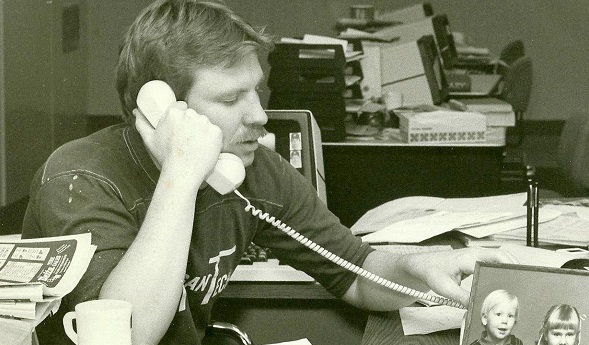
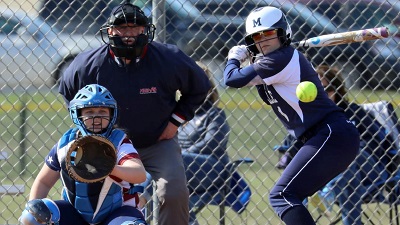
PHOTOS: (Top) Longtime sportswriter Jim Whymer works the phones during his time at the Port Huron Times Herald. (Middle) Whymer also was an MHSAA-registered official for 35 years. (Below) Whymer is survived by his wife Patty and their three children. (Photos courtesy of the Whymer family.)