

NFHS Voice: Time for Teachable Moments
September 6, 2019
By Karissa Niehoff
NFHS Executive Director
Welcome to another year of educational opportunities through high school sports and other activity programs in our nation’s schools. These programs provide many teachable moments not available in the classroom, and we look forward to making an impact on the more than 12 million young people involved in these vital activities.
Many states opened their high school football seasons during the final weekends of August. Thousands of other high school students will be involved in volleyball, cross country, field hockey, soccer and other sports this fall. And then there are those boys and girls involved in speech, debate, music and other cocurricular activity programs.
The NFHS distributed its most anticipated news release of the year earlier last week – the Annual Sports Participation Survey. The number of boys and girls involved in high school sports has been spiraling upward annually since 1988 – an amazing 29 consecutive years. However, due to several factors, the 2018-19 figure dipped to 7,937,491, which is the third-highest total in the 50-year history of the survey.
We have been aware for some time that the number of kids involved in youth sports has been declining. In addition, a decline in the number of public school students has been predicted for a number of years, so there simply may be fewer students in schools.
Understandably, the focus will be on the sport of football. While there were no states with significant drops in boys 11-player football, most states reported slight declines, which amounted to 30,000 participants nationally. However, a comparison of the figures from the past two years indicates that the average number of boys involved in 11-player football on a per-school basis dropped from 73 to 70, which would include freshman, junior varsity and varsity teams.
In some cases, schools are starting and/or increasing programs in 6-player, 8-player and 9-player football as participation numbers were up in all three versions of the game. And participation by girls in 11-player football has doubled in the past 10 years to 2,404 participants last year.
The survey confirmed that schools are not dropping the sport of football, which is great news. We continue to work with our state associations and groups such as USA Football to reduce contact and teach proper tackling skills at the youth level to increase the interest level as kids reach junior high school and high school.
While we hope that the numbers will return in football, we are pleased with the continued growth in several other sports, including volleyball, soccer and lacrosse. Since 2012, participation in girls lacrosse and boys lacrosse has increased 19 percent with a combined 213,452 participants in 2018-19. Girls and boys soccer has gained 70,668 participants since 2012 (a nine percent increase) and now has a combined 853,182 participants.
Seemingly, schools have something for everyone as the survey indicated participation by high school students in 70 different sports, as well as numerous adapted and Unified sports for students with disabilities. Schools are providing opportunities in bowling, badminton, flag football, archery, Ultimate Frisbee, bass fishing, crew and many, many others.
Ultimately, the goal of the NFHS and its 51-member state associations is to ensure that all students have an opportunity to enjoy healthy participation, achievement and good sportsmanship in education-based activities. We are excited about these opportunities as another school year begins.
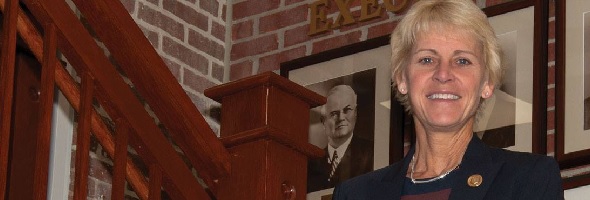
Dr. Karissa L. Niehoff is beginning her second year as executive director of the National Federation of State High School Associations (NFHS) in Indianapolis, Indiana. She is the first female to head the national leadership organization for high school athletics and performing arts activities and the sixth full-time executive director of the NFHS, which celebrated its 100th year of service during the 2018-19 school year. She previously was executive director of the Connecticut Association of Schools-Connecticut Interscholastic Athletic Conference for seven years.
Mason, Okemos Score for a Cure
By
Geoff Kimmerly
MHSAA.com senior editor
November 11, 2014
Three weeks remain in the MHSAA’s 2014 fall season, and we’ve collected a few notes to pass along as we wind down the final three sports before moving inside (except for skiing) for the winter.
 Below are an update on a fundraising game we previewed earlier, plus recognition for perfection at our Girls Golf Finals and another high honor for one of the top players in MHSAA volleyball history.
Score for a cure
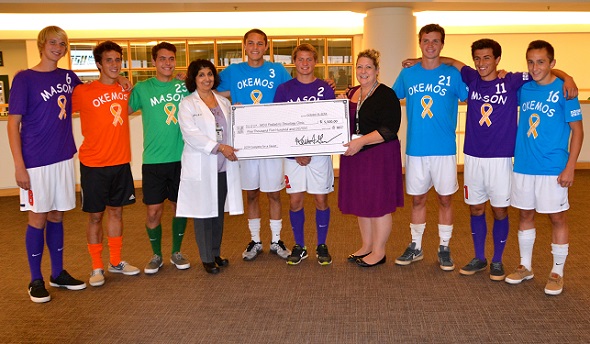
We wrote in September about an upcoming soccer game between Lansing-area powers that would raise money for pediatric cancer research. The “Compete for a Cause” game between Okemos and Mason on Sept. 13 was the third of what has become an annual event started by Mason’s team and coaching staff.
Attendance for this season’s game was nearly double the year before, and funds raised increased more than 500 percent.
The final tally: Roughly 1,400 fans attended the game, which raised $11,000 that was split between the CureSearch for Children’s Cancer national foundation and the Michigan State University Pediatric Oncology Clinic.
The first “Compete” game in 2012 raised $1,000, and the 2013 game drew 800 fans and raised about $2,000. This fall, Okemos was ranked No. 1 in Division 1 and Mason No. 7 in Division 2 when the game was played; it ended in a 1-1 tie. Both went on to postseason success – Okemos advanced to a Regional Final, and Mason fell to eventual Division 2 champion East Lansing in overtime in their Semifinal.
Only one shot needed
 It’s a rarity – most of the time. But for the second straight season, a player at the MHSAA Lower Peninsula Girls Golf Finals sunk a hole-in-one.
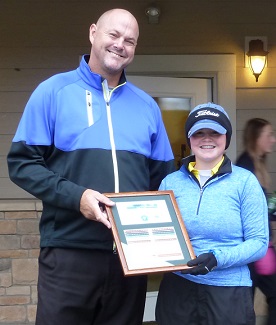
Grosse Pointe South’s Lucy Buzolitz aced the par-3 No. 12 at Bedford Valley in Battle Creek, dropping the shot from 97 yards out during the first round of Division 1 play. Buzolitz was one of two individual qualifiers from her team and shot a 92-97-189 for the two-day tournament.
At the 2013 Division 2 Final, Fenton then-sophomore Madison Shegos aced the par-3 18th hole at Michigan State University’s Forest Akers East.
Sportswoman of the Year
Former Leland and Penn State University volleyball standout and current U.S. national team setter Alisha Glass was a finalist for 2014 Team Sportswoman of the Year at the 35th Salute to Women in Sports gala in October in New York City.
The event, put on by the Women’s Sports Foundation, annually recognizes a Sportswoman of the Year for both individual and team sports based on nominations by sport governing bodies and the public. Glass was one of 10 candidates this year for the team award after being named USA Volleyball Indoor Female Athlete of the Year in 2013. She also was named International Federation of Volleyball’s best setter at the 2014 World Championship in Italy after helping the United States to the title.
Olympic gold medal-winning ice dancer Meryl Davis received the Sportswoman of the Year team award, while the individual award when to gymnastics all-around world champion Simone Biles.
PHOTOS: (Top) Members of the Mason and Okemos boys soccer teams present a check for $5,500 to the MSU Pediatric Oncology Clinic and Dr. Renuka Gera last month. (Middle) Lucy Buzolitz receives a plaque recognizing her hole-in-one at the Division 2 Golf Final from Bedford Valley head pro Dean Kolstad.