


NFHS Voice: Your Best Sports Option
September 18, 2019
By Karissa Niehoff
NFHS Executive Director
Recent articles have documented the rising costs of club sports, with one noting that about 62 percent of “travel ball” parents will go into debt to involve their kids in year-round sports.
A USA Today article in 2017 suggested that travel baseball or volleyball could cost a family upwards of $8,000 a year, with soccer running about $5,000 on the high end. A study by TD Ameritrade suggested some parents were spending about $100 to $500 a month to fund their kids’ participation on a club team, with about 20 percent spending $1,000 a month.
Why? In some cases – unquestionably the minority – students are in the elite category from a skills standpoint and could benefit from a higher level of competition in preparation for college. In most cases, however, it is a case of parents spending beyond their means with the hope that playing club sports will be the difference-maker in their children receiving an athletic scholarship to an NCAA Division I school.
It is, in fact, true that an overwhelming majority of NCAA Division I athletes played club sports. According to an NCAA survey, 92 percent of women and 89 percent of men played club basketball, and 91 percent of women’s volleyball players competed on a non-school team in high school. At the other end, however, only 24 percent of football players competed on a club team.
Herein lies the difference. There are more than 540,000 boys who played high school basketball last year and fewer than 6,000 who played basketball at the NCAA Division I level where most of the scholarships are available. Stated another way, about one percent of high school boys basketball players will play at the NCAA Division I level. About 2.8 percent of the one million-plus boys in high school 11-player football will play at the Division I level.
The answer? Parents should encourage their kids to play multiple sports for their high school teams and save the money they would spend on club sports for college tuition if scholarship money does not materialize. Even in those situations where students are charged a modest fee to participate, school-based sports remain an incredible bargain when compared to club sports.
In many cases, Division I football and basketball coaches are looking to recruit multiple-sport athletes. While there are a few sports where non-school competition is crucial, college coaches will find those athletes who excel in school-based sports.
High school-based sports have more interest, more media coverage and more fans than club sports, and the kids have more fun because they are representing their team and their community.
Playing one sport in the fall, another during the winter and yet another in the spring is the best route to future success – whether that success is on the playing field or court, or in a boardroom.
Dr. Karissa L. Niehoff is beginning her second year as executive director of the National Federation of State High School Associations (NFHS) in Indianapolis, Indiana. She is the first female to head the national leadership organization for high school athletics and performing arts activities and the sixth full-time executive director of the NFHS, which celebrated its 100th year of service during the 2018-19 school year. She previously was executive director of the Connecticut Association of Schools-Connecticut Interscholastic Athletic Conference for seven years.
Choose the Right Sports Medicine Expert
July 7, 2020

By Christina Eyers, Ed.D., AT, ATC
Henry Ford Health System
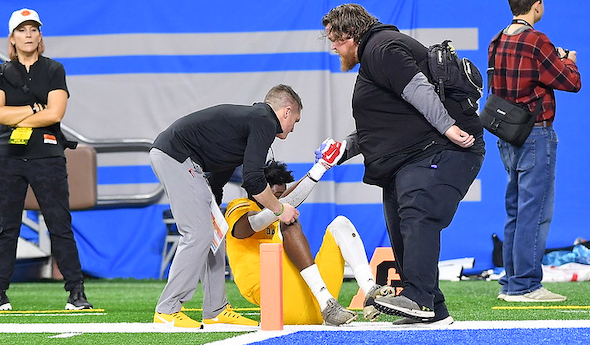
If you're an athlete, chances are you'll require specialized care from a health professional during your career.
Confused about the differences between athletic trainers, sports medicine physicians and exercise physiologists, among other experts? You're not alone!
Each of these professionals has different levels of training, expertise and certifications, but the care they provide often overlaps. That's one reason why they often work together.
Sports Professionals Defined
Caring for athletes isn't always clear-cut. In fact, most athletes require a full team of professionals working in concert to stay at the top of their game. Yet confusion remains about which professionals you need to see for training, injury prevention, and recovery and treatment after an injury.
Each type of professional has its own set of experience, training and certifications. Here’s how they measure up:
· Sports medicine doctor: Sports medicine physicians are typically trained in orthopedic surgery, primary care or emergency medicine. These professionals have medical degrees as well as specialized training in sports medicine, including the prevention and treatment of injury. In addition to caring for conditions ranging from concussion to head colds, sports medicine physicians also focus on helping people return to sports safely and effectively after illness or injury.
· Athletic trainer: Athletic trainers take care of athletes from prevention through rehabilitation. In collaboration with a physician, these professionals offer insights that help minimize risk and prevent injuries. They evaluate athletes and provide immediate care and treatment, sometimes even on the sidelines. They also provide rehabilitation and reconditioning after an injury or illness.
· Exercise physiologist: Exercise physiologists study the effect of exercise on the muscular, cardiovascular, and sympathetic and parasympathetic nervous systems. They examine functional capacity and strength due to endurance training or strength training. These professionals may also test athletes for VO2max (your oxygen volume while training) and body composition (the ratio of fatty mass to lean mass).
· Physical medicine and rehab physician: These professionals treat a variety of medical conditions that affect the brain, spinal cord, nerves, bones, joints, ligaments, muscles and tendons. They take the whole body into account to pinpoint problems and enhance performance without surgery.
· Physical therapist: Physical therapists diagnose and treat individuals of all ages with conditions that limit their ability to move and perform daily activities.
Other Specialized Professionals Who Care for Athletes
In addition to the health care professionals described above, athletes may meet with a host of experts, including:
· Nurses and medical assistants
· Occupational therapists
· Cardiologists
· Neurologists
· Behavioral health specialists
· Dietitians
· Complementary medical practitioners, such as acupuncturists and chiropractors
None of these individuals are "fitness professionals," a term nearly anyone can use to describe a range of professional activities. Rather, these sports medicine experts are part of a comprehensive team that includes at least one physician. They are each licensed by the state to provide specialized care to athletes.
Personal trainers, on the other hand, focus on helping people find their way around the gym, hold them accountable to achieve their goals and help new exercisers and seasoned fitness enthusiasts stick to a workout regimen.
If you're an athlete, you need a team of health professionals who can provide comprehensive care to reach your highest potential.
Christina Eyers, Ed.D., AT, ATC, is the Director of Athletic Training & Community Outreach with Henry Ford Sports Medicine.
Want to learn more? Henry Ford Health System sports medicine experts are treating the whole athlete, in a whole new way. From nutrition to neurology, and from injury prevention to treatment of sports-related conditions, they can give your athlete a unique game plan.
Visit henryford.com/sports or call (313) 972-4216 for an appointment within 24 business hours.