

Radio Neighbors Begin 77th Years in HS Sports
September 6, 2018
By John Johnson
MHSAA Director of Broadcast Properties
Local radio coverage of high school sports can still be found in a lot of places these days – and for a couple of stations, they’re celebrating 77 years of service to school sports in 2018-19.
WTCM-AM in Traverse City and WJMS-AM in Ironwood are literally adjacent on your radio dial, but they’re 250 miles apart as the crow flies across Lake Michigan and through a lot of northeast Wisconsin. In 1941, they started their streak of broadcasting the preps into their local communities.
Mind you, there weren’t that many radio stations as you might think back then, when it was the only electronic medium. WJMS had signed on in November of 1931 and was only one of two stations in the Upper Peninsula at the time and one of 19 statewide, according to Federal Radio Commission records. One of the early issues the station faced was interference with its signal because of the density of iron mines in the area.
When WTCM went on the air early in 1941, there were still only 28 radio stations in our state; five were in the U.P., and WTCM was the only station in the Lower Peninsula north of Saginaw.
Les Biederman owned WTCM and was quickly persuaded by the locals to broadcast a Traverse City High School basketball game.
“So he got the equipment ready and got everything set up, they got permission and everything,” said Jack O’Malley, current program director at the station and a long-time play-by-play voice. “The night of the game, the superintendent says ‘You can’t do the game – the local newspaper is not real happy. They said if people listen to the game, they won’t buy the newspaper in the morning. So you can’t do the game.’
 “So the town had already been told – they were promoting it; and when 7 o’clock rolled around, they went on the air and they announced they were going to do the game tonight, but permission had been revoked, so we can’t do it. And then they left the microphones open at the gym so that everybody could hear the basketball dribbling, the crowd cheering, the horns honking.
“About 15 minutes later, the superintendent was at Les’ door, saying that the phones had gone crazy, you’ve got to do the game. They started with the game and we’ve been doing high school sports ever since.”
WTCM added football and other sports to the mix over time, which played well with Traverse City High School being the only public school in town. The station’s focus these days is football, alternating between Central and West High Schools.
“The whole idea is that we’re part of the community, and WTCM has always been a community radio station,” O’Malley said. “High school sports are all about community. People say, I remember when this kid played on that team and you watch all the kids as they grow up. It’s really a connection through the ages.”
The Biederman family continues to serve radio listeners in the north, with Ross Biederman as the president of what has become the Midwestern Broadcasting Company with four stations in the Traverse City market and two in the Alpena area. And yes, one of the Alpena stations is involved in covering high school sports.
The paper trail isn’t quite as tidy when documenting the history at WJMS. The station moved from its original frequency of 1420 to 1450 after being on the air for about six years, then to 630 in 1947 and its present 590 on the AM dial in 1968. Veteran observers of U.P. radio concluded that WJMS began broadcasting high school games in 1941, which was confirmed by several newspaper articles in the old Ironwood Times from that year.
The station’s signal footprint, which would eventually reach from Marquette to well west of Duluth, Minn., by day, was the early stomping grounds for some great broadcasters.
“I can remember when I was 9 or 10 years old, listening to Bob Olson and Joe Blake doing high school basketball and football in the early 60’s,” said Rod Halverson, who currently calls games for the station. “We had four local schools, Hurley (Wis.), Bessemer, Ironwood and Wakefield, which were all in the Michigan-Wisconsin Conference; and we covered those four schools. I remember listening and seeing those guys at the basketball games.”
Bob Olson, who died earlier this year, and Joe Blake went on from WJMS to purchase WMPL in Hancock in 1969. Olson would spend 35 years behind the microphone calling Michigan Tech ice hockey games and was legendary for his high-pitched tag going into commercial breaks: “This is Huskie Hockey from Houghton!” Blake would purchase WCKD in Ishpeming in 1971 (which later became WMQT-WZAM in Marquette) and run its operations until his death in 2004, calling Northern Michigan ice hockey and volleyball games. Both gentlemen received all kinds of accolades over the years.
But it was the style of an another announcer who followed Olson and Blake – Harry Rizze – who Halverson has worked hard to apply as he calls the games now.
“Harry Rizze was doing games when I started playing basketball,” Halverson said. “He made the games really personable. He would get to know the players by their first names – and he would use their first names on the air sometimes – that’s how close he got to the program. I thought it was a really nice touch. I’m doing some of that now, and I’m trying to emulate the two guys before me – Harry Rizze and Gary Aho.”
And in a place like the Iron Range of the Western U.P., there’s nothing like local radio covering local high school games.
“Some of the players I broadcast now, I played against their dads,” Halverson said. “You get to know everybody. Up here, we cover all of the schools the best we can. I feel bad for the areas that don’t have radio coverage.”
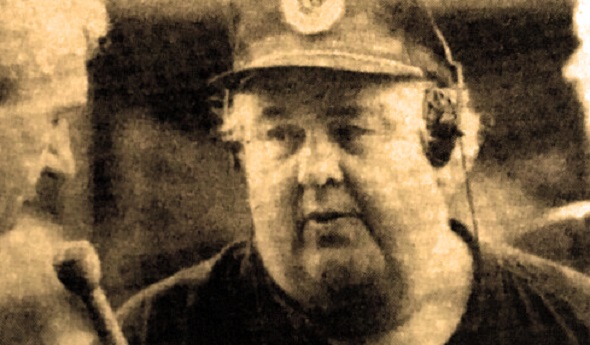
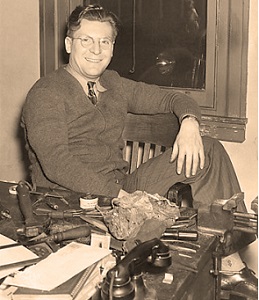
PHOTOS: (Top) Longtime WJMS broadcaster Harry Rizze conducts an interview. (Middle) Late WTCM owner Les Biederman.

English's Hall of Fame Contributions to St. Francis Continue Behind Camera Lens
By
Tom Spencer
Special for MHSAA.com
October 9, 2025
The name Julie English is now synonymous with Traverse City St. Francis football.

English spent her first two decades contributing to the school behind the scenes, helping the Gladiators launch boys and girls soccer programs, and scoring volleyball and basketball. She served as team manager for boys and girls soccer and even bus driver, so to speak, for the latter.
She’s also very noticeable on the sidelines of football, soccer and volleyball games, taking pictures with the aid of a motorized wheelchair.
This past Saturday, she was front and center. She was inducted into the Grand Traverse Area Catholic Schools Hall of Fame – established in 2007 to recognize individuals who inspire others by being exemplary role models.
English was paralyzed 10 years ago as she reached the end of a zip line while chaperoning a girls soccer team trip weeks ahead of the 2015 season. Many recall snow on the ground as she went first, intending to take pictures of the team as they planned to follow. She decided to go first that March day despite a fear of heights.
“It was all part of God's plan because I am afraid of heights – I really had to talk myself into going on the zip line,” said English, who considers it a freak accident and doesn’t discourage anyone from giving zip lining a try. “I was thinking, you know, I'm trying to convince these girls to step outside their comfort zone. And if I'm too afraid to do something like that, what kind of an example am I? So I breathed it and went up and actually it was fun – until it wasn't.“
Past TCSF athletic director Tom Hardy introduced English at the induction ceremony last weekend. He lauded the “amazing women he had the privilege” of working with during his 18-year tenure.
“While such a devastating event might have broken many, it only served to strengthen Julie's unwavering faith,” Hardy said. “She approaches each day with grace, fully aware of the challenges ahead, yet she embraces them with joy, love, and laughter. Following her accident, Julie dove deeper into her passion of photography.”
English now generously volunteers her time capturing St. Francis athletic events and creating lasting memories for students and their families through her lens, leaving school officials, coaches, players and supporters in awe.
Current TCSF athletic director Aaron Biggar has personally been touched by English’s work, through her photographs of his boys playing football for St. Francis. He’s thrilled to have English for home game, and she also travels to – and is welcomed by – volleyball, football and soccer opponents.
 “Julie’s ability to capture those life events for parents who are watching the game and not taking pictures, has been such a gift for our community,” Biggar said. “She's been around so long and (is) so accepted by our community. And even by opposing teams, they allow her to be on the field and make precautions and stuff so she can. Our opponents in other schools have also been so accommodating of her and helping.”
English was at Thirlby Field last week capturing the Glads’ big Homecoming win over Boyne City, 20-13. She won’t be on the road tonight as the Glads put their undefeated football record on the line against Pontiac Notre Dame Prep. But she will be back on the football sidelines Oct. 18 when St. Francis hosts Jackson Lumen Christi. And she’ll also be on the sidelines next week when the boys soccer team continues what it hopes will be another deep run into the postseason.
English’s humility, deep faith, and enduring optimism have had a profound and lasting impact, supporters note. Not surprisingly, her biggest concern as she takes pictures today is not her safety – it is the safety of the home and visiting athletes.
“I think sometimes I make people nervous, but I am always cognizant of what's going on, because the last thing I want to do is hurt anybody, like, have them run into me and then get hurt,” English said. “I want to be where I can get a good picture, but definitely not where someone could get injured if they ran into me.”
English’s photos are treasures for St. Francis families, points out Mike Kanitz, who was inducted into the Hall of Fame alongside English. In fact, he nominated her. Kanitz is the junior varsity girls basketball coach, volleyball game manager, volleyball announcer and volleyball scorekeeper, football press box manager, and the Glads’ soccer game manager.
“Julie’s ability to capture time for SF families, I mean, is priceless,” said Kanitz, who also can be found at the scorer’s table for boys basketball. “She catches kids in their level of joy, and it's cool. It's a snapshot in time, and she does it for every family. I mean, this is all free. She posts it all free. She doesn’t charge anybody. And she she's such a hard worker. She's everywhere.”
Kanitz vividly recalls English’s efforts to bring soccer to St. Francis. It happened in 2002. The Glads first had a club team coached by volunteer Reggie Rix.
“She had to fight some hurdles and it was a lot of work, and to start a new sport – her vision was the correct vision,” Kanitz said. “There were coaches, but Julie was really the one that took care of everything. Julie was fair to all children. She wanted all kids to have that good experience of high school sports.”
Kanitz, one of many who regularly see English’s photos and read her inspiring messages on social media, finds it difficult to think about the zip line accident. His daughter was one of the St. Francis soccer players waiting to come down the line next.
 “It's still hard for me to actually think about and talk about, but Julie's handled it better than anybody,” he said. “Her faith in God is so strong, and her message she writes … these Facebook stories about where she's at in her journey … they're moving and people read them, and it affects people.”
Early on, Julie recognized the vital importance of a Catholic education for her children and committed herself wholeheartedly to making it a reality, Hardy recalled. In addition to operating a full-time in-home daycare for more than 30 years, she worked weekends to help make ends meet and ensure that her four children – Ian, Caitlin, Jordan and Chelsea – remained enrolled in the Catholic schools.
As the owner of a daycare business, English drove a 12-passenger blue van. She often emptied the car seats in time to get 11 players – including Caitlin and Chelsea – to soccer games wherever TCSF was playing.
Caitlin English played on the first TCSF girls soccer team in 2002. She presented Hardy with a petition to offer soccer, signed by St. Francis athletes. As a club, English is proud to say, the team won all 17 of its games. When soccer became a school-sponsored varsity sport a year later, it was a cooperative with Traverse City Christian called Liberty.
Ian English was on the field for St. Francis boys’ first game, played through a co-op also with TC Christian during the fall of 2008. Chelsea English also played soccer for the Glads. Jordan English played rugby.
Ian, Jordan and Chelsea were at Julie’s induction ceremony. Caitlin, now living in the Grand Rapids area, was unable to attend because she is coaching soccer for her own daughter, Emilia, although Julie’s son-in-law did attend.
English gets around today with a vehicle adapted for her. She is supported regularly by Ian and Chelsea, along with a mother of nearby Kingsley High School athletes. She’s been spotted on the sidelines taking pictures at Kingsley volleyball and soccer matches, too. English also has been able to get to Grand Rapids and capture her granddaughter’s early soccer days with her camera.
She is enjoying a new beginning with soccer as well as her newer role for the Glads.
“Back in the day, I was able to run the clock, take pictures and do the book,” English said. “I don't think my brain would handle all of that now, but, you know, it was it was fun to do at the time. Not being able to do daycare anymore and not being able to do the things I did at St. Francis are the hardest things about being in a wheelchair – just not being able to do all the things I used to do.”
This spring marked the 10-year anniversary of the accident. English said she never asks, “Why me?” Rather, she is determined to can find the good and take advantage it.
Hardy agreed.
“Julie has said, ‘Never doubt who and what God puts in front of you,’” Hardy said. “This encapsulates the guiding ethos of her life.”
 Tom Spencer is a longtime MHSAA-registered basketball and soccer official, and former softball and baseball official, and he also has coached in the northern Lower Peninsula area. He previously has written for the Saginaw News, Bay County Sports Page and Midland Daily News. He can be reached at [email protected] with story ideas for Manistee, Wexford, Missaukee, Roscommon, Ogemaw, Iosco, Alcona, Oscoda, Crawford, Kalkaska, Grand Traverse, Benzie, Leelanau, Antrim, Otsego, Montmorency, Alpena, Presque Isle, Cheboygan, Charlevoix and Emmet counties.
PHOTOS (Top) Longtime Traverse City St. Francis supporter Julie English readies for her next shot while attending a Gladiators football game this season. (Middle) English captures a few frames. (Below) English recently was inducted into the Grand Traverse Area Catholic Schools Hall of Fame. (Top two photos by Rick Sack/TC Rick Photo. Below photo by Tom Spencer.)