

Recent Stars Build on HS Sports Foundation
By
Pam Shebest
Special for MHSAA.com
January 23, 2018
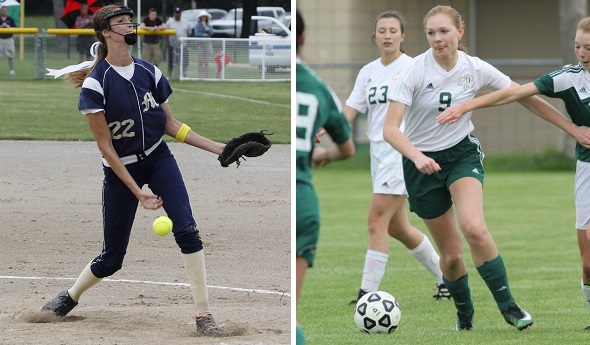
Mattawan’s Allie Havers experienced high school sports in part as a stepping stone to a scholarship and eventual national championship at the University of Nebraska.
 Hackett Catholic Prep’s Hope Baldwin earned two national awards and several scholarships for an essay on the role of high school sports in shaping her future.
But for both Kalamazoo-area athletes, high school sports had a much deeper impact than just national recognition.
Baldwin, who is not playing varsity sports as a freshman at University of Notre Dame, was an MHSAA Scholar-Athlete Award winner, received the National Interscholastic Athletic Administrators Association National Scholar Athlete of the Year award in Phoenix in December and will travel to Atlanta in April for the Coach Wooden Citizenship Trophy.
She wrote the essay while a senior at Hackett and, looking back, she said, “When I wrote that essay, I think it was probably March of my senior year. Now, being in college and not being involved in those athletics any more has given me the opportunity to appreciate them even more.
 “Reading my speech and being able to look back on how I was writing from that perspective still in high school, I was like, ‘Oh my gosh.’ I knew it was important then, but now not having it any more I realize even more what a benefit high school sports are.”
The lasting impression for both athletes is not a specific game or highlight, but “mostly I miss my teammates and coaches,” Baldwin said.
“In each season, coming in every day to practice with the same people really made unique bonds because we were all working toward the same goals.”
Havers, who was first-team all-state in three sports at Mattawan, said looking back, it’s the people who made the deepest impression.
“I remember the people, the coaches, my teammates and the seniors who were on the team my senior year,” she said. “I look back, and it was a pretty cool experience. I’m really humbled.
“I didn’t do it by myself. I had help from my parents, siblings, coaches and teammates.”
Words of wisdom
Baldwin was stunned when her essay won for the state of Michigan and then for her NIAAA section (Michigan, Wisconsin, Iowa, Illinois, Indiana).
She then was chosen as the female national award winner, earning a $2,500 scholarship in addition to a plaque.
Among points she emphasized were the following:
- “Sports have taught me valuable time management skills.”
- “I learned … how to deal with disappointment gracefully, an ability I will carry with me in the years after high school.”
- “Developing a mindset of good sportsmanship has enabled me to look beyond winning or losing. … I realize a disappointing experience is still worthwhile.”
- “I broke my collarbone in a soccer game and had to undergo surgery. … I learned how to lead my team from the bench.”
She added that although most enjoy the thrill of competition, “the true value of athletics lies in the transformation off the court. That is, in the time management, leadership, work ethic and teamwork skills that are carried in one’s character beyond sports and beyond high school.”
Baldwin, who is majoring in neuroscience and behavior with a pre-med concentration, said she chose Notre Dame for academics rather than attending a smaller school where she might have played sports.
While she played four years of volleyball, basketball and soccer at Hackett, that drive for competition has not completely left her.
“I’ve been doing some intramural sports, which is really fun,” she said. “Sand volleyball, basketball and our dorm had a flag football team. We actually ended up making it to the championship and we got to play in the Notre Dame football stadium, so that was really cool.”
Succeeding, switching, succeeding again
Havers had no doubt she would be playing college sports after an outstanding career in basketball, volleyball and softball at Mattawan, graduating in 2013.
She earned a basketball scholarship to University of Michigan but when the coach left, she de-committed and eventually ended up with the Cornhuskers.
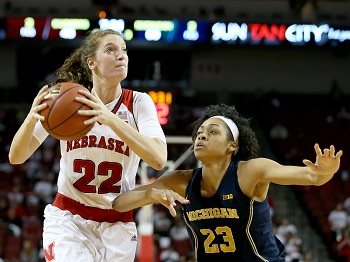 The transition from high school to college hoops was an eye-opener.
“I had to catch up to the game,” Havers said. “In college, the girls are a lot bigger, a lot stronger, a lot faster and more physical. I knew the girls at post, my position, were a lot stronger than me.
“I came in at (6-foot-4) 140 pounds, and most others in the post position were 180 to 200 pounds.”
Her practice schedule was also different.
In high school, the team practiced about two hours a day.
But in college, “We practice four hours and on the court just about every day,” Havers said. “You have school work, lifting, meetings, tutors. You will definitely come out with great organization skills.”
After playing four years of basketball at Nebraska and graduating with a degree in psychology, Havers knew she did not want to give up competition in a college atmosphere.
“I had a fifth year of eligibility left but not in basketball, so I went out for the volleyball team,” said Havers, who is working toward a master’s degree in journalism and mass communications. “I knew if I didn’t try, I would regret it. Nebraska is a volleyball dynasty.”
She was faced with a situation unfamiliar to her.
“I played every basketball game, but I played just two volleyball games,” she said. “It was a lot different. I was used to playing a lot in basketball and all through high school, too.”
“No athlete likes sitting the bench, but you learn your role and you go with it. I feel really blessed for the opportunity and knew I had to work hard for a spot.”
The payoff was the NCAA National Championship when Nebraska defeated Florida in the four-set final Dec. 16.
Even though her college eligibility is gone, Havers, who hopes coach once she graduates, is still playing sports at the intramural level.
“Beach volleyball is a college sport at Nebraska,” she said. “It’s a three-month season with an indoor court.”
Havers' advice for high school athletes is: “Go in with an open mind, go in with heart and leave nothing on the table. Go to practice earlier and stay later.
“Coaches promise you anything, but that’s not always the way it goes. You have to go with the flow.”
 Pam Shebest served as a sportswriter at the Kalamazoo Gazette from 1985-2009 after 11 years part-time with the Gazette while teaching French and English at White Pigeon High School. She can be reached at [email protected] with story ideas for Calhoun, Kalamazoo and Van Buren counties.
PHOTOS: (Top) Mattawan’s Allie Havers, left, and Kalamazoo Hackett’s Hope Baldwin enjoyed outstanding high school athletic careers. (Middle) Baldwin, top, and Havers. (Below) Havers went on to play both basketball and then volleyball at Nebraska. (Basketball photo courtesy of Nebraska’s athletic department; soccer photo courtesy of Hackett’s girls soccer program.)
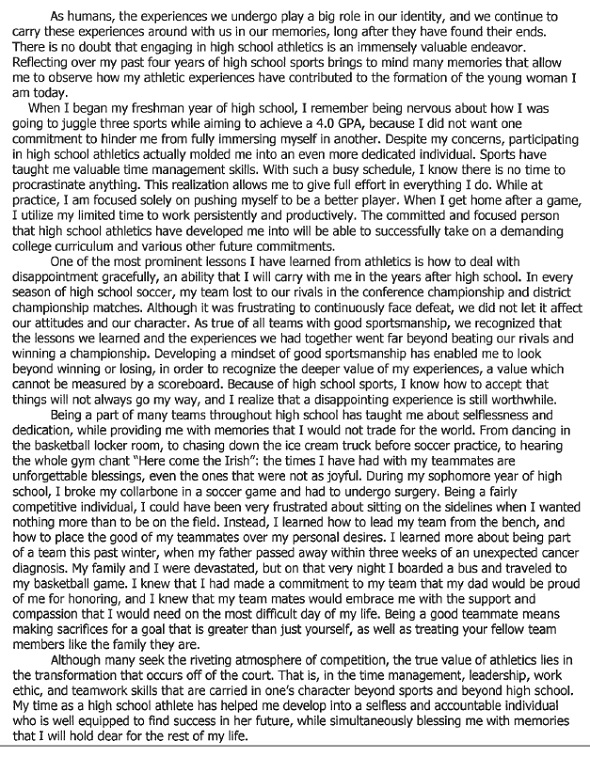
ESSAY: See the full text of Baldwin’s essay below that contributed to her selection as an NIAAA Scholar Athlete winner for 2017.

7 Sleeping Tips for Student-Athletes
November 5, 2019

Henry Ford Health System
Many athletes seem to believe time spent not training is time wasted. But, on the contrary.
The time athletes spend resting and sleeping is actually just as important. Take the world’s best female skier, Mikaela Shiffrin, for example. Shiffrin reportedly not only sleeps nine hours each night, but naps at least an hour every day.
So, what does sleeping have to do with her success? When asleep, the body not only has time to recover, but the information that was taken in during the day goes from short-term memory and becomes long term.
“Being an elite athlete is a 24-hour profession, and sleep and recovery are integral to optimal performance,” says Meeta Singh, M.D., a sleep medicine specialist at Henry Ford Health System.
Here are seven tips to help your student athlete catch some Zzzs during the season:
1. Limit caffeine. Caffeine is a popular ingredient in many pre-workout drinks, and many athletes choose to use it for an energy boost. However, having caffeine late in the day may make falling asleep and staying asleep difficult. But, everyone reacts differently to caffeine, so athletes should try logging their intake to determine what time to stop consuming and how much is okay to consume.
2. Maintain a regular sleep schedule. The body has an internal clock that’s largely affected by environment. Going to bed and waking up at approximately the same time each day can add a natural rhythm to the body’s internal clock, which can cause people to feel more awake during the day and fall asleep easily at night.
3. Workout early. Often times, working out later in the day gives people a burst of energy that can keep them up late into the night. For example, exercising after 9 p.m. can boost body temperature, making sleep difficult. However, research shows morning workouts can help achieve deeper sleep, and working out in the afternoon can help reduce insomnia.
4. Unplug. Nothing can keep one up at night like a buzzing smartphone. Additionally, the blue light a phone emits may slow the production of melatonin, making sleep difficult. Advise your children to leave electronics out of reach while they’re sleeping. And as an added bonus: If their phone is their alarm, it will force them out of bed in the mornings.
5. Use essential oils. Essential oils have seen growing popularity in recent years, and this is in part because scent helps trigger memory. Oils can be diffused, rubbed on temples or drops can be spread on pillows. Popular oils for promoting sleep are lavender, valerian root and roman chamomile.
6. Focus on breathing. Focusing on breath can help steady heart rate and relax the body. A popular breathing technique is the 4-7-8 exercise, in which one inhales through the nose for four seconds, holds their breath for seven, and exhales for eight.
7. Keep it dark, cool and quiet. Having the right environment is an important part of falling asleep … and staying asleep.
Ultimately, when it comes to enhancing athletic performance, getting proper sleep, resting and recovering can be just as important as training or hitting the gym.
“Since sleep can modulate reaction time and accuracy, it’s important to ensure an athlete gets his or her Zzzs,” Dr. Singh says.
See also: Is Your Teen Sleep Deprived?
Want to learn more? Henry Ford Health System sports medicine experts are treating the whole athlete, in a whole new way. From nutrition to neurology, and from injury prevention to treatment of sports-related conditions, they can give your athlete a unique game plan.
Visit henryford.com/sports or call (313) 972-4216 for an appointment within 24 business hours.