

Specialization Not the Only Pathway
April 21, 2015
 By Eric Martin
MSU Institute for the Study of Youth Sports
Specialization is not a new topic facing athletes and parents.
In a 1989 study by Hill and Simons, athletic directors indicated that the three-sport athletes of the past were being replaced by athletes who only participated in a single sport. Multiple athletic directors indicated that the decrease of multi-sport participation was a concern for all involved in the sport environment as increased emphasis on sport specialization was not in the true vision of high school sports.
Even though the distress concerning sport specialization is not a new topic, the rise of club sports and year-round travel teams have increased the number of youth athletes who are forced to make a choice between playing multiple sports or focusing their time and training efforts solely on one sport. The decision to focus solely on one sport sometimes is done by athletes (or their parents) who believe that quitting other sports is the sole way to earn a coveted college scholarship.
However, even though counter intuitive, sport specialization may be hampering their pursuit to play at the next level.
Elite level achievement in sport is rare, with statistics showing that only 0.12 percent of high school athletes in basketball and football eventually reach the professional level. To combat these odds, many in popular media including Malcolm Gladwell have forwarded Anders Ericcson’s proposal that to become an expert in a field, an individual must accumulate 10,000 hours of practice.
To achieve this aim, many parents and athletes disregard other sports believing that extra exposure to a single sport may result in accumulating these hours quicker and increase an athlete's chances of elite skill achievement. Reducing the achievement of sport excellence to solely practice hours overlooks the importance that developmental, psychosocial, and motivational factors play in the achievement of high level success in youth. Further, several research studies have found that elite athletes typically fall short of this 10,000 hour milestone.
Simply accumulating a magic number of hours does not guarantee sport success, and in fact, trying to accumulate these hours too early can lead to many different negative outcomes for youth.
Sport specialization has been shown to have a variety of negative physiological and psychological outcomes for youth athletes. Typically, athletes who specialize in one sport play that sport year-round with little or no offseason. In these cases, athletes who continually perform repetitive motions such as throwing or jumping can experience overuse injuries that can range from tendinitis to torn ligaments.
In addition to the increased risk of injury, youth who specialize and play a single sport year-round are at risk for psychological issues as well. Youth who play a single sport are less likely to allow for proper recovery and face the increased chance of burnout or decreases in motivation that may result in leaving sport entirely. Additionally, as practice time demands and multiple league involvement increases, youth may feel added pressure to succeed due to the increased time and financial costs incurred by parents.
Finally, youth who specialize early in only one sport do not develop the fundamental motor skills that help them stay active as adults, instead only developing a very narrow skill set of a single sport.
If the dangers of sport specialization do not encourage multisport participation, a majority of studies have shown that sport specialization does not increase long-term sport achievement. In fact, most studies indicate that athletes who reach the highest level of sport achievement typically played a variety of sports until after they were well into high school.
For example, a study with British athletes found that youth who played three or more sports at the ages of 11, 13, and 15 had a significantly higher likelihood of playing on a national team at ages 16 and 18. These athletes had a more rounded set of skills, were more refreshed for their chosen sport, and were more psychologically and emotionally ready to perform due to their experiences in a number of sports.
A study recently conducted by the Institute for the Study of Youth Sports with collegiate athletes showed similar results as the British athlete study. In the ISYS study, 1,036 athletes from three Division I universities were asked to report their past youth sport participation. On average, youth participated in three or more sports in elementary and middle school. The number of sports youth participated in decreased with each year of high school, but even with the decrease of participation, a larger number of individuals played more than one sport during every year of high school including senior year than those who played a single sport.
Even though a majority of athletes did play at least two sports throughout high school, several athletes did indicate that they specialized in one sport indicating that there are multiple pathways to elite sport achievement.
Athletes were also asked for their perception of how important it was to specialize in one sport in order to earn a college scholarship. On a scale of 1-9, athletes felt that specializing in one sport prior to high school was neither important nor unimportant (4.97).
Sport specialization is not a new issue, but that does not minimize the damage that can occur if athletes are overtaxed early in their development. Each athlete is unique, and each situation requires care. If an athlete does decide to play in only one sport, the decision should be made in regards to the athlete’s interest and development, not just in the pursuit of a college scholarship. Additionally, if athletes specialize in one sport, it is critical to understand that youth are developing and proper recovery is critical both physically and psychologically.
Early specialization in sport is an issue that is not going to go away, but for coaches, parents, and athletes this decision should be made with a long-term perspective and with the athletes’ long-term well-being central to the choice.
Martin is a fourth-year doctoral candidate in the Institute for the Study of Youth Sports at Michigan State University. His research interests include athlete motivation and development of passion in youth, sport specialization, and coaches’ perspectives on working with the millennial athlete. He has led many sessions of the MHSAA Captains Leadership Clinic and consulted with junior high, high school, and collegiate athletes. If you have questions or comments, contact him at [email protected].
Mason, Okemos Score for a Cure
By
Geoff Kimmerly
MHSAA.com senior editor
November 11, 2014
Three weeks remain in the MHSAA’s 2014 fall season, and we’ve collected a few notes to pass along as we wind down the final three sports before moving inside (except for skiing) for the winter.
 Below are an update on a fundraising game we previewed earlier, plus recognition for perfection at our Girls Golf Finals and another high honor for one of the top players in MHSAA volleyball history.
Score for a cure
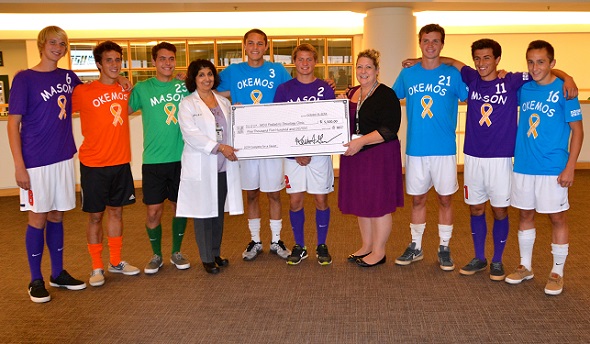
We wrote in September about an upcoming soccer game between Lansing-area powers that would raise money for pediatric cancer research. The “Compete for a Cause” game between Okemos and Mason on Sept. 13 was the third of what has become an annual event started by Mason’s team and coaching staff.
Attendance for this season’s game was nearly double the year before, and funds raised increased more than 500 percent.
The final tally: Roughly 1,400 fans attended the game, which raised $11,000 that was split between the CureSearch for Children’s Cancer national foundation and the Michigan State University Pediatric Oncology Clinic.
The first “Compete” game in 2012 raised $1,000, and the 2013 game drew 800 fans and raised about $2,000. This fall, Okemos was ranked No. 1 in Division 1 and Mason No. 7 in Division 2 when the game was played; it ended in a 1-1 tie. Both went on to postseason success – Okemos advanced to a Regional Final, and Mason fell to eventual Division 2 champion East Lansing in overtime in their Semifinal.
Only one shot needed
 It’s a rarity – most of the time. But for the second straight season, a player at the MHSAA Lower Peninsula Girls Golf Finals sunk a hole-in-one.
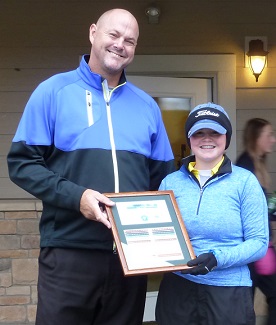
Grosse Pointe South’s Lucy Buzolitz aced the par-3 No. 12 at Bedford Valley in Battle Creek, dropping the shot from 97 yards out during the first round of Division 1 play. Buzolitz was one of two individual qualifiers from her team and shot a 92-97-189 for the two-day tournament.
At the 2013 Division 2 Final, Fenton then-sophomore Madison Shegos aced the par-3 18th hole at Michigan State University’s Forest Akers East.
Sportswoman of the Year
Former Leland and Penn State University volleyball standout and current U.S. national team setter Alisha Glass was a finalist for 2014 Team Sportswoman of the Year at the 35th Salute to Women in Sports gala in October in New York City.
The event, put on by the Women’s Sports Foundation, annually recognizes a Sportswoman of the Year for both individual and team sports based on nominations by sport governing bodies and the public. Glass was one of 10 candidates this year for the team award after being named USA Volleyball Indoor Female Athlete of the Year in 2013. She also was named International Federation of Volleyball’s best setter at the 2014 World Championship in Italy after helping the United States to the title.
Olympic gold medal-winning ice dancer Meryl Davis received the Sportswoman of the Year team award, while the individual award when to gymnastics all-around world champion Simone Biles.
PHOTOS: (Top) Members of the Mason and Okemos boys soccer teams present a check for $5,500 to the MSU Pediatric Oncology Clinic and Dr. Renuka Gera last month. (Middle) Lucy Buzolitz receives a plaque recognizing her hole-in-one at the Division 2 Golf Final from Bedford Valley head pro Dean Kolstad.