

1971: MHSAA Launches 'Big One' for Baseball
June 13, 2016
By Ron Pesch
Special for Second Half
“It’s a big one,” said state director of athletics Al Bush, when asked about organizing the Michigan High School Athletic Association’s inaugural baseball tournament back in January 1971. “The idea has been under study for more than three years.”
After discussions with the MHSAA Representative Council, in mid-December a committee of seven coaches from various parts of the state gathered and built the framework for the tournament, according to Associated Press reports.
Still ranked among the Top 10 all-time fall classics, the Detroit Tigers’ 1968 World Series victory over the St. Louis Cardinals meant interest in the national pastime was on the rise in Michigan.
Bush noted that about 650 Michigan high schools had sponsored baseball in 1970, and that plans for organizing the pending tournament were much like those for basketball, with Districts and Regionals. Circulars sent out by the MHSAA asking about planned participation indicated nearly 500 schools intended to play in the tournament. As in other sports, except basketball, plans were to host separate tournaments for the Upper and Lower Peninsula due to weather conditions experienced above the Mackinac Bridge.
While a number of cities in the past had hosted baseball tournaments where schools from around the state had been invited to participate, the MHSAA had never previously sponsored a statewide tournament. Perhaps the most well-known was one hosted in Battle Creek for about 10 seasons in the 1940s and 1950s.
In April 1971, Districts were announced, with qualifying round play scheduled for May 17-27 and Pre-District contests planned for May 29 that would allow the field of teams to be cut to four for the Districts. A total of 594 teams entered the Lower Peninsula tournament. The Finals for all classes were scheduled for June 19.
“I think you could draw it out of a hat and call a certain team a favorite, and you’d be correct,” said MHSAA Associate Director Vern Norris 45 years ago when discussing the uncharted territory of that first tournament. “There’s just no basis for comparison. I think we can say the teams competing Saturday are the cream of the crop, although in any tourney competition some good teams are eliminated early.”
“Overall, we’ve been very pleased,” he continued. “No. There haven’t been any major problems. The umpiring has been good and the support from the schools excellent. The person who really helped us out was the weatherman.”
 All 48 Regional games were played without a hitch. In years past (and in years to come), weather had played havoc with previous tournaments.
Four sites were used for the games. Class A was played at Wyandotte Memorial Field, while Class B was hosted at Battle Creek Central. Class C contests were scheduled at Marshall High School with Class D at Central Michigan University’s Alumni Field in Mount Pleasant. Semifinal games were scheduled for 10 a.m. and 12:30 p.m., with finals scheduled at 3:30 p.m. at each location.
The Detroit area emerged with three of the four titles, with games played beneath hot and humid weather.
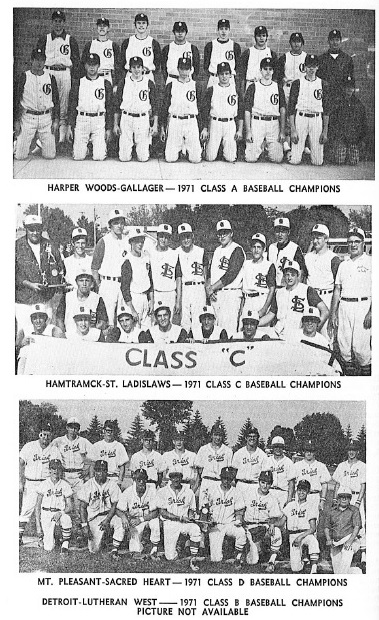
Jim Saad, recruited to Colorado State to play football, smacked a 355-foot two-run homer to left field in the opening inning of the Finals as Harper Woods Bishop Gallagher blanked Royal Oak Kimball 3-0 before 1,200 fans for the Class A crown. Greg Boos tossed a two-hitter for the Lancers, striking out 10 along the way. It was the first of three Class A baseball titles won by Gallagher and their coach Jim Bresciami, who would lead his teams to 545 wins between 1965 and 1985. The Detroit Catholic League’s First Division East champion, Gallagher finished with a 32-5 record on the year. Right-hander Boos ended the season with an 11-2 mark.
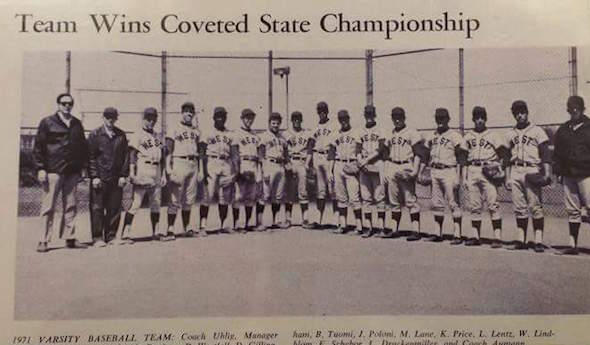
Detroit Lutheran West posted 24 wins against a single defeat, scoring a 4-1 win over Pinconning for the Class B title. A bases-loaded single by Fred Schebor in the fifth inning brought in two runs to break open a 1-1 tie. Bill Lindblom was responsible for West’s other two runs, driving in runners with a single in the second inning and a double in the sixth. Junior Leon Druckenmiller struck out six and scattered six hits for the Leopards for the win. Earlier in the day, John Paloni struck out 18 batters in West’s 3-0 Semifinal win over Wayland.
Hamtramck St. Ladislaus took advantage of a pair of third inning errors, scoring two runs in the team’s 3-0 win over Dearborn Sacred Heart. Tom Crepeau pitched a four-hitter and struck out seven, while Paul Janas led the victors with two singles and a double in the Final. The win avenged a pair of nonleague losses to Sacred Heart during the regular season. Rick Radzinski pitched a two-hitter and drove in three runs in Ladislaus’ 7-1 Semifinal win over Sanford-Meridian.
Managed by 1952 alumnus Jim Powell, Mount Pleasant Sacred Heart rebounded from an early 8-1 deficit in its Semifinal game with Marion for a 16-12 win, gaining a birth in the Class D championship game against Portland St. Patrick. The Irish’s Roger Therman then pitched a four-hitter in a 5-1 win over St. Patrick.
To the north, with its later thaw, the high school baseball season continued to revolve around summer American Legion baseball but also two U.P. high school leagues: the Eastern Upper Peninsula High School Baseball League (EUP) and Western Upper Peninsula High School Baseball League (WUP). In its 14th year of operation, the WUP saw Ironwood post an 11-1 record against six league opponents to earn the 1971 league championship, while Rudyard repeated as champs with a 12-4 season in the nine-team EUP.
Today, the U.P.’s most famous baseball player remains Kevin Tapani, a 1981 graduate of Escanaba, who pitched for 13 years in the Major League. Tapani quarterbacked the Escanaba Eskymos to the MHSAA Class A football title in 1981, yet never threw a pitch for his high school because of the weather.
Forty-five years later, Mother Nature continues to influence baseball in the Upper Peninsula – although over time Upper Peninsula schools began taking part with those from the Lower Peninsula in a statewide MHSAA Tournament. The first U.P. team to make the Semifinals in baseball was Sault Ste. Marie in 1988.
This season, 21 Upper Peninsula schools sponsored varsity baseball teams, as gradually some have brought back programs long in hibernation – Gladstone, for example, made the Division 3 Semifinals in 2014 after bringing back a baseball program the year before that hadn't played since 1959.
 Ron Pesch has taken an active role in researching the history of MHSAA events since 1985 and began writing for MHSAA Finals programs in 1986, adding additional features and "flashbacks" in 1992. He inherited the title of MHSAA historian from the late Dick Kishpaugh following the 1993-94 school year, and resides in Muskegon. Contact him at [email protected] with ideas for historical articles.
PHOTOS: (Top) Detroit Lutheran West stands together for a team photo; it won the inaugural Class B title. (Middle) Champions of the first MHSAA Tournament, in 1971, included Harper Woods Bishop Gallagher, Hamtramck St. Ladislaus and Mount Pleasant Sacred Heart.
St. Mary's Standouts, More Michigan Stars Taking Major Steps in Pro Baseball Climb
By
Steve Vedder
Special for MHSAA.com
July 16, 2026
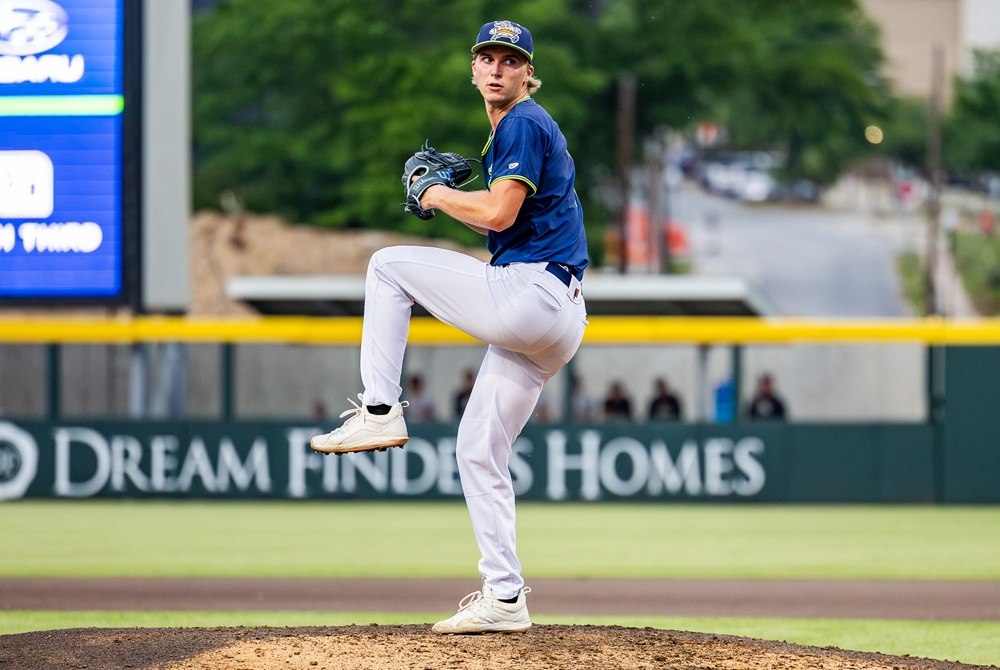
It took former Orchard Lake St. Mary's star Brock Porter three years to reach five professional baseball victories on the mound.
It's taken only four months for Porter to win five more.
Porter is one of four Eaglets from the 2019-22 MHSAA Finals champion clubs now navigating their way through professional baseball. The 2022 Mr. Baseball Award winner, now a 23-year-old right-handed pitcher, went a combined 30-0 with an ERA under a run per game for those three championship teams (with 2020 was canceled due to COVID-19) before being tabbed by the Texas Rangers in the fourth round of the 2022 MLB draft.
Injuries slowed his first three minor league seasons, and Porter didn't win any games over his first two in the Rangers chain. But a healthy Porter has taken significant steps forward this season with the High-A Hub City Spartanburgers (S.C.) with a 5-2 record, 3.56 ERA and 52 strikeouts over 43 innings and 13 games. Porter was actually 0-9 over his first two minor league seasons before going 5-1 a year ago with Hickory of the Class A Carolina League.
He said he doesn't feel rushed in moving up the Rangers minor league ladder.
"I still have time," he said. "The big goal for me is I want to move up throughout the chain. Things are going very well, I'm excited for the season. Health-wise, I feel very good. I still want to grow into the dominant pitcher I was in high school."
Porter's role within the organization has changed. While he started 28 games over first two seasons, Porter has transitioned to the bullpen, where he's pitched in a combined 54 games during last two summers.
His former Eaglets teammates also are winding their ways through the minors.
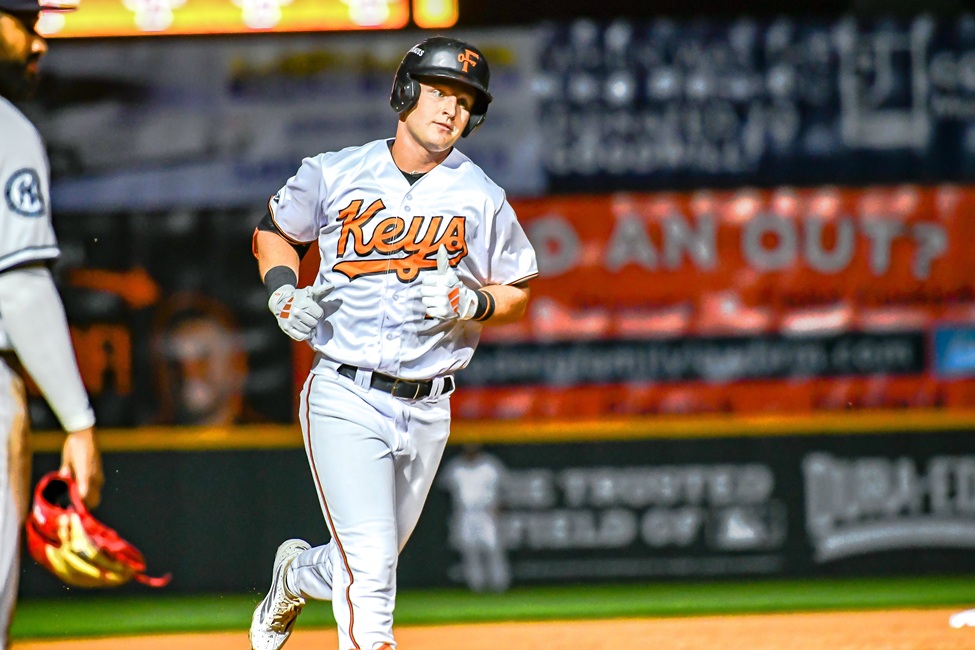 Among them, Ike Irish was one of two former Michigan high school baseball stars who played in Sunday's prestigious MLB Futures Games as part of the all-star festivities in Philadelphia. Irish, a first-round pick a year ago, has emerged as Baltimore's No. 2 prospect as ranked by MLB.com. He went 0-for-1 with a walk after starting the game as his team’s designated hitter. The other past Michigan prep star playing Sunday was Okemos’ Caleb Bonemer, a top prospect in the Chicago White Sox chain. He went 0-for-2 as the starting third baseman for the American League.
Irish, an outfielder who also can catch, has dominated High-A Frederick (Md.) with 12 homers, 15 doubles, 47 RBIs and 18 stolen bases while batting .264. Irish hit .230 in 20 games with Low-A Delarva (Md.) in 2025 after batting .350 with 39 homers over three years at Auburn University, where he was named an All-American as a junior.
Irish, who batted .427 and .450 with a combined 19 homers and 95 RBIs during his two seasons at St. Mary's, said his professional goals don't include obsessing over posting numbers.
"No, I just want to go out there and play," he said. "I don't care about numbers or hitting X number of homers. I would rather just go out and play."
In addition to Porter and Irish, former St. Mary's star Nolan Schubart has heated up at high-Class A Lake County (Ohio) of the Midwest League. A Cleveland Guardians prospect, Schubart was named last Monday as the league's Player of the Week after hitting three homers with 12 RBIs and 20 total bases. The former third-round draft pick is now batting .248 with 67 RBIs in 69 games with a 37-game on-base streak.
The fourth former St. Mary's player in the minors is infielder Alex Mooney, the 2021 Mr. Baseball Award winner. Mooney is batting .203 with 36 RBIs and 18 stolen bases in 22 attempts with Double-A Akron (Ohio). Mooney was taken by the Guardians in the seventh round of the 2023 draft out of Duke. He started his professional career as a shortstop, but has branched out to playing 27 games at second base and 17 at third this season.
Mooney said playing at the Double-A level has been an adjustment.
"It's a tough place," he said. "I'm not really a huge stats person; I just take it day-by-day. When you're playing 140 games a year in the minors you just try to get better every day. That's the mindset. You just try to get better and win the battle in the war."
A fifth member of the 2021-22 Orchard Lake St. Mary's teams will have a shot at professional baseball. Former Eaglets pitcher Nolan Higgins was taken by the Toronto Blue Jays in the fifth round of Sunday's MLB draft.
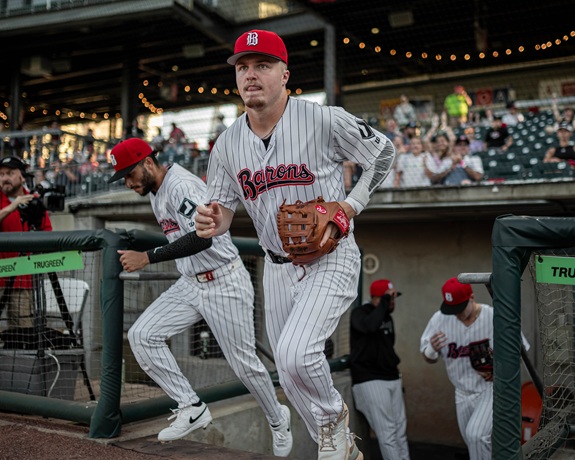 Meanwhile, Okemos’ Bonemer has been in the national spotlight twice over the first four months of this minor league season. A member of the coaches association all-state Dream Team as a high school senior in 2024, he gained a painful national notice May 5. The New York Yankees' all-star pitcher Gerrit Cole, while rehabilitating from an injury with Hudson Valley (N.Y.), surrendered a homer and single during Bonemer’s first two at bats, then drilled the Chicago White Sox prospect with a 97-mph fastball to the shoulder. The move incensed White Sox fans, who believed Cole was trying to send Bonemer a message after banging out the two hits.
Bonemer not only survived, but has thrived. He hit .238 with High-Class A Winston-Salem (N.C.) to start this season, but slammed 18 homers and 15 doubles along while totaling 43 RBIs and 10 stolen bases. That earned him a promotion to Double-A Birmingham (Ala.) where he's off to fast start with a .279 average, three homers and 11 RBIs over his first 17 games.
Four other former Michigan prep stars have had active professional seasons. Outfielder Dante Nori, who helped Northville to the 2024 MHSAA Division 1 championship, has built on his rapid start this spring when he batted .400 for Italy in March's World Baseball Classic. A member of the all-state Dream Team as a senior at Northville, Nori is batting .245 at Double-A Reading (Pa.) in the pitching-heavy Eastern League. Nori has 12 stolen bases and 11 doubles.
Former Saginaw Swan Valley infielder Mitch Jebb has played in 20 games at Double-A Altoona (Pa.) and Triple-A Indianapolis in the Pittsburgh Pirates’ system, batting .273 with eight RBIs. A 2018 all-stater at Swan Valley, this is Jebb's fourth season in the minors after batting .327 in 147 career games at Michigan State.
Howell native and the state's 2017 Mr. Baseball, Sam Weatherly, is playing his fifth year of professional baseball. Weatherly is 1-3 in 23 games at Double-A Hartford (Conn.) of the Eastern League, a Colorado Rockies affiliate. He's struck out 34 batters in 28 innings.
Jeff Criswell from Portage Central is still recovering from Tommy John surgery a year ago. A member of the 2019 NCAA runner-up Michigan club, Criswell was called up to the Rockies for two games during the second week of June. He's divided time between three levels this season, with a 2-1 record and 6.86 ERA over 19 games and 29 strikeouts in 21 innings. In 2025, he pitched in 13 games for the Rockies with a 2.75 ERA before the surgery.
PHOTOS (Top) Orchard Lake St. Mary’s grad Brock Porter delivers a pitch for the Hub City Spartanburgers this season. (Middle) Ike Irish runs the bases for the Frederick Keys. (Below) Caleb Bonemer takes the field for the Birmingham Barons. (Porter photo by Becca Torncello/Hub City Spartanburgers. Irish photo by Robert Kimble. Bonemer photo courtesy of the Birmingham Barons.)