

Brighton Names Baseball Field for Program Builder, Longtime Leader
By
Tim Robinson
Special for MHSAA.com
May 4, 2023
BRIGHTON — Mark Carrow didn’t know what to expect April 22 when he arrived at Brighton High School’s baseball field, where he was the guest of honor for a ceremony officially naming it Carrow Field.
 “I remember back in October, when they announced this would happen, I told my wife, Mary, that there will be probably 60-70 people here, because there are 18 players on each team and their parents,” he recalled. “We pulled up here and there were all these people, and these young men who look older now.”
Dozens of Brighton alumni, some of whom Carrow hadn’t seen since their high school days nearly a half-century ago, were in attendance for the ceremony held before a doubleheader with Ypsilanti Lincoln.
Carrow retired in 2006 after 34 seasons as Brighton’s baseball coach, recording 823 wins, now eighth on the state’s all-time list. He also was an assistant football coach and coached both boys and girls middle school basketball.
He came to Brighton a year after graduating from the University of Michigan, where he played baseball for the Wolverines, starring at third base.
“My dream was to coach baseball at Ann Arbor High,” Carrow said of his high school alma mater, now Ann Arbor Pioneer. “That was my dream.”
But he had applied to Brighton Area Schools as well, and after a year teaching in Grand Rapids, he and Mary both were offered teaching positions.
“Wouldn’t you know it? We were in school for two days and Ann Arbor calls me up,” Carrow said. “They had a phys ed job open. I’d have been the JV football coach, and I knew the baseball coach was on his way out. It was everything I wanted, and I went to (administrator) Bob Scranton and said, ‘Here’s what’s happening.’ He told me to think about it over the weekend and come back Monday.
“My wife and I talked it over, and we were so grateful to Brighton for giving us a chance to be near our hometown that we felt we owed them a year,” Carrow said. “In November, we bought a house that we lived in for 22 years.”
Brighton’s sports teams weren’t the dominant squads of today. The football team had had two winning seasons in 20 years, and the year Carrow arrived went 0-9.
“We played in six homecoming games, including our own,” he said. “Everyone wanted to play us.”
The baseball team wasn’t much better, having gone decades without a winning season.
But the Bulldogs were 12-12 that first spring under Carrow’s leadership, and never finished below .500 during the rest of his tenure.
 The Bulldogs joined the Southeastern Conference the next year and got off to a 7-0 start before losing at Lincoln.
“The kids were crying on the bus ride home,” Carrow said, “and I knew right then that Brighton had turned a corner, that it meant something to win and losing wasn’t acceptable anymore.”
Brighton took off, winning 20 games or more in all of his last 23 years as a coach, and a total of 13 league titles, 12 District titles, three Regional crowns and while making two trips to the Semifinals.
The talent was there, too, including 16 all-state players and two Mr. Baseball Award winners in Ron Hollis and Drew Henson.
Carrow earned national and Michigan Coach of the Year honors three times apiece and was inducted into the Michigan High School Baseball Coaches Hall of Fame in 1992.
The field was renamed in his honor after the Brighton school board changed its policy to allow the renaming of facilities to honor living persons less than two years ago.
But Carrow is quick to cite the reasons for his success.
“The players are the ones who made this possible,” he said. “I mean that from the bottom of my heart. I never threw a pitch or hit the baseball. I got 800 wins, but it was because of them.
Carrow has a photographic memory, which came in handy while chatting with former players.
“It was funny, because with each kid I remembered an incident about them,” he said. “Jeff Bogos, who I hadn’t seen since he graduated in 1979, came out and I said, ‘Do you remember when we were at Milan and your knee went out (of place) in the middle of the field?’ It happened twice. He said, ‘How do you remember that?’ And I said, ‘How could I not?’”
Carrow moved to Florida after his retirement, where he and his longtime assistant, George Reck, meet up a couple of times a week. He makes frequent trips north to watch U-M football and to visit his son, Chris, who lives in Chicago.
Baseball is firmly in his past.
“I think I’ve been to one high school game since I went down there,” Carrow said. “I hated the way the coach was coaching, and Mary did, too. She said, ‘We don’t have to watch any more high school baseball,’ and I said, ‘You’re right.’”
When he retired, Carrow said he would likely be forgotten in a few years.
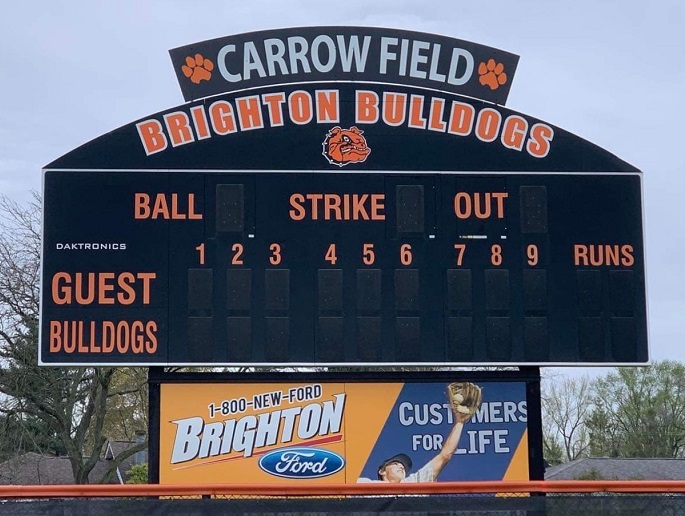
Seventeen years later, his legacy is assured and his memory will be invoked any time one looks at the scoreboard in left-center field that has a “Carrow Field” sign on top of it.
Not bad for a coach who was in the right place at the right time.
“My dream was fulfilled, and rightly so,” Carrow said. “And, believe me, I made the right decision. I couldn't have had better kids to teach or lived in a better community. It couldn't have worked out any better.”
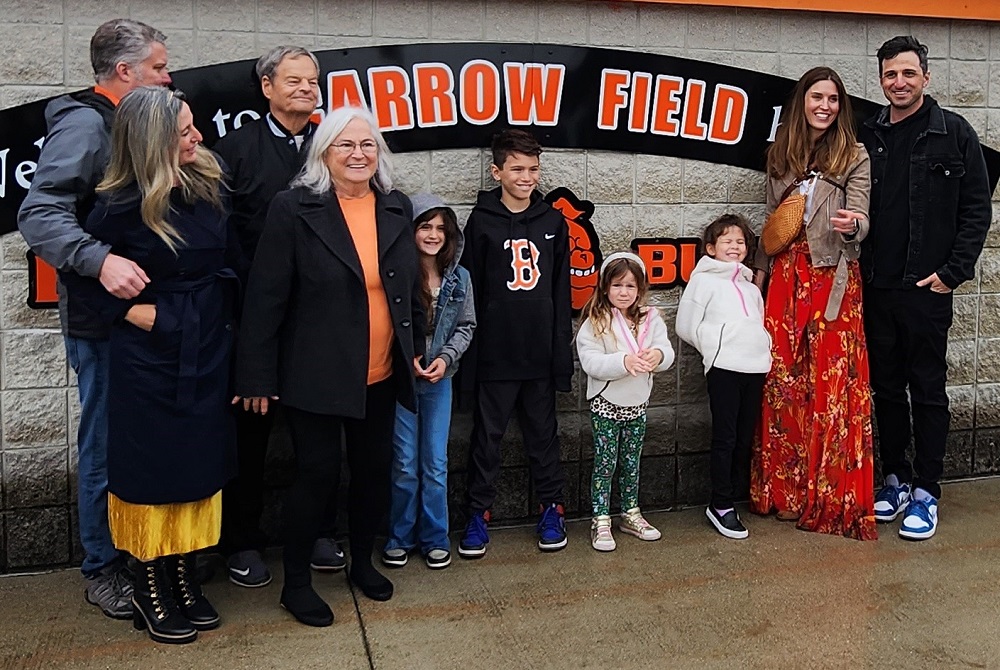
PHOTOS (Top) The Carrow family stands together in front of the welcome sign to Carrow Field – including daughter Tiffany (front left), Mark and Mary (second from left, front and back) and son Chris (far right). (Middle) The Carrow name stands tall atop the scoreboard at the field named for the longtime coach. (Family photo by Daniel Collins.)
Senior-Powered Spring Lake Answering Anticipation, Pursuing High Expectations
By
Dean Holzwarth
Special for MHSAA.com
April 29, 2026
SPRING LAKE – The time is now for the Spring Lake baseball team.
 With the return of 11 veteran seniors, the Lakers entered this spring with lofty expectations and an eye on an extended postseason run.
Anticipation has come to fruition in the form of a state ranking and a nearly perfect start.
“Our motto is we are going to worry about next year next year, and we are going to do all we can this year,” Lakers fourth-year coach Bill Core said. “We knew we were going to have a big experienced group coming back, and that's just how the roster folded out. We have a lot of experience, a lot of returners and pretty high expectations.”
Spring Lake, which finished as Division 2 runner-up in 2024 and won a conference title last year for the first time since 2014, is off to an impressive 13-1 start (9-0 in the Ottawa-Kent Conference Black) and has climbed to No. 7 in the latest coaches poll.
Core said the vast number of returners, which includes five players who will play in college next year, has paid early dividends.
“I think that’s been a big difference,” he said. “We’ve played some younger teams that were breaking in sophomores or juniors or new kids, and our guys were ready to go right from the start. It’s been an advantage early on.”
Senior starting pitchers Oliver Smies and Maddux Kipling believe the strong bond among the senior class has been a major factor in the torrid start.
 “I think something that’s really important about this team is our team chemistry and the amount of seniors we have on the team,” Smies said. “That alone allows us to have a ton of experience, and I think that's a big reason why we are off to such a hot start. We have been playing good team baseball and complementary baseball with good defense and good offense.”
Added Kipling: “We genuinely like being around each other, and every day we show up ready to get a little better. Our team has a real gritty and energetic identity, and I think that shows in how we compete and support each other.”
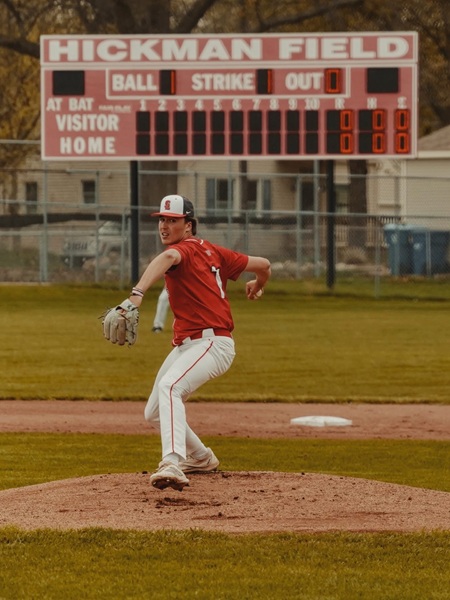
Kipling and Smies have been dominant on the mound this season. They haven’t allowed an earned run while combining for 80 strikeouts. Kipling earned a second-team all-state accolade as a junior and is headed to Michigan State next year. Smies will play at Calvin University.
“It starts with our pitching,” Core said. “Any time you are going to make a run, it starts with your pitching and we are pretty lucky, especially with our top two.”
Offensively, the Lakers possess a balanced lineup and boast a .330 batting average.
Senior Owen Smies, who will join his twin brother at Calvin, is hitting a team-best .432 with 13 RBIs. Seniors Alex Strauss (Adrian College) and Max Feltner (Muskegon Community College) are both batting .333 and have combined to score 25 runs.
As a team, Spring Lake has produced eight shutouts and nine wins by run differential.
“We got off to a good start, but we are going to play a lot better competition,” Core said. “This is a good week for us because we play Northview and state-ranked East Grand Rapids. We just picked them up, so we were excited to fill in the week with those two schools.”
Spring Lake is 62-6 over its last 68 games and trying to remain focused on each game as it attempts to erase the disappointment of last year’s early exit from the postseason.
 Despite winning 30 games, the Lakers suffered a 3-2 loss to Grand Rapids West Catholic in District play.
“I think there is some motivation there from that loss,” Oliver Smies said. “And I think that loss last year taught us that any team can beat any team, so you have to play your best baseball every single game no matter the opponent.”
Core said last year hasn’t been discussed, but believes it still sits in the back of his players’ minds.
“I think they think about that, but we've had quite a few mercies to start the season, and I said to them that when we get to the tournament it's going to be a one-run game and we are going to have to do the little things to make a difference because we are not going to win 14-0 all the time,” he explained. “We try to keep everyone in the moment.”
Kipling isn’t dwelling on the past – or looking too far ahead.
“As a group we’ve done a great job staying focused on the present and not getting caught up in the past or worrying too much about the future,” Kipling said. “My dad has always told me to focus on what you can control because putting energy into things you can’t control is a waste.
"That mindset has stuck with me, especially on the field. I try to live by ‘one pitch at a time,’ and because of that I haven’t really spent time thinking about last year’s loss. That’s behind us, and we’re just focused on what we can do right now.”
 Dean Holzwarth has covered primarily high school sports for Grand Rapids-based WOOD-TV for five years after serving at the Grand Rapids Press and MLive for 16 years along with shorter stints at the Ionia Sentinel and WZZM. Contact him at [email protected] with story ideas for Allegan, Kent and Ottawa counties.
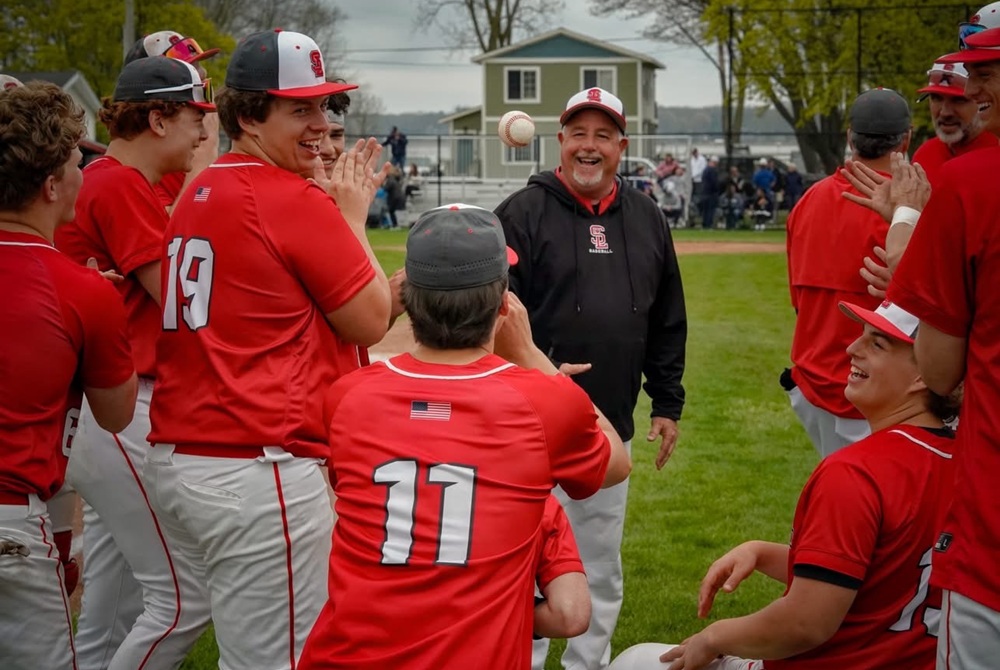
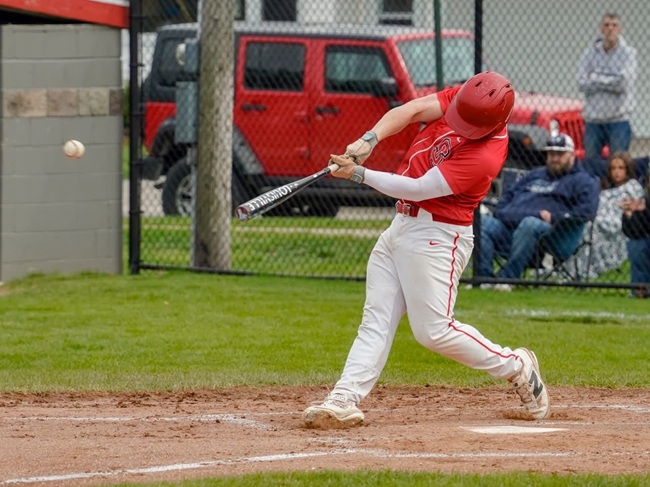
PHOTOS (Top) Spring Lake baseball coach Bill Core tosses Maddux Kipling his home run ball after a win over Fruitport. (Middle) Kipling pitching at Spring Lake's Hickman Field. (Below) Senior Oliver Smies connects with a pitch. (Photos by Trevor McCue/Grand Haven Tribune.)