

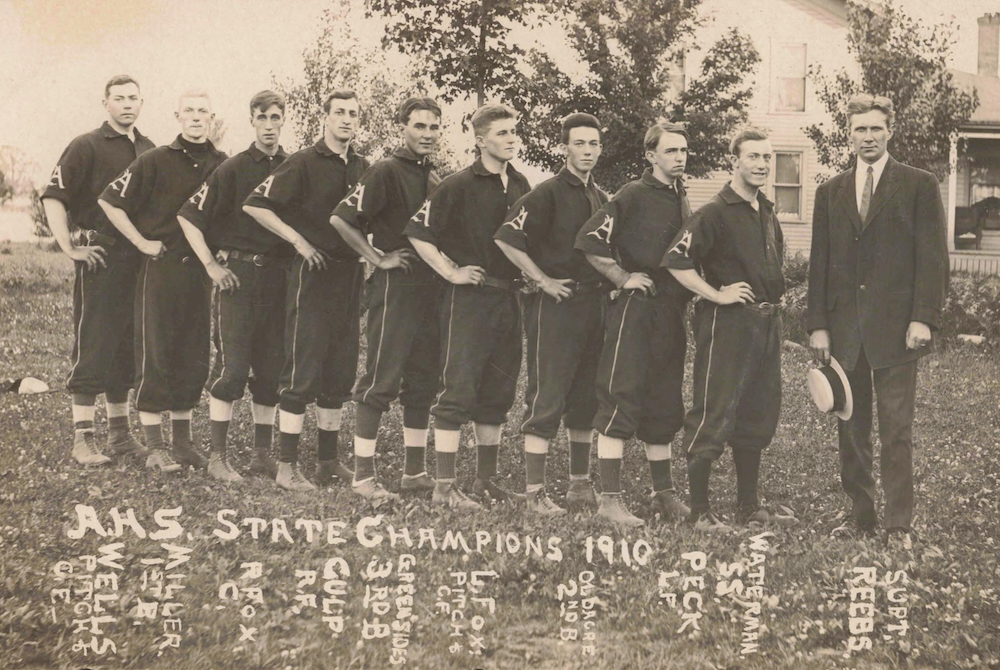
Century-Old Postcard Inspires Researcher to Tell Story of Athens Baseball Dynasty
By
Ron Pesch
MHSAA historian
June 25, 2026
Shortly after graduation from little Athens High School in 1969, Larry DeBow had the chance to head east for a three-day music festival. Held that August on a dairy farm in upstate New York, Woodstock attracted some 400,000 and became one of the most famous cultural moments of the 1960s.
“I didn’t know what it was and blew it off,” he recalled. “I’ve always regretted that.”
That fall, DeBow left the Calhoun County village south of Battle Creek and made his way to Western Michigan University in Kalamazoo. There, he crammed four years of education into three, then, starting in Tecumseh, began a 41-year career in industrial sales with various companies and bounced around the world.
He retired in 2013, took up photography, and started a small business. Unexpectedly, the trip east not taken decades ago, would influence what came next.
“In 2016 I added video when a friend and I decided to take a just-you-and-I road trip,” said DeBow, capsulating life’s path. Their destinations: Woodstock and the Baseball Hall of Fame.
“We were at Woodstock, and my friend Dave – he always talked like this – said ‘Dude, we gotta make a movie about this.’ So, I just started to snap pictures, and I used my iPhone taking video. Then I got home and go, ‘What am I going to do with this? I don’t know how to make a video.’ But on my computer was Movie Maker 7. I created my first video … I think it (runs) only about 10 minutes.”
Eventually, he found Movie Maker couldn’t keep up with his growing technology needs. Now a videographer and tinkering with AI tools, DeBow is ready to debut his latest work – a baseball documentary.
Subject Matter
Following the road trip, DeBow experimented with technology and posted short films to YouTube. In 2017, at the suggestion of another Athens graduate, John Royer, they started assembling material for 1969 – A Celebration of Accomplishment, a documentary initially shared at Larry’s 50th class reunion. The Indians had fielded two pretty good sports teams during DeBow’s senior year.
“John was a year behind me (in high school). He was on the track team … and was (one) of the four guys who still hold the mile relay record for the school. I was on the basketball team, although I was the 12th man,” recalled DeBow, laughing. “I was far from a star. We were the first team to win a Regional game in school history that winter. In the spring, the track team took second in the state Finals.”
Running 26 minutes in length, the finished video included interviews, snapshots, memorabilia, and some old family 8mm film footage from the state track meet.
DeBow followed the production up with another documentary on the Athens’ 2022 girls volleyball team, runner-up in Class D in the annual MHSAA Tournament. While digging around on that project, he came across a real picture postcard. It would set the stage for the current project.
A Baseball Dynasty
The image features members of a team riding on a horse-drawn wagon. Inscribed is, “Athens High School State Champions, 1910, Base Ball Team.”
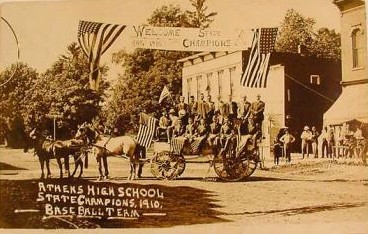 “Tom Doubleday doesn’t like the (professional) title,” states DeBow. “I give it to him anyway. He’s like the curator of the sports section at the Athens Area Historical Society. He asked, ‘Can we do something with this (to tell their story).’"
DeBow immediately recognized the challenge. “If this is all we’ve got, I can’t do anything with that.”
With Doubleday’s assistance they dug into the Society’s archives. The story grew. Intrigued, DeBow was quickly hooked. But this one would highlight the challenges and requirements needed to tell a story cast more than 100 years ago.
Sharing stories
For roughly 30 of the 45 years that I’ve delved into the history of high school sports, the vast majority of time was spent perched on a chair in a library, mostly in Michigan, occasionally somewhere in the Midwest, scrolling through the pages of microfilmed reels of newspapers and periodicals or scanning old school yearbooks, searching for data.
That frequently included trips from Muskegon to the State of Michigan Library in Lansing, where a warehouse of nearly pristine reels of microfilm is maintained for a majority of the state’s newspapers. Over the last 15 years, dramatic changes have allowed searchable scans of the nation’s newsprint to be moved online. Initially, it was a handful of smaller long-defunct publications. Today, the archives of most of the state’s largest dailies are now included in subscription databases, and the listings continue to grow.
One of the great joys of serving as the MHSAA historian is sharing knowledge and resources with sportswriters, coaches, players, school administrators – past and present. Often, individuals reach out, looking for information and guidance on projects on which they are working. Occasionally, we strike up friendships, mostly via telephone calls and email, where we each cheer on each other’s projects and share news of our successes and challenges. Sometimes we meet in person.
In February 2024, I received my first email from DeBow. With the subject line, “Athens Michigan HS 1907 thru 1918 Perhaps a Michigan Baseball Dynasty?”
A Cutout
Tapping into the collection of the Athens Area Historical Society, they found additional postcards and artifacts that would visually expand the lost tale from the early days of prep baseball, featuring an interesting cast of characters.
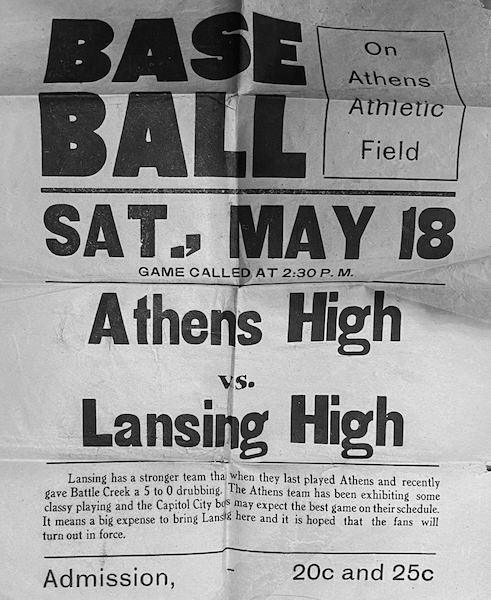 “They found some posters or bills saying Athens was playing North Adams, or Athens was playing Marshall or Athens is playing somebody,” recalled DeBow. “These would be displayed in store windows. There was a poster for (a) 1909 (championship) game with Mt. Pleasant. I don’t know where they found it … but it was literally cut off a wall. None of us had really noticed it before in the historical society. It could have slapped you right in the face because it was right on the side of a doorway going from one section (of the building) to another. I’ve got a lot of that stuff in the documentary.”
Hitting the internet with searches on high school baseball from the era, DeBow came across a list prepared by Kevin Askeland, a staff writer at MaxPreps.
Using research from multiple sources, MaxPreps has retroactively chosen national champions back to 1910, designed to recognize a single champion for each year. The compiled list is a consolidation of previous work produced over the years by various organizations and historians, according to Askeland. MaxPreps credits those individuals and expands on their work via research using modern day access to online newspaper databases that now allow deeper dives into the scanned recorded print history of cities, towns, and villages, with tools previously unavailable.
DeBow asked Askeland if the list was malleable. Askeland said it could happen but would require documentation and detail that strongly made a case for a change.
Contact
DeBow’s conversation with Askeland added a new dimension to his research and led to our connection.
Shortly after his email, we spoke on the phone. At the time, DeBow’s initial newspaper research was limited to the Athens Times microfilm stored at Lansing’s State Library. Purchasing database subscriptions allowed DeBow to conduct research on the first two decades of the century behind a laptop without the road trip. He keyed in countless combinations of words and phrases in search of clues. Before long, he was waist-deep in a long-forgotten and expanding story. Hours flew by. By June of 2025, he had a strong outline, focused on the 10-year span 1907-1916.
 By August 2025, DeBow estimated he had viewed approximately 500 individual articles. Larger newspapers from nearby Battle Creek and Marshall included scores from games. Kalamazoo, Saginaw, and Detroit papers provided additional hints. The Times provided much of the color and detail.
Certain questions hovered above his research. Claims over eligibility of certain players often surfaced in newspaper game coverage. What were governing rules during those days? How did playing “summer ball” affect eligibility? Were there age rules?
Without question, baseball was the “national pastime” during the era. Reports of games in the state of Michigan appear in print as early as 1860. Old Reach and Spalding Baseball Guides help explain the hierarchy, structure, and importance of the sport in these years as foundry, city, independent, and semi-professional minor league teams dominated the landscape in many cities and towns.
The teams competed for talent. "Base ball" was popular in high schools, but certainly not sponsored by all schools. Initially governed by a subcommittee of the Michigan State Teachers’ Association, and then from 1909 through 1924 by the Michigan Interscholastic Athletic Association (MIAA) – both predecessors to the MHSAA – prep athletics at member schools voluntarily cooperated with regulations of eligibility pertaining to amateurism, enrollment, semesters of athletic competition, and school scholarship.
DeBow mentioned he had come across articles that spoke of state champions in track & field, football, basketball, tennis, and summer independent baseball … even MARBLES. But there was no mention of an official “state high school baseball champion” for the years he studied.
Outside of track & field championships, the MIAA did not sponsor postseason tournaments. Hence, all other titles claimed by schools in other sports were generally made by the press, school administration, and/or admiring followers, justified by outstanding results in the win-loss column. That led to challenges from other schools elsewhere in the state making similar claims, and often contests between the schools were arranged, meant to resolve the debate.
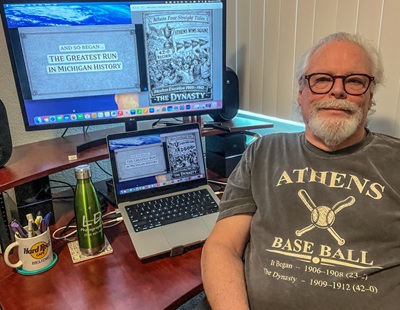 Utilizing modern tools, DeBow collected schedules and final results, and compiled folders full of detail. Slowly, he distilled data into a narrative covering forgotten games and players who represented Athens, and the opponents that they faced. His focus narrowed to a remarkable four-year span – 1909 through 1912 – where the Indians compiled a stunning 42-0 record. Before stellar crowds they triumphed over bigger schools including Dexter, Millington, Mount Pleasant, Battle Creek and Saginaw Arthur Hill.
In September 2025, DeBow penned an e-mail to Askeland, detailing the Athens seasons in a 51-page document. The 1909 team finished 12-0 after defeating Mount Pleasant, 1-0, in a title game at Athens, while 1910’s squad downed Arthur Hill in Saginaw in another 1-0 championship contest, to finish 11-0. Both teams featured the Fox brothers – Loyd, pitcher/outfielder, and Roy, catcher – perhaps the team’s top players. As a sophomore in 1910, Loyd struck out 16 in the title game – the first loss in three years for Arthur Hill.
So, DeBow pitched the 1910 squad to Askeland for consideration as a replacement to 9-1 Commercial High of Brooklyn, N.Y. as the list’s new national champion. Impressed with Athens’ accomplishments, this past February, MaxPreps updated its list accordingly.
Thrilled by the news, and with his research complete, DeBow’s focus narrowed on wrapping up the documentary. His biggest challenge was the limited number of photographs available from the timeframe. To help move the story along, he tapped into the latest Google and Microsoft-funded AI tools to generate period newspaper-style illustrations. The finished film flows like a modern-day graphic novel come-to-life.
After three-plus years of work, the half-hour production, “The Dynasty” Athens High School Baseball 1909-1912, is now available to view on YouTube.
Next, DeBow plans to submit the story to a film festival. With the project complete, he’s given up pretty much all the software subscriptions he’s used on the project – except one.
“I’m probably going to convince myself to keep Chat GPT,” DeBow noted, “just because I’m having too much fun doing other stuff!”
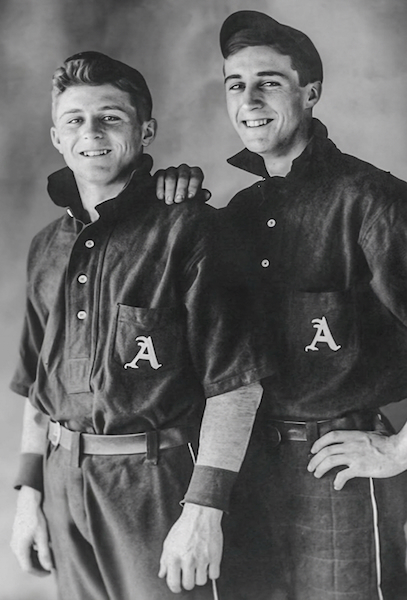
PHOTOS (Top) The 1910 Athens baseball team poses for a photo celebrating its championship season. (2) The 1910 team is welcomed during a parade through its hometown. (3) A sign advertises a matchup with Lansing that season. (4) Brothers Roy and Loyd Fox pose for a photo together in 1911. (4) Videographer Larry DeBow sits at his work station with his latest work on Athens baseball displayed on his computer screen. (Team photo courtesy of the David V. Tinder Collection of Michigan Photography, William L. Clements Library, University of Michigan Library Digital Collections. All others were gathered by Larry DeBow and the Athens Area Historical Society.)
Edison, Buchanan Clutch When It Counts Most to Earn Saturday Return
By
Keith Dunlap
Special for MHSAA.com
June 17, 2022
Even Detroit Edison coach Mark Brown couldn’t really believe it afterwards.
If you would have told Brown before a Division 3 Semifinal against Pewamo-Westphalia that his team would have gotten four hits, committed three errors and his four seniors would’ve gone 0-for-12 with seven strikeouts, he wouldn’t have thought they would be coming back to McLane Stadium on Saturday.
“I would not have believed that,” Brown said. “Especially against a good team like Pewamo-Westphalia. I would not have thought that.”
But somehow, some way, Edison got it done, advancing to its first championship game with a 3-2 win over the Pirates.
The Pioneers (25-12) prevailed through a combination of clutch pitching, clutch hitting and taking advantage of P-W miscues.
Sophomore starter Marwynn Matthews grinded through six innings of work, allowing just two runs and pitching out of jams.
Pewamo-Westphalia loaded the bases in the third inning, but Matthews got out of it with a strikeout. He also stranded a runner at third base in the fourth inning and another at second base in the fifth inning before pitching a 1-2-3 sixth.
“I feel it was a great choice to put me on the mound,” Matthews said. “I felt like nobody could do it better than me. I was trying to work on the outside corners, inside, change-ups low in the dirt and curve balls. Just a mixture of things.”
At 99 pitches to start the top of the seventh, Matthews was pulled in favor of senior Greg Pace, who got the first two outs before a hit batter, wild pitch and walk put runners at first and third.
But Pace induced a weak groundout to first to end the game.
“I’m just trying to throw strikes at that point,” Pace said. “It was a relief. I knew I could trust anybody the ball was hit at.”
Matthews also had two hits to lead the limited offensive production for Edison.
Senior Tanner Wirth and junior Trent Channell each had two hits to lead Pewamo-Westphalia (23-11-2), which also committed three critical errors and a couple of baserunning mistakes that halted rallies.
“Sometimes the results don’t necessarily match the results,” Pewamo-Westphalia head coach Curt Nurenberg said. “But you keep on pushing on and moving on. I thought they did a great job.”
Edison opened the scoring in the bottom of the second inning with two runs. After Matthews reached on an infield single, he stole second and took third when the throw went into centerfield. Matthews then scored on an infield error.
Following a wild pitch that put another runner in scoring position, Edison took a 2-0 lead on an RBI single with two outs by sophomore Deshaun Williams.
The Pirates cut Edison’s lead to 2-1 in the fourth inning on an RBI single by Channell, but Matthews stranded the potential tying run on third base.
Edison then got the run back in its half of the fourth on an RBI single up the middle by sophomore Kole Waterman, again with two outs.
After putting runners on second and first with one out in the fifth inning, Pewamo-Westphalia made it 3-2 on a fielder’s choice groundout when a throw to first to complete a double play got by the Edison first baseman.
Buchanan 6, Standish-Sterling 1 (8 innings)
Up until Buchanan senior Matt Hoover stepped to the plate in the top of the eighth inning, it had been a pile of frustration for the Bucks in the second Division 3 Semifinal.
Buchanan had gone 0-for-11 with runners in scoring position when Hoover took his turn with a runner on second base and one out in a 1-1 game.
“All week, I was hitting high curve balls off the machine over and over again, just seeing the spin at the top of the zone, not trying to do too much and put it in right-center” Hoover said. “I did that all week, and finally got my one in the right spot.”
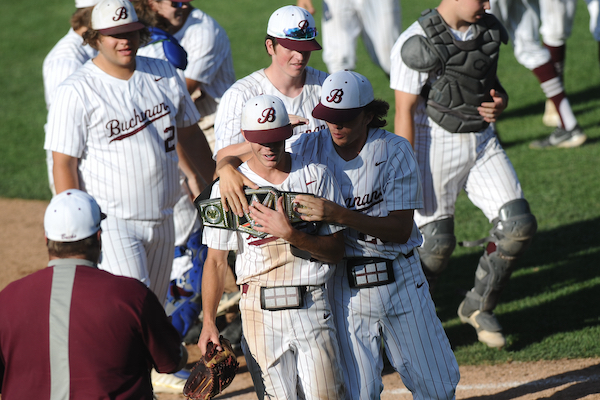 Indeed, just as he did in batting practice, Hoover laced an RBI single to right-center to score junior teammate Cade Preissing and give Buchanan a 2-1 lead.
As it turned out, it also burst a dam for the Bucks, who went on to score five runs total in the inning and earn a return trip to McLane.
The win also earned some redemption for Buchanan (28-4), which was shut out in a Semifinal last year by Grosse Pointe Woods University Liggett.
“Our kids have been on a quest from Day 1,” Buchanan coach Jim Brawley said. “They’ve only wanted to get back here. Last weekend, we didn’t even care about the Regional trophy. Their goal was to get to the championship game.”
Following Hoover’s hit, senior Macoy West sent a two-run triple to center and sophomore Nick Finn added an RBI single to give Buchanan a 5-1 lead. A sixth run scored on a wild pitch.
With Hoover, the team’s ace, at 25 pitches after coming on to relieve starter Drew Glavin in the sixth inning, Buchanan elected to re-insert Glavin in the eighth to finish the game and preserve Hoover for the Final.
The matchup was a pitchers’ duel between Standish-Sterling senior Chase Raymond and Glavin for the first five innings, with neither allowing a run.
Raymond pitched a scoreless sixth, and then Standish-Sterling broke the tie in its half of the inning.
With one out, Raymond dumped a blooper over the second baseman’s head to score senior teammate Cole Prout and give Standish-Sterling a 1-0 lead.
Buchanan answered in the top of the seventh, putting runners on second and third with nobody out after a single by senior Murphy Wegner and a double by West. The Bucks tied the game at 1-1 when Wegner was safe at home on a fielder’s choice groundout.
However, it could’ve been a lot worse for Standish-Sterling.
With runners again on second and third and nobody out, Raymond got out of the jam via a popup, fielder’s choice groundout and a strikeout to keep the game tied.
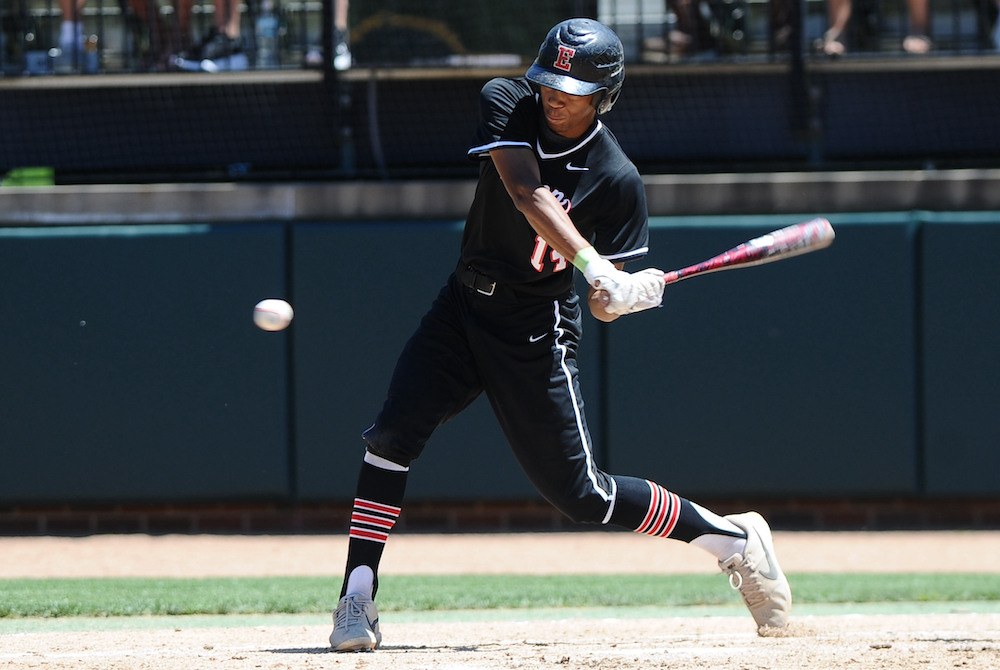
PHOTOS (Top) Detroit Edison’s Kole Waterman powers into a pitch during his team’s Division 3 Semifinal win. (Middle) Buchanan celebrates its extra-inning victory in Friday’s final game.