

Flint Powers Catholic, Spring Lake End Long Waits to Reach Season Finale
By
Scott DeCamp
Special for MHSAA.com
June 14, 2024
EAST LANSING – After his eighth-inning, game-winning hit to finish Flint Powers Catholic’s Division 2 Semifinal win Friday, Chargers senior Gavin Darling gave away the secret to how 42-year head coach Tom Dutkowski stays so young and energetic.
“That dude works out more than probably half the team, honestly,” Darling said. “He’s a great guy, and we just want to do it for him as well.”
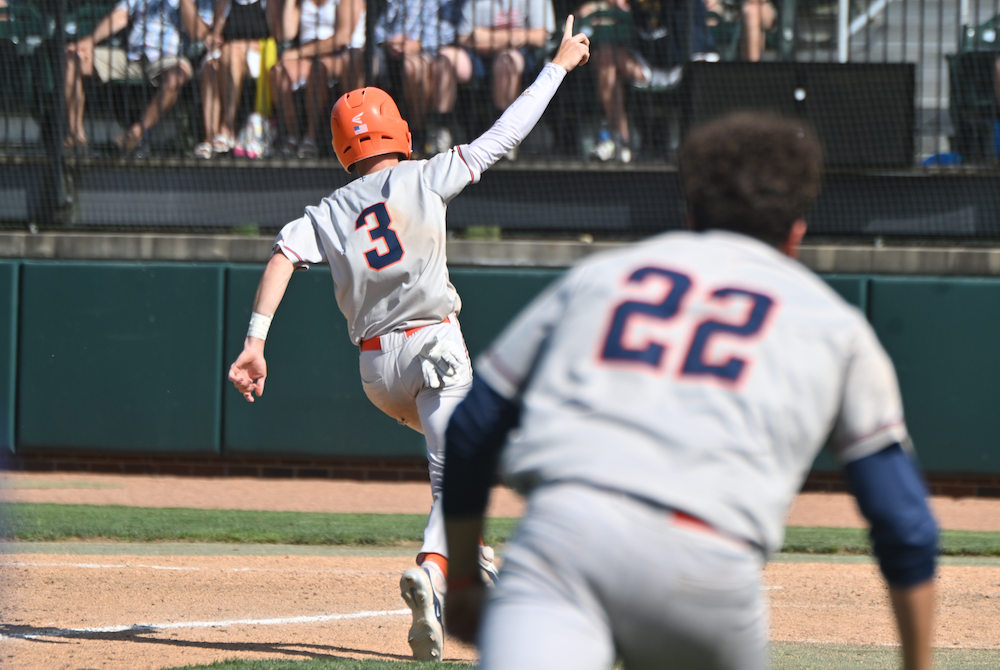
What top-ranked Flint Powers is aiming to do is capture a state baseball championship. Powers has that chance after Darling’s walk-off single to deep left field scored Eli Sturgess for a 4-3 victory over Trenton at Michigan State University’s McLane Stadium.
Powers (36-6) will face Spring Lake (32-9) in Saturday’s 5 p.m. Final. The Chargers are seeking their first Finals title since 1980, and first under Dutkowski’s tutelage.
“We want to win for him, man. It’s not only for us, but it’s for him,” Darling said. “He’s been working hard just like we have.”
Powers and pitcher Grant Garman cruised through the first four innings Friday, Garman carrying a perfect game as the Chargers built a 3-0 lead.
Trenton (30-11-1) began to make Powers work for it in the fifth. The Trojans collected five hits and scored three runs in the inning, keyed by Carson Boike’s two-run single, to knot the score at 3.
The tie remained until the bottom of the eighth inning, when Darling came to the plate with one out and the bases loaded. Powers’ cleanup hitter saw a pitch he could drive, and the rest is history.
“Just (looking for) a pitch to hit, man. They were playing in, so I just had to go for it. I don’t care if it’s a bloop single or a shot like that, I’ve just got to do what I’ve got to do,” Darling said. “(It felt) pretty good to know that I had a guy on third that either way, if it’s caught, he’s tagging and we win the game.
“It’s an unreal feeling, man. These guys are my family, and I can’t thank them enough. They have my back just like I have theirs, and I can’t thank them enough.”
Garman allowed three earned runs on six hits with 10 strikeouts and one walk in five innings. Isaac Sturgess picked up the win in relief, not allowing a hit or run with four strikeouts and one walk over three innings.
Garman led the Powers offense with three hits, while Darling had a pair of RBIs.
Caleb Kidd finished with two hits to pace Trenton. Kidd got the start and worked four innings, allowing three earned runs on five hits with five strikeouts and three walks in four innings. Joel Mator took the loss in relief for the Trojans, surrendering one earned run on three hits with five strikeouts and five walks in 3 1/3 innings.
“I can’t say enough about the fight that was in them,” Trenton coach Todd Szalka said. “He had a shutout (perfect game), we’re going into the top of the fifth, he’s throwing a no-hitter, and then, all of a sudden, we challenge them in the dugout and we come away with five hits in the fifth inning. I mean, that’s almost unheard of, especially against a good pitcher like (Grant) Garman.
“No. 1 team in the state, you’re down 3-0, stakes are on the line, you’re looking at your last nine outs and our kids just continued to fight and went into extra innings. They got the big play when they needed it, and we had gotten the big play the last three games with walk-offs. I’m really proud of the way we came out today.”
Dutkowski instructed Darling to be “short to the ball” on his game-winning hit. The coach was very happy for the player, who “works as hard as anybody.”
Dutkowski believes his team is plenty battle-tested, too, competing in the Saginaw Valley League.
“The Saginaw Valley League is a gauntlet, especially for a school like Powers (as) the smallest school,” he said. “Not that we feel bad about that because we’ve got great players this year, but it is tough.
“ … We beat Bay City Western two out of three this year, and we beat Northville in the Flint Champions Tournament. Neither team was pitching their best, but we beat them. Yeah, we’re battle-tested.”
Dutkowski said that in his younger years, he might have been jumping up and down in the third-base coach’s box during the walk-off play.
On Friday, he said he stayed planted and wanted to make sure Eli Sturgess was tagging at third in case Darling’s deep fly ball was caught.
“I used to be what you’d call an athlete. I used to do all the histrionics, but now my job is to kind of keep guys steady, you know – get them back to neutral as soon as possible,” Dutkowski said.
“I have an ankle-foot orthotic. I am drop foot. I had fusion surgery about 19 months ago on L-4/L-5. No, I’m a wreck. I have this carbon fiber thing,” he said as he pointed to his lower right leg, “that keeps me upright. I’m retired now, so I work out.”
Spring Lake 5, Richland Gull Lake 2
“Next pitch” has been a theme for the Spring Lake baseball team during its run to the Finals.
Of course, when you have Zane Stahl throwing the pitches, that always helps.
The 6-foot-6 Louisville commit scattered five hits and pitched to contact in powering Spring Lake to a 5-2 victory.
On Saturday, Spring Lake will be making its first Finals appearance since 1995 and third overall. The Lakers got there Friday in large part because of Stahl, the defense behind him, and timely hitting.
 Stahl, a right-handed junior, struck out four, walked four, and allowed two earned runs in the complete-game effort.
“(The defense) has been incredible. I’ve been able to make my pitch,” Stahl said. “You know, it’s not always about strikeouts; it’s about making the pitch and getting a ground ball. I mean, they’ve been able to make the routine plays that they’re supposed to and even make them outside of that, so it’s been great.”
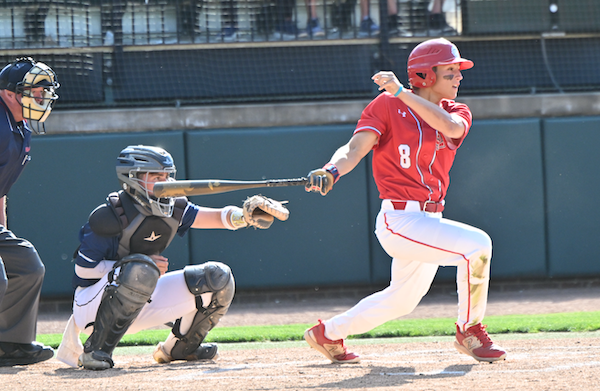
Stahl helped his own cause, too. He finished 2-for-3 at the plate with two RBIs. Oliver Smies doubled twice for Spring Lake, while Gabe Trask had two hits for the Lakers, who have won 19 of their last 20 games.
Spring Lake took a 1-0 lead in the first inning and created separation with four runs in the fifth inning on four hits.
“Somebody else always seemed to pick us up at the right time. We got a couple of nice ground-ball double plays, so some things have fallen into place for us but I’m also a believer, sometimes you make your own luck,” Spring Lake coach Bill Core said. “What we’ve been impressed with so much is somebody always seems to pick up their teammate or somebody’s been coming through with a big play at the right time.
“We’re not a bunch of superstars, but everybody has a role and we’ve got a different hero (each game).”
Gull Lake (26-12) showed life in the later innings, scoring a run on two hits in the sixth and another run on two more hits in the seventh.
Western Michigan University commit Julian Harris took the pitching loss for the Blue Devils. The right-hander allowed three runs (two earned) on five hits with eight strikeouts and one walk in four innings.
“When you get to the final four, no one’s weak, especially against a good arm like (Stahl’s) – you’re scratching and clawing for every run that you get,” Gull Lake coach Reggie Walters said. “If you tie that ballgame up, it just changes the feel of things instead of chasing.
“We wanted to wear (Stahl) down and he started to show that in the sixth and the seventh, but he threw a great game. … It was like, ‘Man, if we would have started it one inning earlier, you don’t know where you’re going to end up.’”
PHOTOS (Top) Flint Powers Catholic's Eli Sturgess (3) crosses the plate for the winning run during his team's Semifinal victory Friday at McLane Stadium. (Middle) Spring Lake’s Gabe Trask drives a pitch.
Senior-Powered Spring Lake Answering Anticipation, Pursuing High Expectations
By
Dean Holzwarth
Special for MHSAA.com
April 29, 2026
SPRING LAKE – The time is now for the Spring Lake baseball team.
 With the return of 11 veteran seniors, the Lakers entered this spring with lofty expectations and an eye on an extended postseason run.
Anticipation has come to fruition in the form of a state ranking and a nearly perfect start.
“Our motto is we are going to worry about next year next year, and we are going to do all we can this year,” Lakers fourth-year coach Bill Core said. “We knew we were going to have a big experienced group coming back, and that's just how the roster folded out. We have a lot of experience, a lot of returners and pretty high expectations.”
Spring Lake, which finished as Division 2 runner-up in 2024 and won a conference title last year for the first time since 2014, is off to an impressive 13-1 start (9-0 in the Ottawa-Kent Conference Black) and has climbed to No. 7 in the latest coaches poll.
Core said the vast number of returners, which includes five players who will play in college next year, has paid early dividends.
“I think that’s been a big difference,” he said. “We’ve played some younger teams that were breaking in sophomores or juniors or new kids, and our guys were ready to go right from the start. It’s been an advantage early on.”
Senior starting pitchers Oliver Smies and Maddux Kipling believe the strong bond among the senior class has been a major factor in the torrid start.
 “I think something that’s really important about this team is our team chemistry and the amount of seniors we have on the team,” Smies said. “That alone allows us to have a ton of experience, and I think that's a big reason why we are off to such a hot start. We have been playing good team baseball and complementary baseball with good defense and good offense.”
Added Kipling: “We genuinely like being around each other, and every day we show up ready to get a little better. Our team has a real gritty and energetic identity, and I think that shows in how we compete and support each other.”
Kipling and Smies have been dominant on the mound this season. They haven’t allowed an earned run while combining for 80 strikeouts. Kipling earned a second-team all-state accolade as a junior and is headed to Michigan State next year. Smies will play at Calvin University.
“It starts with our pitching,” Core said. “Any time you are going to make a run, it starts with your pitching and we are pretty lucky, especially with our top two.”
Offensively, the Lakers possess a balanced lineup and boast a .330 batting average.
Senior Owen Smies, who will join his twin brother at Calvin, is hitting a team-best .432 with 13 RBIs. Seniors Alex Strauss (Adrian College) and Max Feltner (Muskegon Community College) are both batting .333 and have combined to score 25 runs.
As a team, Spring Lake has produced eight shutouts and nine wins by run differential.
“We got off to a good start, but we are going to play a lot better competition,” Core said. “This is a good week for us because we play Northview and state-ranked East Grand Rapids. We just picked them up, so we were excited to fill in the week with those two schools.”
Spring Lake is 62-6 over its last 68 games and trying to remain focused on each game as it attempts to erase the disappointment of last year’s early exit from the postseason.
 Despite winning 30 games, the Lakers suffered a 3-2 loss to Grand Rapids West Catholic in District play.
“I think there is some motivation there from that loss,” Oliver Smies said. “And I think that loss last year taught us that any team can beat any team, so you have to play your best baseball every single game no matter the opponent.”
Core said last year hasn’t been discussed, but believes it still sits in the back of his players’ minds.
“I think they think about that, but we've had quite a few mercies to start the season, and I said to them that when we get to the tournament it's going to be a one-run game and we are going to have to do the little things to make a difference because we are not going to win 14-0 all the time,” he explained. “We try to keep everyone in the moment.”
Kipling isn’t dwelling on the past – or looking too far ahead.
“As a group we’ve done a great job staying focused on the present and not getting caught up in the past or worrying too much about the future,” Kipling said. “My dad has always told me to focus on what you can control because putting energy into things you can’t control is a waste.
"That mindset has stuck with me, especially on the field. I try to live by ‘one pitch at a time,’ and because of that I haven’t really spent time thinking about last year’s loss. That’s behind us, and we’re just focused on what we can do right now.”
 Dean Holzwarth has covered primarily high school sports for Grand Rapids-based WOOD-TV for five years after serving at the Grand Rapids Press and MLive for 16 years along with shorter stints at the Ionia Sentinel and WZZM. Contact him at [email protected] with story ideas for Allegan, Kent and Ottawa counties.
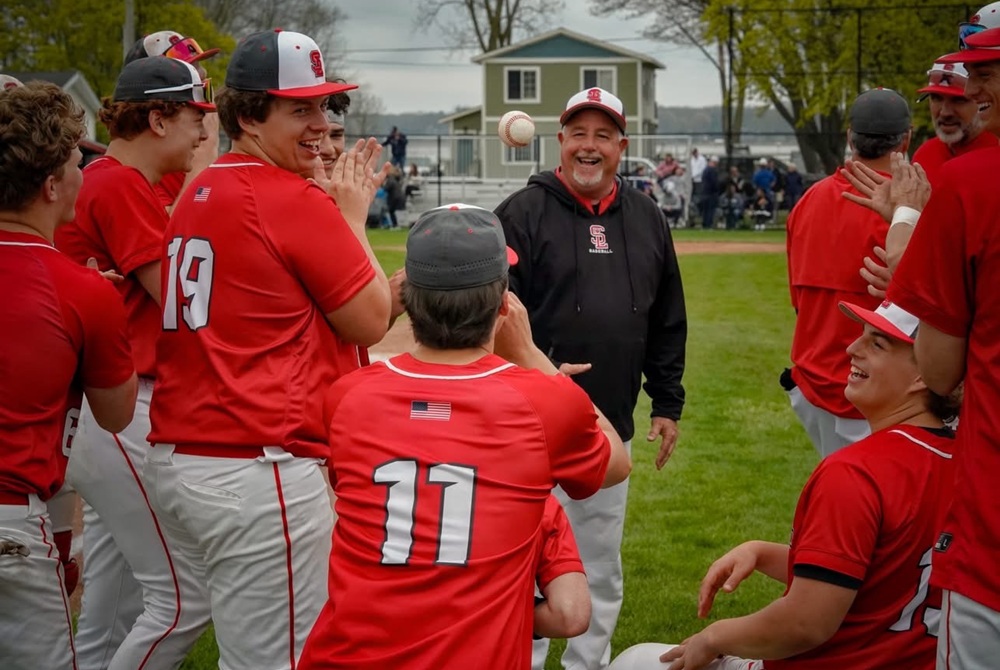
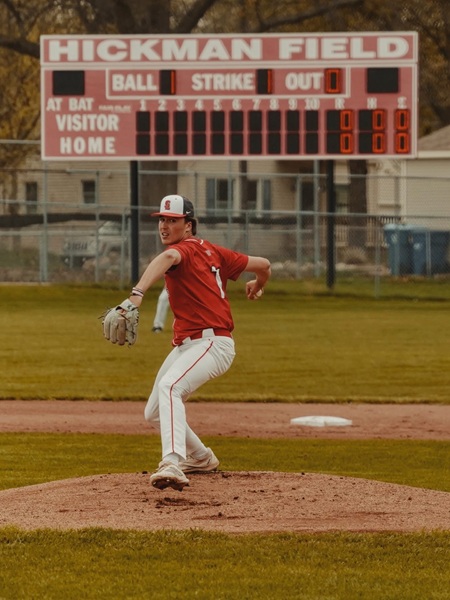
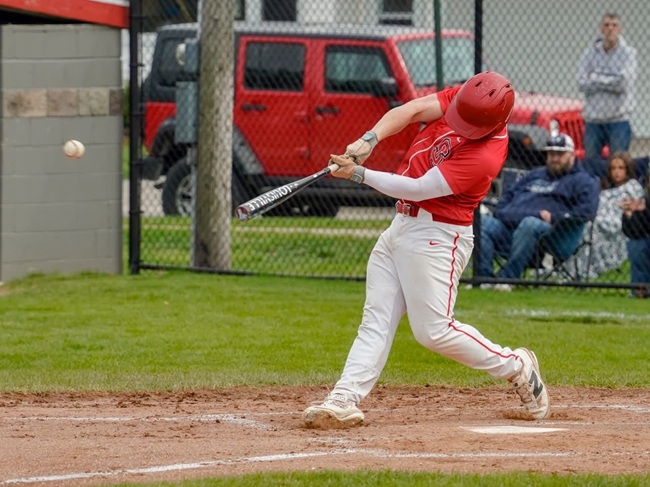
PHOTOS (Top) Spring Lake baseball coach Bill Core tosses Maddux Kipling his home run ball after a win over Fruitport. (Middle) Kipling pitching at Spring Lake's Hickman Field. (Below) Senior Oliver Smies connects with a pitch. (Photos by Trevor McCue/Grand Haven Tribune.)