

Hart Teammates Reunite After 80 Years Now as WWII Vets, Great-Grandfathers
By
Tom Kendra
Special for MHSAA.com
June 7, 2023
Walter “Stretch” Hansen and Harold Tate were good friends and high school basketball and baseball teammates at Hart High School, graduating in 1943.
 No one could have guessed that less than two months after graduation (on July 2, 1943), the two friends would head to Fort Custer in Battle Creek, the first stop on their way overseas to fight for their country in World War II.
No one could have imagined how many twists and turns their lives would take over the next 80 years – from the battlefields in the South Pacific, then back to West Michigan where they both were married with children, grandchildren, great-grandchildren and now Harold even has a great-great-grandchild.
And, certainly, no one would have believed that the two young boys from Hart – who forged a friendship through high school sports long before the days of computers, microwave ovens and cell phones – would still be alive at the age of 98 for an emotional reunion last month, on May 22, seeing each other for the first time in 80 years and, to cap it off, the reunion took place in their hometown of Hart.
“It was such a great day,” Hansen said about the meeting, which was set up by Muskegon-area World War II historian Richard Mullally.
“We picked right up, talking about sports and the service and everything else.”
The conversation came easy for the two old friends, who played for Hart during a “golden era” at the school – particularly in basketball, as the Pirates won 11 West Michigan Conference basketball titles between 1940 and 1954.
 Perhaps the best team during that time period was Hansen and Tate’s as seniors in 1943. That team lost only once, to rival Scottville (31-25), but more than made up for it with an 80-10 trouncing of the Spartans in the final regular-season game.
Hart then crushed Scottville and Newaygo to win the District championship, only to have Michigan’s prep basketball season stopped abruptly at that point because of World War II.
That 1943 team featured four starters over 6-0, led by the duo of Hansen and Stan Kapulak (both 6-6), Joe Mack (6-2), Lyle Burmeister (6-1) and Stanley Riley (the lone starter under 6-foot at 5-11).
“The newspapers called us ‘The Hart Skyscrapers,’” said Hansen, who will be 99 on Nov. 6. “We were taller than most college teams at that time.”
Hansen and Tate’s friendship continued to blossom on the baseball field, only to have their lives turned upside down shortly after graduation 80 years ago, when all Hart senior boys who had been drafted headed to Battle Creek as a brief staging area on their way to the battlefields of Europe and the South Pacific.
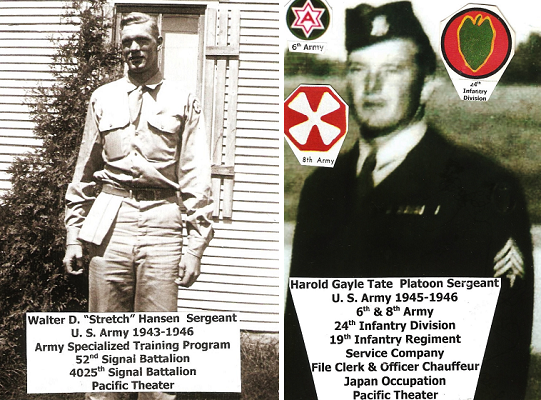
Hansen served in the Army Specialized Training Program and was part of the 52nd Signal Battalion and the 4025th Signal Battalion in the Pacific Theater.
“I had an all-expense paid tour of the South Pacific,” Hansen said with a chuckle. “The Philippines, New Guinea, Okinawa, Hawaii, all over the place.”
Tate did his service in the 24th Infantry Division and the 19th Infantry Regiment, and was stationed in Japan.
During their visit last month, Harold showed off the Japanese Samurai sword and Arisaka rifle which he had sent back from Japan to Hart. The week after their visit, both took part in Memorial Day parades – Hansen in the Lakeside parade in Muskegon and Tate in his 77th Memorial Day service in Hart.
Hansen, who still has a home on a small lake in Holton and lives at a senior care facility in Muskegon, played many years of semi-pro basketball and did some coaching. He worked at GTE and has five children and 10 grandchildren.
 “I have been so blessed,” Hansen said, sorting through one of his many scrapbooks. “All five of my kids are great and I have grandkids that are just amazing, everything they are doing. I don’t even know all of their names, but it’s sure been fun watching them.”
Tate returned to Hart after his military service and has been there ever since, at first working as a carpenter with his father and then becoming a rural mail carrier for the U.S. Postal Service, retiring 26 years ago at the age of 72. He has lived in the same home for 75 years and has three children, six grandchildren, seven great-grandkids and now one great-great-grandchild.
Tate laments the demise of his beloved American Legion post in Hart, a town with just over 2,000 residents, as the number of members has steadily declined.
One topic that brings a smile to both of their faces is the recent resurgence of the Hart High School athletic program, which drew media attention not too many years ago for all the wrong reasons – notably a football program which went 24 years without a winning record.
That string was snapped with a 6-3 mark and the school’s first earned playoff appearance last fall.
But that was just the start.
This winter, Hart’s boys basketball team finished the regular season 22-0, the girls basketball team made it to the Division 3 Semifinals at the Breslin Center, wrestling qualified for the Team Finals for the fourth-straight year and competitive cheer placed fourth in Division 4. This spring, the Hart girls track & field team won its second-straight Division 3 Finals team title, and the boys placed fourth.
“It’s a great place to call home, a great place to live, always has been,” said Hansen of his hometown, which got its name from its central position in the “heart” of Oceana County.
And who would have imagined that these two high school teammates could still come home again for a reunion at the age of 98?
 Tom Kendra worked 23 years at The Muskegon Chronicle, including five as assistant sports editor and the final six as sports editor through 2011. E-mail him at [email protected] with story ideas for Muskegon, Oceana, Mason, Lake, Oceola, Mecosta and Newaygo counties.
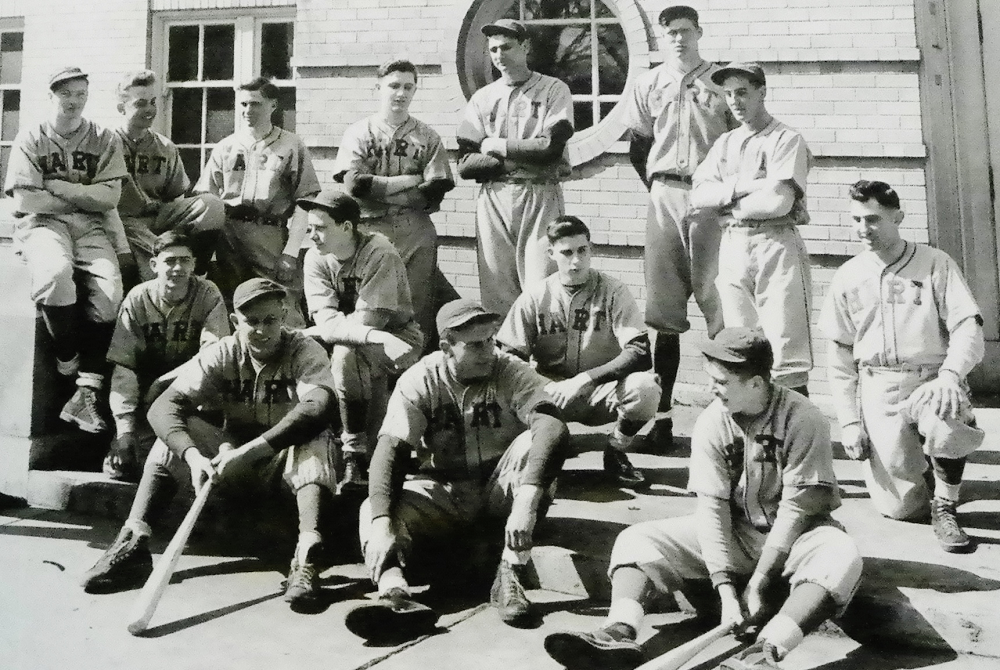
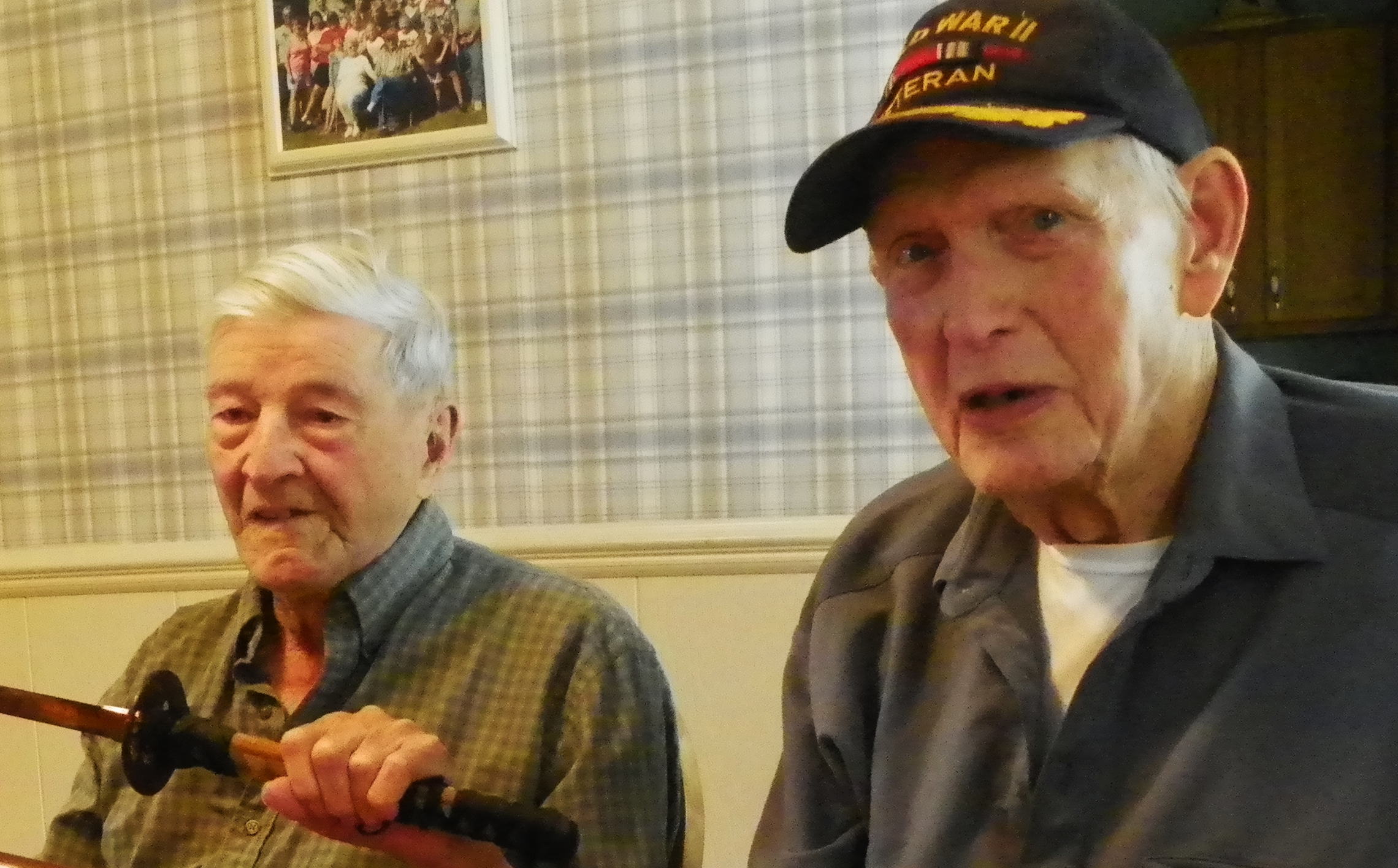
PHOTOS (Top) Members of the 1943 Hart High School varsity baseball team gather together, preparing for a team photo. Among those are Harold Gayle Tate (far left) and Walter "Stretch" Hansen, at 6-6 the tallest player in the back row. (Middle) Hansen, left, and Tate reunite for the first time in 80 years on Monday, May 22, 2023, in their hometown of Hart. (Below) Hansen served from 1943 to 1946 as a Sergeant in the Pacific Theater during World War II. Tate served from 1945 to 1946 as a Platoon Sergeant in the Pacific Theater during World War II. (Top photo courtesy of Stretch Hansen. Middle and below photos courtesy of Richard Mullally.)
Preview: Fantastic Finals Trips Await for 16 Title Contenders
By
Geoff Kimmerly
MHSAA.com senior editor
June 10, 2026
Frequent visitors to Michigan State’s McLane Stadium for MHSAA Baseball Finals weekend know how special the experience can be. And we have a pair of those joining us over the next three days in reigning Division 3 champion Traverse City St. Francis and annual contender Orchard Lake St. Mary’s.
But we’ll also hopefully deliver some breathtaking moments to several communities for the first time – or first time in a long time.
Two teams will play in Semifinals this weekend for the first time, and a handful more for the first time in at least a decade. Six more teams are hoping to play in a championship game Saturday for the first time.
Ten of this weekend’s 16 semifinalists are seeking their first Finals championship in this sport – and three of the six teams that have won in the past are seeking their first title in at least 20 years.
This weekend's schedule is as follows:
Division 1 – Friday
Detroit Catholic Central vs. Mattawan - 2:30 p.m.
Rochester Adams vs. Brownstown Woodhaven - 5 p.m.
Division 2 – Thursday
Vicksburg vs. Grand Rapids Kenowa Hills - 9 a.m.
Orchard Lake St. Mary's vs. Dearborn Divine Child - 11:30 a.m.
Division 3 – Thursday
Detroit Edison vs. Kalamazoo Christian - 2:30 p.m.
Traverse City St. Francis vs. Rochester Hills Lutheran Northwest - 5 p.m.
Division 4 – Friday
Royal Oak Shrine Catholic vs. Mount Pleasant Sacred Heart - 9 a.m.
Marcellus vs. Painesdale Jeffers - 11:30 a.m.
FINALS – Saturday
Division 1 – 5 p.m.
Division 2 – 9 a.m.
Division 3 – 11:30 a.m.
Division 4 – 2:30 p.m.
Tickets cost $11 and may be purchased online only at GoFan. One ticket is good for all baseball, softball and girls soccer games at MSU’s Old College Field that day. All Semifinals and Finals will be broadcast and available with subscription from MHSAA.tv.
Below is a glance at all 16 teams taking the field:
Division 1
BROWNSTOWN WOODHAVEN
Record/rank: 34-5-1, No. 3
Coach: Corey Farner, 12th season (338-90-3)
League finish: First in Downriver League
Championship history: Division 1 runner-up 2018 and 2023.
Players to watch: Cameron Thorning, jr. C (.446, 13 2B, 52 RBI); Lucas Farner, jr. IF/P (.426, 55 R, 32 RBI, 20 SB, 4-1 pitching, 0.97 ERA); Dante Perry, sr. OF (.429, 47 R, 30 SB); Tristan Spencer, soph. 1B/P (.346, 10 2B, 36 RBI, 8-1 pitching, 0.98 ERA, 70 K/50 IP).
Outlook: After falling a win short of the Semifinals last season, Woodhaven is back thanks in part to defeating No. 1 Brother Rice in Saturday’s Regional Final and also league rival No. 19 Allen Park earlier in the tournament. Woodhaven with one more victory also can tie its winningest season (2019) during Farner’s highly-successful run leading the program. Senior Keden Newsted is another ace for the Warriors entering this weekend 8-1 with a 1.53 ERA, and junior Amauri Gutierrez is 4-0 with a 2.69 ERA and a pair of saves. Junior Aaron Scott (.393) can be counted on for a boost at the bottom of the lineup.
DETROIT CATHOLIC CENTRAL
Record/rank: 27-12, No. 6
Coach: Ryan Rogowski, sixth season (138-96)
League finish: Fourth in Catholic High School League Central
Championship history: Three MHSAA titles (most recent 1999), two runner-up finishes.
Players to watch: Bennett Thompson, sr. 2B/C (.380, 27 R, 10 2B); Dylan Fairchild, sr. SS/P (.333, 32 R, 12 2B, 8 HR, 33 RBI); Andrew Mahoney, sr. P (8-1, 1.32 ERA, 81 K/53 IP); Micky Laser, sr. P/3B (8-0, 1.98 ERA).
Outlook: Detroit Catholic Central is making its first Semifinal appearance since 2004 and has defeated No. 16 Novi and No. 20 Dexter along the way after navigating a league that included top-ranked Brother Rice and Division 2 No. 1 Orchard Lake St. Mary’s. The Shamrocks have won 12 of their last 14 games. Seven regulars total are hitting at least .300, with sophomore Luke Fairchild (.357, 25 R, 16 SB) and seniors Tommy Maxwell (.357) and Owen Geisler (.351) all among the leaders right behind Thompson.
MATTAWAN
Record/rank: 29-8, No. 8
Coach: Brett Vaughn, 13th season (29-8)
League finish: First in Southwestern Michigan Athletic Conference
Championship history: Has never played in an MHSAA Final.
Players to watch: Patrick Dougherty, sr. OF (.431, 46 R, 25 SB); Nolan Jominy, sr. SS (.379, 40 R, 16 2B, 30 RBI, 18 SB); John Pelak, jr. OF (.372, 10 2B); Kaden Jominy, sr. P.
Outlook: Although seeking its first championship, Mattawan was at the Semifinals in 2023 and made the Regional Finals last spring before falling short. The Wildcats haven’t given up more than a run in any of six playoff games this spring, including their 3-1 Quarterfinal victory over No. 18 Byron Center, and total they’ve won 11 of their last 12 games. Seven seniors start, including as well outfielder/pitcher Liam Walsh (.367, 28 RBI), and Kaden Jominy will play next at Cornell. Junior Coleton Strong is another big bat in the middle of the lineup, hitting .336 with a team-high 36 RBI.
ROCHESTER ADAMS
Record/rank: 28-8, No. 4
Coach: Andrew Lamkin, 13th season (277-160-3)
League finish: First in Oakland Activities Association Red
Championship history: Class A runner-up 1995 and 1996.
Players to watch: Andrew Wozniak, sr. SS (.327, 31 R, 17 SB); Matt Toeppner, sr. OF/IF (.556): Brady Lindstrom, jr. P/IF (7-0, 1.46 ERA); Koltyn Watters, soph. OF (.398, 45 R, 11 2B, 30 RBI, 38 SB).
Outlook: Adams will play in its first Semifinal since the repeat run to the Class A championship game in 1996. Lamkin actually is in his second tenure running the program, having led the Highlanders from 1994-2003, returned as an assistant in 2011 and taken it back over in 2024. Toeppner, a Michigan State recruit, has been back only three weeks after hand surgery but also has scored 13 runs and stolen nine bases over 11 games. He and Watters both made the all-state first team last season. Adams topped No. 7 Oxford in the Quarterfinal, and a 3-2 win over No. 2 Romeo in the Regional Semifinal was one of three one-run victories this playoffs.
Division 2
DEARBORN DIVINE CHILD
Record/rank: 29-6, No. 7
Coach: Jeremy Shay, fourth season (91-49)
League finish: First in Catholic High School League AA
Championship history: Five MHSAA titles (most recent 2010).
Players to watch: Andrew Ryan, sr. SS/P (.389, 52 R, 28 SB, 5-2 pitching, 2.25 ERA); Dallas Terski, sr. 1B/3B (.370, 34 RBI, 21 SB); Liam Gibbons, sr. P (6-1, 1.01 ERA, 62 K/48 1/3 IP); Kole Boike, soph. CF (.346, 35 R, 30 RBI).
Outlook: Divine Child has taken steps every season under Shay, finishing 15-20 his first season but then adding a District title in 2024, a league championship last spring and now a Regional Finals win and trip to the Semifinals after defeating No. 8 Williamston to advance. Seniors Ian Hall (6-1) and Mason Cubr (5-1) also have seen plenty of starts on the mound and provide the Falcons with more options this weekend. Junior Adam Garcia (.368, 27 RBI) is among five more regulars hitting at least .300. Shay played on Divine Child’s 2008 and 2010 Division 2 championship teams before starring at Bowling Green as well.
GRAND RAPIDS KENOWA HILLS
Record/rank: 35-2, No. 5
Coach: Todd VandenHeuvel, first season (35-2)
League finish: First in River Cities Alliance
Championship history: Has never played in an MHSAA Final.
Players to watch: Will Fussman, jr. CF (.411, 48 R, 44 SB); Mason Peebles, sr. C/P (.423, 41 R, 14 2B, 8 3B, 56 RBI, 28 SB); Jack Stoddard, jr. 3B/P (.408, 41 RBI, 8-1 pitching, 1.97 ERA); Andrew Lake, sr. P (9-0, 0.40 ERA, 62 K/53 IP).
Outlook: Kenowa Hills is making its first Semifinals trip since 2015, continuing a tournament run that has seen wins against No. 11 East Grand Rapids, No. 20 Escanaba and No. 6 Standish-Sterling over the last three rounds. The Knights have won 19 straight games and have a solid set of impressive arms leading the staff this weekend with senior Keegan Garvin (9-0, 1.80 ERA) set to start the Semifinal. Senior shortstop Brennan Gustinis (.395, 50 R, 10 2B, 12 SB) is another dangerous bat in the leadoff spot. VandenHeuvel previously coached at Mona Shores, winning 217 games from 1995-2001.
ORCHARD LAKE ST. MARY’S
Record/rank: 32-5, No. 1
Coach: Nick Di Ponio, ninth season (234-134)
League finish: First in CHSL Central
Championship history: Six MHSAA titles (most recent 2022), three runner-up finishes.
Players to watch: Luke Crighton, sr. CF/SS/P (.457, 55 R, 39 RBI, 20 SB, 9-0 pitching, 1.21 ERA, 75 K/52 IP); Andrew Tribul, sr. C/IF (.376, 43 R, 45 RBI, 18 SB); Hudson Brzustewicz, sr. SS/P (.491, 56 R, 12 2B, 34 RBI, 6-1 pitching, 1.64 ERA, 52 K/34 IP); Derick Conrad, sr. C/IF (.427, 47 RBI).
Outlook: St. Mary’s has won 25 straight games and emerged from the same CHSL Central as Division 1 finalist Detroit Catholic Central, thanks in part to playoff wins over No. 4 Richmond and No. 10 Saginaw Swan Valley. Brzustewicz and Crighton were all-state first-teamers last season and are both the team’s leading hitters and top arms from a staff that has seen eight pitchers throw at least 17 innings and win two or more games this spring. Di Ponio led the Eaglets to Division 2 runner-up finishes in 2007 and 2009 during his first tenure with the program (2005-10) and three straight Regional titles since taking it back over in 2024. Senior outfielder Zach Essig (.357) also bolsters the middle of the lineup.
VICKSBURG
Record/rank: 30-7, No. 14
Coach: Brian Deal, 28th season (487-366-4)
League finish: First in Wolverine Conference
Championship history: Has never played in an MHSAA Final.
Players to watch: Graham Kubiak, jr. IF/P (.405, 37 R, 41 RBI, 25 SB, 3-2 pitching, 1.80 ERA); Mitchell Beyer, sr. IF (.426, 46 R, 17 2B, 44 RBI, 24 SB); Maddox Rosalin, sr. IF/P (.431, 15 2B, 39 RBI, 10 SB, 9-0 pitching, 0.72 ERA); Maguire Bowles, jr. OF (.450, 59 R, 13 2B, 32 RBI, 34 SB).
Outlook: Vicksburg also is returning to the Semifinals for the first time since 2015 and has put together its winningest season during Deal’s nearly three decades leading the program. A 3-0 Regional Semifinal win over No.18 Niles followed up a regular-season split between the two, and the Bulldogs also avenged an early loss to Paw Paw in the District opener and an 11-run loss to Coldwater with a 12-1 Quarterfinal victory. Three more regulars are hitting at least .300, led by junior Spencer Spicer (.338, 31 R), and sophomore Caden Chisolm (7-0, 2.28 ERA) gives Vicksburg another ace as eight pitchers total have made at least one start.
Division 3
DETROIT EDISON
Record/rank: 23-8, No. 4
Coach: Mark Brown, 10th season (210-104)
League finish: First in Charter School Conference
Championship history: Division 3 runner-up 2022.
Players to watch: Jamir Campbell, sr. P/SS (.408, 30 R, 26 SB, 6-1 pitching, 1.50 ERA, 60 K/55 IP); Elijah Hines, fr. OF (.357, 16 SB); David Hemphill III, sr. P/OF (.353, 8-2 pitching, 1.75 ERA, 72 K/71 IP); JonTae Wright, sr. IF (.393, 39 RBI, 13 SB).
Outlook: Edison is back at the Semifinals for the second time in three seasons (and third over the last five) after just missing a year ago, thanks to a 7-6 Quarterfinal win over No. 5 Jackson Lumen Christi. Campbell and Wright made the all-state first team last season and lead a lineup that has scored at least seven runs in 16 games. Junior Melvin Tennyson has been another key player in several ways, going 4-2 with a 1.85 ERA and hitting .318 with 19 stolen bases while leading off and playing center field. The Pioneers’ starting nine are a combined 116 for 128 on stolen-base attempts.
KALAMAZOO CHRISTIAN
Record/rank: 25-8, unranked
Coach: Russ Meyer, first season (25-8)
League finish: First in Southwest Athletic Conference Valley
Championship history: Has never appeared in an MHSAA Final.
Players to watch: Jake Bonnema, jr. 2B (.437, 41 R, 34 SB); James Annen, jr. P/1B/OF (.370, 32 R, 5-2 pitching); Crosby Croel, jr. P/1B/3B (.411, 31 R, 13 2B, 35 RBI, 13 SB, 2-1 pitching); Jackson Herder, sr. P/OF (5-1, 2.33 ERA, .280).
Outlook: Kalamazoo Christian’s first trip to the Semifinals since 2014 will be the result of a dominating run for the unranked Comets, who have outscored their six postseason opponents by a combined score of 71-6. Meyer may be in his first season as the varsity coach but has been an assistant at Christian and K-Central and was promoted after a decade as the Comets’ junior varsity coach. Herder and third baseman Logan Bittle (.286, 4-1 pitching, 2.79 ERA) are the only seniors. Sophomore catcher Jace Rarick is another top run producer hitting .337 with 13 doubles and 31 RBI.
ROCHESTER HILLS LUTHERAN NORTHWEST
Record/rank: 28-6, No. 16
Coach: Russ Kouba, second season (53-14)
League finish: Second in Michigan Independent Athletic Conference
Championship history: Division 4 champion 2004.
Players to watch: Jacob Kouba, sr. P/1B/OF (.455, 46 R, 14 2B, 41 RBI, 23 SB, 10-2 pitching, 1.06 ERA, 94 K/59 2/3 IP); Brennan Goebbel, jr. OF (.516, 44 R, 12 2B, 41 RBI, 40 SB); Nick Oberdier, sr. P/1B/3B (.344, 46 RBI, 4-2 pitching, 2.07 ERA, 64 K/44 IP); Landon Lindhurst, jr. OF/1B (.360, 17 SB).
Outlook: Lutheran Northwest earned its first trip to the Semifinals since 2006, a strong next step after also winning a District title in Russ Kouba’s first season leading the program. This lineup has only three senior starters, but they’re major contributors with pitcher/shortstop Ethan Wilks (.291, 15 SB, 6-1 pitching, 2.17 ERA, 52 K/38 2/3 IP) joining Jacob Kouba and Oberdier noted above. Sophomore catcher Josiah Kouba (.367) is among younger players who have stepped into prominent roles, and junior Rudy Hauss is a catalyst at the top of the order hitting .302 with 44 runs scored and 25 stolen bases.
TRAVERSE CITY ST. FRANCIS
Record/rank: 32-5, No. 1
Coach: Tom Passinault, 13th season (326-96)
League finish: Does not play in a conference.
Championship history: Two MHSAA titles (most recent 2025), two runner-up finishes.
Players to watch: Lanse Vos, jr. 1B/P (.438, 34 R, 7 3B, 32 RBI, 12 SB, 6-0 pitching, 1.50 ERA, 65 K/46 2/3 IP); Sam Wildfong, sr. C/P (.526, 41 R, 15 2B, 62 RBI, 14 SB, 5-1 pitching, 2.59 ERA, 69 K/43 1/3 IP); Tyler Thompson, sr. SS (.382, 51 R, 11 SB, 7-1 pitching, 1.63 ERA); Tyler Endres, sr. P/1B (.353, 9-2 pitching, 1.38 ERA, 82 K/50 2/3 IP).
Outlook: The Gladiators are pursuing a repeat with Wildfong a returning all-state first-teamer and Thompson a returning second-teamer, and total seven starters and both pitchers back from last year’s championship game. The team is anchored by eight seniors – including as well Braxton Lesinski (.326, 35 R, 36 RBI) – but sophomore Colton Peterson (.340, 41 R, 24 SB) and freshman John St. Peter (.340, 38 R, 19 SB) are also among top hitters. Endres got the pitching win and Vos closed last season’s Final after Wildfong threw a complete game in the Semifinal.
Division 4
PAINESDALE JEFFERS
Record/rank: 15-8, unranked
Coach: Joe Romano, first season (15-8)
League finish: Fourth in Western Peninsula Athletic Conference
Championship history: Has not played in an MHSAA Final.
Players to watch: Blake Heltunen, soph. 3B/P (.458, 22 SB); Brogan Turner, sr. P/CF (.424, 26 R, 31 RBI, 11 SB, 4-0 pitching, 1.66 ERA); Carson L’Esperance, fr. SS (.372); Pierce Johnson, jr. C (.326, 24 R, 17 SB, 3-1 pitching).
Outlook: Jeffers is making its first trip to the Semifinals as a talented group of athletes who have had success in other sports have brought it to the diamond as well. The Jets advanced with a 15-9 Quarterfinal win over No. 15 Norway and have scored 10 or more runs in all five of their postseason games. There are only three senior starters, but they bat among the top four – although Jeffers will play this weekend without a fourth senior, pitching ace Cameron Anderson (5-1, 1.99 ERA), a cross country Finals champion in the fall who was injured last weekend. Romano coached the Jets girls basketball team to a Class D runner-up finish in 1994.
MARCELLUS
Record/rank: 21-11, unranked
Coach: Christian Hutson, 11th season (143-138)
League finish: Second in Southwest 10 Conference
Championship history: Has never played in an MHSAA Final.
Players to watch: Seth Barrera, sr. IF/P (.392, 39 R, 14 2B, 16 SB, 6-4 pitching, 2.60 ERA, 67 K/59 1/3 IP); Eli Torres, sr. IF/P/C (.367, 31 RBI, 2-0 pitching); Abram Coffey, jr. IF/P (.684, 4-0 pitching, 1.31 ERA); Cale Hackenberg, jr. IF/P/C (.584, 44 R, 13 2B, 44 RBI, 19 SB, 7-3 pitching, 2.25 ERA, 114 K/53 IP).
Outlook: Marcellus also is making its first trip to the Semifinals, thanks to a 9-6 Quarterfinal win over No. 4 Kalamazoo Hackett Catholic Prep and a pair of one-run Regional wins. Coffey made the all-state second team last season but has played only the last month after recovering for an injury – but he returned just in time to bolster a strong lineup that includes just two seniors. Hutson, who also coaches the girls basketball team, was a standout at Decatur and is the grandson of former softball coach Ron Swartz, who led Marcellus to a Class D title in 1986.
MOUNT PLEASANT SACRED HEART
Record/rank: 36-4, No. 2
Coach: Earl Hartman, 43rd season (944-423)
League finish: First in Mid-State Activities Conference
Championship history: Two MHSAA titles (most recent 1996), two runner-up finishes.
Players to watch: Noah Zeien, sr. 3B/P (.460, 66 R, 45 SB, 3-0 pitching, 0.54 ERA); Hank MacDonald, jr. C/1B (.442, 14 2B, 67 RBI); Brady Davis, sr. 1B/P (.536, 51 R, 14 2B, 48 RBI, 23 SB, 12-2 pitching, 0.52 ERA, 103 K/54 1/3 IP); Nate Siler, jr. SS/P (.457, 11 2B, 51 RBI, 13-1 pitching, 0.80 ERA, 134 K/70 1/3 IP).
Outlook: Sacred Heart has defeated No. 7 Fowler, No. 5 Fulton, No. 3 Beal City and No. 1 Portland St. Patrick during this first Semifinal trip since 1997, and Saturday’s 4-2 Quarterfinal win over the Shamrocks avenged a regular-season loss. Siler made the all-state first team last season and with Davis gives the Irish a powerful 1-2 punch on the mound. Senior center fielder Teegan Duffy (.422, 64 R, 37 RBI, 20 SB) is another big bat at the top of the lineup and has a team-high five triples as well.
ROYAL OAK SHRINE CATHOLIC
Record/rank: 26-8, No. 11
Coach: Dan Noble, 16th season (335-165-3)
League finish: Second in CHSL Intersectional
Championship history: Division 4 runner-up in 2003.
Players to watch: Nate Alba, sr. P/IF/OF (.286, 31 R, 31 RBI, 11-2 pitching, 1.40 ERA, 170 K/84 2/3 IP); Caydin Barbato, sr. P/IF (.444, 50 R, 21 SB); Luke Robinson, fr. P/1B/OF (.385, 35 R, 31 RBI, 21 SB, 3-1 pitching, 2.71 ERA); Sean Murphy, sr. P/C/UTY (.468, 40 R, 17 2B, 43 RBI, 17 SB, 7-3 pitching, 2.62 ERA, 85 K/58 2/3 IP).
Outlook: Shrine won its second Regional championship in four seasons over the weekend, and didn’t give up a run over its first four postseason games until edging Allen Park Cabrini 11-10 in the Quarterfinal. The Knights bounced back from a brief four-game skid midseason to win their last nine, and they’ll bring plenty of pitching to MSU including as well junior Owen Bellows (5-1, 2.91 ERA). Senior Blake Archibald (.333) is another solid bat at the top of a lineup that’s hitting .305 overall this spring.
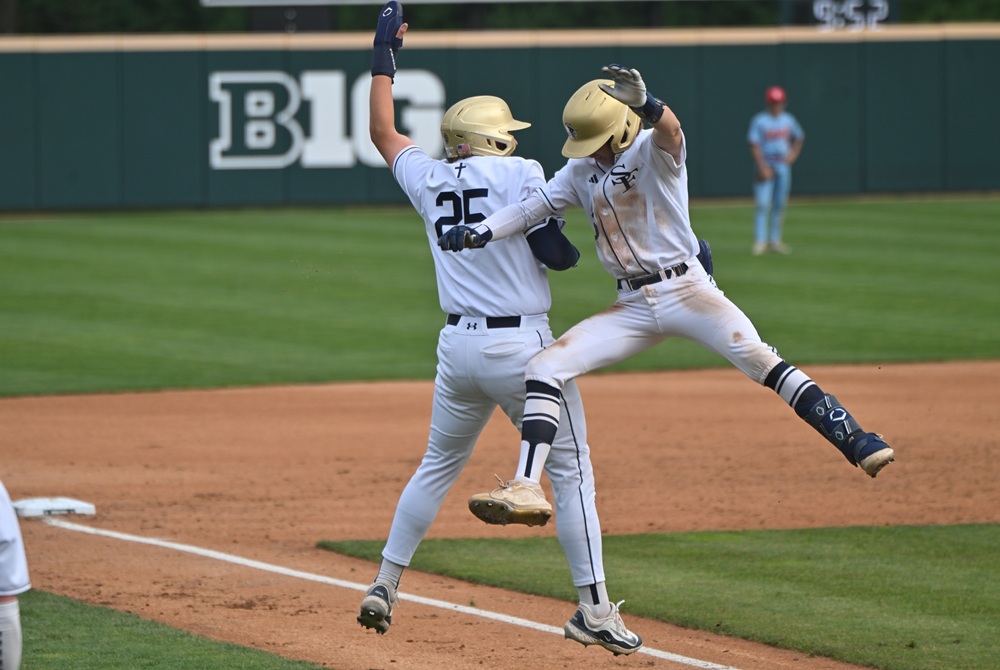
PHOTO (Top) Traverse City’s St. Francis’ Matthew Kane (25) and Colton Peterson celebrate a moment during a Semifinal win in 2025.