

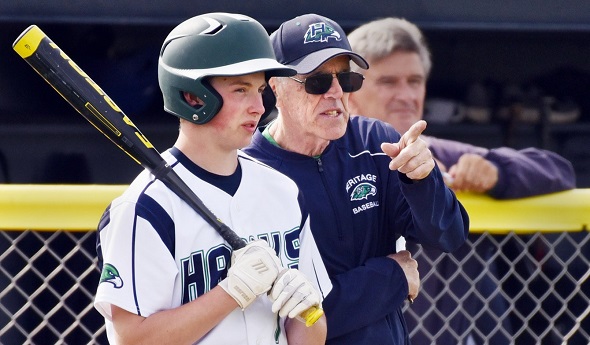
Heritage Coach 'Connects' for Milestone
By
Paul Costanzo
Special for MHSAA.com
May 2, 2017
Baseball has always been a big part of Bob Andrezejewski’s life.
 “I was one of those guys that would sneak a radio in his bed when he was younger to listen to the Tiger ballgame,” Andrezejewski said. “This was back when I was 8, 9, 10-years old. I’ve always been a big baseball fan.”
Half a century later, the enthusiasm for the game is still there for the Saginaw Heritage skipper, who recently became the fourth baseball coach in state history to reach 1,000 career wins.
“I haven’t really tried to stay in coaching to try and get a certain number,” said Andrezejewski, who began his career in Bridgeport in 1970 before coming to Saginaw Heritage in 1996. “There are more positives than any kind of negative that comes up with coaching. Even though I’ve been coaching for a long time, every year is a new year. There are new players, a new direction – that’s just part of the challenge, and it’s exciting.”
Win No. 1,000 came on April 22, when the Hawks – who are now 11-2 on the season – defeated Beal City 12-3 in the Midland Dow Tournament. He entered the season with a 996-440 career record, and joins Pat O’Keefe of Grand Ledge, Larry Tuttle of Blissfield and Frank Sumbera of Grosse Pointe North in the state’s 1,000-win club.
While Andrezejewski said he hasn’t taken the time to think about reaching the milestone, his players certainly knew it was coming up and were excited to be part of the team that helped their coach reach it.
“It’s an honor to be part of the team that got that win for him, but I pitched in that game, so it was even more memorable for me to be able to contribute like that,” Heritage senior Brendan Jackson said. “To do it in that fashion, it really made it even more special.”
Andrezejewski was born and raised in Saginaw and attended Saginaw Arthur Hill High School, where he played football, basketball and baseball. He attended Central Michigan University before coming back to the Saginaw area and joining the Bridgeport baseball coaching staff as the junior varsity coach in 1970. He stayed in that position for three seasons before taking over the varsity position.
In more than 20 seasons at Bridgeport, through the spring of 1994, Andrezejewski had a 449-257 record.
“Then I took a year off – I wanted to concentrate more on my family,” he said. “I took a year off, and the opportunity came and they wanted me to try out for the head baseball job in Heritage, since I lived in the community. I said, ‘OK, I’ll do that for a year or so.’”
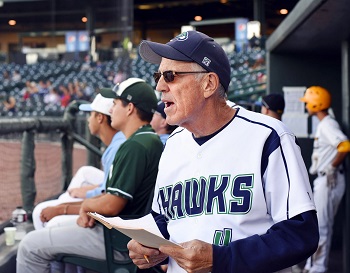 Twenty years, 558 wins, five Saginaw Valley League titles, six District titles, three Regional titles and three MHSAA Semifinal appearances later, Andrezejewski is still at Heritage, and still going strong.
“He’s definitely an old school guy, but in a good way,” Jackson said. “He’s a great leader, and he’s able to motivate his players to get things done, as you can see. He’s able to connect with his players.”
During a career that has spanned more than 40 years, Andrezejewski has plenty of special memories, but didn’t want to single any out as favorites. Instead, he said, it’s the relationships he’s made at both schools that really stick out to him. He still communicates with players he coached in the 1970s, and it’s things like that which stand out more than championships.
“We’ve had teams that were very, very good that went a long ways, and we had teams that were very, very good that didn’t get out of the Districts,” Andrezejewski said. “We’ve had teams that were maybe mediocre that had things click at the right time. That’s what makes baseball so much fun, because it’s so unpredictable. Just because you have a real good team or an average team, it doesn’t mean you’re going to come out on top or make it through. One game should not make the season.”
Perhaps that’s why Andrezejewski’s rallying cry isn’t to go out and win the game, but to go out and play your best. It’s something that has stuck with his players.
“He doesn’t care about winning or losing, he cares about us going out and playing our hardest,” Heritage senior outfielder and pitcher Noah Marcoux said. “He just wants us to go out and give it our best, and winning or losing, that will come.”
It’s a message that has resonated generation after generation for Andrezejewski. So even though he’s coached through five different decades, he’s still reaching and motivating his players.
“I’m a firm believer that baseball is really a timeless sport, and being able to connect through that is really the key to getting your guys fired up and ready to go,” Jackson said. “He has so much baseball wisdom with the experiences he’s had and the teams he’s coached, you can’t not give the guy respect. And even beside that, he’s just a great guy.”
 Paul Costanzo served as a sportswriter at The Port Huron Times Herald from 2006-15, including three years as lead sportswriter, and prior to that as sports editor at the Hillsdale Daily News from 2005-06. He can be reached at [email protected] with story ideas for Genesee, Lapeer, St. Clair, Sanilac, Huron, Tuscola, Saginaw, Bay, Arenac, Midland and Gladwin counties.
PHOTOS: (Top) Heritage coach Bob Andrezejewski reached 1,000 wins as a high school baseball coach April 22; here he instructs Devin Sutter before his at bat against Flint Carman-Ainsworth on April 24. (Middle) Andrezejewski was selected to be part of the coaching staff for the first North/South Baseball Classic with high school players from Bay City and Saginaw taking on players from Flint on July 15, 2015, at Dow Diamond. (Photos by Lamont Lenar/Township View).
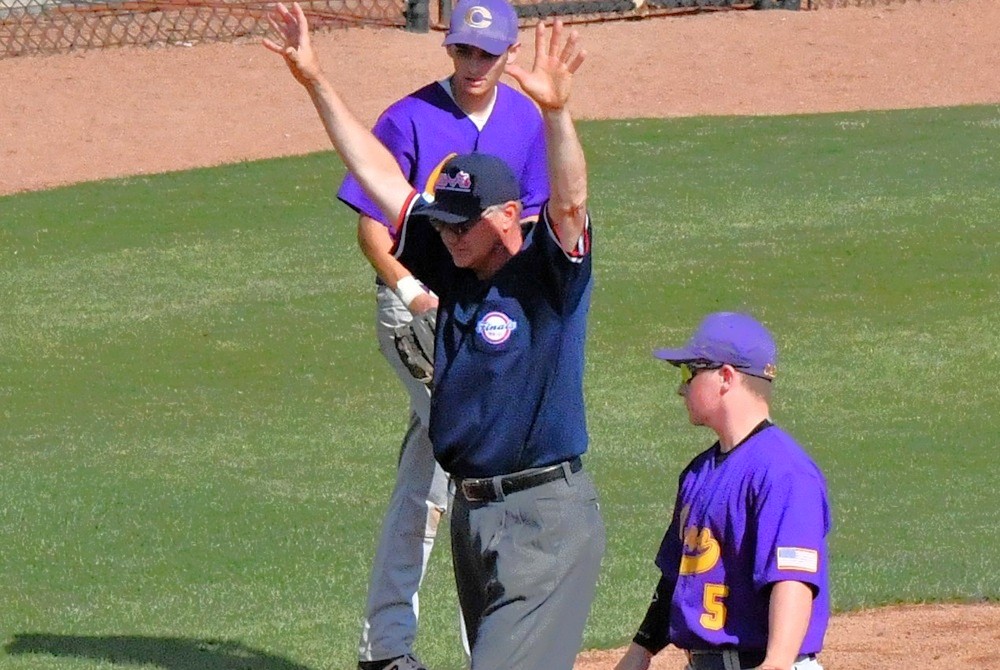
Be the Referee: Injured Runner
By
Paige Winne
MHSAA Director of Brand Management
April 21, 2026
Be The Referee is a series of short messages designed to help educate people on the rules of different sports, to help them better understand the art of officiating, and to recruit officials.
Below is this week's segment – Injured Runner - Listen
We have a baseball scenario for you today:
Your team is down one in the ninth and you are standing on second base when your teammate hits a mammoth game-winning home run.
You are understandably excited. But – in your excitement of rounding the bases – you trip on third base and tear your Achilles tendon. You are unable to get up and continue to home plate.
The home run hitter stops at second base – unsure of where to go.
Because you are entitled to the next base on a home run, your team is able to bring in a pinch runner for the injured runner, and that person can finish running the bases and cross home plate.
The home run hitter can then continue rounding the bases and score the winning run.
Previous 2025-26 editions
April 14: Officiate Michigan Day - Listen
March 11: Basketball Replay - Listen
March 3: Over the Back - Listen
Feb. 24: Wrestling Out-of-Bounds - Listen
Feb. 17: Backwards Skiing - Listen
Feb. 10: Faking Being Fouled - Listen
Feb. 3: Bowling Pins - Listen
Jan. 27: Ski Gates - Listen
Jan. 20: Cheer Judges - Listen
Jan. 13: Basketball Over the Back - Listen
Jan. 6: Bowling Ball Bounces Out of Gutter - Listen
Dec. 9: Puck on Goal Netting - Listen
Dec. 2: Goaltending vs. Basket Interference - Listen
Nov. 25: Football Finals Instant Replay - Listen
Nov. 18: Volleyball Libero Uniforms - Listen
Nov. 11: Illegal Substitution/Participation - Listen
Nov. 4: Losing a Shoe - Listen
Oct. 28: Unusual Soccer Goals - Listen
Oct. 21: Field Hockey Penalty Stroke - Listen
Oct. 14: Tennis Double Hit - Listen
Oct. 7: Safety in Football - Listen
Sept. 30: Field Hockey Substitution - Listen
Sept 23: Multiple Contacts in Volleyball - Listen
Sept. 16: Soccer Penalty Kick - Listen
Sept. 9: Forward Fumble - Listen
Sept. 2: Field Hockey Basics - Listen
Aug. 26: Golf Ball Bounces Out - Listen