


- Baseball
- Girls Soccer
- Softball
- Girls Track & Field
- Boys Track & Field
- Boys Tennis
- Girls Tennis
- Girls Golf
- Boys Golf
- Girls Lacrosse
- Boys Lacrosse
- MHSAA News
Lacrosse Finals Move to U-M Among Headlines as Spring Sports Ramp Up
By
Geoff Kimmerly
MHSAA.com senior editor
April 9, 2024
The Girls & Boys Lacrosse Finals will be played at University of Michigan Lacrosse Stadium for the first time, one of the most notable changes for this season as sports ramp up for more than 100,000 athletes anticipated to participate this spring for Michigan High School Athletic Association member schools.
The MHSAA sponsors postseason competition each spring in baseball, girls and boys lacrosse, girls soccer, softball, girls and boys track & field, boys golf (Lower and Upper Peninsula) and girls golf (UP), and girls (LP) and boys (UP) tennis.
The U-M Lacrosse Stadium opened for competition in 2018 and seats 2,000 spectators. The Girls Lacrosse Finals will be played Friday, June 7, with Division 1 at 4 p.m. and Division 2 at 7 p.m. The Boys Lacrosse Finals will be played the following day, June 8, with Division 2 at 11 a.m. and Division 1 at 2 p.m.
Girls lacrosse also has a significant format adjustment this season, as games will be played with four 12-minutes quarters instead of the previous two halves, in part to allow coaches more opportunities to provide direct instruction during a game. Two more rules changes are expected to improve flow of play – players awarded a free position outside of the critical scoring area no longer must come to a stop and settled stance before self-starting, and false start penalties outside the critical scoring area have been eliminated.
Several more rules changes will be noticeable this spring:
In boys lacrosse, a change was made to enhance player safety. Play will stop immediately any time a player’s helmet comes off, and that player may not return until the next dead ball after play continues.
Fair and legal starts are a continued emphasis for track & field, and a rule change will allow for movement before the start of the race as long as a competitor does not leave their mark with a hand or a foot after the “set” command, or make forward motion before the starting device is activated.
A significant rule change in softball alters pitch delivery mechanics. The pitcher may now have both feet off the ground at the same time when releasing the ball as long as both feet remain within the 24-inch width of a pitching plate and the pitcher does not replant the pivot foot before delivering the pitch.
Another change in softball requires that a playbook/playcard be worn on the wrist or kept in a back pocket to reduce distractions. If worn by the pitcher, the equipment must be worn on the non-pitching arm. Similarly in baseball, a wristband with plays or instructions will be permitted but must be a single, solid color, and for pitchers may not contain the colors white or gray or be otherwise distracting. Baseball players must wear this wristband on the wrist or forearm, and pitchers may wear one only on their non-pitching arm.
Also in baseball, a rule change allows for one-way communication devices worn by the catcher to receive instructions from the dugout while on defense, for the purpose of calling pitches. The coach must be inside the dugout/bench area to use the communication device.
Golfers now are required to participate in at least four competitions for the high school team prior to representing that school team in an MHSAA Regional or Final. Those four regular-season competitions may be 9 or 18-hole events.
In tennis, for the first time in Lower Peninsula play, a No. 1 doubles flight from a non-qualifying team will be able to advance from its Regional to Finals competition. To do so, that No. 1 doubles flight must finish first or second at its Regional, and the No. 1 singles player from that team also must have qualified for the Finals individually by finishing first or second in Regional play.
On the soccer pitch, two officiating-related changes will be especially noticeable. Officials now may stop the clock to check on an injured player without that player being required to leave the match – previously that player would have to sub out. Also, categories for fouls have been redefined: careless (which is a foul but does not receive a card), reckless (a foul with a yellow card) and excessive force (foul with red card).
The 2023-24 Spring campaign culminates with postseason tournaments, as the championship schedule begins with the Upper Peninsula Girls & Boys Golf and Boys Tennis Finals during the week of May 27 and wraps up with Girls Soccer, Baseball and Softball Finals on June 15. Here is a complete list of winter tournament dates:
Baseball
Districts – May 23-June 1
Regional Semifinals – June 5
Regional Finals, Quarterfinals – June 8
Semifinals – June 13-14
Finals – June 15
Golf
LP Boys Regionals – May 28-June 1
UP Girls & Boys Finals – May 29, 30, 31 or June 1
LP Boys Finals – June 7-8
Boys Lacrosse
Pre-Regionals – May 10-15
Regionals – May 16-29
Quarterfinals – May 31 or June 1
Semifinals – June 5
Finals – June 8
Girls Lacrosse
Pre-Regionals – May 16-18, or May 20
Regionals – May 22-June 1
Semifinals – June 5
Finals – June 7
Girls Soccer
Districts – May 22-June 1
Regionals – June 4-8
Semifinals – June 11-12
Finals – June 14-15
Softball
Districts – May 23-June 1
Regionals – June 8
Quarterfinals – June 11
Semifinals – June 13-14
Finals – June 15
Tennis
LP Girls Regionals – May 15-18
UP Boys Finals – May 29, 30, 31 or June 1
LP Girls Finals – May 31-June 1
Track & Field
Regionals – May 16-18
Finals – June 1
Generations of Dedication, Pride Fuel Milford's 34-Year Regional Hosting Run
By
Steve Vedder
Special for MHSAA.com
May 22, 2026
It may seem a bit of a stretch on the surface, but it makes perfect sense to Brian Salyers.
How can planning a wedding feature work much along the same lines as a school hosting an MHSAA Lower Peninsula Regional track meet for 34 straight seasons?
Easy, contends Salyers. Both take an immeasurable amount of planning.
"I have a couple friends who planned a wedding," said Salyers, Milford's girls track coach. "I told them I'd hosted a track meet, and they're so much alike. There are so many things you entrust other people with. There is so much work to be done, you're hoping things go smoothly."
Like a wedding, Salyers said Milford takes great pride in the event's final outcome. The meet's philosophy includes more than being a stepping stone of funneling deserving athletes along to the MHSAA Finals. At Milford, Salyers said organizers have worked diligently for more than three decades to ensure the participants not only leave with lifelong memories, but also that the meet brings together an entire community.
Volunteers from the school work alongside Milford natives not connected in any way to a track program in a multitude of roles from timing races to rototilling and raking long jump pits, selling dogs and T-shirts and taking tickets. Alumni from up to 45 years ago faithfully return to the school to pitch in whenever needed while also taking a moment to rehash old memories with former track teammates.
 Put it all together, Salyers said, and the meet is special.
"It's a melting pot," Salyers said of the mostly unpaid volunteers who work the meet. "It's like, who can come and do it this year? It's not always a fluid list because we pull from such a large group."
The large group has been banding together since 1993. Started by former Mavericks track and cross country coach Gene Balawajder, the school hosted its first Regional in 1988. After moving to a nearby site for a couple years, the Regional landed back at Milford for keeps 34 years ago. Whether it was those first Regionals in the late 1980s or the three and a half decades since, Salyers said the school and community's philosophy hasn't wavered: Take care of the athletes foremost, but also bring the community together to ensure that care happens by organization, identifying issues and swiftly taking action to solve problems.
Milford athletic director James Marszalek said the school handily recruits about 30 people for various positions, only a "handful," he said, who are paid. He said the key to ensuring a smooth meet begins with the volunteers and longtime meet organizer Chris Ceresa, a former athletic director and current assistant coach.
"The No. 1 thing is making sure we have competent people in the right positions and that we make sure it's a day the kids will remember," he said. "But it definitely takes an army."
Ceresa said much of the meet's success comes down to planning and the unselfishness of alumni. For instance, at this year's meet there were five alumni working the long jump, four on the throwing events and two on both the high jump and pole vault as well as many involved as timers.
Ceresa begins recruiting for the following year's Regional at the current event. There he seeks commitments from officials and event workers 12 months in advance.
"We take it very personally; the staff is very committed to the meet," he said. "If you talked to our colleagues at other schools, I think they would tell you they love to come here. It's quite a spectacle, a matter of pride."
The meet even features an unofficial system of where and how volunteers are used. Meet newcomers typically start out in smaller roles, eventually working themselves into the meet's most prestigious position: being an official timer for races. Unfortunately, when the meet became the last Regional in the state to go to electric timing more than a dozen years ago, there was no need for about 20 volunteers who worked as hand timers at the finish line.
 Milford boys track coach Eric Hincka ran in the meet as a junior and senior before graduating in 1998. He said while some Regionals typically run more smoothly than others, because of the hours upon hours of organization and the quality of the volunteers, the Milford event annually draws praise from visiting coaches and participants. And that's no accident, he said.
"Every year you hear horror stories of meets which have problems," he said. "We try our best to see that everything is done right so we don't run into problems. We want to honor the kids – it's our philosophy and we take pride in it.
"At Milford, it's multi-generational. Gene as the founder set the standard, and we're just trying to follow in his footsteps."
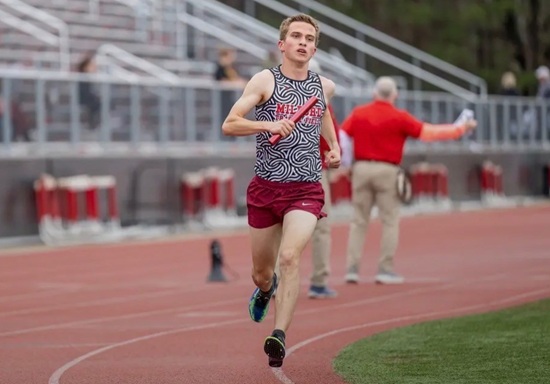
The athletes notice, Milford senior distance runner Kyle O'Rourke said. Headed to run at Michigan State next season, O'Rourke's pedigree in the meet is three-generational. His grandfather has clerked and also made T-shirts for volunteers while O'Rourke has had an older brother and sister run at the Regional. His mother also ran in the meet.
"It's touching for me to see all the old alumni to come back and work; a highlight of the season," said O'Rourke, a six-time all-stater in track and cross country. "They treasured their time here, and now many of them are part of a community that unites to make this meet run well.
"Yeah, it comes in handy (competitive-wise) that this meet is home for us. But there is also a certain pride in us hosting it. I think we all take pride in how we conduct ourselves at the Regional."
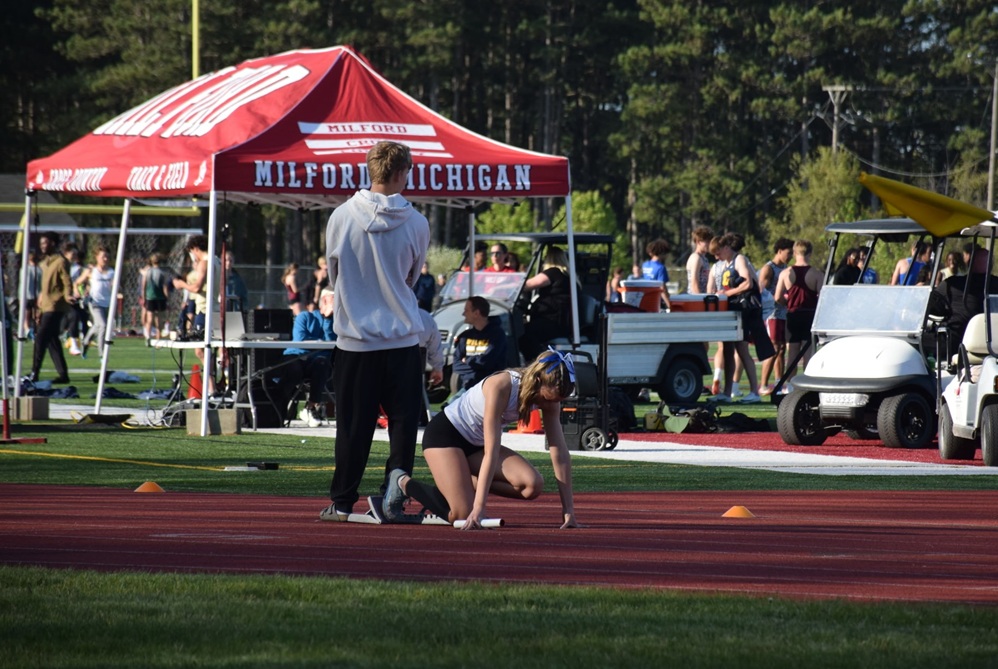
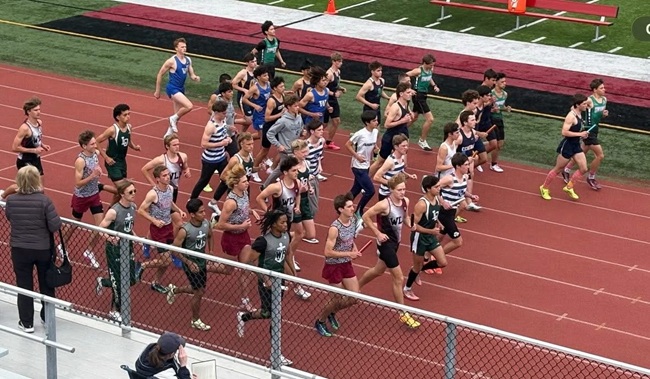
PHOTOS (Top) A relay runner sets up in a starting block during the Lower Peninsula Division 1 Regional hosted by Milford on May 15. (Middle) Runners move toward the starting line before their relay. (Below) Milford’s Kyle O’Rourke rounds a curve during a relay. (Photos courtesy of the Milford athletic department.)