


- Baseball
- Girls Soccer
- Softball
- Girls Track & Field
- Boys Track & Field
- Boys Tennis
- Girls Tennis
- Girls Golf
- Boys Golf
- Girls Lacrosse
- Boys Lacrosse
- MHSAA News
Lacrosse Finals Move to U-M Among Headlines as Spring Sports Ramp Up
By
Geoff Kimmerly
MHSAA.com senior editor
April 9, 2024
The Girls & Boys Lacrosse Finals will be played at University of Michigan Lacrosse Stadium for the first time, one of the most notable changes for this season as sports ramp up for more than 100,000 athletes anticipated to participate this spring for Michigan High School Athletic Association member schools.
The MHSAA sponsors postseason competition each spring in baseball, girls and boys lacrosse, girls soccer, softball, girls and boys track & field, boys golf (Lower and Upper Peninsula) and girls golf (UP), and girls (LP) and boys (UP) tennis.
The U-M Lacrosse Stadium opened for competition in 2018 and seats 2,000 spectators. The Girls Lacrosse Finals will be played Friday, June 7, with Division 1 at 4 p.m. and Division 2 at 7 p.m. The Boys Lacrosse Finals will be played the following day, June 8, with Division 2 at 11 a.m. and Division 1 at 2 p.m.
Girls lacrosse also has a significant format adjustment this season, as games will be played with four 12-minutes quarters instead of the previous two halves, in part to allow coaches more opportunities to provide direct instruction during a game. Two more rules changes are expected to improve flow of play – players awarded a free position outside of the critical scoring area no longer must come to a stop and settled stance before self-starting, and false start penalties outside the critical scoring area have been eliminated.
Several more rules changes will be noticeable this spring:
In boys lacrosse, a change was made to enhance player safety. Play will stop immediately any time a player’s helmet comes off, and that player may not return until the next dead ball after play continues.
Fair and legal starts are a continued emphasis for track & field, and a rule change will allow for movement before the start of the race as long as a competitor does not leave their mark with a hand or a foot after the “set” command, or make forward motion before the starting device is activated.
A significant rule change in softball alters pitch delivery mechanics. The pitcher may now have both feet off the ground at the same time when releasing the ball as long as both feet remain within the 24-inch width of a pitching plate and the pitcher does not replant the pivot foot before delivering the pitch.
Another change in softball requires that a playbook/playcard be worn on the wrist or kept in a back pocket to reduce distractions. If worn by the pitcher, the equipment must be worn on the non-pitching arm. Similarly in baseball, a wristband with plays or instructions will be permitted but must be a single, solid color, and for pitchers may not contain the colors white or gray or be otherwise distracting. Baseball players must wear this wristband on the wrist or forearm, and pitchers may wear one only on their non-pitching arm.
Also in baseball, a rule change allows for one-way communication devices worn by the catcher to receive instructions from the dugout while on defense, for the purpose of calling pitches. The coach must be inside the dugout/bench area to use the communication device.
Golfers now are required to participate in at least four competitions for the high school team prior to representing that school team in an MHSAA Regional or Final. Those four regular-season competitions may be 9 or 18-hole events.
In tennis, for the first time in Lower Peninsula play, a No. 1 doubles flight from a non-qualifying team will be able to advance from its Regional to Finals competition. To do so, that No. 1 doubles flight must finish first or second at its Regional, and the No. 1 singles player from that team also must have qualified for the Finals individually by finishing first or second in Regional play.
On the soccer pitch, two officiating-related changes will be especially noticeable. Officials now may stop the clock to check on an injured player without that player being required to leave the match – previously that player would have to sub out. Also, categories for fouls have been redefined: careless (which is a foul but does not receive a card), reckless (a foul with a yellow card) and excessive force (foul with red card).
The 2023-24 Spring campaign culminates with postseason tournaments, as the championship schedule begins with the Upper Peninsula Girls & Boys Golf and Boys Tennis Finals during the week of May 27 and wraps up with Girls Soccer, Baseball and Softball Finals on June 15. Here is a complete list of winter tournament dates:
Baseball
Districts – May 23-June 1
Regional Semifinals – June 5
Regional Finals, Quarterfinals – June 8
Semifinals – June 13-14
Finals – June 15
Golf
LP Boys Regionals – May 28-June 1
UP Girls & Boys Finals – May 29, 30, 31 or June 1
LP Boys Finals – June 7-8
Boys Lacrosse
Pre-Regionals – May 10-15
Regionals – May 16-29
Quarterfinals – May 31 or June 1
Semifinals – June 5
Finals – June 8
Girls Lacrosse
Pre-Regionals – May 16-18, or May 20
Regionals – May 22-June 1
Semifinals – June 5
Finals – June 7
Girls Soccer
Districts – May 22-June 1
Regionals – June 4-8
Semifinals – June 11-12
Finals – June 14-15
Softball
Districts – May 23-June 1
Regionals – June 8
Quarterfinals – June 11
Semifinals – June 13-14
Finals – June 15
Tennis
LP Girls Regionals – May 15-18
UP Boys Finals – May 29, 30, 31 or June 1
LP Girls Finals – May 31-June 1
Track & Field
Regionals – May 16-18
Finals – June 1
Rivalry Swings Back to Westwood as Patriots Earn 1st Finals Title Since 2021
By
Jason Juno
Special for MHSAA.com
October 1, 2026
NEGAUNEE — Ishpeming Westwood and Negaunee are 10 minutes apart, so they play plenty of tennis against each other whether it’s routine dual meets or the bigger ones with conference and Upper Peninsula championships on the line.
The Miners have been the one winning those meaningful meets lately with the last four U.P. Division 1 titles to their name.
This, however, was Westwood’s year.
The Patriots won the U.P. Finals on Tuesday for the first time since 2021, the last championship before Negaunee’s streak started, with wins in five of the day’s eight flights.
Their mentality was the key to their success this year, coach Sarah Zindler said, and it showed in the way they went up against the Miners.
“They weren’t scared to play Negaunee; they were excited to play Negaunee,” she said. “They were up for the challenge, they wanted to compete. When they were down in a match, they had that mentality of, ‘I can still win this,’ not the defeated (attitude) after you lose a point. That can sometimes be hard, especially for seniors on a U.P. Finals day where they know it’s their last matches.”
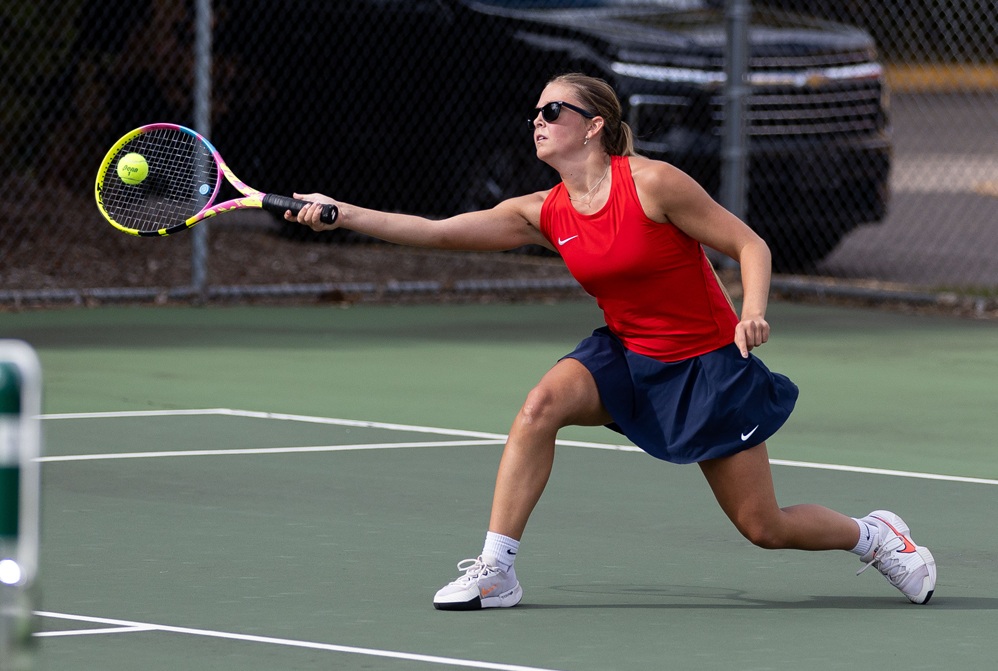
Eliisa Doney is one of those seniors. She talked about seeing Negaunee lifting up trophies in front of them in recent years. So, yeah, this one felt pretty good.
But regardless of the rivalry, she won at No. 2 singles after playing doubles the majority of her career. Her last memories of high school tennis at Westwood are pretty good.
“I’ve never been (a U.P. champion) individually or as a team before, so it’s an incredible feeling that I’ve never felt before,” she said.
Doney played doubles as an underclassmen, missed her junior year with an injury and then filled a spot as Westwood battled other injuries this season. She beat Negaunee’s Addie Chapman 6-2, 7-5 in their flight final Wednesday.
“She just took on the challenge and her first couple matches were a little rocky, but she had that competitive attitude of, ‘I’m gonna figure it out,’” Zindler said. “And now she’s a U.P. champ.”
So are many of her teammates.
Westwood’s Emmi Carlson won No. 3 singles and finished the season with just one loss. Despite that, she trailed Negaunee’s Lucy Rogers 5-2 in the first set of the final.
“And she told us, ‘I got this, I’m gonna win this set 7-5,’” Zindler said. “And she won the set 7-5. And that’s how she’s been all season. If she loses three or four games, she’s like, ‘It’s fine, no big deal, I got this.’”
Carlson won 7-5, 6-2.
Westwood’s Isabel Belpedio beat Negaunee’s Katie Carlson in their final to become the No. 4 singles champion. Belpedio went undefeated in her first year on varsity.
“I played a calm, consistent game,” she said. “I just played my best, and I gave what I had. It feels pretty great … like all the hard work I put in definitely (paid) off.”
“She has also just been steady and confident and knows how to play her game, doesn’t try to do too much and doesn’t let the other girls get in her head,” Zindler added.
The No. 3 doubles team of Emerson Williams and Samiah LaFreniere came out on top over Negaunee’s Bree Helppi and Audrey Hahn in their final despite entering as the third seed. They had lost to Negaunee just last week.
Williams was a part of the winning No. 4 doubles team last year. Since then, she suffered an injury and had to play this entire season left-handed, which is her non-dominant hand.
“They played a great semifinal match, and then in finals just looked like they were confident. They played the net well, they played smart from the back,” Zindler said. “They weren’t the unexpected victory but the wild card that we really needed today for our team.”
The winning No. 4 doubles team was Westwood’s freshmen Jenna Marana and Brie Mahaffey, who just picked up a racket during the summer.
“From the start of the season until now, they have just continually grown and improved,” Zindler said. “I just kept saying, ‘You guys are going to be there, you just got to keep working on it.’ And today, they're the best four doubles team.”
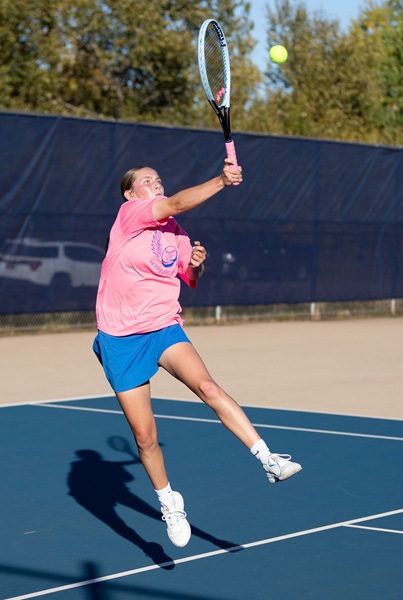
Kingsford junior Aubrie Moore repeated as a U.P. champion with a dominating 6-0, 6-0 win over Escanaba’s Anna Martin at No. 1 singles.
“I’m feeling good, I’m really happy and I’m glad,” Moore said. “It’s my second year, so I’m just really proud of myself. I think I really improved on my serving, and my forehand has gotten a lot better.”
Moore and the entire team played with “We play for her,” shirts with the initials GM in honor of her mom Ginger, who died after battling cancer earlier this year.
“Obviously my mom was by my side the whole time and helped me get through this and win,” Moore said.
Negaunee’s No. 1 doubles team of Paige O’Donnell and Olivia Richards won as juniors.
O’Donnell said Marquette has been tough for them and she was focused on doing well in their match to help out their entire team.
“We played Marquette a couple times, it’s always been super competitive, always super back and forth, usually going to some tiebreakers,” Richards said. “We were kind of expecting that going into it, but we saw their weaknesses in the first set and we knew we had to capitalize on those while also working together.”
Negaunee’s Maia Brunette and Aubrey Harper defeated Escanaba’s Isabella Noblet and Lily Benetti for the No. 2 doubles title.
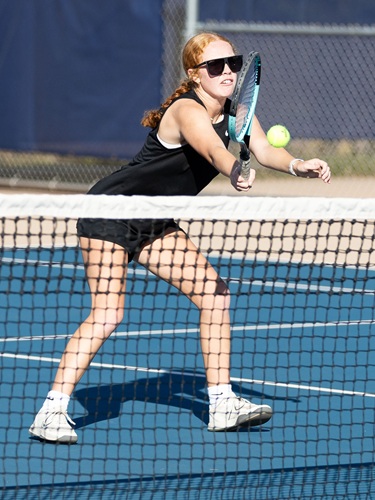
PHOTOS (Top) Ishpeming Westwood’s Eliisa Doney sends a forehand during a match Wednesday at No. 2 singles. (Middle) Kingsford’s Aubrie Moore returns a volley at No. 1 singles. (Below) Marquette’s Charlotte Thomsen reaches out to return a shot. (Photos by Jason Juno.)