

MMA Helps 3-Sporter Shine at BCC
May 3, 2019
By Doug Donnelly
Special for Second Half
BROOKLYN – When Khol Partridge gets some time away from the football field, basketball court and baseball diamond, he knows exactly where he’s going – to relax with some Mixed Martial Arts.
 Partridge is winding down his days as a three-sport athlete at Brooklyn Columbia Central, a Class B school in southeast Michigan’s Irish Hills area. His father Rodney owns Pure Combat, a gym in Cement City that challenges Khol as an athlete, both mentally and physically, in a different way than high school sports do. But, combined, Khol said, it’s made him a stronger athlete and more of a leader.
“In the summertime, I’m in the gym every day,” Partridge said. “It makes you such a better athlete. It improves your attitude, your mindset, your balance, everything about being an athlete.”
Partridge mainly does the Jiu Jitsu form of MMA, not the type that puts him into a ring with another striker, or fighter. But, it’s still intense.
“My dad puts me through all kinds of crazy workouts,” he said. “You get yourself into tough spots in MMA and it makes you have to find a way out of it. That’s one way it helps you in other sports.”
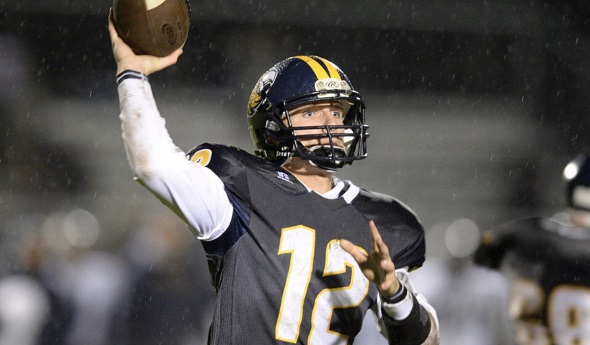
Partridge has been in more than a few tight spots for the Golden Eagles over the last few seasons but has usually found a way to success. The CC football team has gone 23-9 over the last three seasons, making three consecutive playoff appearances. He led the Lenawee County Athletic Association this past season by completing 154-of-257 passes for 2,317 yards and 26 touchdowns. He threw just four interceptions all season. He also ran for 511 yards and nine touchdowns.
CC football coach Josh Kubiak called Partridge an “amazing athlete” and “amazing individual.”
“I could go on about Khol for a long time and tell you about all his stats and achievements,” Kubiak wrote in an e-mail. “In my opinion the best quality Khol has is his leadership skills. I remember back to when he was a freshman on our playoff team. He was the last player on the field after our loss hugging seniors and then came up to me and said, ‘We will be back.’”
The Golden Eagles won their first league football title since 1982 with Partridge at quarterback this past season. He finished with 4,800 career passing yards and a number of CC football records.
 “He has the special talent to get other student athletes to follow him, and he gets the best out of them,” Kubiak said. “He always finds the positive out of the worst situations.”
It’s no surprise that Partridge chose the quarterback position – or, rather, it chose him.
“I was a quarterback since I was really little. I don’t know, maybe it was just because I wanted to be a leader. I’ve always had that mindset. I wanted to be the smartest player on the field, to know what everyone else was doing. My dad always taught me to be a leader, to be the best leader I could be.
“My biggest goal has always been just to be a leader. Leadership is a full-time job. You just have to step up at important times, to be an inspiration to others in the huddle or know when to get after someone and when to just give them a high-five and say, ‘It’s all right. Keep your head up.’”
Partridge got a few looks from colleges and was close to trying to walk on at a Division I school out west. Ultimately, he decided to stay a little closer to home and committed to Ohio’s University of Findlay, a perennial football powerhouse in Division II.
“I got a lot of looks, but nothing seemed to pan out. Then, the Findlay coach hit me up on Twitter,” Partridge said. “They contacted me, so saw tape and I went to visit. They have a great campus. I even did some research, and I know there is a Mixed Martial Arts gym not far from campus.”
In basketball, Partridge was the team’s top scorer in 2018-19, made 48 3-pointers and finished his career with more than 750 points over parts of four seasons. In baseball, he’s one of the team leaders in hitting and is enjoying another season of success.
“I fell in love with football early on in life,” he said. “I always played baseball, too. Me and my buddy, Chase Tompkins, we’ve always played baseball together. I didn’t start playing basketball until later, probably seventh grade.
“If it’s football season, then football is my favorite sport. If it’s baseball season, then baseball is my favorite sport.”
In baseball, Partridge is a middle infielder. When Tompkins pitches, Partridge plays shortstop; otherwise he plays second base.
“We are a really good double-play combination,” he said. “I think last year we turned like 20 double plays together. It’s crazy. We’ve played together a long time. We’ve kind of always been that duo.”
This season, Partridge’s goal is to hit .500.
“The season is going great,” he said. “I’m hitting fairly well, not as well as I want to be hitting, but I’m working hard. Baseball is so mental. You have to be mentally right to play the game.”
Partridge is quick to credit his parents, Rodney and Terri, for his success.
“My dad has been the biggest influence in my life,” he said. “He’s always been someone to look up to. And my mom is the best ever. She keeps my head in line. I’m so blessed to have two parents I can look up to.”
Khol Partridge is excited for the next chapter in life, although he still has some work to do this spring with the CC baseball team. He’s entertaining the idea of trying to walk-on with the Findlay baseball team.
“I definitely think I can,” he said. “Sports are a big part of my life. They always have been. Sports teaches you so much about different aspects in life.”
 Doug Donnelly has served as a sports and news reporter and city editor over 25 years, writing for the Daily Chief-Union in Upper Sandusky, Ohio from 1992-1995, the Monroe Evening News from 1995-2012 and the Adrian Daily Telegram since 2013. He's also written a book on high school basketball in Monroe County and compiles record books for various schools in southeast Michigan. E-mail him at [email protected] with story ideas for Jackson, Washtenaw, Hillsdale, Lenawee and Monroe counties.
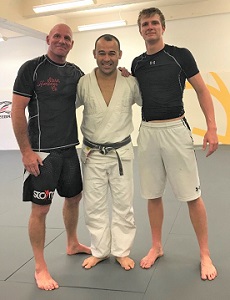
PHOTOS: (Top) Columbia Central’s Khol Partridge unleashes a pass this past fall. (Middle) Partridge, far right, with father Rodney (far left) and renowned Brazilian Jiu-Jitsu competitor Marcelo Garcia. (Photos courtesy of the Partridge family.)

Parking, Entrance Protocols Announced for 2025 11-Player Football Finals
By
Geoff Kimmerly
MHSAA.com senior editor
November 24, 2025
To provide for the convenience and safety of spectators attending the Michigan High School Athletic Association 11-Player Football Finals on Nov. 28 and 30 at Ford Field in Detroit, attendees are being advised of a variety of items related to transportation and security – including policies regarding parking, seating and types of bags allowed into the stadium.
Parking will be available in Ford Field facilities and lots to the east and north of the stadium and costs $8. A map identifying the designated Ford Field lots (4, 5 and 6) and parking deck can be found on the Football page under “2025 Road to the Finals.” (There also are a number of privately-operated parking facilities close to Ford Field, but their pricing may differ.)
Fans also are advised that the consumption of alcohol is prohibited in Ford Field parking facilities and lots, and smoking – including use of electronic cigarettes and vaporizers – is prohibited inside the stadium. Tailgating, including the setting up and use of grilling equipment, also is not allowed.
Tickets are priced at $20 and allow a fan to see all four games in a single day. Tickets are available for purchase at the door (cash or credit accepted), or online from Ford Field via Ticketmaster – links to order tickets both days also are on the MHSAA Website football page. Spectators leaving the stadium will be required to purchase another ticket for re-entry. Babes in arms will be admitted without charge for this event.
Spectators may enter Ford Field at Gates A, D & G. Upon arrival in the building, fans will find their designated seating areas on the South side of the field if their team is the designated home team for their contest and on the North side for the designated visiting team. Home teams this weekend are Detroit Catholic Central, Dexter, DeWitt, Hudsonville Unity Christian, Pontiac Notre Dame Prep, Jackson Lumen Christi, Menominee and Hudson. Brightly-lit video boards above the seating areas will display the names of the participating teams each day, and fans should sit on the side of the stadium where they see their school’s name. For general fans, the entire lower bowl of Ford Field will be open for the event.
Security measures also will be in place to help assure spectator safety. Fans will be subject to metal detector screening, and Ford Field personnel reserve the right to request patrons open their coats, bags and other item-carrying vessels for visual inspection and deny entrance to individuals who do not cooperate. Spectators should remove cell phones, cameras, keys and other large metal objects before passing through the metal detectors.
Items which fans will be prohibited from bringing into the building include, but are not limited to, the following:
* Purses larger than a clutch bag, coolers, briefcases, backpacks, book bags, diaper bags, fanny packs, cinch bags, grocery & paper bags; duffle bags, computer bags or luggage of any kind.
* Aerosol cans (hairspray, mace, pepper spray, etc.)
* Animals (except service animals to aid guests with disabilities)
* Balloons (air or helium)
* Balls (beach balls, footballs, etc.)
* Banners or large flags
* Cameras with lenses longer than five inches or any detachable lens. Selfie Sticks also are prohibited.
* Chairs including folding chairs or stools
* Decals, stickers, confetti or glitter
* Drones and/or remote-controlled aircraft
* Electronic equipment including laptop computers, video recorders (hand-held video cameras are allowed), tripods and wearable video cameras including Go Pros.
* Fireworks
* Flashlights
* Food, beverages – including water – or liquids (cans, bottles, boxes, flasks, etc.)
* Illegal substances
* Knives, pocketknives, box cutters, scissors, etc.
* Laser pointers
* Marijuana including medically prescribed electronic accessories or paraphernalia associated with marijuana or illegal narcotics use.
* Markers (permanent) and/or paint
* Noisemaking devices (bells, horns, kazoos, whistles, etc.)
* Objects that can be used as missiles or projectiles (sticks, poles, bats, clubs, Frisbees, etc.)
* Strollers and infant car seats or carriers
* Umbrellas (large size)
* Weapons
* Wrapped gifts
The following items may be permitted after inspection:
* Bags that are clear plastic, vinyl or PVC and do not exceed 12 inches by 6 inches by 12 inches, or a one-gallon clear plastic freezer bag (Ziploc or similar). An exception will be made for medically necessary items after proper inspection at the Gate.
* Infant items in a clear bag (bottles and formula) only if accompanied by a child
* Binoculars and binoculars cases not exceeding 4½ inches by 6½ inches may be brought in via one of the clear plastic bag options.
* Cameras (lenses may not measure longer than five inches or be detachable, and no tripods or extension cords)
* Small radios (no larger than the size of a football and used with an earpiece)
* Small, compact umbrellas (must be placed securely under seat)
* Posters and signs without poles or sticks, or larger than what one person can hold.
* Tablets (iPads, Kindles, etc.)
* Seat cushions not exceeding 15 inches by 15 inches. Seat cushions also must not contain arm rests, zippers, pockets, flaps or metal backs.
The complete list of prohibited items can be found on the Detroit Lions Website. Prohibited items that are discovered during security inspections at stadium entrances must be returned to the owner's vehicle or discarded. Items will not be held for later pickup.
Fans are reminded that all image taking (still and video) may be only for personal, non-commercial use.