

Nori Continuing Minor League Climb Boosted by World Baseball Classic Stardom
By
Steve Vedder
Special for MHSAA.com
April 20, 2026
It wasn't until Dante Nori stood star-struck in the outfield grass at Houston's rollicking Daikin Park that he fully grasped the massive leap he had just accomplished.
Less than two years after helping Northville to its first Division 1 baseball title before a crowd of hundreds at McLane Stadium, Nori last month found himself playing before a partisan crowd of 38,653 against arguably the best club the United States has fielded for the World Baseball Classic.
It's a leap that few other WBC players have made and not only humbled Nori – a member of Italy's national team – but fulfilled a lifelong dream.
"You're sitting out there in left field and you look at your (defensive) shift card and you see names like Bobby Witt or Aaron Judge or Kyle Schwarber, and I was like a little kid," said Nori, who had turned 21 just five months before the start of the tournament. "You see those guys, the crowd is chanting 'USA, USA,' and it's so cool."
Nori's rapid progression from Michigan's Mr. Baseball Award honoree in 2024 to top Philadelphia Phillies prospect to the WBC could be the stuff of which movies are made. A MaxPreps All-American at Northville, Nori was the 27th overall player taken in the 2024 MLB draft. He promptly opened his professional career with 14 games at low Class A Clearwater to finish out the summer.
He began catching the eye of places like MLB.com, where he's ranked seventh among Phillies prospects, and Baseball America, where he's sixth, by sweeping across three levels of the minors in 2025 while hitting .261 with 18 doubles, 12 triples and 52 stolen bases in 62 attempts.
By the time the Phillies opted to send Nori to the prestigious Arizona Fall League last October, representatives from the Italy team scheduled to play in March's WBC were very much interested. Italy and then the Phillies okayed his participation and left the decision to Nori, who called it a no-brainer.
"Right away I said yes," he said. "I've always dreamed of that and when that dream finally comes true, it's great."
Whether it was spearheading Northville to a 2-1 win over Bloomfield Hills Brother Rice at the MHSAA Finals or helping Italy to one of the biggest upsets in WBC history – a stunning 8-6 win over Team USA – Nori said he long ago learned to deal with the pressure of the moment.
 "I've always been the kind that the more pressure there is, the more I calm down," he said. "It doesn't matter if you're playing Salem High School in 30-degree weather or whether it's the WBC, it's still baseball.
"But if you told me that I'd be playing in a high school state championship game and then would be in the WBC, I wouldn't have believed you. The WBC was just great. I enjoyed the heck out of it. It's so nice when a dream comes true."
Nori admits the only time he ever got a bit antsy on a ballfield was when he caught the eye of Northville teammate Joey Broughton, now in the Milwaukee Brewers chain, during the team's 9-2 win over Bay City Western in the 2024 Semifinals. The pair, who combined to score three runs and drive in six that day, were transfixed on what the team was on the verge of accomplishing.
"I remember it was the most I've ever been hyped up," he said, "but it still wasn't about nerves."
Help for Nori in navigating a pressure-filled WBC came from an unlikely source. Italy's roster featured two other former Michigan high school baseball stars in infielder Jon Berti and center fielder Jakob Marsee, who like Nori are both from the Metro Detroit area. Berti, from Troy High School, was a Mr. Baseball finalist and all-stater in 2008 when he batted .467 with a school record 66 hits and 66 stolen bases. Marsee earned 11 varsity letters in three sports before graduating from Allen Park High School in 2019. He was taken by San Diego in the sixth round of the 2022 draft before being traded to Miami.
Nori said the pair provided a steadying influence.
"I knew they were both from Michigan, but I had never met either one," he said. "But my mom and Jakob's mom are friends, so it was kind of cool to bond with him. I had never played left field before, and he helped me with directions in playing out there. It helped me get a feel for playing."
Italy wound up being one of the WBC's best stories, winning its bracket and making the semifinals before finishing 5-1. The team was a combination of veterans such as Royals first baseman Vinnie Pasquantino and Aaron Nola of the Phillies, but also top prospects like Nori and infielders Andrew Fischer and Sam Antonacci.
"If you look at the roster with the prospects and major leaguers, absolutely," he said of making the semifinals. "It was a blend of everything – experience and young talent who worked so well together. We all believed the same way – that we could be in the championship game. We played with a chip on our shoulder."
Nori not only enjoyed the WBC, he excelled. The 5-foot-9, 170-pound speedster wound up leading Italy in hitting with a .400 mark while adding a pair of homers, six RBIs and two stolen bases. His tournament included going 3-for-3 with two runs, two RBIs, a double and a homer against Brazil, a pair of hits and an RBI against Great Britain, a key sacrifice fly against USA and an RBI single against eventual champion Venezuela.
But maybe the biggest honor came after Nori returned home and received a late-night phone call from his father. Nori joined USA's Roman Anthony and Fernando Tatis Jr. of the Dominican Republic on the WBC all-tournament outfield.
"I was asleep about midnight, and I was kinda groggy and the phone goes off," he said. "It's my dad and he never calls that late unless it's important. I'm half asleep and confused and my dad says, "Did you see that?' It still hasn't hit me. You look (at the outfielders), and you see names like Tatis and you're the only minor leaguer on that team. That's something."
With this WBC now in the record books, Nori can now turn his attention to playing for Double-A Reading (Pa.) this summer. He's off to a solid start through the team's first eight games with a .310 batting average, seven extra-base hits and six RBIs.
As for the prospect of playing in the next WBC, Nori finds himself in a rare position. He already has Italy qualification, but since he was born in Canada he could play for that country's national team. Or if his career blossoms, he could one day play for the United States. Actually, Nori said there is little doubt what choice he'd make.
"I thought about that, playing for one of the three," he said. "But with Italy, we created such a relationship and bond that I'm locked in for Italy. There is no way I would leave that group."
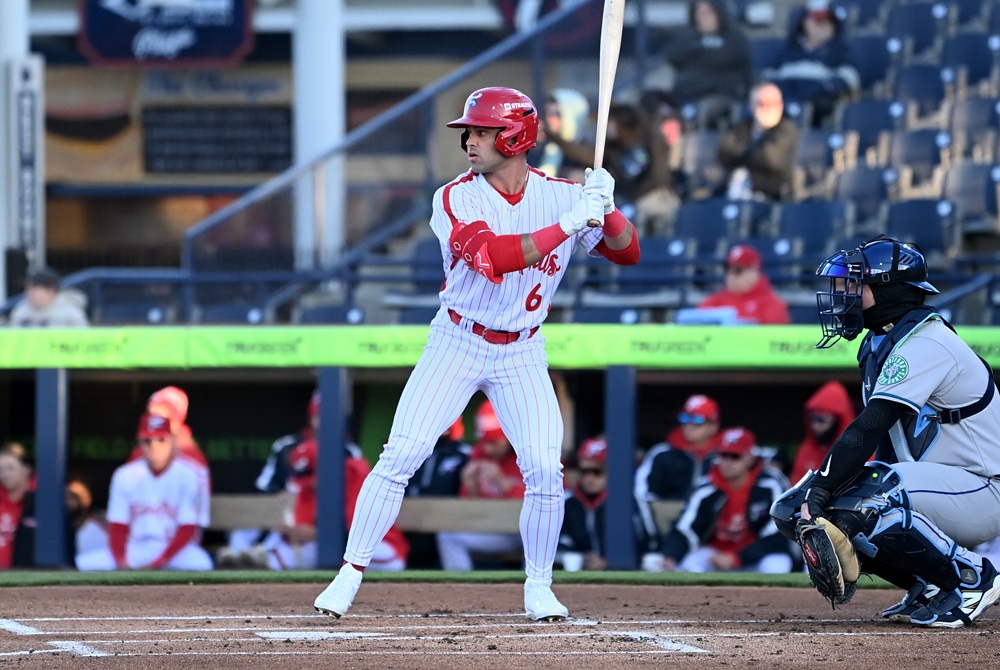
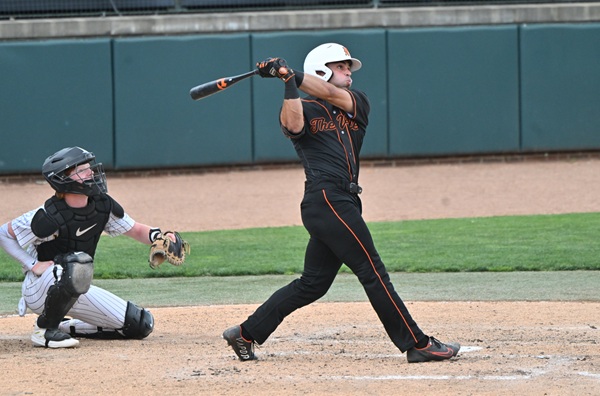
PHOTOS (Top) Dante Nori (6) stands in for the next pitch during an at bat for the Reading Fightin Phils this spring. (Middle) Nori watches the home run he’d just launched travel out of McLane Stadium during Northville’s 2024 Division 1 Semifinal win over Bay City Western. (Top photo courtesy of the Reading Fightin Phils.)
Woodhaven, GP South Slug to Semifinal Wins
By
Tom Markowski
Special for Second Half
June 14, 2018
EAST LANSING – The best season in Brownstown Woodhaven’s history just got better.
Woodhaven, which had never won a District baseball title before this spring, defeated perennial powerhouse Birmingham Brother Rice 7-3 in a MHSAA Division 1 Semifinal on Thursday at McLane Stadium on Michigan State’s campus.
Colin Czajkowski’s two-run homer broke a 1-1 tie in the third inning, and senior lefthander Drew Szczepaniak allowed five hits in 6 2/3 innings and survived a bases-loaded situation in the top of the fifth to earn the victory.
Woodhaven set a state record earlier this season when it recorded 60 consecutive scoreless innings, which included eight consecutive shutouts. The pitching staff has continued to compete at a high level in the tournament, allowing 12 runs over seven games.
But, defensively, Woodhaven had its difficulties Thursday. The Warriors committed four errors, two in the fifth inning and two in the sixth. The two in the sixth led to Brother Rice’s only run. The two in the fifth helped Brother Rice load the bases with two outs. Szczepaniak got the last out on a pop up to third basemen Zach Biggs.
“In a game like this, you have to put (the errors) aside,” Szczepaniak said. “In the end, if you dwell on it, it won’t do you any good. Yes, I had to stay patient.
“Hey, we’re Woodhaven. We hadn’t won a District until this year. Everything is going so fast, and we’re just trying to take it one day at a time.”
Czajkowski agreed. No one expected Woodhaven to be in a Semifinal let alone the Division 1 championship game, so this is all new.
“We just got to keep level-headed,” he said. “That home run, things were definitely different. Definitely, beating a team like Rice is something special.”
Saturday’s Final, for just the second time in Division 1/Class A history, will feature two teams from Wayne County as Woodhaven (34-5) will play Grosse Pointe South (32-12) at 11:30 a.m.
The other time two Wayne County teams played for the title was in 2006, when Grosse Pointe North defeated Detroit U-D Jesuit 7-5.
To Woodhaven coach Corey Farner, it didn’t matter whom his team was playing Thursday. After all, this is Woodhaven. There isn’t anything with which to compare what his team and the community are going through.
“I didn’t care who we played,” Farner said. “They have a storied history. We’re Woodhaven. We’re not supposed to be here.
“That home run was huge. It was a 1-1 game at that time. It’s someone different every game coming through.”
Woodhaven could be without starting catcher Justin Charron in the Final. As he stopped at second base after batting in a run with a double, he slid awkwardly and left the game. Farner confirmed that Charron injured his right ankle, and his status for Saturday is uncertain.
Carson MacDonell replaced Charron, threw out a base runner attempting to steal and had an RBI single.
Like Farner said, it’s a different player each game.
Brother Rice (31-9), attempting to reach its first Final since 2013, used a handful of pitchers. But it seemed that no matter who coach Bob Riker pitched, Woodhaven’s batter were ready.
“They just out-pitched us,” Riker said. “We just didn’t get that big hit. When we tied it at 1-1, I said, ‘Ok, here we go.’ Then the guy hits that two-run bomb.”
Grosse Pointe South 10, Midland 0
South scored eight runs in the sixth inning of the first Division 1 Semifinal. Nathan Budziak went all six innings on the mound and allowed three hits, no walks and he struck out seven. He’s pitched three shutouts in his three tournament starts and has struck out a combined 29 hitters.
 He was in a groove again, and Midland had no answer for him.
“He’s been lights out,” South coach Dan Griesbaum said of Budziak. “Winning 10-0, it’s unreal. We’re hitting over .300 as a team, but we weren’t hitting well early in the season. Maybe it was the weather.”
South had 14 hits paced by Cameron Mallegg with three. Joseph Naporani had three RBI and was one of four players with two hits.
Budziak, and Saturday’s expected starting pitcher, Cameron Shook, both suffered injuries during the season that had each out for a month. Budziak suffered a broken thumb on his left (throwing) hand and returned three weeks ago. Shook suffered a dislocated kneecap and made his first start since his return Tuesday, a 9-1 Quarterfinal victory over Macomb Dakota.
“The other players stepped up after (the two injuries),” Griesbaum said. “It wasn’t just the pitchers. It was a total team effort.”
Saturday’s will be South’s third Final appearance. The Blue Devils won their only title in 2001.
Midland (30-12) used three pitchers. Garrett Willis went the first five innings, giving up four earned runs, and took the loss to finish 10-3 this spring.
VIDEO: Grosse Pointe South tallied eight runs in the sixth inning; here's the two-run single by Giovanny Lutfy that ignited the rally.
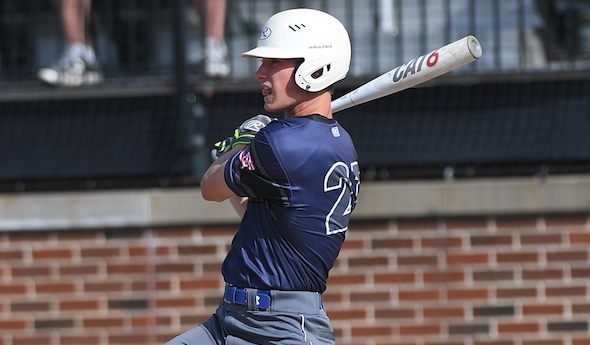
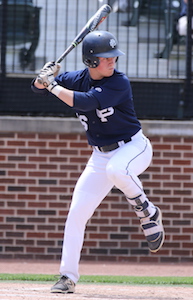
PHOTOS: (Top) Brownstown Woodhaven’s Drew Szczepaniak turns on a pitch during Thursday’s Semifinal win over Brother Rice. (Middle) Cameron Mallegg eyes an offering during Grosse Pointe South’s victory.