

Opponent 'Pinch Hits' as Translator
May 9, 2016
By Butch Harmon
Special for Second Half
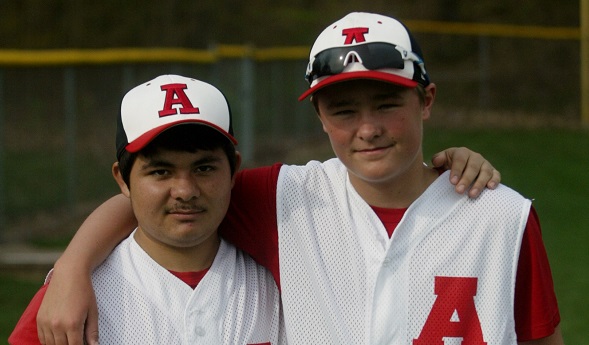
ALLENDALE – A few weeks after Forest Hills Northern second baseman Mitchell Gumbko “pinch hit” to help Allendale pitcher Javier Gonzalez bridge a language gap during a freshman baseball game, their story of sportsmanship continues to spread around the Grand Rapids area and beyond.
Pitching in his first high school game as a member of the Allendale freshman baseball team against Grand Rapids Forest Hills Northern on April 18, Gonzalez was in a jam. Not only did he walk the first batter he faced, but he then committed a balk. With the umpire coming out to the mound to explain the situation, the jam only worsened as Gonzalez – who has been in the United States for only just over a year – speaks very little English.
In a society where winning is a major emphasis in sports, Gonzalez, however, picked up a major assist from the Northern batter who was due up soon.
Gumbko has been in the Forest Hills Northern school district’s Spanish Immersion program since he was in kindergarten. With Gonzalez continuing to struggle, Gumbko made his way to the mound with the coaches and umpires to give his opponent some help.
“I didn’t realize their pitcher was struggling so much,” Gumbko told Advance Newspapers/MLive last week, “but Coach (Joe) Payne asked if anyone speaks Spanish on our team. I have been in the Spanish Immersion program since kindergarten so I told Coach that I’m fluent in Spanish.”
Gonzalez’ coach Chad DeWeerd was happy for the help from the opposing dugout.
During Allendale practices, DeWeerd has been counting on freshman Cooper Tolson to give all the help he can. But explaining the balk rule required a little more explanation than the rest of the Falcons could offer their teammate.
“Before the game I let the Northern coach know that Javier speaks hardly any English,” DeWeerd also told Advance Newspapers/MLive. “My kids know a little Spanish, but not enough to help in that situation.”
DeWeerd had told Payne beforehand about Gonzalez and the language hurdle. “As I was walking to coach third base, the head coach from Allendale warned me that his pitcher does not speak English and that this is his first time pitching,” Payne said. “I told him not to worry.
“The Allendale pitcher looked nervous and uncomfortable, and you can tell he was unfamiliar with pitching. After walking our first batter, the next pitch he balked, which advanced our runner to second base. I saw the field umpire trying to explain to the pitcher what he was doing wrong, but the pitcher looked at him with a blank look.”
Payne informed the home plate umpire about the situation. After a few more pitches, and with Gonzalez continuing to struggle with the balk rule, Payne called on his player to step in and become a language pinch-hitter.
At Ada Vista Elementary, all subjects are taught in Spanish beginning in the first grade. Gumbko has become fluent in his second language.
“I needed Mitchell to become his coach instead of his opponent,” Payne said. “I asked the Allendale coach if I could call time out and have one my players translate to the pitcher.”
This time the conference on the mound became a lot more beneficial for Gonzalez, who had someone with whom he could communicate – even though he was wearing the opponent’s uniform.
“I think he was pretty surprised and also happy to be able to talk to someone he could understand,” Gumbko said. “The umpire told me what to say to him because he was balking, and he did not know he was doing it. It was pretty awesome to just know that I can use (Spanish) on a daily basis and was cool to realize I was helping him out.”
 “You can tell Javier was nervous and did not know what was going on, until Mitchell started to translate instructions to him in Spanish,” Payne said. “Javier’s eyes just sparkled. Javier just kept nodding yes, ‘Si,’ and at the same time agreeing in Spanish back to Mitchell and understanding what Mitchell was saying.”
While Gonzalez’ teammates are not as familiar with the Spanish language as Gumbko, they have been trying their best to pick up as much as possible.
“The team has really embraced Javy,” DeWeerd said. “The first day of tryouts when they were stretching and loosening up they started counting in Spanish.”
“Cooper knows a little more Spanish than the rest of the guys,” DeWeerd added. “He has tried to help him as much as he can. The guys also have an app on their phone that helps with translation, and they have a lot of fun on the bus rides. This is a really special team and they have embraced Javy, and he really is one of the kids.”
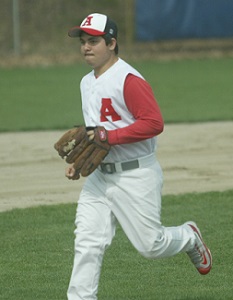
Gonzales and his family of five, who are originally from the southern section of Mexico, have been in the United States for a year and a month. While he also enjoys soccer and was a member of Allendale’s junior varsity soccer team last fall, he has been playing baseball since he was a child and enjoys pitching the most. Along with pitching, Javy also plays right field for the Falcons.
Since the Northern game more people in the Allendale community have learned about Javy’s story – and offered assistance.
“Our 8th-grade Spanish teacher, Mrs. (Lynne) Burns, found out about Javy’s story and sent an e-mail to our athletic director offering to come and help,” DeWeerd said. “She is going to be at our next game. It’s not just the team that has helped out Javy, but the whole school is helping.”
Having Gumbko step up in that first game, however, was an act of sportsmanship that will be remembered for some time.
“I just stopped and realized this is why I am a teacher,” Payne also said in the Advance Newspapers/MLive report. “This is why I coach, for moments like this.”
PHOTOS: (Top) Allendale freshman baseball players Javier Gonzalez (left) and Cooper Tolson. (Middle) Gonzalez jogs on the field during a recent game. (Photos by Butch Harmon.)
Pointes' Pride Instilled by Longtime Leaders
By
Tom Markowski
Special for Second Half
May 31, 2017
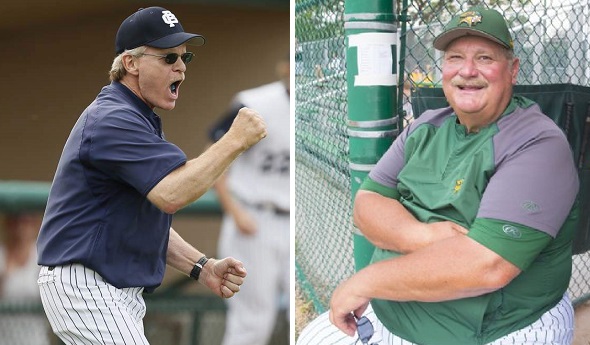
GROSSE POINTE – Neither Frank Sumbera nor Dan Griesbaum were raised in Grosse Pointe.
 But no one, at least at the high school level, has done more to enhance and promote baseball in the Pointes than this long-serving pair.
Sumbera, 69, is in his 45th season as coach at Grosse Pointe North and Griesbaum, 64, is in his 34th season at Grosse Pointe South. In this sport the rivalry that exists between Grosse Pointe’s two public high schools is as good as it gets. Sumbera holds the upper hand in MHSAA Finals titles, 2-1, and Griesbaum has the edge in District titles, 23-14.
This last statistic is notable in a sense that the two programs are often paired in the same District, as they are this season. South will host North in a Division 1 District Semifinal at 10 a.m. Saturday.
This season there is an added twist to the much-anticipated community showdown. Grosse Pointe Woods University Liggett, for the first time, will compete in the Division 1 tournament lined up on the other side of the bracket from North and South. University Liggett will play Detroit East English in the other Semifinal at 11:30 a.m. The winners will play for the title approximately 2 p.m.
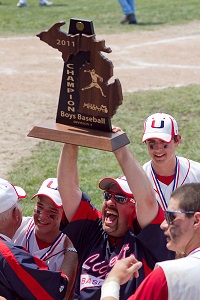
University Liggett won four MHSAA Finals titles the past six seasons, two in Division 4 and two in Division 3, including last season in the latter. Coach Dan Cimini, knowing he had a strong team returning, petitioned the MHSAA to opt up to Division 1 for this season and 2018.
So far the Knights have proven they can hang at the Division 1 level. They are ranked No. 2 in the latest poll released by the Michigan High School Baseball Coaches Association.
And Cimini’s group received a break in the draw as it won’t have to defeat both North and South to win the District title.
This is Cimini’s 14th season as head coach, and he tips his hat to the job Sumbera and Griesbaum have done in laying the groundwork.
“Frank has been there forever,” Cimini said. “Dan has been there a long time. I feel old, and I’m 48. I’ve coached 22 years. No doubt about it, those guys have set the standard.”
Cimini grew up in Grosse Pointe and competed in the city’s strong Little League program. He played for Griesbaum at South and played four years in college, two at Macomb College and two at University of Detroit Mercy. He was part of the 1987 South team that reached the MHSAA Semifinals for the first time in school history.
Cimini said the quality of baseball has remained strong in the community over the years but noted there have been some changes.
“The Little Leagues are phenomenal,” he said. “The Federation ball is phenomenal. But there aren’t as many kids playing. Now there are seven teams playing in the (Little League) majors. Back when I played there were 13 of 14. I miss those days. If I could take myself back, that’s where I’d go.”
At least in the modern era, one must point to Sumbera as the person most responsible for the quality of baseball being played at the high school level.
Sumbera played three sports at Chesaning High – baseball, basketball and football – and then went on to Central Michigan where he played basketball.
 Upon graduation Sumbera went looking for a job and received a tip from a college roommate. Sumbera was told that Grosse Pointe High would be splitting into two schools, North and South, and that they needed teachers, and, naturally, coaches. North opened for the 1968-69 school year, and Sumbera was hired as an assistant junior varsity football coach. In 1973 he became the assistant varsity baseball coach, and the next season he took over the baseball program.
“We won the District that year,” he said. “I’ll never forget it. We beat (then Detroit, now Warren) DeLaSalle, 2-1, in the final.”
Sumbera has coached some of the best teams in the state. His 2006 Division 1 championship team was 38-1. His 1980 Class A championship team was probably his best. Five players on that team were selected in the Major League Baseball amateur draft including Bill Babcock, one of the top pitchers on that team. Babcock’s son, Luke, will enter the ninth grade next fall is expected to enroll at North and play for Sumbera.
That’s the way it is in the Pointes. This large community that borders Detroit’s eastside is infectious. It’s common for someone who grew up here to remain in the area and raise his or her own family.
“A lot of the kids I coached in the 80s, I’m coaching their sons,” Sumbera said. “They play a lot of baseball here. As they grow through the ranks to high school, (Griesbaum) and I have to make cuts. You might have 250 at the Little League level, and by the time I get them we have like eight.
“The North-South rivalry is as good as any around. I coach football, and it’s intense every year. In baseball it’s as good a rivalry as there is in the state. It’ll be the fifth time we will have played South (this season). In our last doubleheader we won the first, 12-6, and lost the second, 3-2, in eight innings. That was a crusher. It’s big. The kids know it. The families know it. They all go to church together and play against each other during the summer.”
Griesbaum, a graduate of St. Clair Shores South Lake and Central Michigan, where he played baseball, said the level of competition is remarkable especially when one considers the schools do not have open enrollment. The only way one can play for North or South is to live in the school district.
Griesbaum got his start as an assistant under Sumbera (1980-83) before going to South in 1984.
“There’s nothing like a North-South game,” he said. “Our rivalry is one of the best. It’s a baseball community. My 6-year-old grandson plays T-ball. You look at what North and South have accomplished. There’s the (Grosse Pointe) Farms and City (Little League) teams. Then there’s the success of the Redbirds that (former Detroit Tiger) Dave Bergman ran. We run a (Christmas) Holiday hitting camp. We have 75 kids the first day and 75 more the next. It’s for the second through the sixth grades. We want to expose baseball at an early age.”
Some have expressed displeasure that all three Grosse Pointe schools are in the same district. Cimini scoffs at that thought. He said there are many districts throughout the state that have more than their share of quality teams.
The last two seasons North and South were in separate Districts, and they won their respective Districts both years. In 2015, they met in a Division 1 Quarterfinal, and South won. It was the Blue Devils’ seventh trip to the Semifinals, a record (tied with Saline and Grand Ledge) for a public school in Division 1/Class A.
Cimini said he’s looking forward to seeing what his team can do against the established powers.
“I can’t wait,” Sumbera said. “The whole thing is, come June 3 you have to be ready to play.”
 Tom Markowski is a columnist and directs website coverage for the State Champs! Sports Network. He previously covered primarily high school sports for the The Detroit News from 1984-2014, focusing on the Detroit area and contributing to statewide coverage of football and basketball. Contact him at [email protected] with story ideas for Oakland, Macomb and Wayne counties.
PHOTOS: (Top) Grosse Pointe South's Dan Griesbaum, left, and North's Frank Sumbera both have led their respective programs for more than three decades (Sumbera for more than four). (Middle) University Liggett coach Dan Cimini played for Griesbaum at South and has built a top program in the community as well. (Photos courtesy of the Griesbaum family, C&G Newspapers and the University Liggett baseball program.