

Over MLB Draft's History, Michigan High Schools Graduate 25 1st-Round Picks
By
Ron Pesch
MHSAA historian
May 6, 2022
Long before today’s travel ball captivated the scene, recreation sandlot baseball programs – often sponsored by local businesses and guided by volunteer coaches – sparked the dreams of countless kids, instilling a love of the game and a hope they might, one day, grace a bubble-gum card.
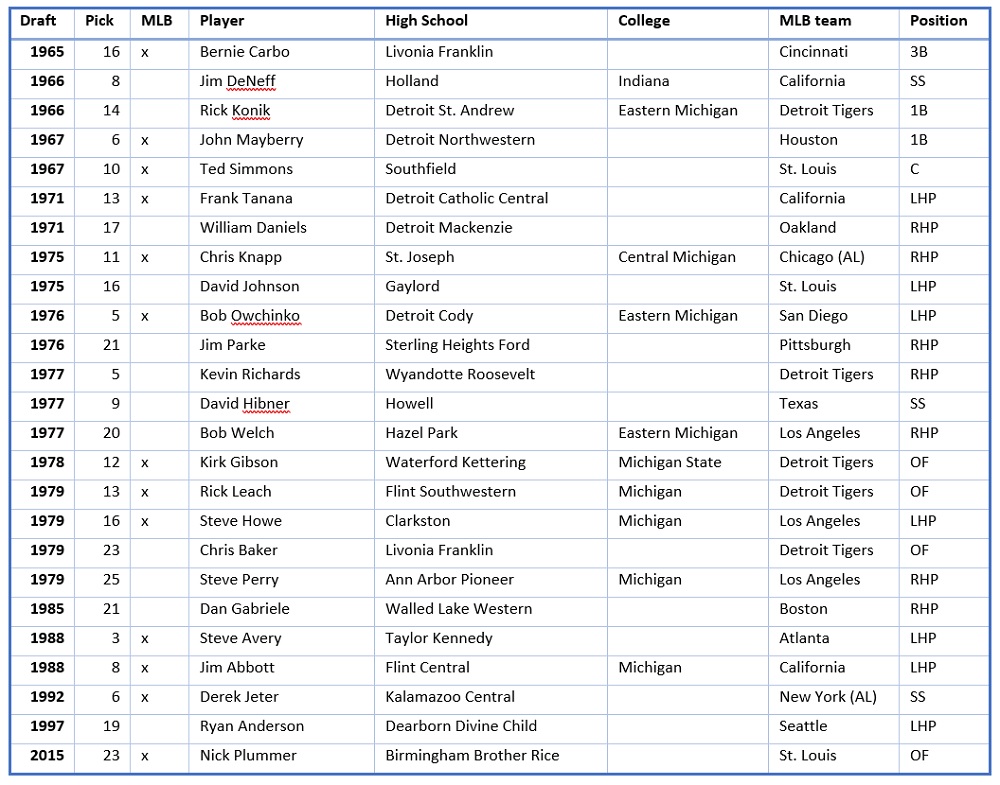
Hundreds of thousands of prep ballgames have been played since Major League Baseball instituted the amateur draft in 1965. Since that time, 25 Michigan high school ballplayers have been chosen in the first round of the league’s annual draft. Without a doubt, Derek Jeter, who played for Kalamazoo Central and spent 20 seasons with the New York Yankees, stands as the most accomplished. Bloomfield Hills Brother Rice’s Nick Plummer is the most recent to join the list. Selected by St. Louis in 2015, the outfielder spent seven seasons in the minors before making his debut this spring with the New York Mets. He is the 13th on the list to see time in the Majors.
The Draft
“Prior to the implementation of the First-Year Player Draft, amateurs were free to sign with any Major League team that offered them a contract,” notes the Baseball Almanac detailing the process’s history. “As a result, wealthier teams such as the New York Yankees and St. Louis Cardinals were able to stockpile young talent, while poorer clubs were left to sign less desirable prospects.
“Originally, three separate drafts were held each year. The June draft, which was by far the largest, involved new high school graduates, as well as college seniors who had just finished their seasons. … A second draft was held in January for high school and college players who graduated in the winter.”
The January draft lasted until 1986. For just the initial two seasons, a draft for players participating in amateur summer leagues also took place.
Navigating the Basepaths
Baseball was a favorite pastime in cities and small towns all across the state years before the turn of the 20th century.
Depending on the time and place where they grew up, the way kids were introduced to playing the game differed.
The Detroit Amateur Baseball Federation (DABF), started in 1915 and active into the 1970s, was a well-organized sandlot program. Split across age groups and classifications, games were played on diamonds spread around the city. Detroit Tigers legend Willie Horton was just one of the sandlot legends to emerge from the DABF, with stories of his performances carving space in Detroit newspapers.
For many others, baseball sponsored by local American Legion posts served as their introduction to organized ball. First proposed at a Legion convention in 1925 in South Dakota, and introduced a year later, Legion baseball had expanded across the nation by 1929.
Little League baseball, famously first organized in 1939 in Williamsport, Pa., targeted boys under 12. By 1950, it had spread to 37 states.
The Babe Ruth League – originally organized as the “Little Bigger League” in 1951 in Hamilton Township, near Trenton, N.J., was for boys ages 13-15.
NABF (Started 1914)
The DABF was a member of the National Baseball Federation, established in Louisville, Ky., in 1914. Later renamed the National Amateur Baseball Federation, the organization required membership by league instead of team, governed sandlot baseball in a dozen cities across the United States, and sponsored tournaments designed to name national champions. In 1922, the NABF barred member teams from paying players to play.
From 1914 through 1943, a single NABF national champion was named, and winning the tournament was a source of great civic pride during the heydays of the game. In 1944, the tournament was split into two, with a “Major Division” designated for players of any age, and a “Senior Division” for players 18 and younger. In 1962, a Junior Division was added for those 16 and younger.
From 1960 through 1973, the Detroit Metro area won nine of 14 Senior championships, while Michigan teams won nine of the 11 Junior titles between the inception of the division through the 1972 tournament. The NABF is still in operation today, and since 2014 Battle Creek has hosted the Major Division World Series at the city’s John W. Bailey Park.
AABC (Started 1935)
The American Amateur Baseball Congress began organizing amateur baseball when it was founded in Chicago in March 1935 with approximately 450 teams from 10 states, including Michigan. In March 1937, under the guidance of Cooper Othniel ‘C. O.’ Brown (the AABC’s first and only president until his passing in 1966) the AABC found a long-term home for its annual National Championship Tournament in Battle Creek.
The all-ages tournament quickly became a regular stop for big-league scouts looking to sign talent. In 1951, hosting the finals for an organization with well over 2,000 teams in 33 states and Cuba, Battle Creek was known as the “Amateur Baseball Capital of the World.” That year, the organization split play into two divisions – a Major Division for those over 18 and a Minor Division for ballplayers 18 and younger. Niles served as home for the Minor Tournament in the initial years. Following the 1954 season, the Minor Division was renamed the “Connie Mack” league, in honor of the “Grand Old Man of Baseball” who had celebrated his 92nd birthday in December. In 1963, Stan Musial lent his name to the Major Division. The Cereal City continued to play host to the “Stan Musial World Series” until 2005.
Corralling Amateur Baseball
In 1954, at the urging of MLB commissioner Ford Frick, the National Committee for Amateur Baseball was formed to corral and coordinate the country’s wide assortment of amateur baseball programs. The organization was comprised of Vince Williams of the Babe Ruth League, C. O. Brown of the AABC, Lou Brissie of the Junior American Legion program, Colgate University’s Eppy Barnes, secretary of the National Association of College Baseball Coaches; Henry Van Arsdale Porter, president of the National Federation of State High School Athletic Associations; Vern Hernlund, head of the National Park Executives; Clarence Brewer, president of the National Recreation Association; and Pete Moser, president of the American Recreation Society.
The group quickly worked to standardize cutoff birthday dates for eligibility within the various national junior leagues, and rules for participation in state or national competitions.
These organized baseball programs gave kids summertime activities and groomed them on the intricacies of the national pastime. Showcasing their skills on high school ballfields, in summer-league games, and in national tournaments, multiple players caught the eyes of scouts representing Major League ballclubs.
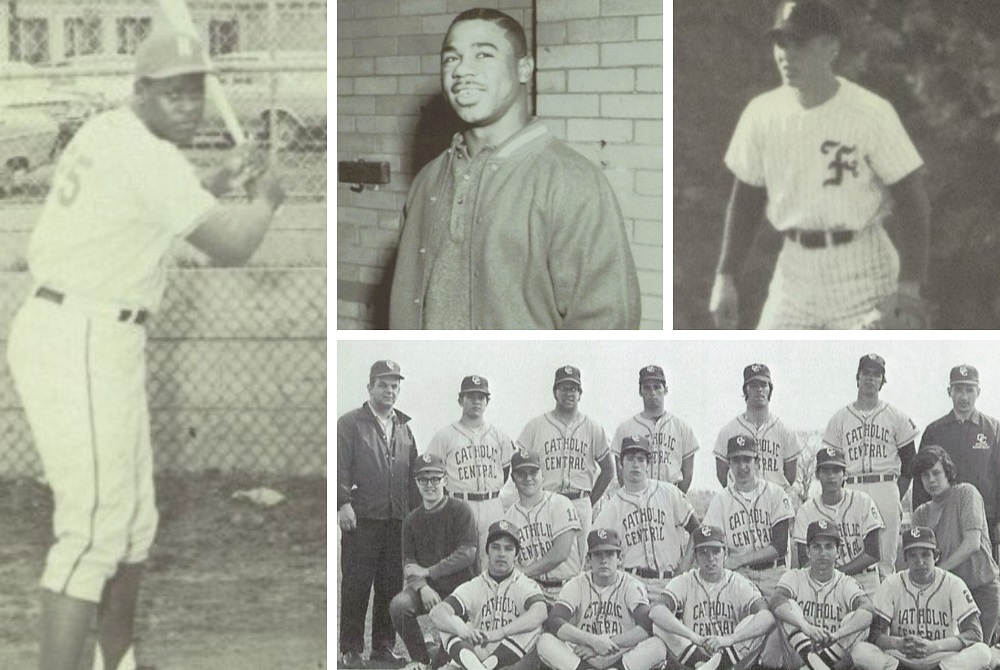
Bernie Carbo of Livonia Franklin was the state’s first first-round draft pick, plucked from the list of candidates at No. 16 by Cincinnati in 1965. He spent 12 years in the big leagues, playing in 1,010 games and logging time with six teams.
Not All Picks Reach the Majors
Two Michigan players were selected in the opening round of the 1966 draft. Jim DeNeff, a star in American Legion ball and an all-around athlete at Holland High School, played shortstop at Indiana University. Standing 6-foot-1, the 190-pound DeNeff led the Hoosiers in a host of categories and earned second-team All-America honors in 1966 before he was selected by California with the eighth pick of the draft. He spent six years in the minors, including two in Triple-A ball, before retiring.
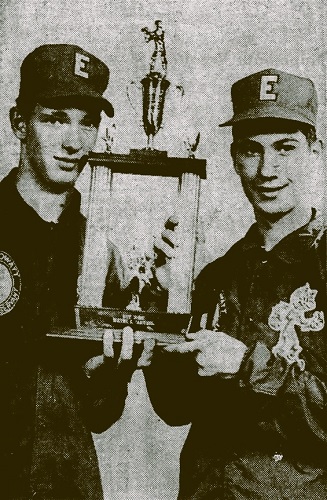 Richard ‘Rick’ Konik, a 6-foot-1 18-year-old, chosen six slots later, is perhaps, the most intriguing of Michigan’s first-round picks.
A pitcher and all-purpose player, Konik was playing for American Legion Thomas A. Edison Post No. 187 when he impressively became the first to earn the Michigan Legion’s Hazen ‘Ki-Ki’ Cuyler plaque in successive years – 1964 and 1965.
“Cuyler came out of Harrisville, 21 miles south of Alpena, to play 18 seasons in the National League. He was elected to Baseball’s Hall of Fame in 1968,” wrote Hal Schram of the Detroit Free Press, recalling the player and the origins of the award first presented in 1929.
“For the past 45 years, the walnut-based bronze plaque has been awarded each season to the American Legion player judged the most valuable to his team in the annual state championships.”
Future MLB players Mike Tresh (1930), Hal Newhouser (1937), and Milt Pappas (1956), all from Detroit, Neil Berry (1939) from Kalamazoo, Merv Rettenmund (1961) from Flint, and Dick Lange (1967) from Midland were all winners of the award.
The 1964 Edison Post team won the American Legion state tournament, then advanced to the semifinals of the Legion’s Junior World Series played in Little Rock, Ark., before being defeated by Charlotte, N.C., Post 9. The Edison boys repeated as Michigan’s Legion champs in 1965, and advanced to the Regional finals before elimination by Arlington Heights, Ill., in 11 innings. Konik was named MVP of that Regional tournament.
From his sophomore year, Konik’s star shone on the basketball court and baseball diamond at Detroit St. Andrew.
“(I)t’s a rare year when the Flyers aren’t led by a boy who could be even a bigger star at a larger high school,” said the Free Press in May of 1966. “Rick Konik is the top Flyer this year. An (All West, Second Division) All-Catholic basketball player, Konik is drawing even more attention as a pitcher. … He scored the winning run and pitched a no-hitter Thursday to give St. Andrew a 2-0 victory over Our Lady of Sorrows. It was his fifth straight shutout. Konik struck out 15 batters in the seven inning game.”
In June 1966, Konik was picked by the Detroit Tigers in the opening round of the Major League draft at No. 14.
“… Konik of St. Andrew High has been called the best local player wooed by the Tigers since they signed Bill Freehan off the University of Michigan campus,” noted the Free Press following the draft.
According to the Washington, D.C., Evening Star, “the Tigers went as high as $20,000” in their attempt to sign Konik following the draft in ‘66, but Konik rejected the offer.
In January 1967, Konik was a student at Schoolcraft College, when he was drafted for the second time, when the Kansas City Athletics selected the left-handed-hitting infielder in the first round of the Secondary draft. Once again, he couldn’t come to terms and went unsigned.
Konik was drafted yet again, this time by the Washington Senators in the fifth round of the Special Phase draft, in June 1967. Still, they could not come to terms.
In the summers of 1966 and 1967, Konik could be found playing amateur ball in the Free Press Baseball League with A&B Brokers, then was picked up by Detroit Harper Sports for the ‘67 National Baseball Congress (NBC) tournament. Playing first and hitting .500, he was one of 16 players selected to the NBC all-star squad named by the tournament committee in August.
He then enrolled at Eastern Michigan University, where he earned varsity baseball letters in 1968 and 1970. Under head coach Ron Oestrike, the Hurons posted a 41-11 record in 1970, emerging from the District 23 National Association of Intercollegiate Athletics playoffs to advance to the NAIA National Tournament in Phoenix, Ariz. In the championship game, EMU won five straight in double-elimination play, downing Northeast Louisiana State College, 1-0, to win the 14th Annual NAIA College World Series.
While the numbers may be greater thanks to today’s analytic-driven league, a 2012 report by Mike Rosenbaum for Bleacher Report stated, “Only 66 percent of first-round draft picks play in the major leagues.” According to the online database Baseball-Reference, Konik never played professionally.
Big Leaguers
The 1967 draft included a pair of three-sport stars picked in the first round. Detroit Northwestern’s big first baseman, John Mayberry, was taken at No. 6 by Houston, followed by Southfield catcher Ted Simmons by St. Louis at No. 10. An All-City basketball selection, the 6-foot-3, 214-pound Mayberry signed a tender in May to play at the University of Michigan, but few expected him to see the court in Ann Arbor.
“Every team in the major leagues came to see Mayberry,” said Fred Snowden, his coach at Northwestern, to the Free Press. Mayberry had posted a .487 average with three home runs and batted in 21 runs. As a pitcher, he gave up only one hit across 11 2/3 innings in relief. “Mayberry was simply too good a hitter to use as a pitcher, so I had him play first base to capitalize on his bat in every game,” added Snowden.
The Colts were still in the thick of the prep baseball season at the time of the draft. Northwestern ultimately downed Detroit Denby, 9-2, to win the City League championship in a game played at Tiger Stadium. It was their first city title since 1959. (In that ’59 league championship game, Willie Horton, then a sophomore, and teammate Matt Snorton, a junior, both smacked tape-measure home runs into the stands at the stadium, located at Michigan and Trumbull. Snorton would later play pro football for the Denver Broncos.)
A starter at first base, Mayberry was called in to relieve in the title game, allowing just a single hit in 5 1/3 innings, as well as ripping a single and a 415-foot triple “to the screen in deep right center.”
Simmons had played ball with Konik on the A&B Brokers team in the summer of 1966. A switch hitter, in 1967 he was hitting at a .490 clip across 18 games at Southfield. The Blue Jays had wrapped up their prep season with a 19-2 record when he was selected by St. Louis. Simmons spent 21 seasons in MLB – including 13 with the Cardinals – and was inducted into the National Baseball Hall of Fame in Cooperstown, N.Y. – along with Jeter – in 2020.
Like his father Frank Richard, who had starred at Detroit St. Andrew in the early 1950s, Frank Daryl Tanana excelled in basketball and baseball. The 6-foot-2 left-handed pitcher had posted a 23-1 mark entering his senior year at Detroit Catholic Central. That past summer he pitched the Larco’s Inn team to the National Amateur Baseball Federation Senior Division championship, played in Cincinnati.
As a high school senior, he had upped his prep mark to 32-1, boasting a sparkling 0.30 ERA, with an average of two strikeouts per inning.
“Tanana started on the mound for Catholic Central,” in a 4-0 loss to Holy Redeemer in the Catholic League First Division baseball championship, played at Tiger Stadium at the beginning of June, “but shifted to first base with a sore arm after pitching hitless ball and striking out eight in four innings.”
The issue was enough for the Tigers – holding the No. 11 pick– to pass over the hometown southpaw in the 1971 MLB draft a week later.
Instead, Tanana was chosen by California. He debuted in the majors in 1973 and spent eight years with the Angels, posting a 102-78 record with a 3.08 ERA during the span. In 1974 – his first full season in the league – he was the team’s No. 2 starter behind Nolan Ryan. He spent 21 years in the majors – including eight in Detroit from 1985 to 1992 – before hanging up the cleats following the 1993 season.
Others from the list of Michigan first-rounders who reached MLB include Chris Knapp from St. Joseph (selected at No. 11) in 1975, Detroit Cody’s Bob Owchinko (5) in 1976, and Waterford Kettering’s Kirk Gibson (12) in 1978.
Rick Leach (13) from Flint Southwestern and Steve Howe (16) from Clarkston advanced to the Big Leagues out of the 1979 draft. Four Michigan players were selected in the opening round that year– the most ever in a single draft.
Steve Avery from Taylor Kennedy at No. 3 – the highest selection among the 25 – and Jim Abbott from Flint Central at No. 8 were both picked in 1988.
Jeter was the sixth pick in 1992, while Plummer was the 23rd player selected in 2015.
The 2022 MLB draft kicks off July 17. MLB.com currently projects Orchard Lake St. Mary's pitcher Brock Porter as the 13th-best prospect eligible for selection.
 Ron Pesch has taken an active role in researching the history of MHSAA events since 1985 and began writing for MHSAA Finals programs in 1986, adding additional features and "flashbacks" in 1992. He inherited the title of MHSAA historian from the late Dick Kishpaugh following the 1993-94 school year, and resides in Muskegon. Contact him at [email protected] with ideas for historical articles.
PHOTOS (Top) Clockwise from left: Detroit Northwestern’s John Mayberry, Northwestern’s Willie Horton (a three-year player who, as noted in his senior high school yearbook, “During this entire time in all the league games, he never struck out at bat.”), Livonia Franklin’s Bernie Carbo, and the 1971 Detroit Catholic Central team with Frank Tanana standing second from right. (Middle) Bob Sobditch, left, and Rick Konik, American Legion Edison Post teammates. (Photos collected by Ron Pesch.)
Preview: Fantastic Finals Trips Await for 16 Title Contenders
By
Geoff Kimmerly
MHSAA.com senior editor
June 10, 2026
Frequent visitors to Michigan State’s McLane Stadium for MHSAA Baseball Finals weekend know how special the experience can be. And we have a pair of those joining us over the next three days in reigning Division 3 champion Traverse City St. Francis and annual contender Orchard Lake St. Mary’s.
But we’ll also hopefully deliver some breathtaking moments to several communities for the first time – or first time in a long time.
Two teams will play in Semifinals this weekend for the first time, and a handful more for the first time in at least a decade. Six more teams are hoping to play in a championship game Saturday for the first time.
Ten of this weekend’s 16 semifinalists are seeking their first Finals championship in this sport – and three of the six teams that have won in the past are seeking their first title in at least 20 years.
This weekend's schedule is as follows:
Division 1 – Friday
Detroit Catholic Central vs. Mattawan - 2:30 p.m.
Rochester Adams vs. Brownstown Woodhaven - 5 p.m.
Division 2 – Thursday
Vicksburg vs. Grand Rapids Kenowa Hills - 9 a.m.
Orchard Lake St. Mary's vs. Dearborn Divine Child - 11:30 a.m.
Division 3 – Thursday
Detroit Edison vs. Kalamazoo Christian - 2:30 p.m.
Traverse City St. Francis vs. Rochester Hills Lutheran Northwest - 5 p.m.
Division 4 – Friday
Royal Oak Shrine Catholic vs. Mount Pleasant Sacred Heart - 9 a.m.
Marcellus vs. Painesdale Jeffers - 11:30 a.m.
FINALS – Saturday
Division 1 – 5 p.m.
Division 2 – 9 a.m.
Division 3 – 11:30 a.m.
Division 4 – 2:30 p.m.
Tickets cost $11 and may be purchased online only at GoFan. One ticket is good for all baseball, softball and girls soccer games at MSU’s Old College Field that day. All Semifinals and Finals will be broadcast and available with subscription from MHSAA.tv.
Below is a glance at all 16 teams taking the field:
Division 1
BROWNSTOWN WOODHAVEN
Record/rank: 34-5-1, No. 3
Coach: Corey Farner, 12th season (338-90-3)
League finish: First in Downriver League
Championship history: Division 1 runner-up 2018 and 2023.
Players to watch: Cameron Thorning, jr. C (.446, 13 2B, 52 RBI); Lucas Farner, jr. IF/P (.426, 55 R, 32 RBI, 20 SB, 4-1 pitching, 0.97 ERA); Dante Perry, sr. OF (.429, 47 R, 30 SB); Tristan Spencer, soph. 1B/P (.346, 10 2B, 36 RBI, 8-1 pitching, 0.98 ERA, 70 K/50 IP).
Outlook: After falling a win short of the Semifinals last season, Woodhaven is back thanks in part to defeating No. 1 Brother Rice in Saturday’s Regional Final and also league rival No. 19 Allen Park earlier in the tournament. Woodhaven with one more victory also can tie its winningest season (2019) during Farner’s highly-successful run leading the program. Senior Keden Newsted is another ace for the Warriors entering this weekend 8-1 with a 1.53 ERA, and junior Amauri Gutierrez is 4-0 with a 2.69 ERA and a pair of saves. Junior Aaron Scott (.393) can be counted on for a boost at the bottom of the lineup.
DETROIT CATHOLIC CENTRAL
Record/rank: 27-12, No. 6
Coach: Ryan Rogowski, sixth season (138-96)
League finish: Fourth in Catholic High School League Central
Championship history: Three MHSAA titles (most recent 1999), two runner-up finishes.
Players to watch: Bennett Thompson, sr. 2B/C (.380, 27 R, 10 2B); Dylan Fairchild, sr. SS/P (.333, 32 R, 12 2B, 8 HR, 33 RBI); Andrew Mahoney, sr. P (8-1, 1.32 ERA, 81 K/53 IP); Micky Laser, sr. P/3B (8-0, 1.98 ERA).
Outlook: Detroit Catholic Central is making its first Semifinal appearance since 2004 and has defeated No. 16 Novi and No. 20 Dexter along the way after navigating a league that included top-ranked Brother Rice and Division 2 No. 1 Orchard Lake St. Mary’s. The Shamrocks have won 12 of their last 14 games. Seven regulars total are hitting at least .300, with sophomore Luke Fairchild (.357, 25 R, 16 SB) and seniors Tommy Maxwell (.357) and Owen Geisler (.351) all among the leaders right behind Thompson.
MATTAWAN
Record/rank: 29-8, No. 8
Coach: Brett Vaughn, 13th season (29-8)
League finish: First in Southwestern Michigan Athletic Conference
Championship history: Has never played in an MHSAA Final.
Players to watch: Patrick Dougherty, sr. OF (.431, 46 R, 25 SB); Nolan Jominy, sr. SS (.379, 40 R, 16 2B, 30 RBI, 18 SB); John Pelak, jr. OF (.372, 10 2B); Kaden Jominy, sr. P.
Outlook: Although seeking its first championship, Mattawan was at the Semifinals in 2023 and made the Regional Finals last spring before falling short. The Wildcats haven’t given up more than a run in any of six playoff games this spring, including their 3-1 Quarterfinal victory over No. 18 Byron Center, and total they’ve won 11 of their last 12 games. Seven seniors start, including as well outfielder/pitcher Liam Walsh (.367, 28 RBI), and Kaden Jominy will play next at Cornell. Junior Coleton Strong is another big bat in the middle of the lineup, hitting .336 with a team-high 36 RBI.
ROCHESTER ADAMS
Record/rank: 28-8, No. 4
Coach: Andrew Lamkin, 13th season (277-160-3)
League finish: First in Oakland Activities Association Red
Championship history: Class A runner-up 1995 and 1996.
Players to watch: Andrew Wozniak, sr. SS (.327, 31 R, 17 SB); Matt Toeppner, sr. OF/IF (.556): Brady Lindstrom, jr. P/IF (7-0, 1.46 ERA); Koltyn Watters, soph. OF (.398, 45 R, 11 2B, 30 RBI, 38 SB).
Outlook: Adams will play in its first Semifinal since the repeat run to the Class A championship game in 1996. Lamkin actually is in his second tenure running the program, having led the Highlanders from 1994-2003, returned as an assistant in 2011 and taken it back over in 2024. Toeppner, a Michigan State recruit, has been back only three weeks after hand surgery but also has scored 13 runs and stolen nine bases over 11 games. He and Watters both made the all-state first team last season. Adams topped No. 7 Oxford in the Quarterfinal, and a 3-2 win over No. 2 Romeo in the Regional Semifinal was one of three one-run victories this playoffs.
Division 2
DEARBORN DIVINE CHILD
Record/rank: 29-6, No. 7
Coach: Jeremy Shay, fourth season (91-49)
League finish: First in Catholic High School League AA
Championship history: Five MHSAA titles (most recent 2010).
Players to watch: Andrew Ryan, sr. SS/P (.389, 52 R, 28 SB, 5-2 pitching, 2.25 ERA); Dallas Terski, sr. 1B/3B (.370, 34 RBI, 21 SB); Liam Gibbons, sr. P (6-1, 1.01 ERA, 62 K/48 1/3 IP); Kole Boike, soph. CF (.346, 35 R, 30 RBI).
Outlook: Divine Child has taken steps every season under Shay, finishing 15-20 his first season but then adding a District title in 2024, a league championship last spring and now a Regional Finals win and trip to the Semifinals after defeating No. 8 Williamston to advance. Seniors Ian Hall (6-1) and Mason Cubr (5-1) also have seen plenty of starts on the mound and provide the Falcons with more options this weekend. Junior Adam Garcia (.368, 27 RBI) is among five more regulars hitting at least .300. Shay played on Divine Child’s 2008 and 2010 Division 2 championship teams before starring at Bowling Green as well.
GRAND RAPIDS KENOWA HILLS
Record/rank: 35-2, No. 5
Coach: Todd VandenHeuvel, first season (35-2)
League finish: First in River Cities Alliance
Championship history: Has never played in an MHSAA Final.
Players to watch: Will Fussman, jr. CF (.411, 48 R, 44 SB); Mason Peebles, sr. C/P (.423, 41 R, 14 2B, 8 3B, 56 RBI, 28 SB); Jack Stoddard, jr. 3B/P (.408, 41 RBI, 8-1 pitching, 1.97 ERA); Andrew Lake, sr. P (9-0, 0.40 ERA, 62 K/53 IP).
Outlook: Kenowa Hills is making its first Semifinals trip since 2015, continuing a tournament run that has seen wins against No. 11 East Grand Rapids, No. 20 Escanaba and No. 6 Standish-Sterling over the last three rounds. The Knights have won 19 straight games and have a solid set of impressive arms leading the staff this weekend with senior Keegan Garvin (9-0, 1.80 ERA) set to start the Semifinal. Senior shortstop Brennan Gustinis (.395, 50 R, 10 2B, 12 SB) is another dangerous bat in the leadoff spot. VandenHeuvel previously coached at Mona Shores, winning 217 games from 1995-2001.
ORCHARD LAKE ST. MARY’S
Record/rank: 32-5, No. 1
Coach: Nick Di Ponio, ninth season (234-134)
League finish: First in CHSL Central
Championship history: Six MHSAA titles (most recent 2022), three runner-up finishes.
Players to watch: Luke Crighton, sr. CF/SS/P (.457, 55 R, 39 RBI, 20 SB, 9-0 pitching, 1.21 ERA, 75 K/52 IP); Andrew Tribul, sr. C/IF (.376, 43 R, 45 RBI, 18 SB); Hudson Brzustewicz, sr. SS/P (.491, 56 R, 12 2B, 34 RBI, 6-1 pitching, 1.64 ERA, 52 K/34 IP); Derick Conrad, sr. C/IF (.427, 47 RBI).
Outlook: St. Mary’s has won 25 straight games and emerged from the same CHSL Central as Division 1 finalist Detroit Catholic Central, thanks in part to playoff wins over No. 4 Richmond and No. 10 Saginaw Swan Valley. Brzustewicz and Crighton were all-state first-teamers last season and are both the team’s leading hitters and top arms from a staff that has seen eight pitchers throw at least 17 innings and win two or more games this spring. Di Ponio led the Eaglets to Division 2 runner-up finishes in 2007 and 2009 during his first tenure with the program (2005-10) and three straight Regional titles since taking it back over in 2024. Senior outfielder Zach Essig (.357) also bolsters the middle of the lineup.
VICKSBURG
Record/rank: 30-7, No. 14
Coach: Brian Deal, 28th season (487-366-4)
League finish: First in Wolverine Conference
Championship history: Has never played in an MHSAA Final.
Players to watch: Graham Kubiak, jr. IF/P (.405, 37 R, 41 RBI, 25 SB, 3-2 pitching, 1.80 ERA); Mitchell Beyer, sr. IF (.426, 46 R, 17 2B, 44 RBI, 24 SB); Maddox Rosalin, sr. IF/P (.431, 15 2B, 39 RBI, 10 SB, 9-0 pitching, 0.72 ERA); Maguire Bowles, jr. OF (.450, 59 R, 13 2B, 32 RBI, 34 SB).
Outlook: Vicksburg also is returning to the Semifinals for the first time since 2015 and has put together its winningest season during Deal’s nearly three decades leading the program. A 3-0 Regional Semifinal win over No.18 Niles followed up a regular-season split between the two, and the Bulldogs also avenged an early loss to Paw Paw in the District opener and an 11-run loss to Coldwater with a 12-1 Quarterfinal victory. Three more regulars are hitting at least .300, led by junior Spencer Spicer (.338, 31 R), and sophomore Caden Chisolm (7-0, 2.28 ERA) gives Vicksburg another ace as eight pitchers total have made at least one start.
Division 3
DETROIT EDISON
Record/rank: 23-8, No. 4
Coach: Mark Brown, 10th season (210-104)
League finish: First in Charter School Conference
Championship history: Division 3 runner-up 2022.
Players to watch: Jamir Campbell, sr. P/SS (.408, 30 R, 26 SB, 6-1 pitching, 1.50 ERA, 60 K/55 IP); Elijah Hines, fr. OF (.357, 16 SB); David Hemphill III, sr. P/OF (.353, 8-2 pitching, 1.75 ERA, 72 K/71 IP); JonTae Wright, sr. IF (.393, 39 RBI, 13 SB).
Outlook: Edison is back at the Semifinals for the second time in three seasons (and third over the last five) after just missing a year ago, thanks to a 7-6 Quarterfinal win over No. 5 Jackson Lumen Christi. Campbell and Wright made the all-state first team last season and lead a lineup that has scored at least seven runs in 16 games. Junior Melvin Tennyson has been another key player in several ways, going 4-2 with a 1.85 ERA and hitting .318 with 19 stolen bases while leading off and playing center field. The Pioneers’ starting nine are a combined 116 for 128 on stolen-base attempts.
KALAMAZOO CHRISTIAN
Record/rank: 25-8, unranked
Coach: Russ Meyer, first season (25-8)
League finish: First in Southwest Athletic Conference Valley
Championship history: Has never appeared in an MHSAA Final.
Players to watch: Jake Bonnema, jr. 2B (.437, 41 R, 34 SB); James Annen, jr. P/1B/OF (.370, 32 R, 5-2 pitching); Crosby Croel, jr. P/1B/3B (.411, 31 R, 13 2B, 35 RBI, 13 SB, 2-1 pitching); Jackson Herder, sr. P/OF (5-1, 2.33 ERA, .280).
Outlook: Kalamazoo Christian’s first trip to the Semifinals since 2014 will be the result of a dominating run for the unranked Comets, who have outscored their six postseason opponents by a combined score of 71-6. Meyer may be in his first season as the varsity coach but has been an assistant at Christian and K-Central and was promoted after a decade as the Comets’ junior varsity coach. Herder and third baseman Logan Bittle (.286, 4-1 pitching, 2.79 ERA) are the only seniors. Sophomore catcher Jace Rarick is another top run producer hitting .337 with 13 doubles and 31 RBI.
ROCHESTER HILLS LUTHERAN NORTHWEST
Record/rank: 28-6, No. 16
Coach: Russ Kouba, second season (53-14)
League finish: Second in Michigan Independent Athletic Conference
Championship history: Division 4 champion 2004.
Players to watch: Jacob Kouba, sr. P/1B/OF (.455, 46 R, 14 2B, 41 RBI, 23 SB, 10-2 pitching, 1.06 ERA, 94 K/59 2/3 IP); Brennan Goebbel, jr. OF (.516, 44 R, 12 2B, 41 RBI, 40 SB); Nick Oberdier, sr. P/1B/3B (.344, 46 RBI, 4-2 pitching, 2.07 ERA, 64 K/44 IP); Landon Lindhurst, jr. OF/1B (.360, 17 SB).
Outlook: Lutheran Northwest earned its first trip to the Semifinals since 2006, a strong next step after also winning a District title in Russ Kouba’s first season leading the program. This lineup has only three senior starters, but they’re major contributors with pitcher/shortstop Ethan Wilks (.291, 15 SB, 6-1 pitching, 2.17 ERA, 52 K/38 2/3 IP) joining Jacob Kouba and Oberdier noted above. Sophomore catcher Josiah Kouba (.367) is among younger players who have stepped into prominent roles, and junior Rudy Hauss is a catalyst at the top of the order hitting .302 with 44 runs scored and 25 stolen bases.
TRAVERSE CITY ST. FRANCIS
Record/rank: 32-5, No. 1
Coach: Tom Passinault, 13th season (326-96)
League finish: Does not play in a conference.
Championship history: Two MHSAA titles (most recent 2025), two runner-up finishes.
Players to watch: Lanse Vos, jr. 1B/P (.438, 34 R, 7 3B, 32 RBI, 12 SB, 6-0 pitching, 1.50 ERA, 65 K/46 2/3 IP); Sam Wildfong, sr. C/P (.526, 41 R, 15 2B, 62 RBI, 14 SB, 5-1 pitching, 2.59 ERA, 69 K/43 1/3 IP); Tyler Thompson, sr. SS (.382, 51 R, 11 SB, 7-1 pitching, 1.63 ERA); Tyler Endres, sr. P/1B (.353, 9-2 pitching, 1.38 ERA, 82 K/50 2/3 IP).
Outlook: The Gladiators are pursuing a repeat with Wildfong a returning all-state first-teamer and Thompson a returning second-teamer, and total seven starters and both pitchers back from last year’s championship game. The team is anchored by eight seniors – including as well Braxton Lesinski (.326, 35 R, 36 RBI) – but sophomore Colton Peterson (.340, 41 R, 24 SB) and freshman John St. Peter (.340, 38 R, 19 SB) are also among top hitters. Endres got the pitching win and Vos closed last season’s Final after Wildfong threw a complete game in the Semifinal.
Division 4
PAINESDALE JEFFERS
Record/rank: 15-8, unranked
Coach: Joe Romano, first season (15-8)
League finish: Fourth in Western Peninsula Athletic Conference
Championship history: Has not played in an MHSAA Final.
Players to watch: Blake Heltunen, soph. 3B/P (.458, 22 SB); Brogan Turner, sr. P/CF (.424, 26 R, 31 RBI, 11 SB, 4-0 pitching, 1.66 ERA); Carson L’Esperance, fr. SS (.372); Pierce Johnson, jr. C (.326, 24 R, 17 SB, 3-1 pitching).
Outlook: Jeffers is making its first trip to the Semifinals as a talented group of athletes who have had success in other sports have brought it to the diamond as well. The Jets advanced with a 15-9 Quarterfinal win over No. 15 Norway and have scored 10 or more runs in all five of their postseason games. There are only three senior starters, but they bat among the top four – although Jeffers will play this weekend without a fourth senior, pitching ace Cameron Anderson (5-1, 1.99 ERA), a cross country Finals champion in the fall who was injured last weekend. Romano coached the Jets girls basketball team to a Class D runner-up finish in 1994.
MARCELLUS
Record/rank: 21-11, unranked
Coach: Christian Hutson, 11th season (143-138)
League finish: Second in Southwest 10 Conference
Championship history: Has never played in an MHSAA Final.
Players to watch: Seth Barrera, sr. IF/P (.392, 39 R, 14 2B, 16 SB, 6-4 pitching, 2.60 ERA, 67 K/59 1/3 IP); Eli Torres, sr. IF/P/C (.367, 31 RBI, 2-0 pitching); Abram Coffey, jr. IF/P (.684, 4-0 pitching, 1.31 ERA); Cale Hackenberg, jr. IF/P/C (.584, 44 R, 13 2B, 44 RBI, 19 SB, 7-3 pitching, 2.25 ERA, 114 K/53 IP).
Outlook: Marcellus also is making its first trip to the Semifinals, thanks to a 9-6 Quarterfinal win over No. 4 Kalamazoo Hackett Catholic Prep and a pair of one-run Regional wins. Coffey made the all-state second team last season but has played only the last month after recovering for an injury – but he returned just in time to bolster a strong lineup that includes just two seniors. Hutson, who also coaches the girls basketball team, was a standout at Decatur and is the grandson of former softball coach Ron Swartz, who led Marcellus to a Class D title in 1986.
MOUNT PLEASANT SACRED HEART
Record/rank: 36-4, No. 2
Coach: Earl Hartman, 43rd season (944-423)
League finish: First in Mid-State Activities Conference
Championship history: Two MHSAA titles (most recent 1996), two runner-up finishes.
Players to watch: Noah Zeien, sr. 3B/P (.460, 66 R, 45 SB, 3-0 pitching, 0.54 ERA); Hank MacDonald, jr. C/1B (.442, 14 2B, 67 RBI); Brady Davis, sr. 1B/P (.536, 51 R, 14 2B, 48 RBI, 23 SB, 12-2 pitching, 0.52 ERA, 103 K/54 1/3 IP); Nate Siler, jr. SS/P (.457, 11 2B, 51 RBI, 13-1 pitching, 0.80 ERA, 134 K/70 1/3 IP).
Outlook: Sacred Heart has defeated No. 7 Fowler, No. 5 Fulton, No. 3 Beal City and No. 1 Portland St. Patrick during this first Semifinal trip since 1997, and Saturday’s 4-2 Quarterfinal win over the Shamrocks avenged a regular-season loss. Siler made the all-state first team last season and with Davis gives the Irish a powerful 1-2 punch on the mound. Senior center fielder Teegan Duffy (.422, 64 R, 37 RBI, 20 SB) is another big bat at the top of the lineup and has a team-high five triples as well.
ROYAL OAK SHRINE CATHOLIC
Record/rank: 26-8, No. 11
Coach: Dan Noble, 16th season (335-165-3)
League finish: Second in CHSL Intersectional
Championship history: Division 4 runner-up in 2003.
Players to watch: Nate Alba, sr. P/IF/OF (.286, 31 R, 31 RBI, 11-2 pitching, 1.40 ERA, 170 K/84 2/3 IP); Caydin Barbato, sr. P/IF (.444, 50 R, 21 SB); Luke Robinson, fr. P/1B/OF (.385, 35 R, 31 RBI, 21 SB, 3-1 pitching, 2.71 ERA); Sean Murphy, sr. P/C/UTY (.468, 40 R, 17 2B, 43 RBI, 17 SB, 7-3 pitching, 2.62 ERA, 85 K/58 2/3 IP).
Outlook: Shrine won its second Regional championship in four seasons over the weekend, and didn’t give up a run over its first four postseason games until edging Allen Park Cabrini 11-10 in the Quarterfinal. The Knights bounced back from a brief four-game skid midseason to win their last nine, and they’ll bring plenty of pitching to MSU including as well junior Owen Bellows (5-1, 2.91 ERA). Senior Blake Archibald (.333) is another solid bat at the top of a lineup that’s hitting .305 overall this spring.
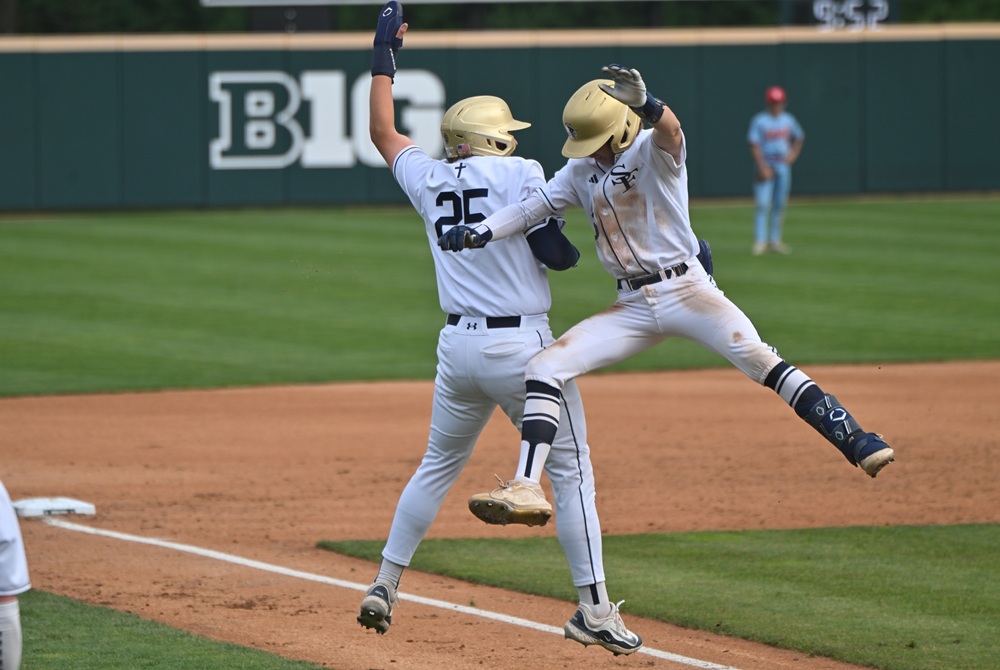
PHOTO (Top) Traverse City’s St. Francis’ Matthew Kane (25) and Colton Peterson celebrate a moment during a Semifinal win in 2025.