

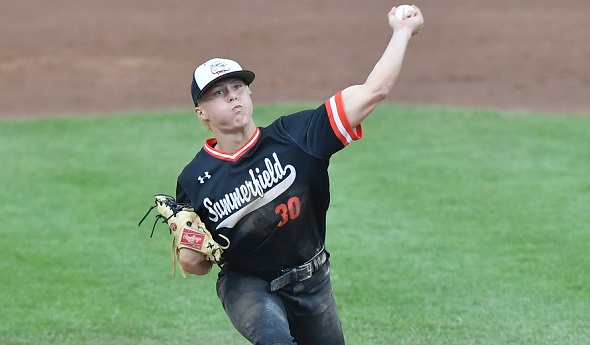
Performance: Summerfield's Derek Clark
June 20, 2019
 Derek Clark
Petersburg Summerfield junior – Baseball
The Bulldogs closed one of the most dominating runs in MHSAA Baseball Tournament history with their first championship Saturday, and Clark turned in a performance to match. The pitcher/centerfielder threw a four-hit shutout in the 9-0 Division 4 Final win over Saginaw Nouvel, capping a run of 44 straight scoreless innings pitched to close his junior season as he earned the MHSAA “Performance of the Week.”
Clark’s pitching statistics this spring were jaw-dropping. He finished 13-0 with a 0.20 ERA – good for seventh lowest in MHSAA history. He had 116 strikeouts in 70 innings pitched, with 11 strikeouts in the championship game including for the season’s final out. He was 4-for-7 from the plate over the Semifinal and championship games to push his average to .500 for this spring, and he also finished with 48 runs scored and 52 stolen bases (tied for 19th most) on 54 attempts over 32 games. Summerfield defeated Gaylord St. Mary 5-0 in the Semifinal on the way to meeting Nouvel on Saturday, and finished with a combined scoring margin of 89-2 over eight postseason games. The championship was the school’s first at the Finals level in any boys sport. The Bulldogs also won the Tri-County Conference and finished 28-4 overall, capping a complete program turnaround – more on that below.
A three-sport athlete as a junior, Clark doesn’t plan to play football as a senior but will return as the point guard for a basketball team that won the league this past winter for the first time since 2011-12. He’s also a 3.6 student, part of National Honor Society and student council, and is leaning toward studying business or sports marketing when high school is done. He should have some interesting options to continue on the diamond as well – the left-hander made the Division 4 all-state first team this spring as a pitcher after earning the same as an outfielder in 2018.
Coach Travis Pant said: “He’s an ultra competitor. He hates to lose, and it shows in the way he plays the game. Derek’s energy and leadership fueled this historic weekend that we had as a program. He’s a humble leader who brings an enthusiasm to the field every single day that is unmatched. What people saw this weekend in the Finals is what I have watched for the past three seasons. He plays the game the right way and is very fun to watch. … He has been the face of the rebuild we had at Summerfield. When he was an eighth grader, we went 6-28. In his freshman year he quickly became the ace and a leader in the dugout. We have won at least 21 games in every year since. Derek has pitched us to two District championships, two Regional championships and a state championship. He wants the ball in big games and the team fuels off his confidence. … Derek’s junior season was nothing short of amazing. He broke the county record for ERA with a 0.20 and was within three of the county stolen base record with 52. To do what he does on the mound and at the plate for us at such a consistent rate is amazing. Derek never had a bad day on the mound. No matter what the situation, he showed up with his best stuff.”
Performance Point: “The community's been really great about it. I can't go anywhere without having somebody say congratulations. I've had people I've never seen in my life say ‘Congrats,’” Clark said. “It's really nice to have that back-up, so to say, with our community. … With the weekend, it was just so good. All of our hard work, it finally paid off, finally got (us) to our number one goal. It's really nice to accomplish something this big. … The last out, to strike him out for the game, I was telling my catcher, ‘If we get to two outs, we've got to strike him out.’ I think that was probably the best moment. I just felt like it was more ecstatic, had us all pumped up. Because we had the confidence, I don't think it was shocking, so to say. We were really confident in ourselves and in our play because we were playing really well at the time. I think it was just more of a relief.”
Talking turnaround: “I think it’s just having guys that can play. The junior class this year was really big. We started five freshmen my freshman year. So just having that, and having guys come out. Also just having confidence in each other and trusting in each other, because team chemistry is huge. If you don’t have that, talent doesn’t really mean anything. … We’ve always been a baseball group. There’s been football and basketball, but we’ve been more of a baseball grade. I think we’ve been all right coming up, and we’ve just hit a stride the last couple of years and (we’re) just getting better.”
 Taking the lead: “I just try to be a leader of everything, every sport I play. When it comes to basketball, I'm the point guard so you've gotta communicate, you've gotta use your words, you can't be quiet. You're the general of the floor – you've got to know what to do, what's going on at all times. That's kinda how I am with baseball. I just try to keep everybody engaged and try to get everybody looks and help everybody as much as I can.”
Title time: “It's just great to finally get it done. Our baseball program, Coach (Darrell) Polter built it up (before retiring in 2014 after nearly 40 seasons). He has 17 league titles at Summerfield, and just to finally get that state title meant a lot to us. Nobody's really ever been there to do that, in any sport, so (the community) made a really big deal. We came home after we won, and there was a big parade in town and it was just really surreal and awesome to be a part of.”
Never stop competing: “I think we're all just so competitive. We'll be in math class, doing something that's competitive, and if you lose it's hectic. Nobody wants to lose. I think that's got something to do with (our success). When we grew up, we didn't want to lose ever. That's how we've been since we were little. Some kids take it even into school, like ‘Ha ha, I have better grades than you.’ It gets wild. I’m not bad (academically), but our shortstop Brendan Dafoe has a 4-point, and Brayden Jewell has a 3.8 or 3.9 or something like that. We’re all in advanced class, so we get after each other in there.”
- Geoff Kimmerly, Second Half editor
Past 2018-19 honorees
June 13: Audrey Whiteside, East Grand Rapids lacrosse - Read
June 6: Kari Miller, Ann Arbor Pioneer tennis - Read
May 23: Keshaun Harris, Lansing Waverly track & field - Read
May 16: Gabbie Sherman, Millington softball - Read
May 9: Nathan Taylor, Muskegon Mona Shores golf - Read
May 2: Ally Gaunt, New Baltimore Anchor Bay soccer - Read
April 25: Kali Heivilin, Three Rivers softball - Read
March 28: Rickea Jackson, Detroit Edison basketball - Read
March 21: Noah Wiswary, Hudsonville Unity Christian basketball - Read
March 14: Cam Peel, Spring Lake swimming - Read
March 7: Jordan Hamdan, Hudson wrestling - Read
February 28: Kevon Davenport, Detroit Catholic Central wrestling - Read
February 21: Reagan Olli, Gaylord skiing - Read
February 14: Jake Stevenson, Traverse City Bay Reps hockey - Read
February 7: Molly Davis, Midland Dow basketball - Read
January 31: Chris DeRocher, Alpena basketball - Read
January 24: Imari Blond, Flint Kearsley bowling - Read
January 17: William Dunn, Quincy basketball - Read
November 29: Dequan Finn, Detroit Martin Luther King football - Read
November 22: Paige Briggs, Lake Orion volleyball - Read
November 15: Hunter Nowak, Morrice football - Read
November 8: Jon Dougherty, Detroit Country Day soccer - Read
November 1: Jordan Stump, Camden-Frontier volleyball - Read
October 25: Danielle Staskowski, Pontiac Notre Dame Prep golf - Read
October 18: Adam Bruce, Gladstone cross country - Read
October 11: Ericka VanderLende, Rockford cross country - Read
October 4: Kobe Clark, Schoolcraft football - Read
September 27: Jonathan Kliewer, Grand Rapids Forest Hills Northern soccer - Read
September 20: Kiera Lasky, Bronson volleyball - Read
September 13: Judy Rector, Hanover-Horton cross country - Read
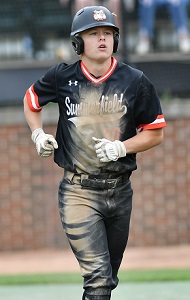
PHOTOS: (Top) Petersburg Summerfield's Derek Clark unloads a pitch during Saturday's Division 4 championship game win at McLane Stadium. (Middle) Clark heads back to his dugout after sliding in head-first to score in Friday's Semifinal.
Senior-Powered Spring Lake Answering Anticipation, Pursuing High Expectations
By
Dean Holzwarth
Special for MHSAA.com
April 29, 2026
SPRING LAKE – The time is now for the Spring Lake baseball team.
 With the return of 11 veteran seniors, the Lakers entered this spring with lofty expectations and an eye on an extended postseason run.
Anticipation has come to fruition in the form of a state ranking and a nearly perfect start.
“Our motto is we are going to worry about next year next year, and we are going to do all we can this year,” Lakers fourth-year coach Bill Core said. “We knew we were going to have a big experienced group coming back, and that's just how the roster folded out. We have a lot of experience, a lot of returners and pretty high expectations.”
Spring Lake, which finished as Division 2 runner-up in 2024 and won a conference title last year for the first time since 2014, is off to an impressive 13-1 start (9-0 in the Ottawa-Kent Conference Black) and has climbed to No. 7 in the latest coaches poll.
Core said the vast number of returners, which includes five players who will play in college next year, has paid early dividends.
“I think that’s been a big difference,” he said. “We’ve played some younger teams that were breaking in sophomores or juniors or new kids, and our guys were ready to go right from the start. It’s been an advantage early on.”
Senior starting pitchers Oliver Smies and Maddux Kipling believe the strong bond among the senior class has been a major factor in the torrid start.
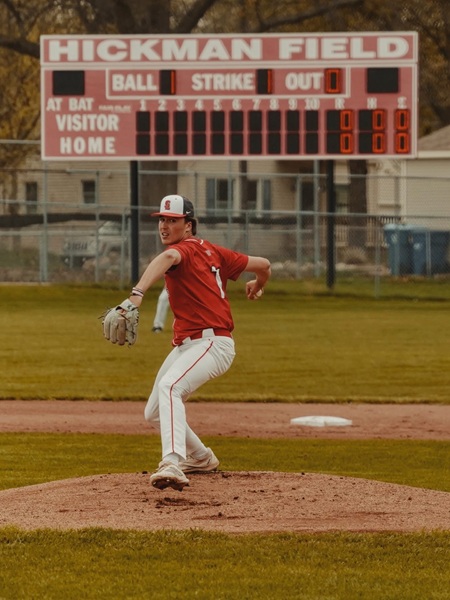 “I think something that’s really important about this team is our team chemistry and the amount of seniors we have on the team,” Smies said. “That alone allows us to have a ton of experience, and I think that's a big reason why we are off to such a hot start. We have been playing good team baseball and complementary baseball with good defense and good offense.”
Added Kipling: “We genuinely like being around each other, and every day we show up ready to get a little better. Our team has a real gritty and energetic identity, and I think that shows in how we compete and support each other.”
Kipling and Smies have been dominant on the mound this season. They haven’t allowed an earned run while combining for 80 strikeouts. Kipling earned a second-team all-state accolade as a junior and is headed to Michigan State next year. Smies will play at Calvin University.
“It starts with our pitching,” Core said. “Any time you are going to make a run, it starts with your pitching and we are pretty lucky, especially with our top two.”
Offensively, the Lakers possess a balanced lineup and boast a .330 batting average.
Senior Owen Smies, who will join his twin brother at Calvin, is hitting a team-best .432 with 13 RBIs. Seniors Alex Strauss (Adrian College) and Max Feltner (Muskegon Community College) are both batting .333 and have combined to score 25 runs.
As a team, Spring Lake has produced eight shutouts and nine wins by run differential.
“We got off to a good start, but we are going to play a lot better competition,” Core said. “This is a good week for us because we play Northview and state-ranked East Grand Rapids. We just picked them up, so we were excited to fill in the week with those two schools.”
Spring Lake is 62-6 over its last 68 games and trying to remain focused on each game as it attempts to erase the disappointment of last year’s early exit from the postseason.
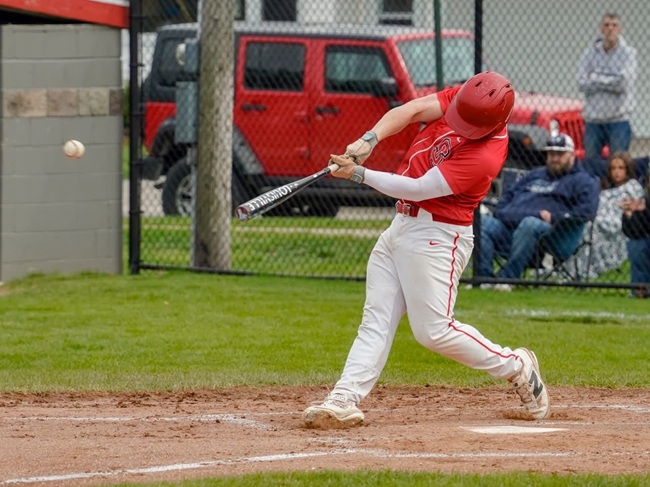 Despite winning 30 games, the Lakers suffered a 3-2 loss to Grand Rapids West Catholic in District play.
“I think there is some motivation there from that loss,” Oliver Smies said. “And I think that loss last year taught us that any team can beat any team, so you have to play your best baseball every single game no matter the opponent.”
Core said last year hasn’t been discussed, but believes it still sits in the back of his players’ minds.
“I think they think about that, but we've had quite a few mercies to start the season, and I said to them that when we get to the tournament it's going to be a one-run game and we are going to have to do the little things to make a difference because we are not going to win 14-0 all the time,” he explained. “We try to keep everyone in the moment.”
Kipling isn’t dwelling on the past – or looking too far ahead.
“As a group we’ve done a great job staying focused on the present and not getting caught up in the past or worrying too much about the future,” Kipling said. “My dad has always told me to focus on what you can control because putting energy into things you can’t control is a waste.
"That mindset has stuck with me, especially on the field. I try to live by ‘one pitch at a time,’ and because of that I haven’t really spent time thinking about last year’s loss. That’s behind us, and we’re just focused on what we can do right now.”
 Dean Holzwarth has covered primarily high school sports for Grand Rapids-based WOOD-TV for five years after serving at the Grand Rapids Press and MLive for 16 years along with shorter stints at the Ionia Sentinel and WZZM. Contact him at [email protected] with story ideas for Allegan, Kent and Ottawa counties.
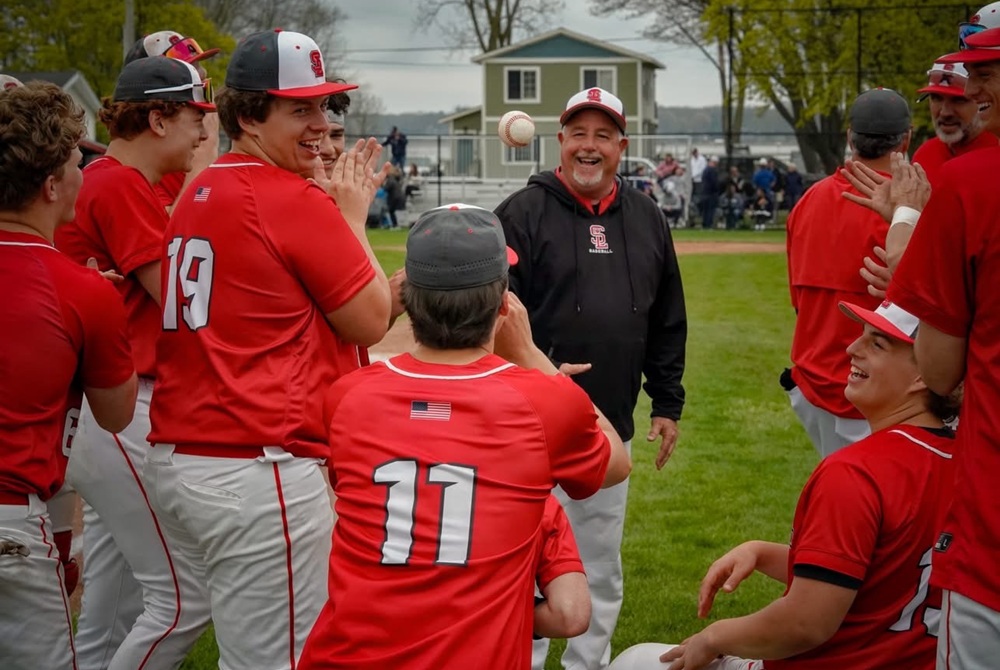
PHOTOS (Top) Spring Lake baseball coach Bill Core tosses Maddux Kipling his home run ball after a win over Fruitport. (Middle) Kipling pitching at Spring Lake's Hickman Field. (Below) Senior Oliver Smies connects with a pitch. (Photos by Trevor McCue/Grand Haven Tribune.)