


Pitch Perfect
August 5, 2016
The national rules of high school baseball for the 2017 season will require for the first time that state high school associations adopt policies and procedures that limit the number of pitches that an individual player may make over a specified number of days.
Presently, Michigan High School Athletic Association rules state that a student may not pitch more than three consecutive days regardless of the outs pitched, and shall not pitch for two calendar days following that in which the player pitched his 30th out.
In the past, there has not been consensus among Michigan high school baseball coaches or support by the MHSAA Baseball/Softball Committee to impose a specific pitch count; and the new national rule does not prescribe what the maximum count should be or how it should be applied.
The MHSAA will convene a group of coaches and administrators this month to discuss the many questions created by the nebulous national mandate. The group’s challenge is to craft a rule that will not result in students pitching more than they do under the current rule, especially at earlier grade levels, and a rule that is as simple to monitor and manage as the current rule.
The proposal of this study group will be reviewed by baseball coaches and school administrators throughout Michigan before submission for action by the Representative Council in December.
Michigan’s climate and culture within high school baseball probably makes a change in the MHSAA pitching rule unnecessary for the high school season. And sadly, any change made for high school play is likely to have little or no effect on the summer and fall ball that may be much more damaging to young arms than the high school season which often is much more restrained in the number of games per day and per season than non-school baseball.
We can hope, of course, that the additional focus on pitching risks at the high school level will be seen and taken seriously outside the high school season.
Preview: New Champ (at least 1) Guaranteed
June 10, 2015
By Geoff Kimmerly
Second Half editor
This weekend’s MHSAA Baseball Finals at Michigan State University’s McLane Stadium are guaranteed to provide at least a few first-time thrills.
Of 16 teams playing in Semifinals starting Thursday, 11 have never played in an MHSAA baseball championship game. In fact, only seven of 15 that play in conferences won those leagues this spring.
Two of the five teams that have won MHSAA titles won theirs at least 30 years ago. And definitely keep an eye on Division 4 on Saturday; all four semifinalists are playing for their first MHSAA baseball championship.
See below for a schedule of this weekend’s games, plus glances at all 16 teams that will take the field beginning Thursday.
Semifinals – Thursday
Division 1
Grand Rapids Kenowa Hills vs. Hartland, 9 a.m.
Grosse Pointe South vs. Portage Northern, 11:30 a.m.
Division 2
Mount Pleasant vs. Adrian, 2:30 p.m.
Vicksburg vs. Orchard Lake St. Mary’s, 5 p.m.
Semifinals – Friday
Division 3
Elkton-Pigeon-Bay Port Laker vs. Jackson Lumen Christi, 9 a.m.
Buchanan vs. Gladstone, 11:30 a.m.
Division 4
Centreville vs. Rudyard, 2:30 p.m.
Muskegon Catholic Central vs. Ubly, 5 p.m.
Finals – Saturday
Division 1: 9 a.m.
Division 2: 11:30 a.m.
Division 3: 2:30 p.m.
Division 4: 5 p.m.
Tickets cost $8 per round and include admission to softball and girls soccer games that day also at MSU’s Old College Field. Radio broadcasts of all games can be heard online at MHSAAnetwork.com. All games will be streamed live online at MHSAA.TV and viewable on subscription basis.
All statistics below are through at least the regular season, with most through teams' Regionals. (Click for links to brackets and scores.)
DIVISION 1
GROSSE POINTE SOUTH
Record/rank: 32-11, No. 9
Coach: Dan Griesbaum, 32nd season (740-381-2)
League finish: Second in Macomb Area Conference Red.
Championship history: Division 1 champion 2001, runner-up 2014.
Players to watch: Ryan Liagre, sr. 3B (.416, 44 R, 12 2B, 4 HR, 29 RBI); James Fishback, sr. 1B (.387, 34 RBI); Andrew Fabry, sr. P (9-1, 0.45, 60 K).
Outlook: Grosse Pointe South defeated its five tournament opponents by a combined score of 48-5 after entering the postseason with four losses over its final five regular-season games. It avenged one of those losses, to Detroit U-D Jesuit, in the Regional Final. Liagre made the all-state Dream Team last season, and with Fishback provides muscle in the middle of the lineup surrounded by junior Will Poplawski (.350), sophomore Brad Thompson (.338) and senior Justin McMann (.327); all nine regulars hit at least .291. Senior Will Norris moves over from second base to follow Fabry in the rotation and is 7-1 with a 2.72 ERA.
GRAND RAPIDS KENOWA HILLS
Record/rank: 33-4, No. 8
Coach: Joe Acker, fourth season (93-34)
League finish: First in Ottawa-Kent Conference Black.
Championship history: Has never played in an MHSAA Final.
Players to watch: Christian Falicki, jr. P (.325, 9-0 pitching, 2.03 ERA); Jacob Sposaro, sr. SS/P (.448, 35 R, 12 2B, 31 RBI, 6-1 pitching, 2.15 ERA); Jace Beatty, jr. OF/P (.493, 25 R, 4-0 pitching, 2.76 ERA)
Outlook: Kenowa Hills has increased its win total each of the last three seasons under Acker, adding a third straight league and second straight District title this spring. The pitching staff is deep with junior Bennett Norry (7-1) just behind Falicki in innings pitched this spring. Six hitters bat .348 or better – the team batting average is an impressive .325 – and eight had driven in at least 12 runs through the end of the District. Sposaro also has stolen 10 bases on 11 attempts, third on a team that has swiped 74 bases in 80 tries.
HARTLAND
Record/rank: 26-16-1, unranked
Coach: Brian Morrison, 14th season (359-153-3)
League finish: Third in Kensington Lakes Activities Association West.
Championship history: Has never played in an MHSAA Final.
Players to watch: Gary Turnbull, jr. 1B (.344, 30 R, 15 2B, 20 RBI); John Baker, jr. 1B/P (.328, 30 R 13 2B, 26 RBI, 8-2 pitching, 0.93 ERA, 110 K); Alex Vydick, jr. SS/P (.336, 25 R, 22 RBI, 4-1, 3.43 ERA).
Outlook: Hartland won its third Regional in five seasons and fourth in seven years, but broke through for its first Semifinal berth since 2000 and second in program history. While unranked, Hartland finished third in its KLAA division behind No. 4 Brighton and No. 12 Howell. This could be only the start of a nice run – the starting lineup includes only two seniors. Six batters are hitting .317 or better, led by freshman third baseman Max Hendricks at .419.
PORTAGE NORTHERN
Record/rank: 28-7-1, unranked
Coach: Chris Andrews, 15th season (376-160)
League finish: Second in Southwestern Michigan Athletic Conference West.
Championship history: Has never played in an MHSAA Final.
Players to watch: Collin Hall, sr. 1B (.434, 26 R, 13 2B, 32 RBI); Max Schuemann, sr. SS (.380, 37 R, 20 RBI, 17 SB, 3-0 pitching, 1.35 ERA); Tommy Henry, jr. P/OF (.320, 25 R, 21 RBI, 16 SB, 8-1, 0.35 ERA, 112 K).
Outlook: Portage Northern has had a solid run under Andrews with at least 20 wins in 13 of his 15 seasons after he arrived from Kalamazoo Loy Norrix in 2001. This is the team’s first Semifinal appearance since 1972, the second season of the MHSAA Tournament for the sport. Portage Northern advanced in part by defeating No. 10 Taylor Kennedy in the Quarterfinal and is riding an 11-game winning streak. Eight regulars are hitting at least .300, and senior Blake Therrian (7-2, 2.80) could also see the mound this weekend.
DIVISION 2
ADRIAN
Record/rank: 27-9, unranked
Coach: Greg Jackson, 26th season (524-351)
League finish: Second in Southeastern Conference White.
Championship history: Has never played in an MHSAA Final.
Players to watch: Matt Clark, sr. P/IF (.489, 37 R, 15 2B, 42 RBI, 15 SB, 6-2 pitching, 1.02 ERA); Tanner Heath, jr. C (.469, 25 R, 16 2B, 31 RBI); Noah Solis, jr. SS (.414, 40 R, 15 RBI, 25 SB).
Outlook: Adrian has bounced back from two straight sub-.500 seasons to win its first Regional since 2003 and make its first Semifinal since 1979. The Maples defeated No. 6 Milan in the District Final after losing three of its final four games before the start of the postseason; Adrian was ranked as high as No. 5 this spring. Clark is the only senior in the starting lineup, and two underclassmen start including sophomore leftfielder Ty Peck (.355).
MOUNT PLEASANT
Record/rank: 26-12, unranked
Coach: Luke Epple, 24th season (646-181)
League finish: Third in Saginaw Valley Association
Championship history: Three MHSAA titles (most recent 2014), two runner-up finishes.
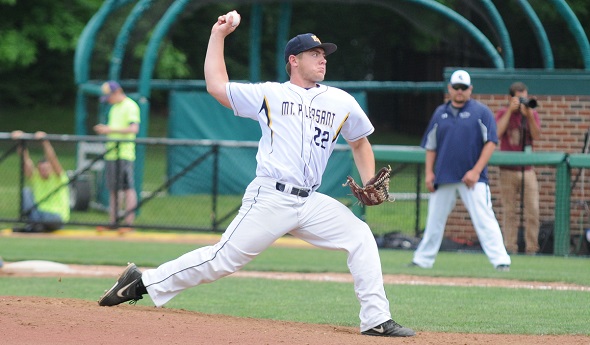
Players to watch: Hunter Buczkowski, jr. P/OF (.380, 22 R, 23 RBI, 6-2 pitching, 1.06 ERA); Zachary Heeke, jr. 3B (.469, 42 R, 22 RBI, 17 SB); Obie Ricumstrict, soph. SS (.400, 45 R, 11 2B, 21 RBI, 16 SB).
Outlook: The Oilers are on another dominant run, outscoring their six postseason opponents by a combined score of 58-2 with five shutouts. Add in two more shutouts at the end of the regular season for seven in their last eight games. Buczkowski made the all-state second team last season and leads a staff with three starters who have each won at least four games. His sophomore brother Logan is one of them and also plays centerfield and bats clean-up, hitting .369 with 10 doubles and 35 RBI. Senior designated hitter Ryan Lucksted (.388) and junior outfielder Max Trucks (.362) are two more big bats, and senior pitcher Mitch Ridley (4-1, 1.73 ERA) could find himself in an important spot as well this weekend.
ORCHARD LAKE ST. MARY’S
Record/rank: 30-13, No. 7
Coach: Matt Petry, fifth season (104-79)
League finish: Second in Detroit Catholic League Central.
Championship history: Two MHSAA titles (most recent 2003), three runner-up finishes.
Players to watch: Mason Vaughan, jr. OF (.373, 22 R, 26 RBI); Drake Titus, jr. 2B/P (.362, 42 R, 20 RBI, 18 SB, 11-2 pitching, 0.69 ERA); Campbell Kinch, sr. OF (.359, 36 R, 20 RBI, 13 SB).
Outlook: St. Mary’s will play in its first Semifinal since 2009, when it eventually finished Division 2 runner-up. The Eaglets have the pitching to compete for the entirety, with senior Greg Loukinen (6-4, 1.38 ERA) expected to get the Semifinal start and junior Scott Grant (5-2, 1.65 ERA) another option. This could be the beginning of a solid two-year run; the team has only four seniors and only two start as part of what is otherwise a junior-dominated lineup. Sophomore designated hitter Carter Macias (.333) and junior third baseman Drew Boyd (.322) are among others who add offensive boost.
VICKSBURG
Record/rank: 27-7, unranked
Coach: Brian Deal, 17th season (record at school N/A)
League finish: First in Wolverine Conference East.
Championship history: Has never played in an MHSAA Final.
Players to watch: Conner Henderson, sr. CF/P (.465, 39 R, 12 2B, 26 SB, 1.00 ERA pitching, 5 Sv); Dalton Ketelaar, sr. RF/P (.435, 11 2B, 4-1 pitching, 1.27 ERA); Brenden Lovell, soph. P/UTY (.413, 25 R, 15 2B, 25 RBI, 8-0 pitching, 1.08 ERA).
Outlook: Vicksburg won its first Regional title this spring, beating No. 2 Stevensville Lakeshore 2-1 in the Final, and then advanced to its first Quarterfinal by beating No. 1 East Grand Rapids 10-0 (Vicksburg had fallen to Lakeshore 11-0 during the regular season). Seven of the team’s eight seniors start and three more hit at least .300. First baseman Patrick Callahan is among them and also could play a role on the mound, entering the week 6-1 with a 1.64 ERA. Vicksburg was ranked as high as No. 9 this season and opened 16-2.
DIVISION 3
BUCHANAN
Record/rank: 23-7, No. 3
Coach: Lonnie Hoover, third season (52-31)
League finish: First in Berrien-Cass-St. Joseph West.
Championship history: Class C champion 1985, runner-up 1982 and 1981.
Players to watch: Chad Adkerson, soph. C (.449, 26 R, 20 RBI, 13 SB), Jarrett Thomas, jr. P/SS (.271, 29 R, 13 SB, 9-1 pitching, 1.01 ERA); Dalton Riddle, soph. P/OF (.380, 29 R, 31 RBI, 5-3 pitching, 1.98 ERA).
Outlook: The Bucks will play in their first Semifinal since 1999 and have made good on their high ranking, eliminating No. 8 Lansing Catholic in the Quarterfinal. Former junior varsity coach Hoover has led the team to an increase in wins each of the last two seasons, and they should surge again in 2016 as they graduate only one regular starter. Seven hit .300 or higher this spring, with sophomores Darren Shearer (.386) and Christian Hall (.375) and junior Gavin Morris (.362) among the other toughest outs. Another sophomore, Kyle Leazenby, might be an option on the mound after entering this week 5-1 with a 2.03 ERA.
ELKTON-PIGEON-BAY PORT LAKER
Record/rank: 22-10, unranked
Coach: Adam Grybauskas, fifth season (81-74)
League finish: First in Greater Thumb Conference West.
Championship history: Has never played in an MHSAA Final.
Players to watch: Cody Voelker, sr. P/IF (.353, 32 R, 8-2 pitching, 0.43 ERA); Austin Parrish, sr. P/3B (.348, 21 R, 18 RBI, 2-1 pitching, 2.46 ERA); Austin McCabe, sr. 1B (.333, 17 R, 27 RBI).
Outlook: Laker has won 14 of its last 16 with lockdown pitching led by Voelker and senior Brady Post (6-2, 2.13 ERA). The Lakers have outscored five tournament opponents by a combined 43-9, allowing no more than two runs in a game until Shepherd scored three in the Quarterfinal. Grybauskas formerly coached Central Lake from 2005-10 before taking over this program. Six of the team’s eight seniors start, but junior Logan Breismiester (.344) and sophomore Seth Bowles (.333) also supply offensive help.
GLADSTONE
Record/rank: 28-9, No. 9
Coach: Don Lauscher, third season (74-24-1)
League finish: Does not play in a conference.
Championship history: Has never played in an MHSAA Final.
Players to watch: Hunter Garling, jr. OF/P (.442, 25 R, 27 RBI, 2-3 pitching, 2.02 ERA); Justin Jurek, sr. C (.354, 4 HR, 22 RBI, 27 R); Jake Peterson, sr. OF/P (.398, 20 RBI, 32 R, 4-2 pitching, 1.87 ERA).
Outlook: The Braves’ incredible run continues, from not having a program for more than 50 years until 2013, to making the Semifinals last season and now again. They defeated No. 4 Traverse City St. Francis in the Regional Final before advancing to this weekend with an extra-inning 6-5 win over Muskegon Oakridge in the Quarterfinal. Garling made the all-state first team as a sophomore. Junior Elliot Danhoff (5-1) and sophomore Ben Schwalbach (3-0) are among others who can be called on to take the mound.
JACKSON LUMEN CHRISTI
Record/rank: 22-16, unranked
Coach: Phil Clifford, fifth season (record at school N/A)
League finish: Fourth in Interstate 8 Athletic Conference.
Championship history: Class B champion 1978.
Players to watch: John Fleming, jr. C; Josh Iocca, sr. RF; Zach Mehelich, jr. P. (Statistics not submitted.)
Outlook: Lumen Christi has had its share of baseball success in recent history, but after a .500 regular season it’s fair to call the first Regional title and Semifinal berth since 1997 surprises. The Titans did load up on some solid competition, playing in the same league as Division 2 No. 9 Parma Western and facing Division 2 No. 10 Niles, No. 6 Milan and semifinalist Vicksburg in tournament play. Six seniors anchor the starting lineup.
DIVISION 4
CENTREVILLE
Record/rank: 28-1, unranked
Coach: Mike Webster, fourth season (79-33)
League finish: First in BCS East.
Championship history: Has never played in an MHSAA Final.
Players to watch: Michael Kool, jr. P/IF (.337, 29 R, 9-0 pitching, 0.70 ERA, 100 K); Nick Kelley, jr. C (.400, 32 R, 22 RBI); Jalen Brown, jr. 1B (.398, 21 R, 26 RBI).
Outlook: Centerville’s most impressive regular-season highlight might’ve been a 5-1 win over Buchanan, a semifinalist in Division 3. It clearly was a sign of what was possible; the Bulldogs’ only loss was to Mendon, which they came back to beat in the District opener, and Centreville eliminated No. 2 Decatur in the Regional Semifinal. Kool made the all-state first team last season and is one of three pitchers who combined for all of the team’s decisions heading into the week; senior Jordan Gest (10-1, 3.17 ERA) and sophomore Coletin Gascho (8-0, 1.57) had the rest. And stay tuned: only two starters are seniors.
MUSKEGON CATHOLIC CENTRAL
Record/rank: 37-1-1, No. 3
Coach: Steve Schuitema, seventh season (170-41-2)
League finish: First in Lakes 8 Conference.
Championship history: Has never played in an MHSAA Final.
Players to watch: Nicholas Holt, sr. P/1B (.450, 39 R, 48 RBI, 23 SB, 12-0 pitching, 1.03 ERA); Jacob Holt, jr. C (.412, 35 R, 38 RBI); Anthony Woodard, sr. SS/P (.459, 60 R, 14 2B, 28 RBI, 28 SB, 3-0 pitching, 0.40 ERA).
Outlook: This will be MCC’s seventh Semifinal and first since 2012. The team has increased its win total the last six seasons and won four straight league titles and five Districts in those six seasons. Nicholas Holt made the all-state first team last season and Jacob Holt made the second team, and they are among a group that has put up gaudy numbers while facing mostly larger schools from their league and area. Five pitchers are at least 3-0 with ERAs under 1.50; sophomore Devin Comes is 9-1 with a 0.87 ERA. Senior Zachary Winzer is another tough out, hitting .427 with 50 runs, 11 doubles and 38 RBI.
RUDYARD
Record/rank: 30-4, No. 8
Coach: Ron VanSloten, 22nd season (444-185-4)
League finish: First in Straits Area Conference.
Championship history: Has never played in an MHSAA Final.
Players to watch: James Rosebrock, jr. CF/P (.383, 29 R, 39 RBI, 4-0 pitching, 0.94 ERA); Travis Myers, sr. P/1B (.375, 43 R, 27 RBI, 19 SB, 8-2 pitching, 0.74 ERA); Connor Myers, sr. P/1B (.319, 20 R, 19 RBI, 10-2 pitching, 0.21 ERA, 103 K).
Outlook: This is Rudyard’s third trip to the Semifinals in nine seasons, the most recent coming in 2012, and it beat No. 5 Maple City Glen Lake in the Quarterfinal to get here. Picking out the standouts is tough because there are so many who have played major roles. Connor Myers and senior third baseman Cory Gillett made the all-state second team last season, but eight regulars bat .300 or better. Senior catcher Owen Mills receives from a staff with three starters sporting ERAs less than 1.00, and he hits .373 and is 2-0 with a 1.95 ERA on the mound.
UBLY
Record/rank: 22-7, unranked
Coach: James Becker, 16th season (259-170)
League finish: Second in Greater Thumb Conference East.
Championship history: Has never played in an MHSAA Final.
Players to watch: Cody Hutchinson, sr. CF/P (.343, 26 R, 14 SB, 2-1 pitching, 1.09 ERA); Jeffrey Wright, jr. P/SS (.353, 26 R, 16 2B, 25 RBI, 15 SB, 7-2 pitching, 1.44 ERA, 113 K); Cole Roggenbuck, sr. SS/P (.341, 24 R, 29 RBI, 17 SB, 5-3 pitching, 1.44 ERA).
Outlook: A season after Ubly’s softball team made its first Semifinals, the baseball team has accomplished the same. The Bearcats have won six District titles under Becker, but were 5-21 only five seasons ago. The team hits .295 with four players over .300; junior second baseman Evan Block joins the three mentioned above with a team-best .361. Becker played at Saginaw Valley State University and then served as an assistant coach with the Cardinals from 1995-98.
PHOTO: Mount Pleasant’s Hunter Buczkowski pitches the Oilers to last season’s Division 2 Final; Mount Pleasant is the only returning champion back this weekend.