

Pointes' Pride Instilled by Longtime Leaders
By
Tom Markowski
Special for Second Half
May 31, 2017
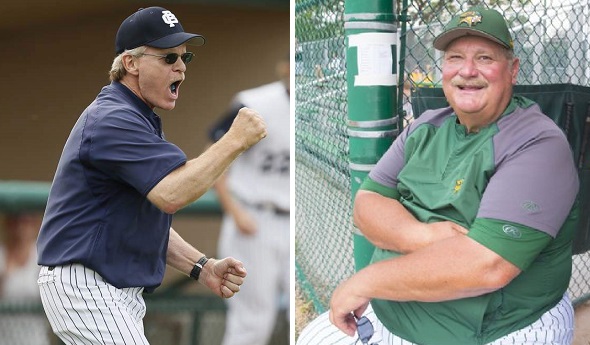
GROSSE POINTE – Neither Frank Sumbera nor Dan Griesbaum were raised in Grosse Pointe.
 But no one, at least at the high school level, has done more to enhance and promote baseball in the Pointes than this long-serving pair.
Sumbera, 69, is in his 45th season as coach at Grosse Pointe North and Griesbaum, 64, is in his 34th season at Grosse Pointe South. In this sport the rivalry that exists between Grosse Pointe’s two public high schools is as good as it gets. Sumbera holds the upper hand in MHSAA Finals titles, 2-1, and Griesbaum has the edge in District titles, 23-14.
This last statistic is notable in a sense that the two programs are often paired in the same District, as they are this season. South will host North in a Division 1 District Semifinal at 10 a.m. Saturday.
This season there is an added twist to the much-anticipated community showdown. Grosse Pointe Woods University Liggett, for the first time, will compete in the Division 1 tournament lined up on the other side of the bracket from North and South. University Liggett will play Detroit East English in the other Semifinal at 11:30 a.m. The winners will play for the title approximately 2 p.m.
University Liggett won four MHSAA Finals titles the past six seasons, two in Division 4 and two in Division 3, including last season in the latter. Coach Dan Cimini, knowing he had a strong team returning, petitioned the MHSAA to opt up to Division 1 for this season and 2018.
So far the Knights have proven they can hang at the Division 1 level. They are ranked No. 2 in the latest poll released by the Michigan High School Baseball Coaches Association.
And Cimini’s group received a break in the draw as it won’t have to defeat both North and South to win the District title.
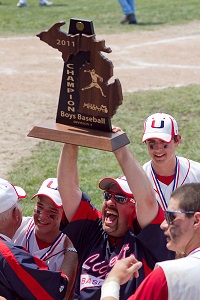
This is Cimini’s 14th season as head coach, and he tips his hat to the job Sumbera and Griesbaum have done in laying the groundwork.
“Frank has been there forever,” Cimini said. “Dan has been there a long time. I feel old, and I’m 48. I’ve coached 22 years. No doubt about it, those guys have set the standard.”
Cimini grew up in Grosse Pointe and competed in the city’s strong Little League program. He played for Griesbaum at South and played four years in college, two at Macomb College and two at University of Detroit Mercy. He was part of the 1987 South team that reached the MHSAA Semifinals for the first time in school history.
Cimini said the quality of baseball has remained strong in the community over the years but noted there have been some changes.
“The Little Leagues are phenomenal,” he said. “The Federation ball is phenomenal. But there aren’t as many kids playing. Now there are seven teams playing in the (Little League) majors. Back when I played there were 13 of 14. I miss those days. If I could take myself back, that’s where I’d go.”
At least in the modern era, one must point to Sumbera as the person most responsible for the quality of baseball being played at the high school level.
Sumbera played three sports at Chesaning High – baseball, basketball and football – and then went on to Central Michigan where he played basketball.
 Upon graduation Sumbera went looking for a job and received a tip from a college roommate. Sumbera was told that Grosse Pointe High would be splitting into two schools, North and South, and that they needed teachers, and, naturally, coaches. North opened for the 1968-69 school year, and Sumbera was hired as an assistant junior varsity football coach. In 1973 he became the assistant varsity baseball coach, and the next season he took over the baseball program.
“We won the District that year,” he said. “I’ll never forget it. We beat (then Detroit, now Warren) DeLaSalle, 2-1, in the final.”
Sumbera has coached some of the best teams in the state. His 2006 Division 1 championship team was 38-1. His 1980 Class A championship team was probably his best. Five players on that team were selected in the Major League Baseball amateur draft including Bill Babcock, one of the top pitchers on that team. Babcock’s son, Luke, will enter the ninth grade next fall is expected to enroll at North and play for Sumbera.
That’s the way it is in the Pointes. This large community that borders Detroit’s eastside is infectious. It’s common for someone who grew up here to remain in the area and raise his or her own family.
“A lot of the kids I coached in the 80s, I’m coaching their sons,” Sumbera said. “They play a lot of baseball here. As they grow through the ranks to high school, (Griesbaum) and I have to make cuts. You might have 250 at the Little League level, and by the time I get them we have like eight.
“The North-South rivalry is as good as any around. I coach football, and it’s intense every year. In baseball it’s as good a rivalry as there is in the state. It’ll be the fifth time we will have played South (this season). In our last doubleheader we won the first, 12-6, and lost the second, 3-2, in eight innings. That was a crusher. It’s big. The kids know it. The families know it. They all go to church together and play against each other during the summer.”
Griesbaum, a graduate of St. Clair Shores South Lake and Central Michigan, where he played baseball, said the level of competition is remarkable especially when one considers the schools do not have open enrollment. The only way one can play for North or South is to live in the school district.
Griesbaum got his start as an assistant under Sumbera (1980-83) before going to South in 1984.
“There’s nothing like a North-South game,” he said. “Our rivalry is one of the best. It’s a baseball community. My 6-year-old grandson plays T-ball. You look at what North and South have accomplished. There’s the (Grosse Pointe) Farms and City (Little League) teams. Then there’s the success of the Redbirds that (former Detroit Tiger) Dave Bergman ran. We run a (Christmas) Holiday hitting camp. We have 75 kids the first day and 75 more the next. It’s for the second through the sixth grades. We want to expose baseball at an early age.”
Some have expressed displeasure that all three Grosse Pointe schools are in the same district. Cimini scoffs at that thought. He said there are many districts throughout the state that have more than their share of quality teams.
The last two seasons North and South were in separate Districts, and they won their respective Districts both years. In 2015, they met in a Division 1 Quarterfinal, and South won. It was the Blue Devils’ seventh trip to the Semifinals, a record (tied with Saline and Grand Ledge) for a public school in Division 1/Class A.
Cimini said he’s looking forward to seeing what his team can do against the established powers.
“I can’t wait,” Sumbera said. “The whole thing is, come June 3 you have to be ready to play.”
 Tom Markowski is a columnist and directs website coverage for the State Champs! Sports Network. He previously covered primarily high school sports for the The Detroit News from 1984-2014, focusing on the Detroit area and contributing to statewide coverage of football and basketball. Contact him at [email protected] with story ideas for Oakland, Macomb and Wayne counties.
PHOTOS: (Top) Grosse Pointe South's Dan Griesbaum, left, and North's Frank Sumbera both have led their respective programs for more than three decades (Sumbera for more than four). (Middle) University Liggett coach Dan Cimini played for Griesbaum at South and has built a top program in the community as well. (Photos courtesy of the Griesbaum family, C&G Newspapers and the University Liggett baseball program.
Senior-Powered Spring Lake Answering Anticipation, Pursuing High Expectations
By
Dean Holzwarth
Special for MHSAA.com
April 29, 2026
SPRING LAKE – The time is now for the Spring Lake baseball team.
 With the return of 11 veteran seniors, the Lakers entered this spring with lofty expectations and an eye on an extended postseason run.
Anticipation has come to fruition in the form of a state ranking and a nearly perfect start.
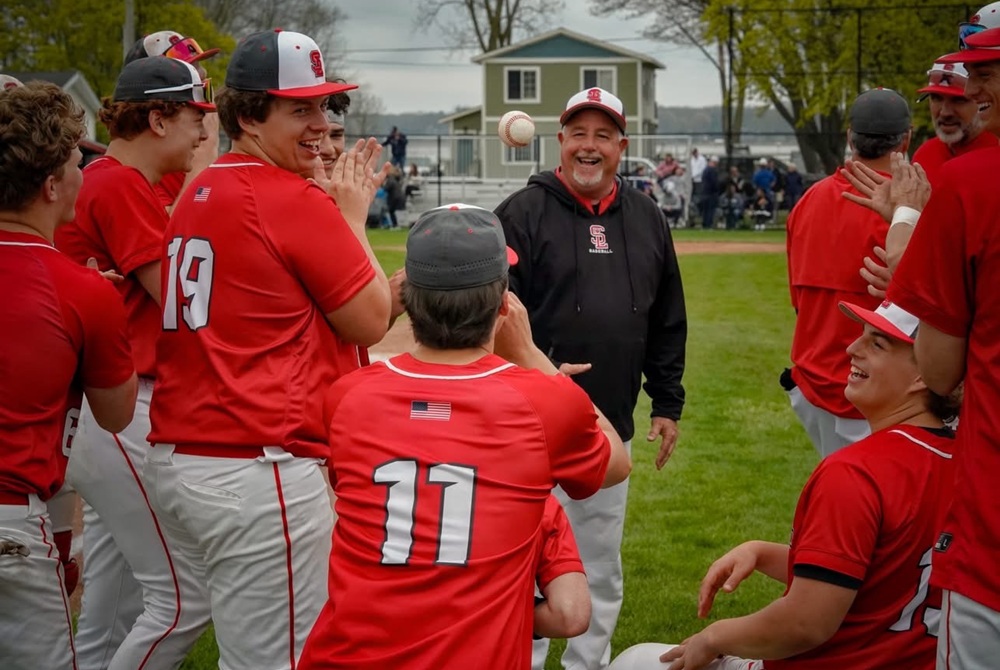
“Our motto is we are going to worry about next year next year, and we are going to do all we can this year,” Lakers fourth-year coach Bill Core said. “We knew we were going to have a big experienced group coming back, and that's just how the roster folded out. We have a lot of experience, a lot of returners and pretty high expectations.”
Spring Lake, which finished as Division 2 runner-up in 2024 and won a conference title last year for the first time since 2014, is off to an impressive 13-1 start (9-0 in the Ottawa-Kent Conference Black) and has climbed to No. 7 in the latest coaches poll.
Core said the vast number of returners, which includes five players who will play in college next year, has paid early dividends.
“I think that’s been a big difference,” he said. “We’ve played some younger teams that were breaking in sophomores or juniors or new kids, and our guys were ready to go right from the start. It’s been an advantage early on.”
Senior starting pitchers Oliver Smies and Maddux Kipling believe the strong bond among the senior class has been a major factor in the torrid start.
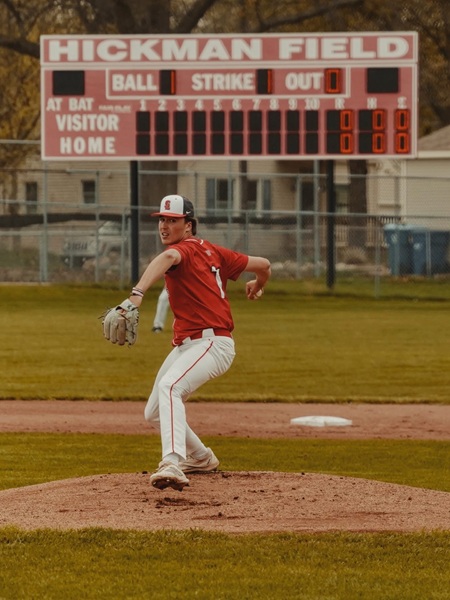 “I think something that’s really important about this team is our team chemistry and the amount of seniors we have on the team,” Smies said. “That alone allows us to have a ton of experience, and I think that's a big reason why we are off to such a hot start. We have been playing good team baseball and complementary baseball with good defense and good offense.”
Added Kipling: “We genuinely like being around each other, and every day we show up ready to get a little better. Our team has a real gritty and energetic identity, and I think that shows in how we compete and support each other.”
Kipling and Smies have been dominant on the mound this season. They haven’t allowed an earned run while combining for 80 strikeouts. Kipling earned a second-team all-state accolade as a junior and is headed to Michigan State next year. Smies will play at Calvin University.
“It starts with our pitching,” Core said. “Any time you are going to make a run, it starts with your pitching and we are pretty lucky, especially with our top two.”
Offensively, the Lakers possess a balanced lineup and boast a .330 batting average.
Senior Owen Smies, who will join his twin brother at Calvin, is hitting a team-best .432 with 13 RBIs. Seniors Alex Strauss (Adrian College) and Max Feltner (Muskegon Community College) are both batting .333 and have combined to score 25 runs.
As a team, Spring Lake has produced eight shutouts and nine wins by run differential.
“We got off to a good start, but we are going to play a lot better competition,” Core said. “This is a good week for us because we play Northview and state-ranked East Grand Rapids. We just picked them up, so we were excited to fill in the week with those two schools.”
Spring Lake is 62-6 over its last 68 games and trying to remain focused on each game as it attempts to erase the disappointment of last year’s early exit from the postseason.
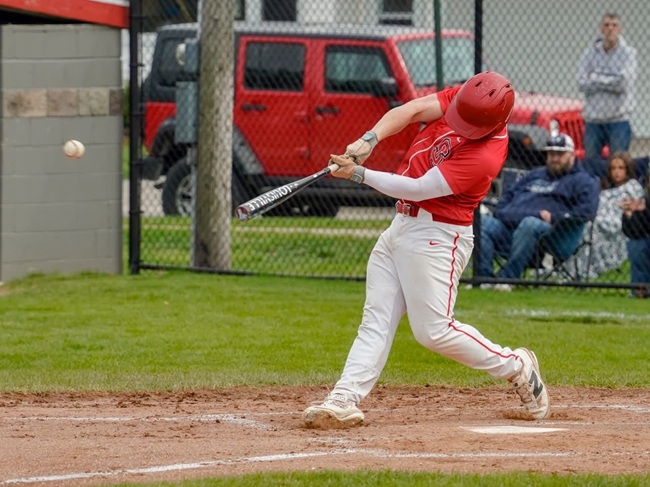 Despite winning 30 games, the Lakers suffered a 3-2 loss to Grand Rapids West Catholic in District play.
“I think there is some motivation there from that loss,” Oliver Smies said. “And I think that loss last year taught us that any team can beat any team, so you have to play your best baseball every single game no matter the opponent.”
Core said last year hasn’t been discussed, but believes it still sits in the back of his players’ minds.
“I think they think about that, but we've had quite a few mercies to start the season, and I said to them that when we get to the tournament it's going to be a one-run game and we are going to have to do the little things to make a difference because we are not going to win 14-0 all the time,” he explained. “We try to keep everyone in the moment.”
Kipling isn’t dwelling on the past – or looking too far ahead.
“As a group we’ve done a great job staying focused on the present and not getting caught up in the past or worrying too much about the future,” Kipling said. “My dad has always told me to focus on what you can control because putting energy into things you can’t control is a waste.
"That mindset has stuck with me, especially on the field. I try to live by ‘one pitch at a time,’ and because of that I haven’t really spent time thinking about last year’s loss. That’s behind us, and we’re just focused on what we can do right now.”
 Dean Holzwarth has covered primarily high school sports for Grand Rapids-based WOOD-TV for five years after serving at the Grand Rapids Press and MLive for 16 years along with shorter stints at the Ionia Sentinel and WZZM. Contact him at [email protected] with story ideas for Allegan, Kent and Ottawa counties.
PHOTOS (Top) Spring Lake baseball coach Bill Core tosses Maddux Kipling his home run ball after a win over Fruitport. (Middle) Kipling pitching at Spring Lake's Hickman Field. (Below) Senior Oliver Smies connects with a pitch. (Photos by Trevor McCue/Grand Haven Tribune.)