

Record-Setting Offense, Pitching Ace Drive Beal City Finals Run
By
Geoff Kimmerly
MHSAA.com senior editor
April 13, 2023
On the way to finishing Division 4 runner-up last season, Beal City produced a record-breaking offensive performance while following one of the most consistently successful pitching aces in state history.
The Aggies set an MHSAA record by scoring 12.5 runs per game in finishing 30-3, also making the team record book with 413 runs total, 78 doubles, 22 triples (tied for third all-time), 345 RBI and a .442 team batting average that ranks second on that list.
Brendan Martin made the career consecutive pitching wins list with 19 over his junior and senior seasons, and senior teammate Brayden Haynes earned listings for two home runs and six RBI in one inning of a win over Lake City. Martin is pitching this spring at Mid Michigan College.
See below for more recent additions to the baseball record book:
Baseball
Over a five-game stretch during April 2021, Kalamazoo Hackett Prep’s Stephen Kwapis got a hit in 13 straight at bats – the fourth-longest such streak in MHSAA history. He began with a hit in his final at bat in the first game of two that April 16 against Watervliet, then went 2 for 2 in the second game, a combined 7 for 7 during a doubleheader against Galesburg-Augusta on April 22, and finished with hits in his first three at bats April 24, 2021, against Grand Rapids Forest Hills Northern. He piled up five doubles, a triple and four home runs, along with three singles during the streak.
Portage Central’s run to the 2021 Division 1 championship game included record-book accomplishments by three individuals. Senior Luke Leto scored 73 runs over 37 games, good to tie for fifth-most runs in a season. Zach MacDonald was added for seven triples and 15 home runs, both over 40 games, and senior pitcher Gavin Brasosky posted a 0.84 ERA over 66 2/3 innings pitched. Leto is playing at Kansas after starting his college career at Louisiana State, and Brasosky is throwing at Kansas after playing a season at Tennessee. MacDonald is continuing at Miami (Ohio).
In 2016, Concord's Charlie Ropp became the second player from his family on the single-season stolen bases list, with his 63 over 35 games ranking for third-most in his family but sixth-most statewide.
Nearly 30 years later, Jason Knowlton has received his due for a performance April 29, 1994. On that day, he connected on back-to-back grand slams for Bridgman against Eau Claire, in consecutive innings. He’s one of seven to be listed for doing so in consecutive at bats.
Three of the oldest listings in this sport were added, all from Morrice. Jim Pavlica, a junior in 1946, was added for six stolen bases in a game that season against Byron. Pavlica would go on to play in the minors for the Chicago White Sox. He would have two more stolen bases when Morrice swiped 19 total against Byron in 1947, a performance that ranks fourth on the single-game steals list. Morrice also was added for 18 steals in a 1944 game against Byron.
Over the course of 11 days last spring, two Manistee hitters made the record book for steals in a game. Junior Ethan Edmondson tied for third on the list with seven against Bear Lake on April 30. Junior Jeff Huber made the list with six against Muskegon Orchard View on May 10.
Kingsley’s Owen Graves was added to the records for his seven triples as a senior in 2021. He now plays at Aquinas College.
Brighton Charyl Stockwell pitcher Aidan Liedeke was tough to hit last spring, as he struck out more than two batters per inning. He finished with 135 strikeouts over 61 1/3 innings pitching, for an average of 15.41 strikeouts per game – third-most on that record list. A senior this school year, he’s committed to continue at Kalamazoo College.
Jack Lamb brought plenty of speed to Perry’s offense last spring as a senior, making the record book twice. He reached the single-season list with 53 steals over 33 games, and also the single-game list with six steals on May 9, 2022, against Vermontville Maple Valley.
A performance more than four decades old from a school no longer open got its due. Orlando Villarreal hit a combined .451 over the 1979 and 1980 seasons to make the career batting average list for Wyoming Park. He went on to play at Central Michigan.
Jacob Morton became the first player on record since 2017 to hit two home runs in one inning when he did so in the first inning for Adrian Lenawee Christian against Britton Deerfield on May 16, 2022. Morton is a senior this school year.
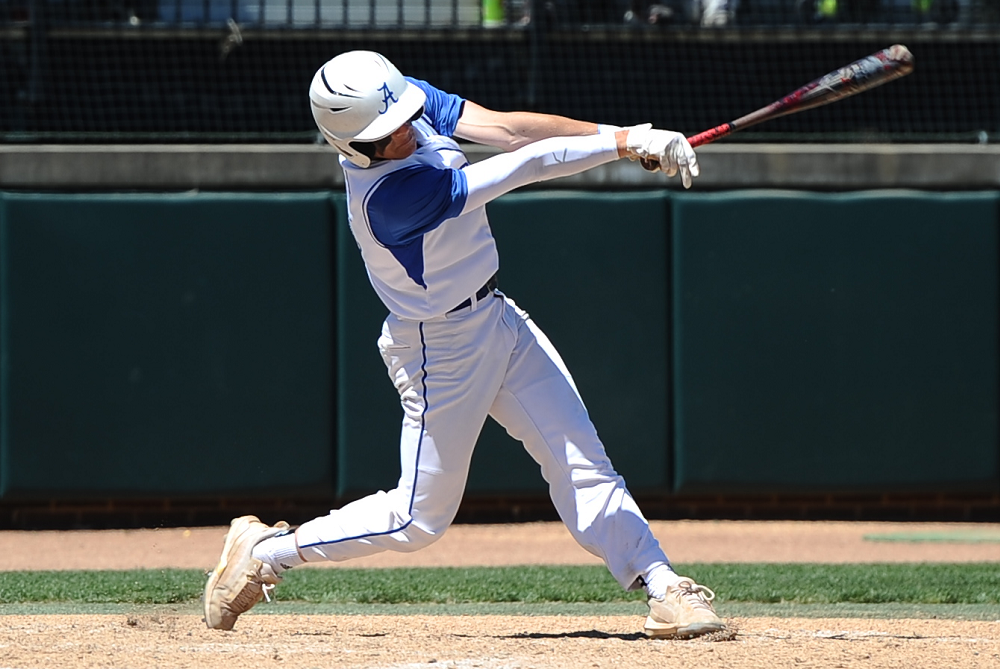
PHOTO Beal City standout Cayden Smith drives a pitch during last season’s Division 4 Final against Riverview Gabriel Richard.
Finalists Cash In on Clutch Performances
By
Tom Markowski
Special for Second Half
June 14, 2018
By Tom Markowski
Special for Second Half
EAST LANSING – Oli Carmody had been in pressure situations before, but nothing compared to what confronted the sophomore from Stevensville Lakeshore on Thursday.
With one out in a scoreless game, Carmody relieved Logan Morrow with runners on first and second base in the bottom of the ninth inning. Carmody went to 3-0 on Orchard Lake St. Mary’s leadoff hitter before retiring him on a fly to center. He got the next batter on a fly out to end the inning, and then singled in Lakeshore’s first run of a three-run 10th as the Lancers held on to defeat St. Mary’s 3-0 in a Division 2 Semifinal at Michigan State’s McLane Stadium.
Back in November, Carmody – playing his first season as goalkeeper on the soccer team – made a diving stop of a penalty kick to give Lakeshore a 2-1 victory over Plainwell in a Division 2 Regional Semifinal.
When asked which game held more importance, Carmody gave a quick response.
“It’s not even close,” he said. “Baseball is my life. This was the greatest experience of my life.
“I’ll admit that I was a little nervous (pitching in relief). When I saw I was missing high, I made adjustments. Once I got that first strike over, I got my confidence right there.”
Lakeshore (26-14) will attempt to repeat as Division 2 baseball champion when it faces Saginaw Swan Valley at 9 a.m. Saturday. Lakeshore also won Class B in 1990.
Thursday’s starting pitchers Connor Brawley of Lakeshore and Logan Wood of St. Mary’s were outstanding. Brawley allowed six hits, one walk and struck out seven in his 7 1/3 innings, and Wood went 8 2/3 and allowed two hits, three walks and struck out nine.
“It was crazy,” Brawley said. “The game flies by. I felt good out there. It was so hard (to come out). Our offense, we just compete. It’s been that way all season.”
Carmody went 1 2/3 innings to notch the victory, allowing no hits and one walk.
Catcher Bray Plomb and Cam Dalrymple started the 10th inning for Lakeshore with singles. A wild pitch put runners on second and third. Carmody singled to score the first run, and the second run scored on a wild pitch. Joel Brawley, Connor’s cousin, knocked in the third run with a bunt single.
St. Mary’s (28-13), the champion in 2015, had good chances to win the game in the seventh, eighth and ninth innings. The Eaglets had two runners in the seventh, but Connor Brawley recorded a strikeout to end the inning.
In the eighth, St. Mary’s loaded the bases and Alex Mooney lined out to right field to end the inning. In the ninth Carmody worked out of the jam to end the Eaglets’ last serious threat.
“There were many times we were against the ropes,” Lakeshore coach Mark Nate said. “They score, they win. We grinded it out.”
St. Mary’s is a young team, but coach Matt Petry gave no excuses. The Eaglets started four freshmen and four sophomores last season, so even though they have only four seniors on the roster, two of whom start, Petry said his players have been in a number of big games.
“We made the Catholic League final this year,” he said. “These guys have played in Comerica Park. We expected to make a good run in the tournament. We’re excited for the future. but today stinks. We hit the ball hard. We had runners in scoring position.”
Saginaw Swan Valley 3, DeWitt 1
Swan Valley scored three runs in the first inning, and that’s all the Vikings needed to earn their first championship game appearance since 2001, when they defeated Wyoming Park, 4-1, for the Division 2 title.
 In the first frame, Swan Valley (33-8-3) loaded the bases with one out, and Easton Goldensoph was hit by a pitch to force in the first run Logan Pietz drove in the next with a single, and the third run scored on a wild pitch.
DeWitt (27-7) scored its run in the top of the sixth inning on a Jace Preston single.
Goldensoph’s brother, Avery, a freshman, went the distance for the victory. He allowed six hits, walked two and struck out five.
“We’re excited to be back,” Swan Valley first-year coach Craig Leddy said. “These kids are young. They don’t know what pressure is. They drive me crazy, they’re so loose.”
Nolan Knauf allowed just two hits in going all six innings for DeWitt. The one bad inning did him in.
“Nothing’s promised,” DeWitt coach Alan Shankel said. “Credit goes to Swan Valley. They made the plays. We were knocking on the door all game.”
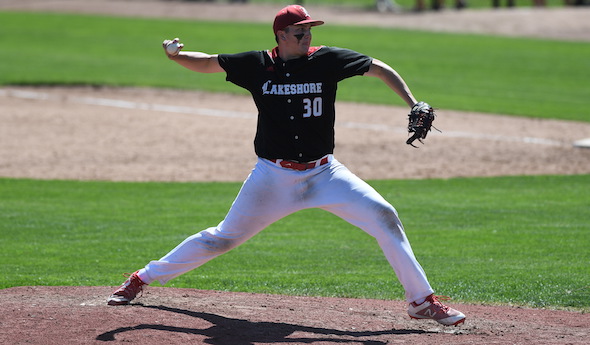
PHOTOS: (Top) Stevensville Lakeshore’s Logan Morrow makes his move toward the plate in Thursday’s first Division 2 Semifinal. (Middle) Swan Valley’s Avery Goldensoph drives a pitch during the second Semifinal at McLane Stadium.