

'Retired' Periard Still Finding Ways to Serve Suttons Bay
By
Tom Spencer
Special for MHSAA.com
May 28, 2021
When Doug Periard retired in August, some thought he had done it all as a teacher, coach, mentor and athletic director for Suttons Bay Schools.
 Retirement has proven many wrong.
He did intend to stay on as the baseball coach at least thru the 2022 season. He also thought he’d help out some with the bus driver shortage using the CDL (Commercial Drivers License) he’d recently obtained. Substitute teaching sounded good to him too.
So he came back in October. He immediately took on an emergency assignment, coaching the school’s 8-player football team to a win over Manistee Catholic Central. He also drove the bus to the game.
“Doug is that kind of guy ... when there is a need to filled, Doug will fill it for you,” said Andy Melius, principal at Suttons Bay. “The community means a lot to him, and the school means a lot to him. He bleeds red and white.”
Also since returning, he’s served as a K-1 gym teacher, filled in at the school’s front desk and headed up the district’s COVID-19 testing as the Quarantine Officer.
On Tuesday, Periard will coach baseball after driving the bus transporting the Norsemen to Buckley to begin postseason play. It’s no different than what he’s been doing all spring.
However, some questioned if Periard could handle bus driving and coaching on the same day.
 “It’s been interesting,” Periard said with a little laugh. “I was a champion at taking a nap (on the bus as coach).
“I would be asleep before we got to the split in the road and wake up when we got there,” he continued. “So, there was some real skeptics out there wondering if I’d be able to both drive and coach when I got there.”
Periard has hopes of hitting the 400-win mark before giving up baseball. He’s compiled a 379-280-18 record since taking over the Norseman baseball program on a “temporary” basis in 1998. It was supposed to be only until another coach was found. He had coached the JV squad the year prior.
And, there’s something else about Periard very few people know. Someone who does is Christine Mikesell, Suttons Bay’s assistant athletic director. Mikesell’s five boys at one time or another played sports coached by Periard.
“Every kid is important to Doug,” noted Mikesell, who is stepping down in June. “He really has a big heart for those that are struggling, and he makes a pathway for a kid to achieve if they take it.
“He is one of those kind of guys you want on your side because he is a team player ... a real team player when it comes to the school and athletics and coaching.”
Mikesell has seen him help lots of high schoolers who end up graduating perhaps without knowing how much help Periard provided. He often made sure kids had a white dress shirt so no one was left out on the school’s game day dress-up tradition. He’s also paid for lunches and arranged transportation for students coming from hard-life circumstances.
“I have seen him go well out of his way,” said Mikesell. “I know a lot of it is his own pocket.
“He has eyes, and he watches,” she continued. “He finds the one that is struggling, and he goes and brings them as part of the team.”
Periard became AD in 2008, a year he will never forget. It was marked by the stock market crash and he, along with his wife Anne, was dealing with his daughter Grace’s new diabetes diagnosis. The economic circumstances also threatened his continued employment as a teacher.
The job loss did not materialize. Grace is now in college. And, she was the 2020 recipient of the Suttons Bay High School Berserker Award presented to Norse athletes who have competed in three sports every year of high school.
The award was created several years back by Periard. Now he hopes his son Hugh, a junior pitcher and three-sport athlete, will follow his sister’s footsteps and be similarly recognized next spring.
“I stole the (Berserker) idea from my little brother who was the AD at Birch Run,” he admitted. “I am proud to have gotten the thing rolling.
“I think playing three sports is vital to a small school and development of young people.”
Periard’s legacy also will include strong co-op developments, including the establishment of NorthBay, and keeping a great football tradition alive while the school struggled with declining enrollment. The co-ops are established for all sports with Northport and include Leelanau St. Mary’s in boys and girls track & field and soccer.
 Periard guided the Norsemen’s move to 8-player football in 2017. The previous season, Suttons Bay had to forfeit the majority of its games because it did not have enough players to compete in 11-player.
Mikesell’s son Baylor was one of seniors who missed out as part of that 2016 team. Another son, Lucas, was a star player in the school’s run to back-to-back 8-player Division 2 runner-up finishes the last two seasons.
“My son lost his senior year because we were still 11-man, and we couldn’t field a team,” she said. “Doug is a problem solver and comes up with solutions outside the box.
“He did tons of research on it to get us in a place (where) we could participate in football because he saw that the risk of losing football here at the school, what a damaging thing it would be.”
Periard is most proud, however, of the behavior of the student body during athletic contests. His game management included a “bristle” – a knowing look – passed on from his grandfather to his mother and ultimately to he and his brothers.
With his simple bristle he was able to instantly, and non-verbally, communicate to the students they’d better stop what they’re doing.
“They bought into my stern look when they were in any way at all not cheering for their team,” he said. “They knew they should be cheering for their teams and not being disparaging against their opponent, and only treating opponents with class.”
 Tom Spencer is a longtime MHSAA-registered basketball and soccer official, and former softball and baseball official, and he also has coached in the northern Lower Peninsula area. He previously has written for the Saginaw News, Bay County Sports Page and Midland Daily News. He can be reached at [email protected] with story ideas for Manistee, Wexford, Missaukee, Roscommon, Ogemaw, Iosco, Alcona, Oscoda, Crawford, Kalkaska, Grand Traverse, Benzie, Leelanau, Antrim, Otsego, Montmorency, Alpena, Presque Isle, Cheboygan, Charlevoix and Emmet counties.
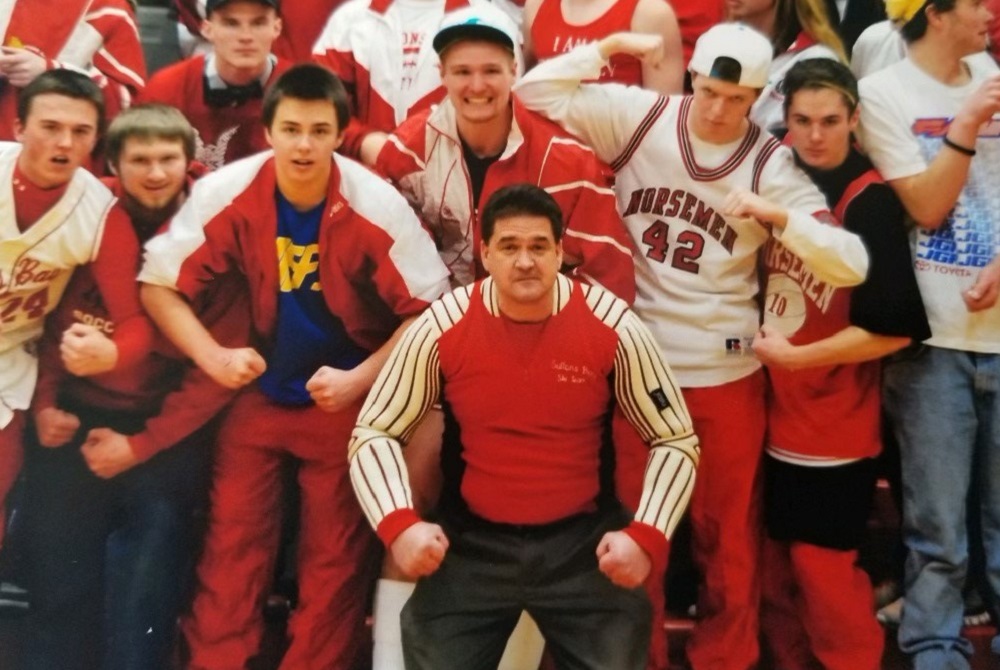
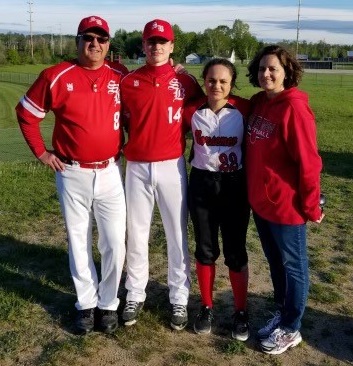
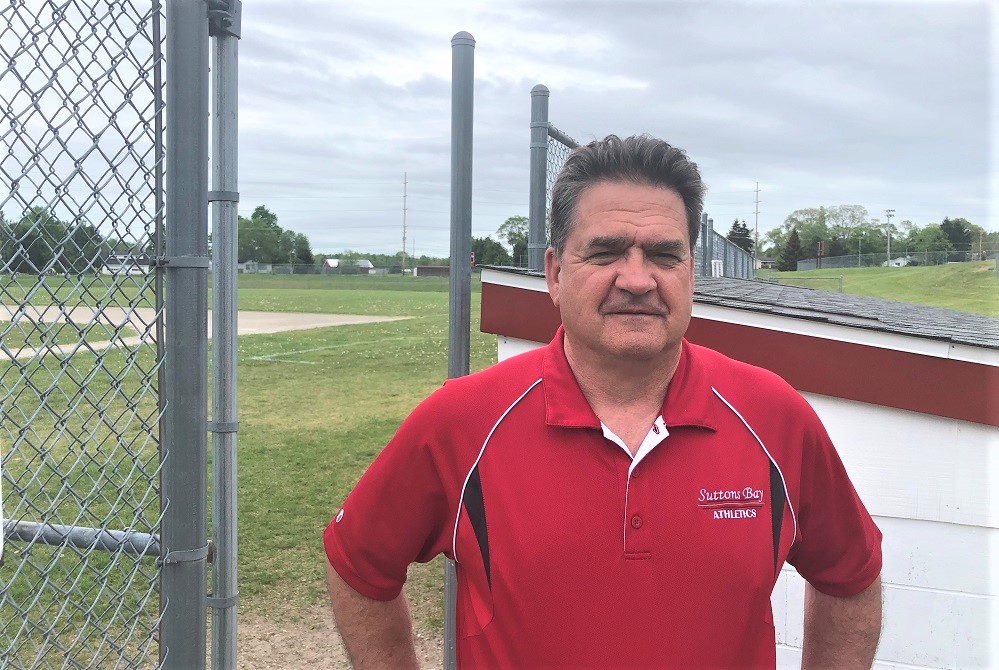
PHOTOS: (Top) Doug Periard enjoys a moment surrounded by enthusiastic Suttons Bay student fans during his tenure. (Middle) Periard, also the baseball coach, with son Hugh, daughter Grace and wife Anne a few years ago. (Below) Even in retirement, Periard remains a mainstay in Suttons Bay. (Top and middle photos courtesy of Doug Periard; bottom photo by Tom Spencer.)

Coaches Get U-M Concussion Training
July 24, 2012
Already administering a strong set of protocols addressing the removal and return to play of young athletes suspected of sustaining concussions in competition, the Michigan High School Athletic Association is further ramping up its concussion education efforts of coaches, student-athletes and parents as the 2012-13 school year approaches.
In partnership with the University of Michigan’s NeuroSport and the Pediatric Trauma Program at C.S. Mott Children’s Hospital, required online rules meetings for coaches and officials will include an education component illustrating the serious nature of concussions; recognition of the signs and symptoms; a review of return to play protocols; applicable MHSAA regulations; and downloadable co-branded resources from NeuroSport, as well as materials produced by a joint effort of the Brian Injury Association of Michigan, the Detroit Lions, the Center for Disease Control and the MHSAA.
This is the second year the MHSAA has included concussion education in its online rules meetings, which are annually viewed by nearly 20,000 coaches and game officials. This year, the Michigan NeuroSport Concussion Education - High School Coach edition, endorsed by the American Academy of Neurology last fall, has been modified for the MHSAA audience. The MHSAA will also promote the availability of the NeuroSport concussion education modules offered specifically for parents and coaches.
“These educational efforts, coupled with protocols addressing concussions when they take place on the field of play, put our schools in the best possible position to minimize the risk to young people,” said John E. “Jack” Roberts, executive director of the MHSAA. “We’re pleased to have our new partnership with University of Michigan NeuroSport and our ongoing partnership with the Brian Injury Association of Michigan which put our state at the forefront of addressing the critical health issue for interscholastic athletes.”
Roberts added that the same educational materials the Association has co-branded with its partners will also be used to help raise concussion awareness in other youth sports by other sponsors in the state.
“We are proud to partner with MHSAA and bring the most up-to-date concussion education to those on the frontline of athletics. Education is a vital component to improving player safety,” says Amy Teddy, injury prevention program manager at C.S. Mott Children’s Hospital. “We believe that ‘It takes a team to keep concussions on the sidelines.’ Parents, coaches, teammates, officials and athletic trainers all have a role in protecting athletes from serious injury.
“In addition to our coach modules, we recently launched our parent edition to help another member of the ‘team’ better recognize and understand concussion.” added Teddy, who also is director of education for Michigan Neurosport.
The NeuroSport online programs for parents, high school coaches and youth sports coaches is now available at http://www.MichiganNeuroSport.com. An online program for athletes will be available soon.
NeuroSport has also produced a 60-second public service announcement in which one of the state’s all-time winningest football coaches – John Herrington of Farmington Hills Harrison – talks about concussions. This video, along with a 30-second PSA recently updated by the MHSAA, “No Such Thing As Just Getting Your Bell Rung,” will be made available to media outlets in time for the coming sports season, and will be shown during MHSAA programming online and on cable television.