

Senior-Powered Centreville Eager to Build on 2024 Regional Final Run
By
Scott Hassinger
Special for MHSAA.com
April 8, 2025
CENTREVILLE – Optimism is running high on the baseball diamond in Centreville, where eight seniors return who have unfinished business.
 Dan Truckenmiller, the Bulldogs' fourth-year varsity head coach, has developed a special connection with his senior class – many of whom he has coached for the past 10 years, since they started playing the sport at the Little League level.
"I've been fortunate to be able to move up in the program, along with my group of seniors. We're looking forward to a solid season. We basically have all nine of our starters back from last year," Truckenmiller said.
The coaching continuity and the Bulldogs' experience were big reasons Centreville, 13-4 in league play and runner-up in the Southwest 10 Conference last spring, was able to put together a strong postseason run.
The Bulldogs avenged a pair of regular-season losses by knocking off No. 8-ranked and undefeated Marcellus 11-1 in their District Final. Centreville went on to post a 2-0 shutout of Byron Center Zion Christian in the Regional Semifinals before losing 6-0 to Kalamazoo Hackett Catholic Prep in the Regional championship game to finish 21-11 overall.
Centreville won't have the opportunity to avenge its season-ending loss to Hackett in the playoffs this season after moving to Division 3 (although the two will meet again during the regular season). But with a tougher nonleague schedule, the Bulldogs are confident they will be able to compete against anyone once the postseason arrives.
Centreville opened this season last Tuesday with a nonleague doubleheader on the road against reigning Division 3 champion Watervliet. The Bulldogs also have tough nonleague games lined up against Bronson, Union City, Constantine, Hackett, Schoolcraft and Kalamazoo Christian.
A formidable foe in baseball, Centreville reached the Division 4 Semifinals twice last decade under past coach Mike Webster. The Bulldogs lost to Muskegon Catholic Central 10-8 in the 2015 Final and fell 5-1 to eventual champion Sterling Heights Parkway Christian during the 2016 Semifinals.
Three of the most notable players Centreville's program has produced are former Major League relief pitcher Matt Thornton, along with along with current Division I players Jared Spencer (Texas) and his twin brother Jacob Spencer (Indiana State University).
Thornton, who enjoyed a 12-year MLB career with the Seattle Mariners, Chicago White Sox, Boston Red Sox, New York Yankees, Washington Nationals and San Diego Padres, still ranks second all-time in American League history with 182 holds. Jared Spencer is in the starting pitching rotation for the Longhorns after transferring following a stellar three-year stint at Indiana State.
 Truckenmiller believes his 2025 Bulldogs squad has the potential to leave a special mark of its own.
"Our main goal is to always win the conference, which we haven't been able to do yet. There's always a little hiccup here or there that's kept us from achieving that," he said.
Centreville's senior class includes Evan Blair, Matt Swanwick, Ben Truckenmiller, Kobe Carpenter, Vinny Jines, Tristan Smeltzer, Garrison Bunning and Aiden Kohlhoff.
Swanwick, Carpenter, Ben Truckenmiller and Jines are all four-year varsity players.
"My plan right away when I took over as coach was to bring the guys that had varsity potential up and get them that experience," said Dan Truckenmiller, who played high school baseball with Thornton and Matt Swanwick's father Paul Swanwick as well as his uncle Matthew Swanwick. They are all 1995 Centreville graduates.
The 6-foot-5 Matt Swanwick will be Centreville's ace pitcher after posting a 3-1 mark and 1.67 ERA as a junior with 54 strikeouts against just 16 walks over 46 innings.
"I'm looking forward to this season. Our team is one year older, and that should allow us to handle ourselves better in any situation,” said Matt Swanwick, a first-team all-league selection last season who plans to attend Michigan State University to study to become an electrician. “We are deep in our pitching staff and we can all throw strikes, plus we have guys behind us who can make plays,"
Centreville's coach is confident in Swanwick's ability to handle the No. 1 role on the staff.
"Matt excels at whatever he does. He always throws hard and can place the ball where he needs too. At the plate, he's a clutch hitter with power and is probably the fastest guy on our team," said Dan Truckenmiller, who will be assisted for a third straight season by Chad Meade.
"Chad is a great coach who has been around the game of baseball a long time and is someone who knows the Xs and Os of the game very well."
Ben Truckenmiller, son of the head coach, went 6-0 with 73 strikeouts and 19 walks and a 3.50 ERA last spring. He will be the Bulldogs' regular starting catcher when he's not scheduled to throw.
Smeltzer compiled a 4-0 mark on the mound in 2024, allowing 16 walks with 24 strikeouts and a 4.10 ERA. Evan Blair, Carpenter and Jines could all see time on the mound as well.
"Most of our senior class is extremely versatile and can play multiple positions. Ben excels at catching and has been our starter there for four years. He's also become a better pitcher and has some good pitches that throw opposing hitters off," Dan Truckenmiller said.
 "Kobe has been one of the best centerfielders I've ever had. He makes remarkable catches every game and is very vocal and stays positive. Vinny is a bigger kid who can hit the crap out of the ball. He probably hits it the hardest of anyone on our team. When he's up there, he's just looking to get a base hit rather than trying to hit it out of the park."
Swanwick returns as Centreville's top hitter in the No. 3 spot in the batting order where he hit .398 as a junior with 37 hits, including nine doubles, three triples, one home run and 34 RBI.
Carpenter, the Bulldogs' starting centerfielder, returns having batted .311 with 32 hits as the team's lead-off hitter a year ago
"I love the potential of our outfield. We all communicate very well, and there's good chemistry between us. We have lot of faith in each other to make every catch, and we have a strong core of infielders as well," Carpenter said.
Jines, the Bulldogs' starting first baseman, returns to fill the clean-up spot after hitting .395 with 32 hits, including eight doubles, with 32 RBI last season.
"We have a consistent group of guys who have played together from a young age,” Jines said. “I'm looking forward to playing first base again because there is a lot of attention to detail to be good at that position. You have to know the other infielders' style with the throws they make over to you.”
Ben Truckenmiller occupies the No. 2 spot in the batting order. He hit .318 with 28 hits, including three doubles, and had 15 RBI last year.
"I love catching. I have faith in my abilities behind the dish, and I feel like I'm one of the better catchers around our area,” he said. “ We have unfinished business this year and want to win our conference and Districts and go further than last year. It will take being confident and remaining focused to achieve those goals."
Two sophomores will supply a great deal of punch again at the plate for Centreville. Second baseman Cash Dentler returns after hitting .438 with 32 hits and 20 RBI and an on-base percentage of .539, while sophomore starting shortstop Bo Riley batted .281 as a freshman with 25 hits, including seven doubles, and 21 RBI.
Smeltzer batted .293 with 17 hits and 10 RBI. Juniors Jack Bartelt, the starting left fielder, and Matt Blair will play vital roles for the Bulldogs while Bunning is pegged for heavy duty in right field.
"Garrison is a team guy who I can always put into the game to get a clutch hit or make a key play in the field for us," Dan Truckenmiller said. "Jack is a big power hitter and aggressive for his size on the basepaths. Evan is a utility guy and our secret weapon who came out of nowhere last season to pitch valuable innings for us. Aiden has one of the best attitudes of anyone on the team too."
An ability to adjust and play small ball will be critical again to Centreville's success. The Bulldogs are also a big threat on the basepaths.
Centreville stole 124 bases in 2024 as a team. Leading that effort was Matt Swanwick with 22 followed by Ben Truckenmiller (21), Carpenter (18), Dentler (14) and Jines (13).
"Our guys understand that when there are times that we aren't hitting the ball very well, we might have to be able to lay down a bunt,” Dan Truckenmiller said. “I like to be aggressive when we get guys on base. I like to challenge our kids and steal a lot of bases."
 Scott Hassinger is a contributing sportswriter for Leader Publications and previously served as the sports editor for the Three Rivers Commercial-News from 1994-2022. He can be reached at [email protected] with story ideas for Berrien, Cass, St. Joseph and Branch counties.
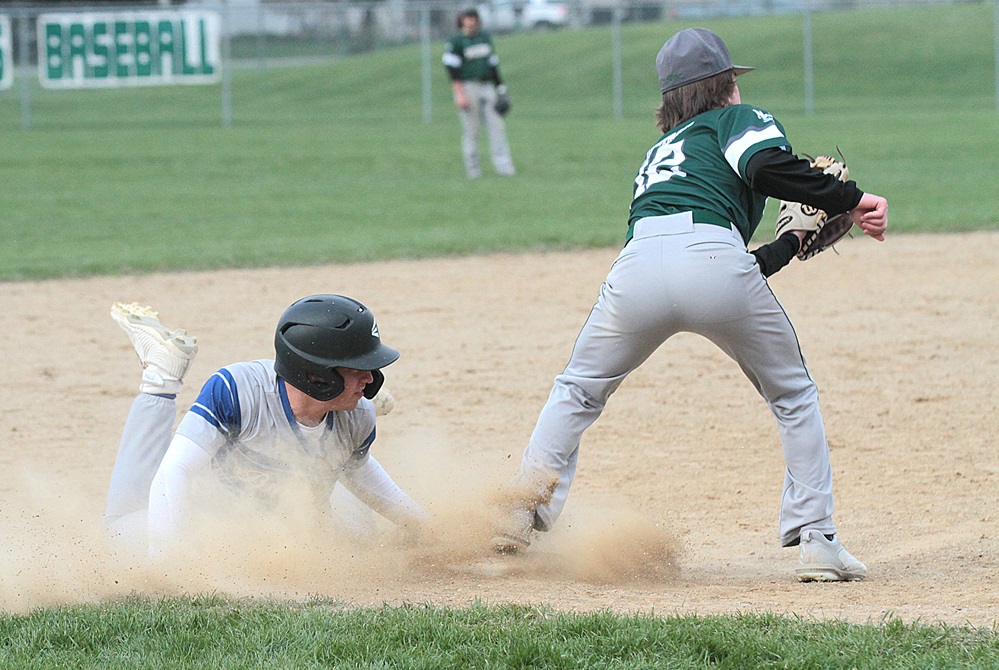
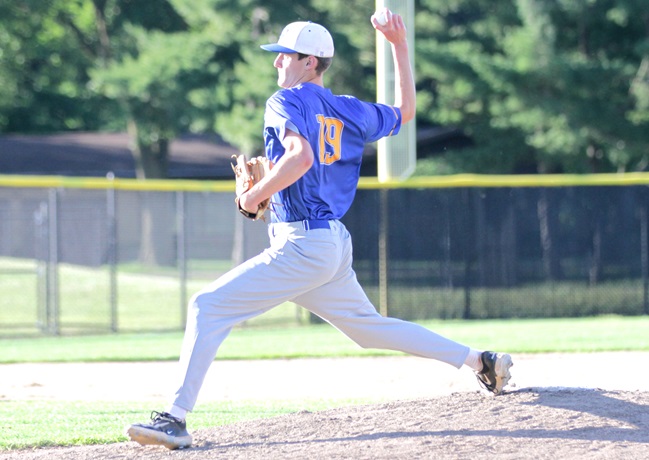
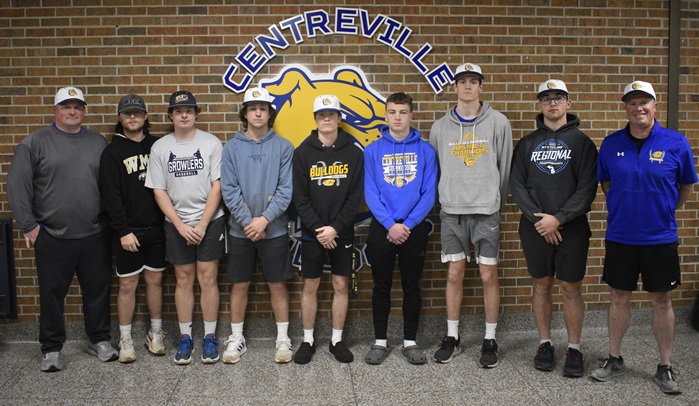
PHOTOS (Top) Centreville’s Ben Truckenmiller, left, beats a tag at third base during a 2024 game. (Middle) Matt Swanwick pitches for the Bulldogs last spring. (Below) Centreville’s seniors and coaches, from left: Assistant coach Chad Meade, seniors Vincent Jines, Tristan Smeltzer, Kobe Carpenter, Ben Truckenmiller, Garrison Bunning, Matt Swanwick and Aiden Kohlhoff; and Centreville head coach Dan Truckenmiller. Missing from the photo is Evan Blair. (Action photos by Brandon Watson/Sturgis Journal. Group photo by Scott Hassinger.)
Still 'Loose' Swan Valley Loaded Again As Well
By
Paul Costanzo
Special for MHSAA.com
April 3, 2019
Mitch Jebb and his teammates on the Saginaw Swan Valley baseball team had plenty of fun a year ago as they made their run to the MHSAA Division 2 Final.
 The young Vikings surprised plenty of people with their runner-up finish, and a crucial part of that was how loose the team played. Even with a larger target now on their back, don’t expect them to tighten up.
“If you come to one of our games, we’re always loose,” said Jebb, a junior shortstop who earned all-state first-team honors as a sophomore. “We’re just out there having fun, and why would you play baseball if you’re not having fun? That’s how we look at things – play your game, but have fun doing it. This year, we’re probably more loose than we were last year.”
Swan Valley is still plenty young, with a roster comprised mostly of juniors and sophomores, but another deep postseason run wouldn’t come as a surprise to anyone. The Vikings were ranked No. 6 in Division 2 in the Michigan High School Baseball Coaches Association preseason rankings, and they opened the season Tuesday with a pair of mercy-rule victories (13-0 and 11-0, both in five innings) at Chesaning.
“I think we surprised quite a few people because we were so young and they had never heard of us before,” Swan Valley coach Craig Leddy said. “They were just playing and winning, and they were loose. That’s not going to happen this year. People have us on the radar.”
The runner-up finish is likely the biggest reason the Vikings are on the radar, but it also doesn’t hurt to have three players on the roster who have committed to Big Ten baseball programs – none of whom are seniors.
Jebb and classmate Brian Ross, a 6-foot-8 pitcher, have committed to Michigan State, while sophomore Avery Goldensoph, a 6-foot-2 pitcher, is committed to Michigan. Goldensoph, a first-team all-state selection as a freshman, opened the season by throwing a no-hitter against Chesaning.
“I knew the group coming, and we have some more kids coming next year as sophomores, so I’m excited about what we have,” said Leddy, who was a longtime assistant before taking over the Swan Valley program a year ago. “This is a special group that’s played a lot of travel ball, and that’s huge.”
 There’s plenty of quality depth to go along with those stars, both in the lineup and the pitching rotation. Junior infielder Victor Mancini had 46 RBI through the team’s first 42 games a year ago, while junior catcher Easton Goldensoph had nine doubles and 26 RBI. Senior pitcher Conner Sika was the team leader in earned-run average, coming in at 0.51 while striking out 53 and allowing 26 hits and nine walks in 54 2/3 innings. He was superb on opening night, allowing just one hit in his shutout victory against Chesaning.
“I think we can do it this year,” Avery Goldensoph said of making another deep run. “We’ve got me, Brian and Conner Sika who pitched (in the opening series), he’s really good. Our lineup put up 13 runs and 11 runs, that’s a great start.”
With a tough Tri-Valley Conference Central schedule ahead, the games figure to get more difficult. But the Vikings view that challenge as a good way to prepare for the postseason, and invite the daily pressure playing in that league brings.
Because even as they try to avoid it, the pressure of greater expectations is a reality they have to face.
“I think we have a really good team, in my opinion,” Ross said. “Last year we were kind of going after everybody, and now we’re being looked at like they want us. So I would say it’s a little more pressure, but it’s nothing we can’t handle.”
The best way to handle any pressure that may seep in? By going back to what worked so well a year ago – staying loose. That starts with the coaching staff.
“We’re a little more relaxed; we’re not screaming and hollering,” Leddy said about his staff, which includes assistants Mark Jebb and David Finzel, as well as pitching coaches Chris and Nick Sarmiento. “I remember what it was like when I was a young kid; the last thing you wanted was a coach kicking you in the (behind) all the time. You want someone encouraging you to be a better person and a better ballplayer. I’m blessed to have some great coaches on staff that know a lot about baseball and care about the kids.”
The attitude of the coaches has certainly gotten through to the players.
“What happens, happens, right?” Mitch Jebb said. “If we win, we win. The goal is to win, but it’s not like Coach is saying, ‘You better win a state championship.’ We’re all playing the game we love, and it’s fun. It’s fun playing. If we can win, we want to win – you always want to win. But the overall picture is to go out there and play your game and have fun.”
 Paul Costanzo served as a sportswriter at The Port Huron Times Herald from 2006-15, including three years as lead sportswriter, and prior to that as sports editor at the Hillsdale Daily News from 2005-06. He can be reached at [email protected] with story ideas for Genesee, Lapeer, St. Clair, Sanilac, Huron, Tuscola, Saginaw, Bay, Arenac, Midland and Gladwin counties.
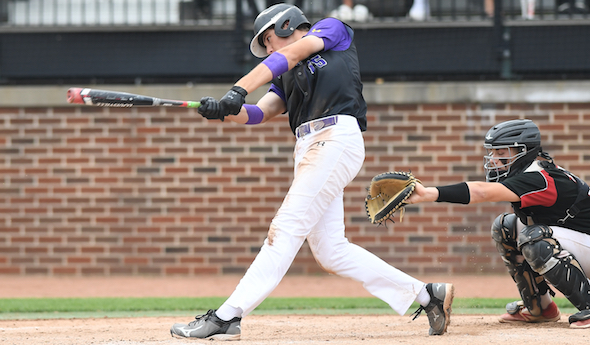
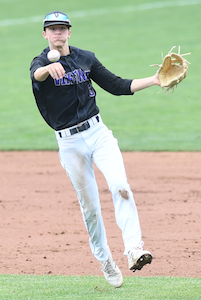
PHOTOS: (Top) Swan Valley’s Victor Mancini drives a pitch during last season’s Division 2 championship game against Stevensville Lakeshore. (Middle) Shortstop Mitch Jebb fires a throw to first.