

Summerfield, Nouvel Add to Playoff Perfection
By
Paul Costanzo
Special for MHSAA.com
June 14, 2019
EAST LANSING – Petersburg Summerfield pitcher Brock Olmstead said he was a little surprised when he got the ball to start Friday’s Division 4 Semifinal, thinking it would be Bulldogs ace Derek Clark who took the mound with a trip to the Finals on the line.
His coach, Travis Pant, feels his team has two aces, however, and his confidence was rewarded as the sophomore threw a two-hitter to lead the Bulldogs to a 5-0 win over Gaylord St. Mary and their first-ever championship game appearance.
“I kind of thought he was going to put Derek to throw in front of me, because we want to get there before we can actually play there,” Olmstead said. “I was happy that he trusted me, and he threw me out there, and it worked out good.”
Summerfield (27-4) will play Saturday against Saginaw Nouvel, which defeated Decatur 4-2 in the second Semifinal at McLane Stadium on the campus of Michigan State University.
Olmstead entered Friday’s game with a chip on his shoulder, carried all the way from last year’s Quarterfinal, a 3-2 loss to St. Joseph Lake Michigan Catholic. Olmstead took the pitching defeat in that game and said he’s had the final scoreboard saved as the lock screen on his phone ever since.
“I just have all the confidence in the world in Brock,” Pant said. “He lost the Quarterfinal game last year, so I was going to give him a chance for some redemption. He’s been throwing great for us all year, and we’re solid defensively when he pitches because I get to put Derek in center field – he made a couple plays today that you just kind of shake your head at. But that was the decision, that’s what we’ve been rolling with and I wasn’t going to change anything because I didn’t want him to think I didn’t have any confidence in him. He’s been throwing Game 1, and Derek will throw Game 2.”
Clark had three hits, one RBI and two runs scored Friday. Olmstead struck out five, allowing the two hits and one walk, facing just 24 batters in seven innings of work.
He also had some early run support, as the Bulldogs jumped on the Snowbirds (26-6) right away. Brendan Dafoe led the game off with a single, followed by a bunt single from Clark. They were both driven in two batters later by Ethan Eyler.
It was the top of the order that was responsible for all of Summerfield’s runs, as the Bulldogs struck again in the third inning. Clark and Eyler each had an RBI triple in the frame, putting the Bulldogs up 4-0. Another run was added in the fifth when No. 5 hitter Mark Keller drove in Dafoe with a sacrifice fly.
Dafoe and Clark each ended the game with three hits, while Eyler had two.
“Our early leads, we’ve been doing that all year,” Eyler said. “I think it’s really key for us to get the early lead and then keep adding on and on. The top of our order is really killing it right now. Everyone one through nine is a hard out.”
Drew Koenig and Logan Murrell each had a hit for St. Mary. Koenig took the loss, striking out five while allowing nine hits.
The Snowbirds were making their fourth straight Semifinal appearance and could see every player who started Friday’s game return next season.
“Obviously next year is next year, but we have the same crew of kids coming back for the most part,” St. Mary coach Matt Nowicki said. “Our plan is next year to work just as hard and get here again.”
 Click for the full box score
Saginaw Nouvel 4, Decatur 2
Brady Alverson and his Saginaw Nouvel teammates didn’t see themselves as a below-.500 team entering the postseason, despite their 9-16-1 record.
“We didn’t really think about our record,” the Nouvel sophomore said. “We knew going into the postseason it starts 0-0. It doesn’t really matter what our record is, it just matters who wins the most games in a row.”
Thanks to a big fifth inning and a resilient pitching performance by senior Jacob Burr, Nouvel has now won five in a row, and a sixth win will give them a Finals title and a .500 record.
“Our regular season, we played a lot of tough teams,” Nouvel coach Shawn Larson said. “We try to do that, too. Not only is our conference tough, but when we’re scheduling out-of-conference games, we want to play good teams. That makes us better, because we know come playoffs, everybody is 0-0 and we all have a shot.”
The Panthers made the most of their shot with a two-out rally in the top of the fifth inning, which provided all four of their runs. Alverson started the scoring with a bases-loaded double, which plated two runs, and in the next at-bat, Justin Osmond singled to drive in two more and make the score 4-1. Prior to that inning, the Panthers had managed just one hit against Decatur pitcher Jakob Southworth.
“I was just thinking of a way I could help my team,” Alverson said. “I was looking for a fastball on the inner half of the plate and tried driving it. I was a little late on it, and I put it in the left-center gap. When it hit the ground, I knew we were going to score, and it was just a rush of adrenaline going through my body as we scored that run.”
That was enough for Burr, who bounced back after allowing a solo home run to Southworth in the first inning that cleared the scoreboard in left field. Burr finished the game with four strikeouts while allowing five hits and two runs in seven innings.
“That’s kind of like the theme of our season: can we come back after being punched in the mouth,” Larson said. “Overcoming some adversity has been huge for us, and I credit the entire season for how we responded right then. There was a time when this team would have shut it down, but not anymore.”
Decatur did add a run in the bottom of the sixth inning, as Benjamin Cerven scored on a double steal following a strikeout.
Southworth led Decatur with two hits. He also struck out seven while allowing seven hits and two walks in 6 2/3 innings pitched. Sam Bartels led Nouvel with two hits.
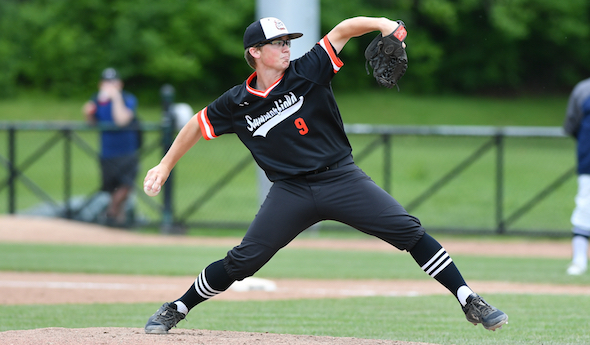
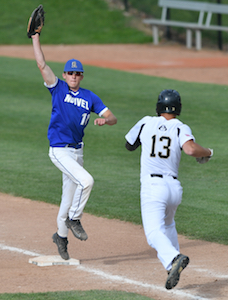
PHOTOS: (Top) Summerfield's Brock Olmstead unwinds toward the plate during his team's Division 4 Semifinal win Friday. (Middle) Nouvel's Michael Ehlman (11) snags a throw at first base just in front of Decatur runner Justin Gale.
Be the Referee: Fair or Foul?
By
Paige Winne
MHSAA Director of Brand Management
May 6, 2026
Be The Referee is a series of short messages designed to help educate people on the rules of different sports, to help them better understand the art of officiating, and to recruit officials.
Below is this week's segment – Fair or Foul? - Listen
In baseball or softball, what makes a batted ball fair or foul? Seems pretty easy, right?
Let’s go through some scenarios.
The white chalk line is considered fair territory. So are any foul poles. If a ball hits the foul pole – it’s a fair ball.
If a ball hits a base – it’s a fair ball.
If a ball that hits the ground in the infield, crosses over a base in fair territory before slicing into foul ground, it’s a fair ball because it crossed the base in fair territory.
A ball in the infield that is hit into foul territory that spins back into fair ground is fair. It doesn’t matter that it hit in foul territory first.
And a ball that rolls to a stop before getting to a base, that is sitting in foul territory but is hanging over the white chalk line, is fair.
Previous 2025-26 editions
April 28: Wrong Green - Listen
April 21: Injured Runner - Listen
April 14: Officiate Michigan Day - Listen
March 11: Basketball Replay - Listen
March 3: Over the Back - Listen
Feb. 24: Wrestling Out-of-Bounds - Listen
Feb. 17: Backwards Skiing - Listen
Feb. 10: Faking Being Fouled - Listen
Feb. 3: Bowling Pins - Listen
Jan. 27: Ski Gates - Listen
Jan. 20: Cheer Judges - Listen
Jan. 13: Basketball Over the Back - Listen
Jan. 6: Bowling Ball Bounces Out of Gutter - Listen
Dec. 9: Puck on Goal Netting - Listen
Dec. 2: Goaltending vs. Basket Interference - Listen
Nov. 25: Football Finals Instant Replay - Listen
Nov. 18: Volleyball Libero Uniforms - Listen
Nov. 11: Illegal Substitution/Participation - Listen
Nov. 4: Losing a Shoe - Listen
Oct. 28: Unusual Soccer Goals - Listen
Oct. 21: Field Hockey Penalty Stroke - Listen
Oct. 14: Tennis Double Hit - Listen
Oct. 7: Safety in Football - Listen
Sept. 30: Field Hockey Substitution - Listen
Sept 23: Multiple Contacts in Volleyball - Listen
Sept. 16: Soccer Penalty Kick - Listen
Sept. 9: Forward Fumble - Listen
Sept. 2: Field Hockey Basics - Listen
Aug. 26: Golf Ball Bounces Out - Listen