

Top-Ranked Saline Learns from 2015
By
Chip Mundy
Special for Second Half
May 26, 2016
By Chip Mundy
Special for Second Half
SALINE – Players and coaches on the Saline baseball team know how it feels to enter the MHSAA Tournament as the top-ranked team in the state. They did it last year and just might do it again this year.
 They also know how it feels to be the top-ranked team and end up four victories short of the title. Obviously, there is no hope for a repeat there.
Saline will be at or near the top of the Division 1 rankings again this season when next week’s District tournament begins, and the memories of the bitter end last year have not been forgotten.
“There are a lot of kids who sat in that locker room last year,” Saline coach Scott Theisen said. “They realize that they don’t want to be in that spot again, and they will do anything they need to do. They will be able to live with the result if they at least know they have done everything in their powers.
“They learned last year that no matter how good you are, it’s a one-day thing. Or even a one-inning thing, and it can be over.”
Regrouping with a new group
Saline lost in the Division 1 Regional Final last year. It was a tough 1-0 loss to Taylor Kennedy that left the Hornets with a 36-3 record but without a berth in the Quarterfinals.
The Hornets lost their starting first baseman, third baseman, catcher, center fielder and three starting pitchers to graduation – but have plugged those spots nicely.
“The program is in such good shape – Scott does such a good job – that you just kind of re-energize it,” assistant coach Dave Sontag said.
The program seemingly does re-energize itself. Saline won its fifth consecutive Southeastern Conference title this season. And the Hornets were not devoid of talent from last year’s team. The starting middle infielders (shortstop Thomas Miller and second baseman Zachary Owings) are back, and starting left fielder Zach Schwartzenberger, a junior, made the switch to center field.
Among the newcomers who have helped fill the voids are senior catcher Cal Livesay, junior first baseman/pitcher Sean O’Keefe, third baseman Jake Finkbeiner, junior left fielder Ryan Foley and pitchers Cole Daniels, John Hovde and Ted Eppinga.
It all has added up to a 28-6 record – not as stunning as last year’s but quite impressive considering how much talent was lost. The team batting average is an amazing .346, a higher average than in 2015.
“It’s funny because I think maybe we had a little more talent at the plate last year,” Theisen said. “But this team has just bought into being more aggressive and trying to have better approaches at the plate. Maybe they are playing a little more to be dangerous than worrying about maybe what happens if we fail.
“I think as coaches we can learn from that. I think we had some talented kids at the plate last year who didn’t have poor years but probably didn’t achieve as well as they could have, and some of that was the pressure they put on themselves. So, we are trying to be more positive.”
Coach Sontag preaches positive.
“We lost some bullets that were pulled off of this team last year, and for guys to step right in and not create much of a void, that’s the story of the season,” he said. “And you know what? It’s not going to be much different next year, either, because the sophomores and this year’s juniors who are going to be seniors are going to do the same thing again.”
Coach T
Theisen has quite the resume as a high school baseball coach in Michigan. Last year, he became just the 22nd baseball coach to win 600 games in a career. His career record is 653-303, including 630 at Saline. He started his coaching career with a one-year stint at Walled Lake Central before going to Saline, his alma mater.
There is one glaring omission on his record, however: The lack of an MHSAA Finals championship.
“We’ve been to the Finals four times, and I’m 0 for 4 right now. I’m Marv Levy,” he said, referring to the former Buffalo Bills head coach who lost four Super Bowls in a row.
Although Theisen’s teams didn’t lose four in a row, they did lose three in a row from 2008-10 and also lost in 1998.
“It used to bother me more than it does now,” he said. “I think when you’re younger, you’re more competitive in trying to do things and try to win titles and championships. Now that I’m getting older, I get more satisfaction out of the relationships with the coaches and the growth we see in our players.
 “Yes, you still have the drive that you want to get there and win it, but you know it may never happen, and if it doesn’t, I’m OK with that because of what we’ve done as a program and what we do to try to help the kids be better players and better people.
“I get more satisfaction out of that now, and maybe I didn’t see that as a younger coach.”
The players look up to him and respect his experience and knowledge – and as much as they would like to win the Division 1 championship for themselves, they also want to win one for him.
“That would mean a lot,” said Foley, a junior left fielder. “I know how much it would mean to him, and for us to get it for him would be great. He’s such a good coach.”
Nelson, the No. 1 pitcher, said, “He brings a lot of motivation and experience to the team. He has so much knowledge about the game. He knows what to do in all of the situations and how to coach somebody from their freshman year to their senior year.”
Senior shortstop Miller said, “It would feel great to win one for Coach T. It would mean the world to him, and to do it in my senior year along with the rest of the guys, it would be the best.”
Although Theisen said he could live with never winning an MHSAA championship, that doesn’t mean the desire to do so runs deep.
“If we never get it done, I would still feel really proud of everything that we’ve done,” he said, “but I sure would like to see what it feels like.”
Learning from a loss
The loss in the Regional Final last year is something the coaches and players can’t forget, and they don’t want to forget it, either. It provides motivation and a valuable lesson.
Theisen and the players made it known that they don’t want to offend anyone, but they felt they were the team that should have won Division 1 last year – and certainly should not have been stopped in the Regional Final.
“It’s a natural tendency of young kids to maybe let up, and we’ve been snake-bitten by doing that,” Theisen said. “We got beat last year in the tournament by a team that we felt – no offense to them – that we were better than. It also happened over at Ann Arbor Huron to us, so I think the kids understand that if you let your guard down, you have a good chance to get beat.
“To win the state tournament, you have to win seven in a row to do it. You can’t be up and down during those seven games, so you have to learn how to practice and play at a high level consistently or that seven-game stretch is going to be even more difficult.”
It is that lesson that Theisen turns to when he sees the team taking it a little lax.
“It isn’t over and forgotten about,” he said. “It was a tough pill to swallow. We expected to win the state title – we expected to win the last game – and that’s the same thing we expect this year.
“They’ve been reminded on multiple occasions, and it won’t be the last time we tell them. We have to be ready no matter who we are playing.”
Has the lesson been learned? The jury is still out. Has the lesson been delivered and absorbed? Well, let the players give the answer.
 Foley: “Ratings mean nothing to us, and we understand that anybody can beat anybody at any time, just like last year with Taylor Kennedy. We’ll bring it up because we have to keep it in our head that anybody can beat anybody. We have to try to get over that hump because it is lingering a little bit, but we don’t try to dwell on it too much.”
Nelson: “We’re obviously thinking about that because we’re on the same level and we can do the same things that we were supposed to do last year. We just have to play better as a team every single game and keep getting better every game in the playoffs so we can avoid having that happen again.”
Livesay: “It’s definitely there for us, and coach always brings it up when it seems like we’re not motivated during practice or during games. What you are ranked before the playoffs doesn’t mean anything. The loss was definitely eye-opening for us. We weren’t expecting them to beat us.”
Miller: “You can’t overlook any team that you are playing. We saw some other teams lose ahead of us, and we got a little giddy. We have to play the game that we’re in and focus on one game at a time.”
Unexpected spark
When the final cuts were about to be announced, Foley was on the bubble, and he knew it.
“I was just doing everything I could to be on the team,” he said. “I never knew until the last day whether I was going to make it, so I just did everything I could to please the coach.”
It was enough.
“When we chose our team in March, Foley was one of the last kids chosen, and now we can’t get him out of the lineup,” Theisen said. “He’s been a sparkplug for all of us. He’s a kid who kept his mouth shut and kept saying to himself, ‘I’ll show them, I’ll get my chances,’ and when he got his chances, he capitalized.”
Foley’s chance came when O’Keefe, the starting first baseman, went down with a hamstring injury. That forced a corner outfielder to take over at first and opened a spot in the outfield. Theisen turned to Foley.
Although Foley bats ninth, he leads the team with a .423 average and 17 stolen bases. And if there were hustle stats, he’d be near or at the top there, too.
“Ryan is going to get on base and cause problems because he can run really well,” Theisen said. “He is one of the better base runners we’ve ever had, and he’s got a little bit of being a thorn in the side of the other team. He’s not disrespectful, but if you’re going to give him an inch, he’s taking a foot.”
Theisen says that sort of attitude can be the difference between a good team and a great team.
“There was a point in the season when we talked about being good,” Theisen said. “We knew we would win a lot of games because we were talented – but if you want more, you have to have some moxie in your game. Foley probably exhibits that more than anybody. He’ll take second on a bobbled ball in the outfield, and he’ll dive for a ball. He’s more aggressive in practice and gets dirty diving and just running everything out hard and playing the game the way it should be played.
“It’s fun to watch that start to spill over to other kids. He gives us energy, and it is snowballing. That’s something our talented teams in the past might not have had.”
Foley gets great satisfaction out of going from being on the bubble to being the main spark.
“It feels great to know that you’ve worked so hard and are making an impact on the team,” he said. “Coach has taught me that no matter what the talent you have, you can always make an impact on the team. He really emphasizes that. Even with the little things, it really means a lot for everybody to do a little bit.”
Theisen said he learned a lesson in the process as well.
“When you are choosing the team, you sometimes have to look at those intangibles that a kid can bring,” he said. “They might not light up the radar gun, so to speak, but what else do they bring to the team to help you become a better team? You have to look at those things, too.”
Well-rounded team
There has never been a team that can’t improve, and Saline is no different. However, the Hornets have all their bases covered. They can hit. They can field. And they can pitch.
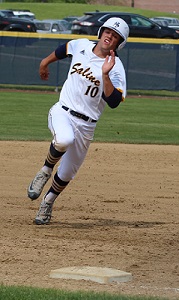 Nelson, a senior right-hander who is headed to Wayne State, is 8-0 with a 0.61 ERA. He has allowed just 25 hits in 47 1/3 innings with 56 strikeouts.
“I never expected to come out here and dominate like I have,” he said. “I throw a fastball, slider and a change-up. My best pitch is the slider. I throw it about 30-40 percent of the time. It’s my out pitch.”
Saline is not a one-pitcher team, either. O’Keefe, who missed half the season with a hamstring injury, threw a perfect game and is 5-0 with a 2.27 ERA. Daniels, a sophomore, is 6-2 with a 0.95 ERA. Eppinga is 3-1 with a 1.72 ERA, and Hovde is 2-1 with a 0.60 ERA.
Finkbeiner, a third baseman who bats fifth, provides a lot of pop as he has a team-leading four home runs and 33 RBI to go with a .419 average. Second baseman Owings also is hitting .419, while Daniels, the sophomore pitcher, is batting .405.
Although he missed half the season with an injury, O’Keefe is at .391 with one home run and 10 RBI in just 17 games. Miller, the four-year starter at shortstop who is headed to Oakland University, is hitting .353.
“We’ve seen a lot of different ways to win, from a perfect game one day to a seventh-inning comeback at Bedford to 15 runs in four innings at Ann Arbor Huron,” Theisen said. “It’s been interesting because on many days it has been different people who get it done. It’s not just one or two guys, and sometimes it’s the guys who are not even our regular starters.
“There is a lot of depth and competition in the group.”
And quite a bit of confidence as well.
“I think we’ve played some teams that could make runs to the state title, and we’ve beaten them,” Miller said. “We came back against Bedford. We were down 4-2 in the seventh and came back and won 5-4. We just beat Northville the other day, and that’s a very good club. We just build off of that.
“We have the talent for sure to win a state title.”
 Chip Mundy served as sports editor at the Brooklyn Exponent and Albion Recorder from 1980-86, and then as a reporter and later copy editor at the Jackson Citizen-Patriot from 1986-2011. He also co-authored Michigan Sports Trivia. E-mail him at [email protected] with story ideas for Jackson, Washtenaw, Hillsdale, Lenawee and Monroe counties.
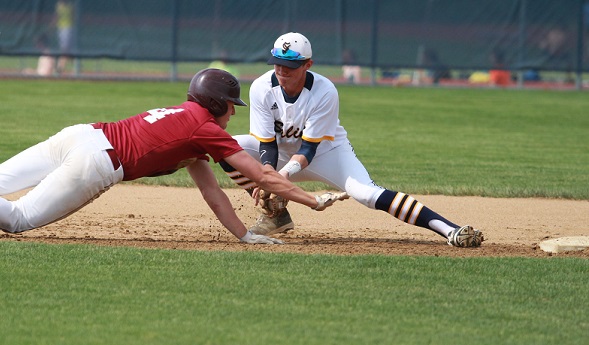
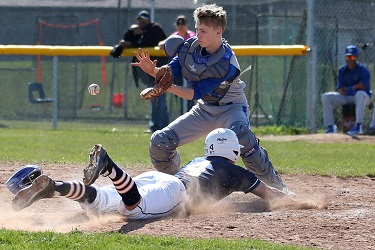
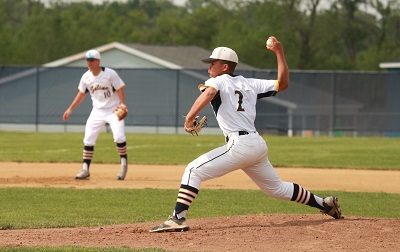
PHOTOS: (Top) Saline shortstop Thomas Miller prepares to apply a tag during a game this season. (Middle top) Zachary Owings slides into the plate just ahead of a throw home. (Middle below) Senior Josh Nelson is an impressive 8-0 this spring. (Below) Jake Finkbeiner rounds third base on his way home. (Photos by Terry Owings.)
Senior-Powered Spring Lake Answering Anticipation, Pursuing High Expectations
By
Dean Holzwarth
Special for MHSAA.com
April 29, 2026
SPRING LAKE – The time is now for the Spring Lake baseball team.
 With the return of 11 veteran seniors, the Lakers entered this spring with lofty expectations and an eye on an extended postseason run.
Anticipation has come to fruition in the form of a state ranking and a nearly perfect start.
“Our motto is we are going to worry about next year next year, and we are going to do all we can this year,” Lakers fourth-year coach Bill Core said. “We knew we were going to have a big experienced group coming back, and that's just how the roster folded out. We have a lot of experience, a lot of returners and pretty high expectations.”
Spring Lake, which finished as Division 2 runner-up in 2024 and won a conference title last year for the first time since 2014, is off to an impressive 13-1 start (9-0 in the Ottawa-Kent Conference Black) and has climbed to No. 7 in the latest coaches poll.
Core said the vast number of returners, which includes five players who will play in college next year, has paid early dividends.
“I think that’s been a big difference,” he said. “We’ve played some younger teams that were breaking in sophomores or juniors or new kids, and our guys were ready to go right from the start. It’s been an advantage early on.”
Senior starting pitchers Oliver Smies and Maddux Kipling believe the strong bond among the senior class has been a major factor in the torrid start.
 “I think something that’s really important about this team is our team chemistry and the amount of seniors we have on the team,” Smies said. “That alone allows us to have a ton of experience, and I think that's a big reason why we are off to such a hot start. We have been playing good team baseball and complementary baseball with good defense and good offense.”
Added Kipling: “We genuinely like being around each other, and every day we show up ready to get a little better. Our team has a real gritty and energetic identity, and I think that shows in how we compete and support each other.”
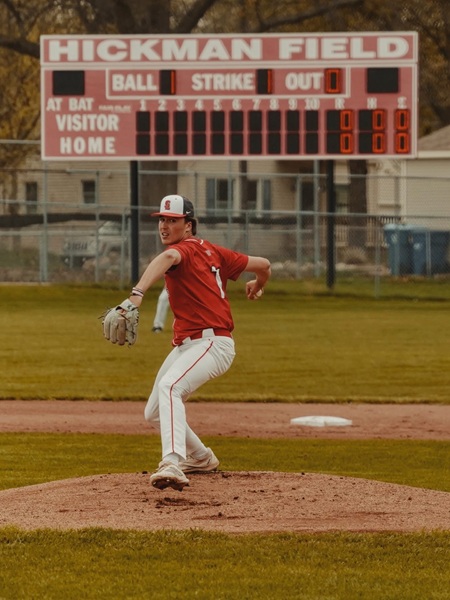
Kipling and Smies have been dominant on the mound this season. They haven’t allowed an earned run while combining for 80 strikeouts. Kipling earned a second-team all-state accolade as a junior and is headed to Michigan State next year. Smies will play at Calvin University.
“It starts with our pitching,” Core said. “Any time you are going to make a run, it starts with your pitching and we are pretty lucky, especially with our top two.”
Offensively, the Lakers possess a balanced lineup and boast a .330 batting average.
Senior Owen Smies, who will join his twin brother at Calvin, is hitting a team-best .432 with 13 RBIs. Seniors Alex Strauss (Adrian College) and Max Feltner (Muskegon Community College) are both batting .333 and have combined to score 25 runs.
As a team, Spring Lake has produced eight shutouts and nine wins by run differential.
“We got off to a good start, but we are going to play a lot better competition,” Core said. “This is a good week for us because we play Northview and state-ranked East Grand Rapids. We just picked them up, so we were excited to fill in the week with those two schools.”
Spring Lake is 62-6 over its last 68 games and trying to remain focused on each game as it attempts to erase the disappointment of last year’s early exit from the postseason.
 Despite winning 30 games, the Lakers suffered a 3-2 loss to Grand Rapids West Catholic in District play.
“I think there is some motivation there from that loss,” Oliver Smies said. “And I think that loss last year taught us that any team can beat any team, so you have to play your best baseball every single game no matter the opponent.”
Core said last year hasn’t been discussed, but believes it still sits in the back of his players’ minds.
“I think they think about that, but we've had quite a few mercies to start the season, and I said to them that when we get to the tournament it's going to be a one-run game and we are going to have to do the little things to make a difference because we are not going to win 14-0 all the time,” he explained. “We try to keep everyone in the moment.”
Kipling isn’t dwelling on the past – or looking too far ahead.
“As a group we’ve done a great job staying focused on the present and not getting caught up in the past or worrying too much about the future,” Kipling said. “My dad has always told me to focus on what you can control because putting energy into things you can’t control is a waste.
"That mindset has stuck with me, especially on the field. I try to live by ‘one pitch at a time,’ and because of that I haven’t really spent time thinking about last year’s loss. That’s behind us, and we’re just focused on what we can do right now.”
 Dean Holzwarth has covered primarily high school sports for Grand Rapids-based WOOD-TV for five years after serving at the Grand Rapids Press and MLive for 16 years along with shorter stints at the Ionia Sentinel and WZZM. Contact him at [email protected] with story ideas for Allegan, Kent and Ottawa counties.
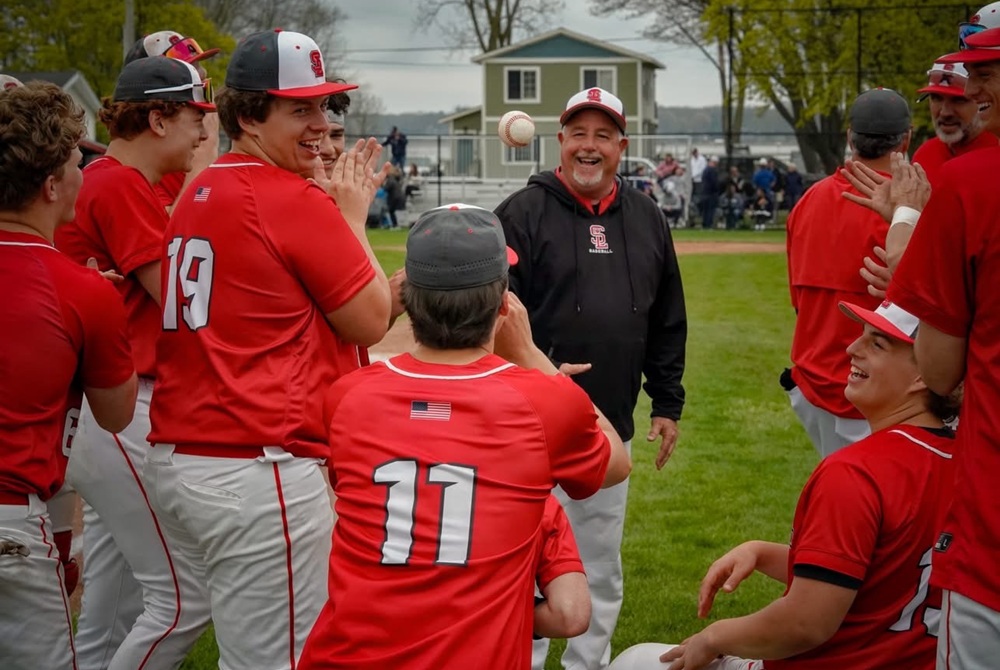
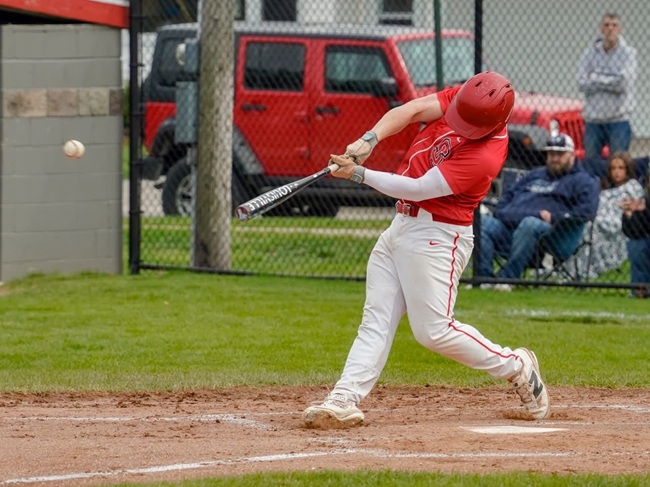
PHOTOS (Top) Spring Lake baseball coach Bill Core tosses Maddux Kipling his home run ball after a win over Fruitport. (Middle) Kipling pitching at Spring Lake's Hickman Field. (Below) Senior Oliver Smies connects with a pitch. (Photos by Trevor McCue/Grand Haven Tribune.)