

Top-Ranked Saline Learns from 2015
By
Chip Mundy
Special for Second Half
May 26, 2016
By Chip Mundy
Special for Second Half
SALINE – Players and coaches on the Saline baseball team know how it feels to enter the MHSAA Tournament as the top-ranked team in the state. They did it last year and just might do it again this year.
 They also know how it feels to be the top-ranked team and end up four victories short of the title. Obviously, there is no hope for a repeat there.
Saline will be at or near the top of the Division 1 rankings again this season when next week’s District tournament begins, and the memories of the bitter end last year have not been forgotten.
“There are a lot of kids who sat in that locker room last year,” Saline coach Scott Theisen said. “They realize that they don’t want to be in that spot again, and they will do anything they need to do. They will be able to live with the result if they at least know they have done everything in their powers.
“They learned last year that no matter how good you are, it’s a one-day thing. Or even a one-inning thing, and it can be over.”
Regrouping with a new group
Saline lost in the Division 1 Regional Final last year. It was a tough 1-0 loss to Taylor Kennedy that left the Hornets with a 36-3 record but without a berth in the Quarterfinals.
The Hornets lost their starting first baseman, third baseman, catcher, center fielder and three starting pitchers to graduation – but have plugged those spots nicely.
“The program is in such good shape – Scott does such a good job – that you just kind of re-energize it,” assistant coach Dave Sontag said.
The program seemingly does re-energize itself. Saline won its fifth consecutive Southeastern Conference title this season. And the Hornets were not devoid of talent from last year’s team. The starting middle infielders (shortstop Thomas Miller and second baseman Zachary Owings) are back, and starting left fielder Zach Schwartzenberger, a junior, made the switch to center field.
Among the newcomers who have helped fill the voids are senior catcher Cal Livesay, junior first baseman/pitcher Sean O’Keefe, third baseman Jake Finkbeiner, junior left fielder Ryan Foley and pitchers Cole Daniels, John Hovde and Ted Eppinga.
It all has added up to a 28-6 record – not as stunning as last year’s but quite impressive considering how much talent was lost. The team batting average is an amazing .346, a higher average than in 2015.
“It’s funny because I think maybe we had a little more talent at the plate last year,” Theisen said. “But this team has just bought into being more aggressive and trying to have better approaches at the plate. Maybe they are playing a little more to be dangerous than worrying about maybe what happens if we fail.
“I think as coaches we can learn from that. I think we had some talented kids at the plate last year who didn’t have poor years but probably didn’t achieve as well as they could have, and some of that was the pressure they put on themselves. So, we are trying to be more positive.”
Coach Sontag preaches positive.
“We lost some bullets that were pulled off of this team last year, and for guys to step right in and not create much of a void, that’s the story of the season,” he said. “And you know what? It’s not going to be much different next year, either, because the sophomores and this year’s juniors who are going to be seniors are going to do the same thing again.”
Coach T
Theisen has quite the resume as a high school baseball coach in Michigan. Last year, he became just the 22nd baseball coach to win 600 games in a career. His career record is 653-303, including 630 at Saline. He started his coaching career with a one-year stint at Walled Lake Central before going to Saline, his alma mater.
There is one glaring omission on his record, however: The lack of an MHSAA Finals championship.
“We’ve been to the Finals four times, and I’m 0 for 4 right now. I’m Marv Levy,” he said, referring to the former Buffalo Bills head coach who lost four Super Bowls in a row.
Although Theisen’s teams didn’t lose four in a row, they did lose three in a row from 2008-10 and also lost in 1998.
“It used to bother me more than it does now,” he said. “I think when you’re younger, you’re more competitive in trying to do things and try to win titles and championships. Now that I’m getting older, I get more satisfaction out of the relationships with the coaches and the growth we see in our players.
 “Yes, you still have the drive that you want to get there and win it, but you know it may never happen, and if it doesn’t, I’m OK with that because of what we’ve done as a program and what we do to try to help the kids be better players and better people.
“I get more satisfaction out of that now, and maybe I didn’t see that as a younger coach.”
The players look up to him and respect his experience and knowledge – and as much as they would like to win the Division 1 championship for themselves, they also want to win one for him.
“That would mean a lot,” said Foley, a junior left fielder. “I know how much it would mean to him, and for us to get it for him would be great. He’s such a good coach.”
Nelson, the No. 1 pitcher, said, “He brings a lot of motivation and experience to the team. He has so much knowledge about the game. He knows what to do in all of the situations and how to coach somebody from their freshman year to their senior year.”
Senior shortstop Miller said, “It would feel great to win one for Coach T. It would mean the world to him, and to do it in my senior year along with the rest of the guys, it would be the best.”
Although Theisen said he could live with never winning an MHSAA championship, that doesn’t mean the desire to do so runs deep.
“If we never get it done, I would still feel really proud of everything that we’ve done,” he said, “but I sure would like to see what it feels like.”
Learning from a loss
The loss in the Regional Final last year is something the coaches and players can’t forget, and they don’t want to forget it, either. It provides motivation and a valuable lesson.
Theisen and the players made it known that they don’t want to offend anyone, but they felt they were the team that should have won Division 1 last year – and certainly should not have been stopped in the Regional Final.
“It’s a natural tendency of young kids to maybe let up, and we’ve been snake-bitten by doing that,” Theisen said. “We got beat last year in the tournament by a team that we felt – no offense to them – that we were better than. It also happened over at Ann Arbor Huron to us, so I think the kids understand that if you let your guard down, you have a good chance to get beat.
“To win the state tournament, you have to win seven in a row to do it. You can’t be up and down during those seven games, so you have to learn how to practice and play at a high level consistently or that seven-game stretch is going to be even more difficult.”
It is that lesson that Theisen turns to when he sees the team taking it a little lax.
“It isn’t over and forgotten about,” he said. “It was a tough pill to swallow. We expected to win the state title – we expected to win the last game – and that’s the same thing we expect this year.
“They’ve been reminded on multiple occasions, and it won’t be the last time we tell them. We have to be ready no matter who we are playing.”
Has the lesson been learned? The jury is still out. Has the lesson been delivered and absorbed? Well, let the players give the answer.
 Foley: “Ratings mean nothing to us, and we understand that anybody can beat anybody at any time, just like last year with Taylor Kennedy. We’ll bring it up because we have to keep it in our head that anybody can beat anybody. We have to try to get over that hump because it is lingering a little bit, but we don’t try to dwell on it too much.”
Nelson: “We’re obviously thinking about that because we’re on the same level and we can do the same things that we were supposed to do last year. We just have to play better as a team every single game and keep getting better every game in the playoffs so we can avoid having that happen again.”
Livesay: “It’s definitely there for us, and coach always brings it up when it seems like we’re not motivated during practice or during games. What you are ranked before the playoffs doesn’t mean anything. The loss was definitely eye-opening for us. We weren’t expecting them to beat us.”
Miller: “You can’t overlook any team that you are playing. We saw some other teams lose ahead of us, and we got a little giddy. We have to play the game that we’re in and focus on one game at a time.”
Unexpected spark
When the final cuts were about to be announced, Foley was on the bubble, and he knew it.
“I was just doing everything I could to be on the team,” he said. “I never knew until the last day whether I was going to make it, so I just did everything I could to please the coach.”
It was enough.
“When we chose our team in March, Foley was one of the last kids chosen, and now we can’t get him out of the lineup,” Theisen said. “He’s been a sparkplug for all of us. He’s a kid who kept his mouth shut and kept saying to himself, ‘I’ll show them, I’ll get my chances,’ and when he got his chances, he capitalized.”
Foley’s chance came when O’Keefe, the starting first baseman, went down with a hamstring injury. That forced a corner outfielder to take over at first and opened a spot in the outfield. Theisen turned to Foley.
Although Foley bats ninth, he leads the team with a .423 average and 17 stolen bases. And if there were hustle stats, he’d be near or at the top there, too.
“Ryan is going to get on base and cause problems because he can run really well,” Theisen said. “He is one of the better base runners we’ve ever had, and he’s got a little bit of being a thorn in the side of the other team. He’s not disrespectful, but if you’re going to give him an inch, he’s taking a foot.”
Theisen says that sort of attitude can be the difference between a good team and a great team.
“There was a point in the season when we talked about being good,” Theisen said. “We knew we would win a lot of games because we were talented – but if you want more, you have to have some moxie in your game. Foley probably exhibits that more than anybody. He’ll take second on a bobbled ball in the outfield, and he’ll dive for a ball. He’s more aggressive in practice and gets dirty diving and just running everything out hard and playing the game the way it should be played.
“It’s fun to watch that start to spill over to other kids. He gives us energy, and it is snowballing. That’s something our talented teams in the past might not have had.”
Foley gets great satisfaction out of going from being on the bubble to being the main spark.
“It feels great to know that you’ve worked so hard and are making an impact on the team,” he said. “Coach has taught me that no matter what the talent you have, you can always make an impact on the team. He really emphasizes that. Even with the little things, it really means a lot for everybody to do a little bit.”
Theisen said he learned a lesson in the process as well.
“When you are choosing the team, you sometimes have to look at those intangibles that a kid can bring,” he said. “They might not light up the radar gun, so to speak, but what else do they bring to the team to help you become a better team? You have to look at those things, too.”
Well-rounded team
There has never been a team that can’t improve, and Saline is no different. However, the Hornets have all their bases covered. They can hit. They can field. And they can pitch.
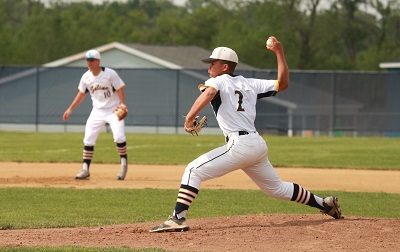
 Nelson, a senior right-hander who is headed to Wayne State, is 8-0 with a 0.61 ERA. He has allowed just 25 hits in 47 1/3 innings with 56 strikeouts.
“I never expected to come out here and dominate like I have,” he said. “I throw a fastball, slider and a change-up. My best pitch is the slider. I throw it about 30-40 percent of the time. It’s my out pitch.”
Saline is not a one-pitcher team, either. O’Keefe, who missed half the season with a hamstring injury, threw a perfect game and is 5-0 with a 2.27 ERA. Daniels, a sophomore, is 6-2 with a 0.95 ERA. Eppinga is 3-1 with a 1.72 ERA, and Hovde is 2-1 with a 0.60 ERA.
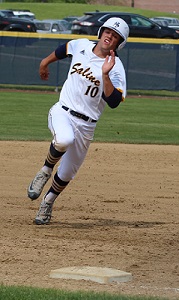
Finkbeiner, a third baseman who bats fifth, provides a lot of pop as he has a team-leading four home runs and 33 RBI to go with a .419 average. Second baseman Owings also is hitting .419, while Daniels, the sophomore pitcher, is batting .405.
Although he missed half the season with an injury, O’Keefe is at .391 with one home run and 10 RBI in just 17 games. Miller, the four-year starter at shortstop who is headed to Oakland University, is hitting .353.
“We’ve seen a lot of different ways to win, from a perfect game one day to a seventh-inning comeback at Bedford to 15 runs in four innings at Ann Arbor Huron,” Theisen said. “It’s been interesting because on many days it has been different people who get it done. It’s not just one or two guys, and sometimes it’s the guys who are not even our regular starters.
“There is a lot of depth and competition in the group.”
And quite a bit of confidence as well.
“I think we’ve played some teams that could make runs to the state title, and we’ve beaten them,” Miller said. “We came back against Bedford. We were down 4-2 in the seventh and came back and won 5-4. We just beat Northville the other day, and that’s a very good club. We just build off of that.
“We have the talent for sure to win a state title.”
 Chip Mundy served as sports editor at the Brooklyn Exponent and Albion Recorder from 1980-86, and then as a reporter and later copy editor at the Jackson Citizen-Patriot from 1986-2011. He also co-authored Michigan Sports Trivia. E-mail him at [email protected] with story ideas for Jackson, Washtenaw, Hillsdale, Lenawee and Monroe counties.
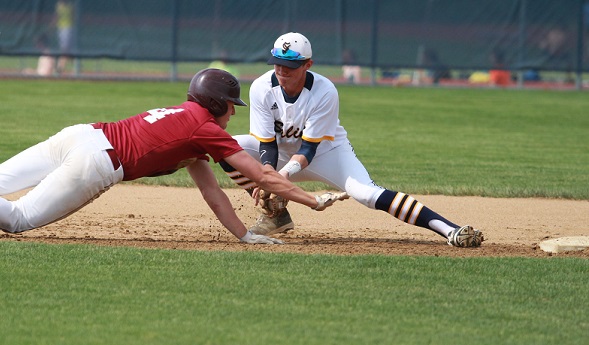
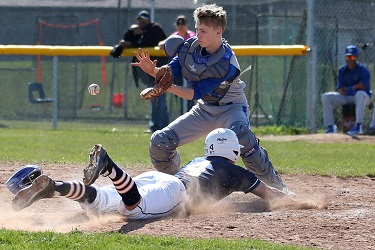
PHOTOS: (Top) Saline shortstop Thomas Miller prepares to apply a tag during a game this season. (Middle top) Zachary Owings slides into the plate just ahead of a throw home. (Middle below) Senior Josh Nelson is an impressive 8-0 this spring. (Below) Jake Finkbeiner rounds third base on his way home. (Photos by Terry Owings.)
Ace Paces Richard's Championship Triumph
June 16, 2018
By Jason Schmitt
Special for Second Half
EAST LANSING – He’d seen a dropped third strike 100 times before Saturday’s championship game.
Excuse Riverview Gabriel Richard’s Matthew Silka for getting caught up in the moment.
With two outs in the seventh inning, the junior got a swinging third strike to seemingly clinch his team’s first MHSAA baseball title. But his biting breaking ball ended up in the dirt – so he looked at the catcher, then glanced at first. Finally, he turned and looked at his second baseman, who was charging toward him to celebrate.
At that moment, he figured it out. His team had just won the Division 3 championship, defeating reigning champ Madison Heights Bishop Foley, 3-0.
“I was so confused,” said Silka, smiling with a championship medal hanging from his neck. “That’s not an ideal way to end the game, because I’m not sure if we won or not. I was looking at the first base ump to see if he was going to call him out or not. We were all waiting for someone to say something.”
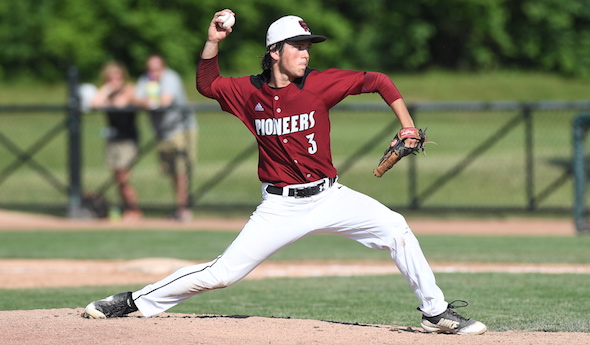
The game-ending strikeout was his seventh of the game, one he dominated from start to finish. Silka, a junior, allowed just one hit, that coming in the seventh inning. Prior to that single, he was on his way to becoming the first pitcher to toss a complete-game no hitter in MHSAA Finals history.
Instead, he became just the fifth pitcher in Finals history to allow just one hit in a complete game.
“I was trying to keep (the ball) to the corners, and not make too many mistakes and leave the ball over the heart of the plate,” Silka said. “I was just trying to throw strikes and help my teammates out.”
His teammates helped him out early on, scoring a run in the second, third and fourth innings to stake him to a 3-0 advantage.
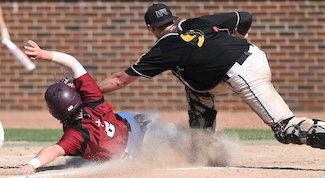 The Pioneers scored their first run unconventionally. Leadoff batter Hayden Burke reached on a dropped third strike. The junior then moved over to second base on a walk to fellow junior Frank Klamerus. Those two advanced to second and third thanks to a pair of wild pitches. Burke then scored on a fielder’s choice by junior Hayden Flynn to make it 1-0.
In the third inning, Richard pieced together three singles – the last by Flynn plated junior Niko Maloney. In the fourth inning, the Pioneers used a walk, sacrifice bunt and an RBI-single by sophomore David Zubor to cap off their scoring, giving Silka more than he needed to get the job done.
“I think momentum is one of the biggest parts of the game,” Silka said. “That was really huge for us to get out in front. I knew once we had a lead and we got rolling, it was going to be a lot easier to pitch.”
Richard coach Mike Magier said Silka’s success was due to his ability to keep the Ventures off balance.
“He went through the lineup one time and he gained a little confidence, and he could use his secondary pitches a little bit more,” Magier said. “(Silka) has been a workhorse for us. He’s really been a competitor.
“He’s been our ace. He’s pitched against all our tough teams.”
Bishop Foley (19-18-1) could muster just one hit – from sophomore Liam Pollock to lead off the seventh inning.
“That’s baseball,” Foley coach Tim McEvoy said. “We ran into a stud pitcher who threw strikes. He kept us off balance, and we weren’t able to get out in front of his fastball. That was the main issue.
“I want to congratulate their coaching staff. They have a great staff and a great pitcher.”
For Richard (29-3), this could be just a taste of what’s to come next year. There are no seniors on the roster, so everyone should be back for another title run in 2019.
“I guess it’s kind of unusual,” said Magier, talking about a lack of seniors on his roster. “That (junior) class, as soon as they came in in ninth grade, we had three or four guys come up on varsity and we knew we had a pretty good class there.
“It takes a lot to win a state championship, so we won’t take it for granted. We’re going to enjoy this one, and hopefully next year we can do the same.”
VIDEO: Gabriel Richard pitcher Matthew Silka finishes his seventh strikeout, which wrapped up the 3-0 win over the Ventures.
PHOTOS: (Top) Gabriel Richard ace Matthew Silka makes his move toward the plate Saturday. (Middle) A Pioneers runner tries to slide in under the tag of Bishop Foley catcher Mason Minzey.