

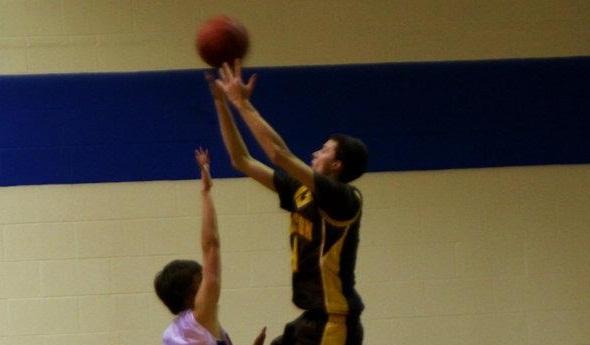
2,241 Reasons to Watch Chris Hass
February 14, 2012
Chris Hass began his freshman basketball season with his sights set on breaking an MHSAA career record.
But if you’ve heard at all of the Pellston High standout, it’s probably not the record you’d think.
Hass is one of just 34 players in MHSAA history to score at least 2,000 points. Only nine players have scored more than his 2,241 points heading into Wednesday’s game against Bellaire.
That record he wanted to break? Career assists, of course. And Hass has a bunch of those too. But the 6-foot-5 senior clearly is known for scoring in bunches few in MHSAA history have equaled.
“For me, it wasn’t something where it was my goal. I definitely feel honored to play on a team that’s willing to give me an opportunity to do that,” Hass said. “I guess it’s a big deal in northern Michigan, getting our name out there. Pellston is a small school, and to hit 2,000 points, it’s starting to get Pellston on the map, which is what the community deserves.”
Hass earned one of this week’s MHSAA High 5s not just for the ridiculous numbers he’s put up this season and over the last four, but for how he’s led the Class D Hornets into at least a glimmer of the state spotlight.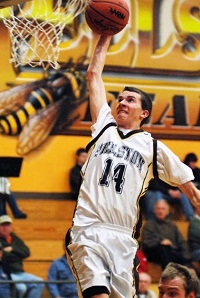
Pellston is 14-1 and can avenge its lone loss tonight against Bellaire, which beat the Hornets 75-58 on Jan. 17. Bellaire is ranked No. 1 and Pellston No. 3 in this week’s Associated Press Class D state poll.
Hass has a history with Bellaire – he scored 26 points in the fourth quarter alone before fouling out in a loss last season to Eagles. That’s the fourth-most points scored in a quarter in MHSAA history – and just one of the many listings Hass has or will have in the record book after his high school career ends sometime next month.
This season, he’s averaging 30.9 points, 8.5 rebounds, six assists, 4.5 steals and 2.5 blocked shots per game. He’s always been a strong ball-handler and continues to man the point despite an ability to play any position. He’s making 55 percent of his shots from the floor – including an incredible 52-percent success clip from 3-point range (he’s made 40 from beyond the arc).
“On nights when we really don’t need him to (score), he almost disappears into the background a little bit to get his teammates involved,” Cliff Hass said. “It’s really about the team, chemistry. He’s always one of the leaders trying to get chemistry (right). Does he love to have that 57-point night? That’s great, but he’s all about winning.”
So much so that Chris Hass almost committing to play next for Bethel College (Ind.), which has won seven NAIA national championships under its current coach, before settling on Bucknell after falling in love with the program and campus during a visit. There, Hass will join 2011 Petoskey graduate Cory Starkey on a team that made the NCAA Tournament last season.
"First and foremost, Chris is just a terrific scorer," said Bucknell coach Dave Paulsen in his program’s early-signing day press release. "He is an excellent shooter with great range, but he is also athletic and `bouncy' and can get to the rim. We expect that Chris will be able to give us a real explosive offensive presence from the perimeter."
Hass’ point total is exactly 600 short of the MHSAA record set by Mio’s Jay Smith from 1976-79. It’s unlikely Hass will break that record – he’d have to average 50 points a game through the MHSAA Final just to tie it – but being in the conversation is something special in itself.
Filling it up is nothing new in the Hass family. Older sister Stephanie Hass held the MHSAA girls scoring record with 2,732 points for a decade until Central Lake’s Jasmine Hines broke it last season. Hass, who played high school at Harbor Springs Harbor Light Christian – and then at Saginaw Valley State University – finished with a career scoring average of 31.4 points per game, tops in the record book.
And she never took it easy on her little brother.
Chris Hass remembered once, when he was 8 or so, getting so angry during a game of one-on-one that he started throwing rocks at his sister. But he also watched and emulated how she worked to improve her game. And around 12 years old, he beat her one-on-one for the first time.
“I do see similarities in both, offensively; ball-handling was probably their number one attribute. It’s the first thing I really noticed,” said Cliff Hass, their father and also Pellston’s boys varsity coach. “(And) they both developed that mentality of being able to score at any time.
“I tell all the players I coach, if you touch the ball 94 feet away (from the basket), your first goal is to score from 94 feet away. Being in the mentality of looking to score, you put pressure on the defense, and they have to stop you. And they might need a second person to try to stop you. “
Chris echoes his dad’s philosophy. But he wanted to make sure people saw him as more than a scorer. At Harbor Light in sixth and seventh grade, he’d been mostly a distributor passing to Collin Hewitt, who now plays at Spring Arbor. But Hass switched to his dad’s school for ninth grade, and began switching roles as well.
He still tries to get as many assists as he can. But although Pellston has other scorers (senior Andy Hamlin tallied his 1,000th career point this season), Hass knows for the Hornets to continue this run – and get a chance to show what they can do against competition from further down state – he needs to keep putting up the points.
“When you say you’re from the Petoskey area, people have no idea where that is,” Hass said. “Knowing we finally maybe might get some respect, I’m definitely excited about it.”
Country Day Will Play for 9th Title
March 22, 2013
By Geoff Kimmerly
Second Half editor
EAST LANSING – Detroit Country Day coach Kurt Keener said he doesn’t get hung up on numbers, like the ninth MHSAA title his team could claim Saturday.
For this group of Yellowjackets, it would be the first. And that’s what counts most of all.
Country Day has come to Breslin Center and left without a championship the last two seasons. But for the first time since winning Class B in 2010, the Yellowjackets will play in the championship game – thanks to a 73-42 Semifinal win Friday over Cadillac.
“It would mean everything to me,” Country Day senior Austin Price said. “The last two years we came up here expecting to win and fell short. It would be great to end on a high note and win my last game as a high school basketball player.”
Top-ranked Country Day will face either Wyoming Godwin Heights or Detroit Community for the title at 6:30 p.m. Saturday.
In terms of Finals experience, few programs could sit on further ends of the spectrum.
 While Country Day is a Breslin regular, Cadillac (21-5) made its first appearance in an MHSAA Semifinal.
Country Day’s last two Finals weekend visits ended with Semifinals losses to eventual champion
Lansing Sexton. But these Yellowjackets have a different look than some of their most recent teams, with a smaller lineup and a style Keener tells his players should be more track meet than golf match.
That speed became tough for Cadillac to handle immediately, as Country Day (24-3) jumped to a 22-10 lead by the end of the first quarter. The Vikings committed nine turnovers during the first eight minutes.
But they wouldn’t be run off. Cadillac pulled within 26-20 midway through the second quarter.
“At 26-20 we had the game where we wanted it,” Cadillac coach Jeff McDonald said. “We wanted it to be close and give ourselves a puncher’s chance.”
But they ran out of punches soon after, as Country Day went on a 14-2 run and never led by fewer than 10 points over the final 18 minutes.
Junior Edmond Sumner led the Yellowjackets with 30 points on 9 of 15 shooting, and also had six steals. Senior Mory Diane added 11 points.
Of Cadillac’s 26 turnovers, 21 were Country Day steals.
“Defensively, they don’t make mistakes. And obviously they like an uptempo game. They like to gamble on defense,” Vikings senior Nick Paquet said. “We like to slow it down, make it a halfcourt game. We allowed ourselves to play a little faster than we wanted to, and that hurt us.”
Paquet led Cadillac with 18 points and four steals. Junior Jalen Brooks added 15 points and a game-high seven rebounds.
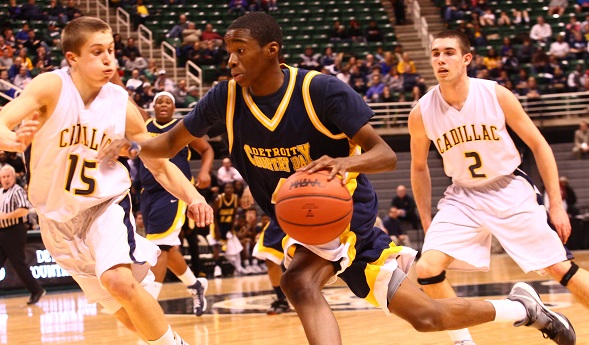
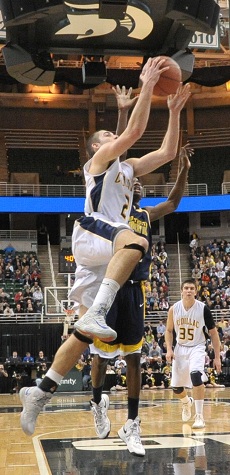
PHOTOS: (Top) Detroit Country Day's Edmond Sumner pushes the ball upcourt Friday while Cadillac's Jalen Brooks (2) and Lewis Finch (15) give chase. (Middle) Brooks makes a strong move to the basket during the Semifinal. (Photos by Hockey Weekly Action Photos.)