

60 Years Later, Chassell Streak Stands
March 22, 2016
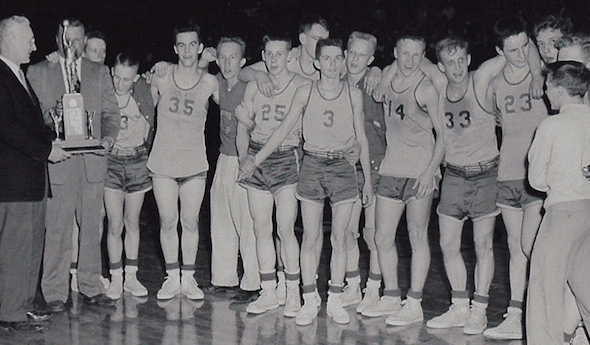
Sixty years ago, something happened in Michigan high school boys basketball that hadn’t happened before and hasn’t happened since – three Upper Peninsula teams won titles. Stephenson beat Detroit St. Andrew, 73-71 in overtime when “Marvelous” Mel Peterson made the first basket of sudden death; Crystal Falls (before it was called Forest Park) beat Berrien Springs, 71-69, in Class C; and Chassell won the first of three straight Class D titles, beating Portland St. Patrick, 71-68, by rallying from a 15-point deficit with less than four minutes to play.
The win was part of Chassell’s state record 65-game winning streak, which still stands. Below is an excerpt of a piece on the Chassell streak written before the teams were honored as part of the “Legends of the Games” program at the 1998 Boys Basketball Finals.
The old adage in sports states that records are made to be broken. The longer, however, the record stands, the more legendary the accomplishment becomes.
Chassell's wins were the centerpiece of Upper Peninsula success in the MHSAA Boys Basketball Tournament during the first 11 years after the format unified the two peninsulas. From 1932 to 1947, separate finals were conducted in both peninsulas. Between 1948 and 1958, Upper Peninsula schools won three Class B crowns (there were no Class A schools in the U.P. at the time), two Class C titles, and seven Class D championships – over one-third of the available first-place finishes.
Wrote the Marquette Mining Journal in 1956, the year that Stephenson in Class B, Crystal Falls in Class C and Chassell in Class D all won MHSAA titles, "All of these is a startling figure since in the period the U.P. has only 42 (schools) -- one eighth of all the lower class quarterfinalists.
"Under the law of averages, the U.P. should come up with one state champ every three years."
It looked at first that the law of averages would catch up with Chassell. After starting the 1955-56 season with 11 straight wins, the Panthers lost a close January game at Trout Creek, and then won their way downstate into the finals against Portland St. Patrick. In that final game, St. Patrick held a 15-point lead at 68-53 with less than four minutes to play.
Coach Ed Helakoski, the architect of the Chassell winning streak, called time out and told his team to apply full court pressure, a rarity at the high school level at that time.
Playing without standouts Terry Pokela and Tom Peters, who had fouled out, Chassell scored the final 18 points of the contest, the biggest game-ending rally in Finals history, and won the first crown, 71-68. Sophomore guard Don Mattson scored the winning points with only seconds to play, finished the game with a finals record 25 points, and the Panthers finished the season 25-1 with 14 consecutive victories.
During the 25-0 run to the crown in 1956-57, the only close games were regular-season wins against National Mine (71-66), L'Anse (64-63), Doelle (73-69), and a 58-50 decision over Stevensville in the championship game at Jenison Fieldhouse. Of the other 21 games, none were closer than 13 points, and the average margin of victory was 27 points.
The winning streak stood at 39 entering the 1957-58 season, and the 10-year state record of 59 consecutive victories by Mass from 1947-49 was within reach. However, Mattson was the only returning starter from the back-to-back championship teams, and perhaps Helakoski's greatest coaching job lay ahead to replace four starters in a school which had just over 30 boys enrolled in grades 9-12.
Doelle, which had given the Panthers one of its closest games the season before, was leading, 62-60, in an early-season contest. As time ran out, Bob Belhummer of Chassell was fouled at midcourt and sent to the free throw line with a one-and-one opportunity. Belhummer sank both shots to force the only overtime game of the streak, a 72-66 victory.
The new state record of 60 consecutive victories came in a 45-43 decision over Marenisco in the MHSAA District championship game. A trip over the newly-constructed Mackinaw Bridge came two weeks later and the Panthers became the first school to bring an MHSAA trophy across the structure when the 65th victory was recorded, a 66-61 decision over Owosso St. Paul. Mattson tallied 27 points in the finale to set another championship game record.
In the 40 years since Chassell's incredible feat, only twice has the winning streak been threatened. Flint Northwestern racked up 60 victories between January of 1984 and February of 1986; and Saginaw Buena Vista had a streak reach 55 games between December of 1991 and December of 1993.
In many communities, success streaks come and go, but a constant ideal of school sports then and today was captured by John Pyykkonen, a guard and forward on the 1956 and 1957 teams who summarized the events: "I remember the friendly competition amongst the members of the team and how well we worked together and how our parents, fans and the community were behind us 100 percent of the way. One of the greatest highlights in a young man's life and will never be forgotten."
Records were made to be broken. But legends, especially Legends of the Games like Chassell, endure the test of time.
GLORY DAYS ... Remembering The Streak
John Pyykkonen - 1956-57 Guard-Forward: "One thing I remember clearly, besides the games, is walking into Jenison Fieldhouse and being totally awestruck by the raised floor and the huge (in my eyes) guides who showed us around the building. I recall the game in 1956 when we were so far behind in points and we were able to overcome the point deficit by a full court press. The huge crowd gathered there were all cheering for the small-town team."
Robert Belhumer - 1956-1957-1958 Guard: "We had a great camaraderie among the members of our team. Also Chassell is a small town in the Upper Peninsula and the fans were there rooting for us during our seasonal games and were there for us at the championship games in Lansing."
Donald Jaakkola - 1956 Guard (On the championship game): "We ran out onto the court to a crowd of 12,000 people, most of whom were cheering for Portland St. Patrick. Needless to say, we felt a bit in awe as we came from Chassell, a small town in the Upper Peninsula.
"We were down 15 points with four minutes to go and two of our tallest players had fouled out earlier. Coach Ed Helakoski called a timeout and the basketball gods were with us. We threw a full court press defense and scored 18 points while holding St. Patrick scoreless. It gave us a screaming 71 to 68 victory. The crowd of 12,000 was now cheering for us."
Mike Wisti - 1956 Guard (On Coach Ed Helakoski): “I am quite sure there are many who will remember Ed Helakoski as a good coach. I'm sure he was a good coach; he had a knack for demanding discipline and teamwork, while not stifling the creativity of his players. However, I believe he should also be remembered as a great classroom teacher. He taught Government one year and Sociology the next and was the best classroom teacher that I had in high school. His ability to make Government interesting and explain how everything was designed to work is probably one of the biggest reasons for my lifelong interest in government and politics."
Kenneth Tormala - 1956-1957-1958 Forward: "The first year we surprised a lot of teams and people by winning the state championship. The second year we were picked to win when the year started and it would have been a real disappointment not to have done so. The third year was a real challenge since we lost so many players, but we had the backbone of the team, Don Mattson, who was an all-stater. This team was the most closely knit of all. We had a lot of very close games and had to dig down to everything we had learned to win many of them. A very satisfying year and we kept the winning streak going, to the surprise of many, including the previous teams.
"These memories will be fondly remembered until we die. Thank you to the late Mr. Helakoski."
James Komula, 1958 Guard (On what stands out from that season): "Being from a small town and playing in small gyms, the spaciousness and large crowd in Jenison Fieldhouse proved very exciting. Also, the reception and festivities upon our triumphant return to Chassell will forever be a highlight of personal memories. People were waiting in their vehicles nearly 30 miles from town to accompany our motorcade home.
"Although I didn't give it much thought, the experience and influence of playing on that team would set the direction for my career. Upon graduation from Michigan Tech, I was given an interim position to teach and coach at L'Anse High School. In 1966, I was assistant coach when L'Anse won the Class C state championship. After that I moved to Livonia, where in later years I was head coach at Bentley High School. Although I never intended, my high school basketball did influence my career to work with youngsters, and help them share in the rewards of the commitment and lifelong learning of athletics."
Terry Pokela, 1956-1957 Center: "We truly had a team. Coach Helakoski did not allow us to think of individual statistics or anything like that. He constantly emphasized the team concept. It certainly paid off.
"Also, we were one of the first teams to fast break after every missed shot by opponents. Our three-lane break broke many team's backs, as they couldn't keep up with us. Coach Helakoski emphasized rebounding position to enable the fast break to get started. We could also shoot field goals from any part of the court. Don Mattson would have scored 40 points a game if the three-point field goal would have been in effect."
Manton, Buckley Prepped for Final Week
March 17, 2017
By Dennis Chase
Special for Second Half
TRAVERSE CITY – History repeated itself Wednesday night.
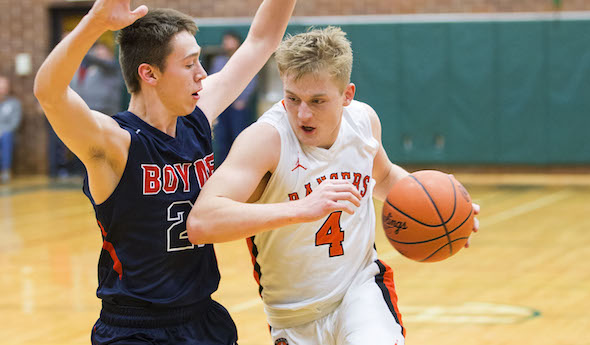
 Down four midway through the fourth quarter, Manton rallied for an edge-of-your-seat 47-46 win over Boyne City in the MHSAA Class C Regional Final at Houghton Lake.
It was Manton’s first Regional title since 1998, when the Rangers topped Boyne City, also at Houghton Lake.
“It’s interesting how things work out,” said Manton coach Ryan Hiller, who was a star player on that 1998 squad.
The Rangers next will face Negaunee on Tuesday in Petoskey.
Manton is one of two Wexford County teams marching on to the Quarterfinals. Unbeaten Buckley upended Suttons Bay 56-37 for a Class D Regional crown at Traverse City Central.
It was Buckley’s first Regional championship since 2010. The Bears will meet Wyoming Tri-unity Christian on Tuesday in Cadillac.
“Let’s do it,” said Bears coach Blair Moss, who starts five underclassmen. “This is fun. I told the kids, ‘This is something you’ll remember the rest of your lives. Let’s not waste it.’ I’m not worried about next year because you never know what will happen next year. Let’s do it right now.”
While Manton players, coaches and fans were basking in the glow of victory in Houghton Lake, Hiller was relieved to be moving on. The Rangers won despite shooting 26 percent from the field – 23 percent from beyond the 3-point arc. In Monday’s Regional opening win over Maple City Glen Lake, the Rangers were 1-of-11 behind the arc in the first half.
“We just don’t shoot well in that gym,” said Hiller. “We’re a 42 percent 3-point shooting team. We had a stretch of five games this season where we hit over 10 3s (in each game).
“These were the two worst shooting nights we’ve had all year. That was my fear (coming into the Final). If we don’t hit our 3s, it’s a dogfight. And that’s exactly what happened.”
It forced Manton to rely on other parts of its game.
 “Free throws and defense won the game for us,” said junior guard Hunter Ruell after the title-clinching victory. “We got some big stops at the end – our coaches had a good gameplan for us – and we hit our free throws. That’s what got us the win.”
The Rangers were 14 of 18 from the charity stripe, 9 of 10 in the fourth quarter. On Monday night, they finished 17 of 19, 9 of 11 over the final eight minutes.
Ruell led the way Wednesday with 13 points, but Jayden Perry, Wyatt Baker and Trever Salani all made key shots down the stretch.
“It’s amazing,” said Ruell. “(A tournament run has) been our dream since day one. Our first goal was to get past McBain (in the District). Since then, we’ve been playing it game by game and it’s been working out.”
“For the players and coaches, who have all worked hard and put the time in, this is rewarding,” added Hiller. “And it’s great for our community. Our community needed something like this. I think our whole town was watching or listening to the game tonight.”
The tournament door swung open for the 20-4 Rangers when they beat unbeaten and top-ranked McBain in the District Final, 54-48. McBain had beaten Manton twice during the regular season, 57-55 and 61-45. The Ramblers also had sent the Rangers to the exits in the last two Districts with down-to-the-wire 46-43 and 49-48 triumphs.
“We’ve been so close,” said Hiller. “We’ve been in so many battles with them.”
This time the Rangers won that battle, and now their journey will take them to Petoskey, where they opened the season with wins over Class A Regional finalist Traverse City West 76-72 and the host Northmen 52-48 in the Petoskey Invitational.
Oh, by the way, the Rangers shot 48 percent beyond the arc in those games.
“Our kids should have confidence playing in that gym,” said Hiller.
There’s actually a Petoskey connection at work for the Rangers this season. Former Northmen standout Trevor Huffman, who led Kent State to the NCAA Elite Eight in 2002 and then played 12 years of professional basketball, is helping out, although now it’s “from afar” since he’s been in the Caribbean a good chunk of the season.
“We have good, hard-working, nice kids,” said Hiller. “He (Huffman) formed a bond with them. He said, ‘Hey, I’d love to help as much as I can.’ He’s been helping all season.”
Huffman started working with the team in practice, but left for the Caribbean around the first of the year, Hiller said. Still, he analyzes film for his friend after each Rangers game.
 Hiller loads the film on Hudl, allowing Huffman instant access to it.
“It’s awesome to see the game from his eyes,” said Hiller. “He sees things I don’t. He’s so competitive, and his reports are so detailed. He tells me, ‘You get that game on right after you win and I’ll watch it.’ He’s enjoying the coaching part of it.”
Huffman is also able to leave individual comments on the videos for players to review.
“He promised the kids if they made it to the Breslin he would fly back for the games,” said Hiller. “He’s sticking with it.”
On his Twitter account Wednesday, Huffman congratulated the Rangers on their Regional triumph.
“Proud of their team and what they have put into playing together, on and off the court,” he wrote. “There is nothing better than winning championships with your best friends. Congrats fellas! Enjoy the moment and back to work.”
It’s also back to work for Buckley.
The 24-0 Bears broke Wednesday’s Regional Final open in the third quarter, outscoring Suttons Bay 20-10 to stretch their lead to 15. It was still a 27-22 game when junior Austin Harris nailed a 3-pointer for Buckley. He was fouled after the shot, giving the Bears the ball back. Harris then hit another triple, and Buckley was on its way.
“This team is one of a kind,” said Harris. “We work really hard. We have depth and we have skill. But the biggest thing we have is heart.”
Buckley reached the Regional Finals a year ago, but turnovers in the final couple minutes proved costly in a loss to Bellaire.
“I thought we had them (Bellaire) on their heels,” said Moss, “and then we threw it away the last three or four possessions. We said then we wanted to get back here because we felt we left something on the court. We didn’t take care of the ball, and when you play like that against a good Bellaire team it comes back to haunt you and it haunted us all summer.”
The Bears vowed to improve in crunch time, but so far they rarely have been tested.
Of the 24 wins, 22 are by double digits. Only Glen Lake (63-60) and Manton (77-73) have put the heat on. Manton hit 13 3-pointers in their late February matchup.
 Moss’ message to his team after that game?
“Just a hand up is not good enough,” he said. “You have to get a hand in their face.”
Buckley put added emphasis on defense this season, and the results tell the story. The Bears have held the opposition to under 40 points in 13 games.
Perhaps the best individual defensive effort came Wednesday night when sophomore Ridge Beeman shadowed Suttons Bay’s leading scorer Thomas Hursey, limiting the junior to three points.
“Keep a hand in the chest, stay in front of him and don’t let him shoot,” said Beeman. “That’s what Coach told me to do.”
He then proceeded to carry out the orders.
“Unbelievable,” said Moss, who was still conducting interviews about 30 minutes after the game ended. “I’ve got to go in and shake that kid’s hand. To hold Hursey to three points – and that was on a long desperation shot before half – that was huge. Kudos to him. I told him I don’t care if you don’t score any points at all, you make sure you lock that kid (Hursey) down because he has range, he can score from anywhere.”
Denver Cade hit his average, scoring 21 points for the Bears. Harris added 15, Beeman eight and Joey Weber seven.
“It was a good team win,” said Beeman. “It was a low scoring game for us, but we grinded it out.”
And it kept Buckley’s ultimate goal – a trip to Michigan State’s Breslin Center – in play.
“Our first goal was to win the conference championship, and we accomplished that,” said Cade. “Then it was the District championship, and we accomplished that. The Regional? We just accomplished that. Now our goal is to get to the Breslin.”
The run has also helped Moss get through a difficult time. His mother passed away earlier this month.
“I was very close with my mother,” he said. “That’s been on my mind. I’ve got a heavy heart.”
March, in Michigan basketball circles, is known as a memory-maker month, and Moss is determined to get the best efforts out of his players.
His message?
“Play hard, give me everything,” he said. “Don’t leave anything on the floor because if you do you’ll regret it forever – forever.”
 Dennis Chase worked 32 years as a sportswriter at the Traverse City Record-Eagle, including as sports editor from 2000-14. He can be reached at [email protected] with story ideas for Manistee, Wexford, Missaukee, Roscommon, Ogemaw, Iosco, Alcona, Oscoda, Crawford, Kalkaska, Grand Traverse, Benzie, Leelanau, Antrim, Otsego, Montmorency, Alpena, Presque Isle, Cheboygan, Charlevoix and Emmet counties.
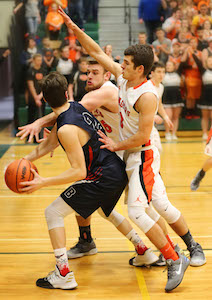
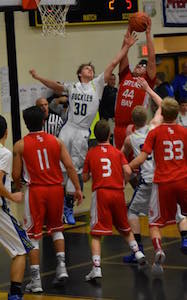
PHOTOS: (Top) Manton’s Trevor Salani works to get around a defender. (Middle top) Buckley celebrates Wednesday’s Regional Final win. (Middle below) Manton’s Wyatt Baker and Hunter Ruell lock down a Boyne City player working toward the basket. (Below) A Buckley player battles for a rebound against Suttons Bay. (Manton photos by Jeannie Christensen; Buckley photos courtesy of Buckley High School.)