

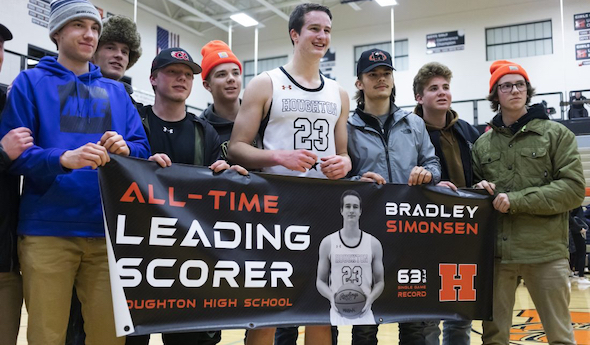
63-Pointer Stirs Memories of UP Legends
February 29, 2020
By Ron Pesch
Special for Second Half
For the first time since 1970 – 50 years ago – and for only the 10th time in Upper Peninsula boys basketball history, a player has scored 60 or more points in a single game.
And that Houghton showing has stoked memories of legendary U.P. scoring showcases going back more than a century.
For the first time, the effort was for naught, at least from a win-loss standpoint, as Houghton dropped a nonconference road contest to Ishpeming 88-83 on Feb. 4. Brad Simonsen hit 23 of 45 field goal attempts, including 7 of 18 from beyond the 3-point arc, as Houghton pushed the play, hoping to narrow what had been a 10-point halftime margin. The 6-foot-6 senior, signed by Michigan Tech, was 10 of 13 from the free throw line and scored 24 points in the fourth quarter, ending the night with 63.
The performance topped Houghton’s school record of 60 points, set by Gary Lange in 1970. The total ranks 14th across the entire state for single game points in a contest, and tied Simonsen for sixth highest above the bridge. There, the mark equaled the top single-game output posted by Stephenson’s Mel Peterson, considered by many the greatest cager ever to come out of the Upper Peninsula.
“Marvelous Mel”
Peterson was the son of a minister and one of 10 children (and eight boys). His older brother, George, broke the U.P. scoring record in 1949 with 44 points in a game for Stephenson High School. The family moved away from the Upper Peninsula following George’s graduation, ultimately landing in southeastern Idaho.
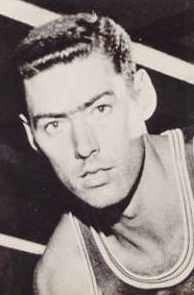 There, Mel emerged as an outstanding athlete for Idaho Falls High School. Standing 6-foot-4½, Peterson’s growth occurred mostly during his freshman year.
“I played quite a bit on the varsity my sophomore year,” recalled Peterson recently. “My junior year I started out very, very slow but ended up very good. (However,) I fractured my ankle with about a minute to go in the semifinals of the (1955) state tournament, which we won.”
Peterson led all scorers with 25 points and dominated the boards that night, but had to be helped from the floor, then didn’t play in the title contest. “We lost the state tournament by three points, (43-40 to Kellogg). I was a cheerleader. … It would have been fun to play in the final game.”
When his father received a call to serve the Mission Covenant Church in Wallace, Michigan, about seven miles south of Stephenson, the family returned to the Upper Peninsula for Peterson’s senior year.
“At that time, it was nothing like it is now, where you can find anything about anybody. Then, that wasn’t the case at all,” Peterson said. “So, when we came back, no one had any idea of where I lived before, if I played or not.”
Indeed, prior to football season, one newspaper report indicated Peterson had transferred in from North Dakota, while another listed him as coming from Illinois. Regardless, Peterson emerged as a solid football player at Stephenson High in the fall of 1955. But it was on the basketball court where his scoring and rebounding prowess quickly loomed. He opened the season with 33 points in a win over Gladstone, despite fouling out early in the fourth quarter.
By January, the media had taken to calling him “Marvelous Mel” as Peterson averaged 32.3 points in his first half-dozen games for the Eagles. He drove Stephenson to a 15-1 regular-season record, posting 11 games over 30 points and scoring more than 40 in six.
On Jan. 21, 1956, he poured in 63 points in an 89-44 win over Manistique, shattering his brother’s school record. Mel nailed 25 of 38 shots from the field and 13 of 16 from the free-throw line. At the time, the scoring total exceeded the previous known best in the U.P. of 60 points, scored by Norbert Purol in February 1952. (Purol, from Ironwood St. Ambrose, would later play two seasons of AAU ball in Chicago before matriculating at Kentucky Wesleyan, earning four letters between 1956 and 1959. Wesleyan ended the 1957 season as runner-up to Wheaton College in the inaugural NCAA Small College Tournament – now known as Division II.)
“I don’t remember a great deal about a lot of it. That was so long ago,” said Peterson, laughing. “I guess the thing I appreciate most about the game was that my coach (Duane “Gus” Lord), let me play the whole game, which didn’t happen real often. Probably the thing I remember most about the whole year is that we played a Catholic school, Lourdes, from Marinette, Wisconsin. The first game we played them we beat them 110 to 44. The second game we lost 68-66.”
Peterson’s regular-season total of 570 points also exceeded Purol’s U.P. record of 556 posted over 19 games in 1952. His regular-season average, which had climbed to 35.6, topped the previous best of 29.6, posted by Pete Kutches in 1952 for Escanaba St. Joseph. Then Peterson pushed the per-game-average even higher in the postseason.
Seeing more playing time in the playoffs, “Marvelous Mel,” notched more than 30 points in all seven postseason games (exceeding 40 in three of the contests and 50 once), leading Stephenson to the MHSAA Class B championship win against Detroit St. Andrews in sudden-death overtime, 73-71. There he scored the game-tying bucket with 17 seconds remaining in the three-minute extra frame, and then sunk the game winner 26 seconds into sudden death, where the first team to gain a two-point advantage was proclaimed the victor. That 1956 season saw three of the four basketball championships awarded to U.P. teams.
Peterson finished with 849 points on the year – at the time the best single-season performance in MHSAA history. He averaged 36.9 points across 23 contests – currently eighth in the MHSAA record book.
Following graduation, Peterson nearly signed to play at the University of Minnesota, but felt a better fit at Wheaton College, outside Chicago. There, he earned three All-American honors. As a freshman in 1957, he led Wheaton to victory in that first NCAA Small College Tournament championship game against Wesleyan, earning Most Outstanding Player honors along the way. Today, he remains Wheaton’s all-time leader in career points, points per game, field goals made and career rebounds, all accomplished “without the benefit of a 3-point line, which had yet to be implemented.”
Peterson, who helped the USA team win gold at the 1963 Pan American Games in Sao Paulo, Brazil, played two games for Baltimore in the National Basketball Association (NBA) before a heart condition sidetracked his career. Once the issue was repaired, he returned to play 134 games over three seasons in the American Basketball Association, earning an ABA league championship with the Oakland Oaks in 1969. In 2019, he was inducted into the Small College Basketball National Hall of Fame.
The High-Scoring Sixties
Roger Roell, a senior at Channing, topped Peterson’s U.P. single game record with a 67-point performance in early January 1960 by dropping 31 field goals and five free throws in a 105-55 win over Michigamme.
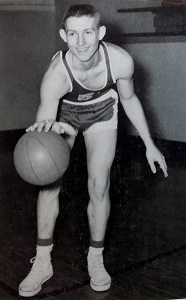 Just over seven weeks later, Jim Manning scored 69 for Trout Creek against Amasa in another lopsided affair, 140-47 (then, a U.P. record for highest team score. The team’s 44 points in the fourth quarter was also a U.P. mark at the time. Trout Creek’s coach, Bruce Warren began substituting in the second quarter).
Manning, a junior, finished the 1959-60 season as the first player in U.P. history to exceed 600 points in one regular season, totaling 608 over 18 games. He would later pitch in the Major Leagues.
Roell finished second with 569 points in 18 regular-season contests. Third on the regular-season scoring list was another junior, Erwin Scholtz of Hermansville, who tallied 505 across 18 games.
As a senior, the 6-foot-5 Scholtz would post 71 points against Channing, a new benchmark for points in a game in the Upper Peninsula.
Or was it?
The Master’s Thesis
Perhaps because of the media coverage of Scholtz’s accomplishment, in 1962 the Crystal Falls Diamond Drill ran an article detailing the recently unearthed exploits of Ed Burling some 50 years prior. Richard Mettlach, football and baseball coach at Crystal Falls, had uncovered the Burling story.
Mettlach, “in the process of preparing a history of local high school sports which he submitted as a part of the preparation for his master’s degree … discovered that the newspaper records of the early years of high school basketball tell of a match between Iron River and Crystal Falls (played during the 1910-11 season).”
Crystal Falls had downed Iron River, 107-27, according to Mettlach’s research, and Burling had scored all but 10 of Crystal Falls’ points.
“Basketball was different in those days,” said Burling when interviewed by the Diamond Drill in January 1962. Then 68 years old and working as the postmaster in Crystal Falls, he recalled, “when one man was hitting the basket well, the rest of the team fed him the ball and let him shoot. I couldn’t miss that night.”
According to the article, “Burling said as he recalled the game, he made 98 points that night. It appears that 97, however, reportedly verified in two newspaper accounts of the game, will have to be the figure used in the record book.”
Burling recalled that the majority of his shots were from in front of the basket and that rules of the day allowed the top shooter on the team to attempt the free throws.
“The 97 point scoring record would probably have never been uncovered if it had not been for Mettlach’s research,” added the Diamond Drill.
Three more U.P. additions
In 1966, Bob Gale of Trout Creek scored 60 against Mercer, Wisconsin. Gale would later play at Michigan State.
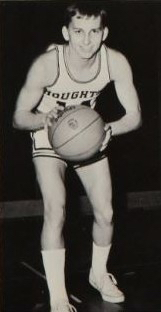 Houghton’s Lange scored his 60 as the Gremlins walloped Painsedale Jeffers, 134-62, on January 23, 1970. One week later, Larry Laitala dropped 65 as Champion crushed Felch, 114-71.
“We had a very good team that year. We had a lot of wings and normally, I wouldn’t play the whole game. My coach was Dominic Jacobetti (who played at Negaunee St. Paul, then Northern Michigan University) and he was a pretty prolific scorer in the U.P. It was one of those nights where the rim was real big,” recalled Laitala, chuckling.
Laitala finished second to Lange in regular-season scoring, 557 to 523, with each athlete playing 17 games.
“Houghton is possibly the best team in any class in the Upper Peninsula,” wrote Hal Schram in the Detroit Free Press, who predicted an MHSAA state title for the team noting that many felt Lange was the top player north of the bridge. The Gremlins, at 17-0, finished as the top-ranked team in Class C in the weekly press polls assembled by the Free Press, The Associated Press and United Press International.
But the season ended earlier than expected for both teams. Houghton fell to St. Ignace in a Regional Semifinal.
“We were beat by our archrival, Republic (61-55) in the first game of the (Class D) Districts, which was kind of an upset,” added Laitala.
Prior to Simonsen’s accomplishment, Lange and Laitala were the most recent players above the Straits of Mackinac to equal or exceed the 60-point minimum established in the MHSAA record book.
The Challenge of Traceability
With modern-day electronic archiving of a number of the state’s newspapers and the accessibility of newspapers on microfilm, an effort has been made to add dates to single-game records, where once only the season of accomplishment was listed. The work continues.
Today, more than 100 years later, the “two newspaper accounts” used back in the 1960s for verification of Burling’s scoring accomplishment have not resurfaced. Hence, neither the date of the game, nor details from period accounts are available for study. That, combined with knowledge that basketball games from the time were usually low-scoring affairs, means doubt is still cast on the mark.
 After investigation, the record was accepted by Crystal Falls historian Malcolm McNeil and U.P. sports archivist, Jim Trethewey, a former sports editor of the Marquette Mining Journal who travelled to Crystal Falls to interview Burling. MHSAA historian Dick Kishpaugh ultimately added the performance to the state record book. Questions about the legitimacy of Burling’s total began almost immediately and have resurfaced every 10 years or so. Todd Schulz, a former sports columnist at the Lansing State Journal, wrote extensively on the chase in 2012.
One of the individuals still working to help solve the mystery is Al Anderson of Crystal Falls.
The Diamond Drill was a weekly paper during Burling’s high school days, and newspapers of the time generally didn’t separate prep sporting news into sections. When reported upon, accounts of high school games were usually included in a ‘School Notes’ column.
The season was, without question, a success. “Winning eight out of ten games played, and having three challenges refused, the local basket ball team lay claim to the U.P. championship for the season of 1910-11,” stated the Diamond Drill in the March 25, 1911 edition.
Still, reports uncovered from the period publication continue to cast doubt on the plausibility of the feat occurring in a high school game. “… More basket ball and less indoor foot ball next time will look better to the audience,” noted the newspaper about a 17-10 victory over Niagara, Wis., in mid-December 1910.
“The basket ball game last night resulted in a dispute near the end of the last half with the score 13 to 12 in favor of Crystal Falls. Iron Mountain disputed a decision by the referee and withdrew from the floor,” was the account in the Feb. 18, 1911 edition of the paper.
“There’s an article that was cut out of the physical copy of the December 10, 1910 Diamond Drill,” reports Anderson, who’s been seeking confirmation in fits and starts for nearly a decade. “It looks like it could be the ‘School Notes.’ portion. It’s missing on microfiche copies as well. Perhaps that’s it.”
So the chase to verify continues.
2019-20 season brings sudden burst
Sophomore phenom Emoni Bates of Ypsilanti Lincoln is the latest prep player to etch his name in the MHSAA record book for scoring 63 points. He accomplished the feat in a 108-102 double-overtime win against Chelsea two weeks after Simonsen’s accomplishment. Statewide, that means 34 players have now scored 60 or more points in a game – 30 boys (10 in the U.P. and 20 in Lower Michigan) and four girls (one in the U.P and three in the Lower Peninsula).
Will the list be reduced by one? Time and additional research will tell.
 Ron Pesch has taken an active role in researching the history of MHSAA events since 1985 and began writing for MHSAA Finals programs in 1986, adding additional features and "flashbacks" in 1992. He inherited the title of MHSAA historian from the late Dick Kishpaugh following the 1993-94 school year, and resides in Muskegon. Contact him at [email protected] with ideas for historical articles.
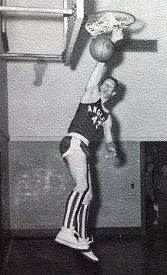
PHOTOS: (Top) Brad Simonsen celebrates becoming Houghton's all-time leading scorer Wednesday. (2) Stephenson's Mel Peterson. (3) Trout Creek's Jim Manning. (4) Houghton's Gary Lange. (5) Trout Creek's Bob Gale. (Top photo courtesy of Houghton Daily Mining Gazette. Peterson photo courtesy of Upper Peninsula Sports Hall of Fame. Houghton and Trout Creek photos courtesy of those schools' yearbook departments.)
Hoping to be 'Hardly Noticed,' 50-Year Official Allen Certainly Recognizable, Respected
By
Mike Dunn
Special for MHSAA.com
December 18, 2025
Editor's Note: An extended version of this article appeared originally in the Cadillac News in March. Since then, Allen has been inducted into the Basketball Coaches Association of Michigan's Hall of Honor in October and is wearing the striped shirt again this basketball season, officially his 50th year.
CADILLAC – Bill Allen’s story is similar to that of many area sports officials, particularly those officials who have been active for many years.
A background in sports, typically playing team sports while growing up, combined with a desire to continue to be involved after high school or college, coupled with an inner urge to be part of the solution – these characteristics find a natural outlet for those brave souls who choose to be officials. and these traits are nearly always part of the make-up of the officials who receive high grades for their efforts and serve capably for many years.
Allen, of Cadillac, would not say this about himself. But he is one of those officials whom coaches are glad to see on the floor because they know they’re getting someone who will be fair and consistent. The same could also be said of Allen when he was umpiring, though he doesn’t work the diamonds anymore.
As Allen can tell you as he enters his 50th year wearing the striped shirt on the hardwood, officiating is a demanding vocation – and it is rewarding at the same time. It requires the right temperament as well as an above-average level of mental and physical fitness, especially as age makes its inevitable demands. It requires the ability to make decisions quickly, sometimes under very stressful conditions. It requires the ability to face criticism, sometimes expressed loudly or very loudly. It requires the ability to be a peacemaker at times and also the willingness not to hold grudges or become petty.
For those like Allen who have what it takes, those who are up to the challenges and the rigors that officiating requires from an individual, there is a deep satisfaction in knowing they are making a positive difference.
“I think that’s a common thread among all the officials, whether it’s basketball or baseball or softball,” Allen said. “You obviously want to do your best, but you want to manage the game in a way that helps it to flow the way it should flow and enables everyone, the players and the coaches and the fans, to get the most out of it.
“It’s an old cliché but it’s true: The best officials are the ones you hardly notice. If you can officiate a game and walk through the crowd afterward and no one recognizes you, then you’ve probably done your job pretty well that game. That’s what every official strives for.
 “You’re never going to get every call right, and you have to be willing to accept that going into it,” he added. “But you know the rules and apply the rules the best you can, you put yourself in the best position to make the calls, especially in basketball, and you call it the way you see it.
“Are you always right? No. But if you put yourself in the right position and make the call you believe is correct, you can live with that and normally the coaches can too, even if they’re angry about a particular call in the moment.”
Allen, like most officials, was an athlete himself growing up in Traverse City and playing multiple sports for what was then known as Traverse City High School, the largest high school in Michigan in the early 1970s. By his own admission, he wasn’t one of the top stars in basketball and baseball but he was a good, reliable player for his coaches and a dependable teammate who loved the atmosphere of the arena during each season as well as the sense of achievement that the act of competing brought out in him like nothing else.
“I was pretty athletic growing up, but not a great athlete at Traverse City High School,” he said. “I was good enough to make the teams, but I wasn’t what you would call an impact player. A lot of officials have the same kind of background as mine. Maybe we weren’t the greatest players, but we still enjoy sports and we like being part of the action.”
It was during his final two years at Michigan State during the mid-1970s that Allen received his start in officiating.
“In my junior year at Michigan State, one of the fellows I roomed with did assignments for the intramural programs at the college,” he said. “Everything from touch football to basketball to slow-pitch softball. He told me to take the officiating class and he would assign me to games, and that’s how it all started 50 years ago.”
Allen jumped into the world of officiating eagerly with both feet, working a sporting event “nearly every night” at MSU.
“I would go to school during the day, ref at night, and do it again the next day,” he recalled.
“There were so many contests, maybe thousands, that I got to work with a number of other officials. Tim McClelland, who later became a Major League umpire and made the illegal pine tar bat call against George Brett, was a colleague back then. It was a lot of good experience and good mentoring and laid a great foundation for what turned out to be ahead.”
Allen initially earned a degree in criminal justice, graduating from Michigan State University in 1977, and worked in the field of corrections for a period of time before his love of baseball and a sense of personal confidence in his potential to officiate at a higher level prompted him to attend a school for prospective umpires in Daytona Beach, Fla.
That didn’t quite work out, but Allen was not deterred. He changed his career plans from criminal justice to education, and the switch would also lead to abundant opportunities for officiating down the road not just on the baseball and softball diamonds but the basketball court as well.
“When I didn’t get picked (for umpiring), I went back to school to earn my teaching certificate and a graduate degree in history with the goal of becoming a teacher at Cadillac,” he explained. Allen’s wife Sue already was employed as a teacher with the school district.
Bill’s goal at that point was to join Sue as a member of the faculty, as a social studies teacher, and that’s just what happened. Bill served for 26 years in the classroom before retiring along with Sue 12 years ago.
“I viewed Cadillac schools as a great organization to work for as a teacher before I got hired there, and I was right,” he said. “I wouldn’t trade my years at Cadillac for anything. Susie and I both thoroughly enjoyed our years there.”
 In conjunction with teaching, Allen continued to officiate basketball in the winter and baseball in the spring and summer. He umpired a lot of men’s summer league softball games through the years and grew to love in particular working the games under the lights at Cadillac’s Lincoln Field.
He also became a registered official with the MHSAA and has continued in that role, though he decided to hang up his umpire cleats a few years ago.
“I registered with the MHSAA while I was still in Lansing,” he said. “The first place I ever did a sanctioned event was in Perry, Michigan. I had barely enough (umpiring) equipment and I’m sure I looked like a real yahoo out there, but I got through it.”
After coming to Cadillac, Allen met Dave Martin, who was an active official and a fellow teacher at Marion, and Martin became his first “crew chief.”
“They needed some JV officials and I got signed up and was off and running,” Allen recalled. “That’s how you got into it back then. You found a crew and the crew chief assigned you some games, and you were evaluated. As long as they liked you and liked what you were doing, they kept you around.”
Allen expressed admiration and appreciation for Martin and also the late June Helmboldt from Lake City, another crew leader “who had a great perspective on the game.”
Allen served as a crew chief himself for a long time and has built rewarding relationships with fellow officials through the years. He has worked many games with Penny McDonald of Cadillac, another longtime official who has earned much respect for her consistency and quality of work in multiple sports over the decades. Allen, in a reversal of roles, is the one receiving assignments from McDonald these days.
Bill Bartholomew is another longtime officiating partner with whom Allen has worked many games over the years and for whom Allen has great respect. This school year, in fact, marks Bartholomew’s 51st year as an official. There are a few others from northern Michigan who have stood the test of time and have passed the 50-year service milestone, such as Paul Williams of Mesick, Tom Post and Mike Muldowney of Traverse City, Tom Johnson of Gaylord, and Dan Aldrich of Charlevoix. All of these, Allen said, are a credit to the craft of officiating and have earned the respect they receive.
Allen also has fond memories of working frequently through the years with Don Blue of Falmouth and Jill Baker-Cooley of Big Rapids, who was chosen for the MHSAA’s prestigious Vern L. Norris Award in 2018.
“I was there when Don and Julie and Penny all got their start in officiating, and they all found their skill set and became excellent officials,” Allen said.
Bill is included in the 50-year milestone group of basketball officials now that the 2025-26 season is underway. He is pleased that he has been able to maintain his longevity; as to the future, he is ready and willing to keep going.
“As long as I’m healthy and can do it properly, I hope to continue,” said Allen, who remains physically fit, jogging regularly along with activities including downhill skiing in the winters and golf during the warmer months.
“I’ll know when it’s time to step aside. When I can’t see well enough to judge the baseline and need to rely on my partners more than I should, then it’s time to hang up the whistle and let the younger ones take over. I hope that’s not for a while though.”
Mike Dunn is a sportswriter for the Cadillac News and the sports editor of the Missaukee Sentinel weekly. He has won numerous awards through the Michigan Press Association as well as the Michigan Associated Press.
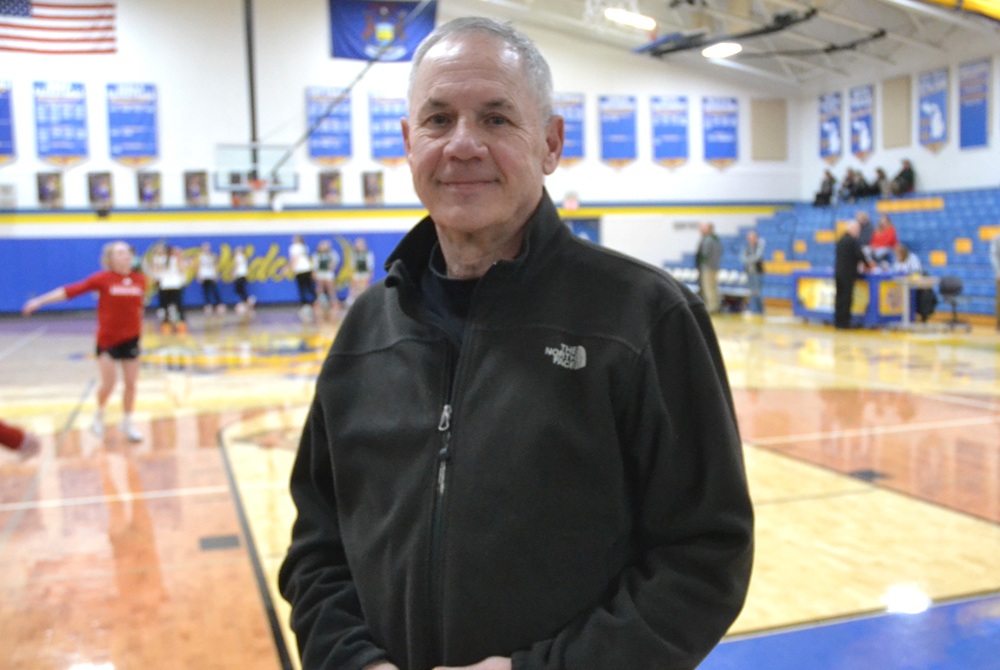
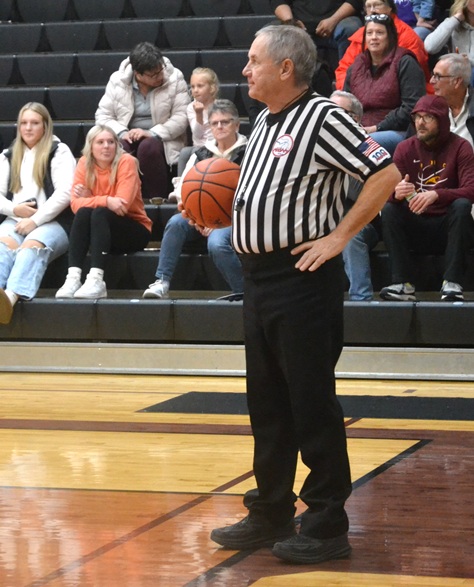
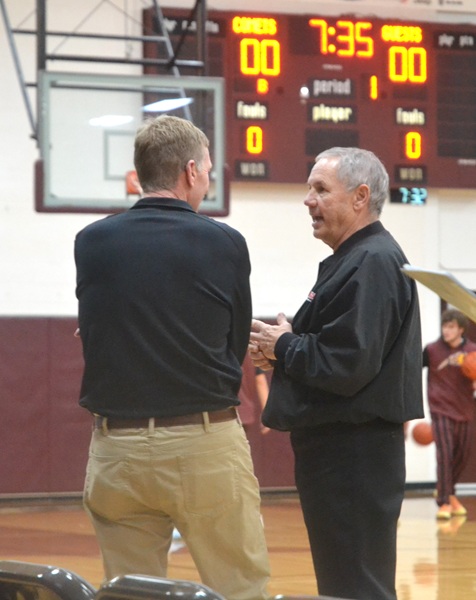
PHOTOS (Top) Cadillac’s Bill Allen, shown here following a varsity girls basketball game in February in Evart, is in his 50th year as an MHSAA registered official. (Middle) Allen waits at the baseline for action to resume. (Below) Allen talks casually with McBain Northern Michigan Christian boys assistant coach Terry Pluger prior to the start of the varsity game with Buckley on Dec. 8. (Photos by Mike Dunn.)