

Amid Season of Hurdles, Tri-unity Earns Breslin Return
By
Steve Vedder
Special for MHSAA.com
April 8, 2021
GRAND RAPIDS – It may be a familiar destination for Wyoming Tri-unity Christian's boys basketball team. But there's no arguing the path to get there has been strewn with potholes this season.
The Defenders will play in their ninth MHSAA Finals championship game since 1996 after racing past Rudyard 61-43 in Thursday's first Division 4 Semifinal at Van Andel Arena.
While playing in a Final is nothing new for Tri-unity, the win overcame another obstacle in what has been a challenging season for the Defenders (14-2), who move along to Saturday's 10 a.m. championship game at Breslin Center. Among the issues Tri-unity has overcome include playing only 10 regular-season games, axing the last two weeks of the schedule due to a COVID shutdown, playing only once in an abbreviated Regional and losing 12 seniors – plus coach Mark Keeler – to quarantine protocol early in the year.
Despite the reduced schedule and missing out on the chance to build early momentum, the Defenders have more than prevailed. The program has won four Finals titles and will make its ninth trip under Keeler, who this winter passed Paul Cook for sixth place on the state's all-time win list (627).
"It's been a very trying year," Keeler said. "I knew we had good potential, and guys have responded so well. We played a tough schedule, the kind of competition you want. We were able to stay humble, which is always something I have believed in. It's been a tough year, but it's been really exciting for the school.
"The guys have played awesome all the way through. We were confident we could make it to the Breslin, and we peaked at the right time. We've got a great senior group, and we really want to finish it out."
The Defenders never trailed Rudyard (18-3) after a 16-2 run snapped a 4-4 tie late in the first quarter. The Bulldogs did cut the lead to 20-16 with 7:13 left in the first half, but Tri-unity scored 16 of the next 19 points for a 36-19 halftime lead. The lead reached 54-34 with four minutes to go in the game.
While Keeler said he believed all along the team was a Finals contender, co-captain Austin Treece, who finished with 11 points and eight rebounds, said there was pressure to meet lofty goals.
"For sure," he said. "There is always pressure, but we just play bigger. We do a great job because I think we're a hungry team."
Co-captain Jaden Ophoff, who had six rebounds, two assists, two steals and four points, said the team has never felt distracted from its goal of playing in East Lansing. Beating Rudyard was just another step, he said.
"We didn't know what to expect from them, coming from the Upper Peninsula," he said. "We were able to adjust to them."
Tri-unity junior guard Brad Titus was virtually unstoppable. He scored 28 points on 11-of-21 shooting while adding four rebounds, six assists and six steals. Titus, who started as a freshman two years ago on a Division 4 semifinalist, said he's heard about playing in a championship game for years.
"This is really big, a blessing. I love it," he said. "We went two years ago, but we were cut short two years ago. It's great to be going."
Rudyard coach Jim Suggitt said Titus, who averages 22 points and four assists per game, was the difference.
"We tried to trade for their point guard, but Mark wouldn't buy it. I told him we'd even throw in the team bus, but he wouldn't go for it," Suggitt said. "He was the best ballplayer on the floor. He could take over whenever he wanted to."
Rudyard's E.J. Suggitt, who finished with 19 points, said the game plan was to keep Titus in check.
"We wanted to stop (him)," Suggitt said. "But even if you stop him, their role players will step up. They are a very tough team; they just played better basketball."
Keeler thinks Titus has played well enough in his career to be at least a two-time all-stater. He's thrilled Titus will have the chance to join his teammates in a championship game.
"The numbers (of past championship game trips) don't matter because this is a whole new group," Keeler said. "It's exciting for them, and it's something they will always remember. They've heard from other players we've had what it's like. It's a thrill."
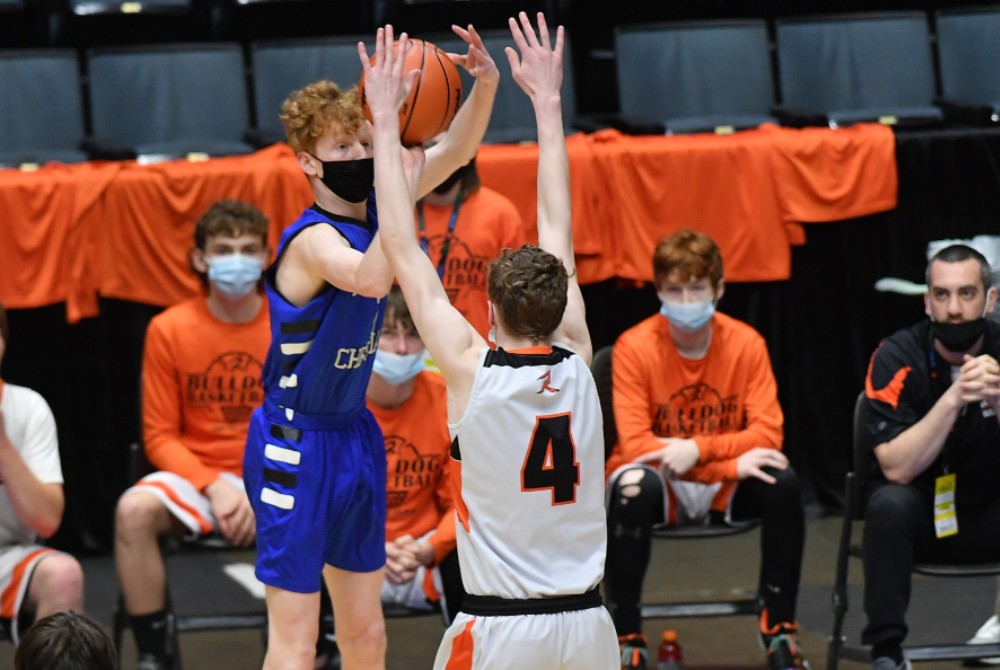
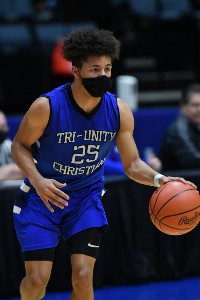
PHOTOS: (Top) Tri-unity Christian's Aidan DeKlyen pulls up for a shot in front of the Rudyard bench Thursday at Van Andel Arena. (Middle) The Defenders' Brady Titus was the game's high scorer with 28 points. (Click for more from Hockey Weekly Action Photos.)

Breslin Bound: Boys Report Week 1
December 17, 2013
By Geoff Kimmerly
Second Half editor
The first month of boys basketball season always is stock-piled with invitationals, showcases and match-ups pitting the predicted best in the state.
Most of those games will take place of the next three weeks and give us a better idea of what to expect once league play heats up in January. But it took only a few days for a number of teams to indicate their winters could be special.
As with last season’s "Breslin Bound" reports, what’s below isn’t a top 10 of any sort – just a list of 10 teams that stuck out last week among the hundreds of results that rolled in to the MHSAA.com Score Center.
1. Walled Lake Western (1-0, Class A) – Arguably the most intriguing result of the season’s first week was Western’s 73-69 win over reigning Class B champion Detroit Country Day, which beat Western by four a year ago.
2. South Haven (2-0, Class B) – The Rams’ 20-win season in 2013-14 ended with a Regional Final loss to Stevensville Lakeshore, but they started last week by beating Lakeshore 70-65.
3. Howell (1-0, Class A) – The Highlanders were a solid 13-10 last season, and jump to this list this week after beating reigning Class C champion Flint Beecher 58-53.
4. Powers North Central (2-0, Class D) – The Jets have hardly slowed after making the Class D Semifinals last season; they opened with wins of 47 and 45 points.
5. Taylor Kennedy (2-0, Class A) – The Eagles are coming off a 10-13 finish, but kicked off December by avenging last season’s 26-point loss to Detroit Catholic Central with a three-point win.
6. Reed City (2-0, Class B) – Reed City looks good to move up from its middle-of-the-league finish last season in the Central State Activities Association, if an opening-night 76-75 win over Cadillac is an indication.
7. Saginaw Valley Lutheran (1-0, Class C) – The Chargers did win 20 games last season after opening with a 24-point loss to Bridgeport; last week the Chargers opened with a 69-60 win over the Bearcats.
8. Coopersville (1-0, Class B) – The Broncos won one game in 2012-13 and lost twice to Spring Lake by an average of 26 points per; they opened this season by beating Spring Lake 55-52.
9. New Lothrop (2-0, Class C) – The Hornets finished 2012-13 with a disappointing exit in their first playoff game, but opened this winter with a 61-49 victory over reigning Class D runner-up Lansing Christian.
10. Dansville (2-0, Class C) – The Aggies’ four-win 2012-13 included a 43-point loss to Lansing Christian; Dansville is halfway to that win total already and beat the Pilgrims 47-44 on Friday.
PHOTO: Portland (white jerseys) kicked off 2013-14 with a 60-50 win at Alma on Tuesday. (Click to see more at HighSchoolSportsScene.com.)