

Bad Memory Fades with Eagles' Fast Start
March 22, 2018
By Geoff Kimmerly
Second Half editor
EAST LANSING – In case his players didn’t remember the heartache, Southfield Christian coach Josh Baker made sure they remembered.
Every practice, he’d mention last season’s Class D Semifinal loss to Powers North Central, decided in overtime on a last-second shot.
The Eagles never let Thursday’s return to the Semifinals get that far, or that close.
Southfield Christian opened up a double-digit lead before Dollar Bay scored its first point, and finished with a 71-32 victory at the Breslin Center.
“The mindset was just completely different this year,” Southfield Christian senior Bryce Washington said. “Coach brings up every day in practice that loss last year, how we have to play our hardest every possession. You see defensively we’ve been a lot better in the playoffs. It’s just played into our game.”
The Eagles (22-4) will play at 10 a.m. Saturday for their fourth Class D title this decade and first since 2014, against either Buckley or Hillsdale Academy.
Defense indeed is a renewed strength for Southfield Christian, and the 32 points were 13 fewer than Dollar Bay’s season low this winter.
Hand in hand with that improved defense is the team’s increased depth – and it played a major role in shutting the Blue Bolts down as Baker rotated multiple players to handle Dollar Bay seniors Devin Schmitz and Jaden Janke. They combined to score only 17 points.
“Last year we (played) about six or seven guys every game,” Eagles junior guard Harlond Beverly said. “This year we go 9-10 deep, and that makes it a lot easier for all of us … to get a two-minute break every game, come back in and keep that energy going.
 The Blue Bolts (26-1) responded to the opening run with a 13-11 stretch, and Schmitz’ 3-pointer with 2:17 to play in the second quarter pulled his team within 12 of the lead.
It would get that close one more time 44 seconds later, but never closer.
Dollar Bay coach Jesse Kentala and his players all admitted it was just about impossible to prepare for Southfield Christian’s speed, even as the Blue Bolts often have that advantage on opponents.
“That was the first time anyone’s matched our speed,” Kentala said. “We’ve kinda lived off being able to go by guys and exposing defenses. I think we were shocked because the first three or four minutes of that game, we couldn’t go by them. And (my players) kept looking at me going, ‘Coach, what do you want us to do?’
“They are so fast and such active defenders … we just don’t see athleticism like we saw tonight.”
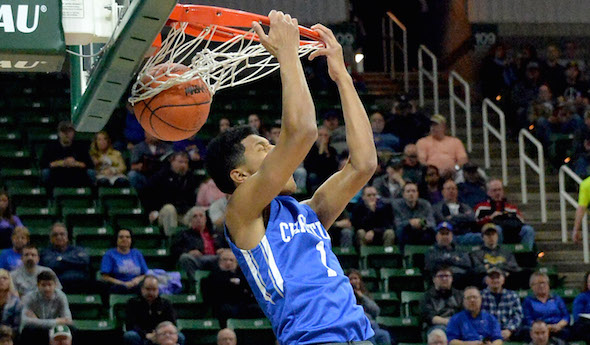
Washington led Southfield Christian (22-5) with 23 points, 10 rebounds and three steals. Junior guard Caleb Hunter added 17 points, four assists and five steals and Beverly – who opened the game with a reverse dunk – added 12 points and four steals. Junior guard Jon Sanders had 10 points and three assists off the bench.
Janke had 12 points, six rebounds and two steals to lead the Blue Bolts in all three categories.
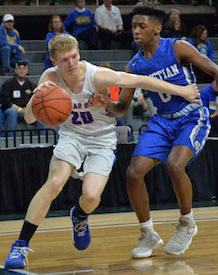
PHOTOS: (Top) Southfield Christian’s Harlond Beverly throws down a dunk during his team’s Class D Semifinal win Thursday. (Middle) Dollar Bay’s Devin Schmitz (20) works to get around Southfield Christian’s Rahmon Scruggs.
Western's White Enjoys 'Special' Career
By
Tom Markowski
Special for Second Half
May 4, 2016
WALLED LAKE – Seeking a higher level of performance, many high school athletes have channeled their energy to one sport.
 Many refer to this concentration as specialization – and Cody White, for one, isn’t buying it.
White, a junior at Walled Lake Western, is a three-sport athlete and he loves every minute of it. He plays basketball during the winter, baseball in the spring and football in the fall. During the summer he competes in AAU basketball, travel baseball, 7-on-7 football games with his Western teammates, and he participates in a few summer football camps.
White has played these same sports all throughout high school. His freshman year he competed in track and field, along with baseball. White hasn’t ruled out returning to track and field, in addition to baseball, as a senior – but this season he’s sticking with just baseball.
It’s a hectic schedule but, again, White wouldn’t have it any other way.
“I couldn’t see myself not competing in those sports,” he said. “I love them so much. I want to finish my senior year playing all three.”
White estimates that he’ll have two days off, away from sports, in June. In July he’ll take a week off, between his summer baseball team schedule ending and the start of football practice.
There’s no question White is driven, but it’s more than that. In some high schools, and with some coaches, playing multiple sports can be a challenge. There are some coaches who would prefer the students to play one sport and only one sport.
According to Western football coach Mike Zdebski, that isn’t the case at his school.
“We encourage them to play more than one sport,” Zdebski said. “For one, we want them to get their money’s worth. We have a pay-to-play policy of $425. You play one sport and it costs $425. You play three sports and it costs the same. And, two, playing other sports helps them develop other skills. In basketball you create space. In baseball you chase fly balls, and that helps with depth perception. Besides you get to work with other coaches and other teams.
“We’re lifting weights during the summer. If a kid is playing summer baseball or AAU basketball, if they have time they can come by and lift weights. And what we always tell them, if you’re tired let us know. You can take a break.”
Zdebski – whose team finished 12-1 last fall – was quick to point out some excellent athletes in the past, like former Kansas City Royals outfielder/Oakland Raiders running back Bo Jackson, who were multiple-sport athletes. And, more recently, there’s Luke Glendenning of the Detroit Red Wings. Glendenning was an all-state running back at East Grand Rapids.
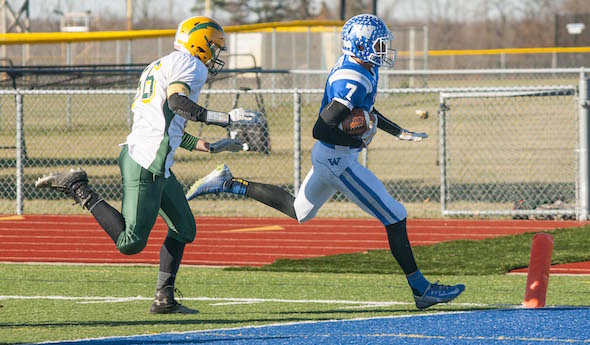
 When his high school career is done, White will play football in college. Two months ago he committed to sign with Michigan State this winter. At 6-foot-3 and 200 pounds, White played receiver, defensive back and also returned kicks last fall. He played a big role in Western’s run to the Division 2 Semifinals.
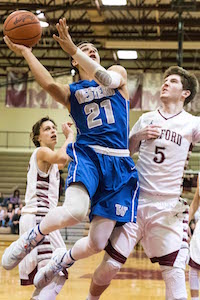
During baseball season, White pitches and plays middle infield and right field. He plays the wing and shooting guard in basketball.
His interest in playing a variety of sports came at an early age and, as is the case with most children, a family member was the one who introduced White to athletics. Former NFL player and Detroit Lions executive Sheldon White is his father, but the first sport White played, at age 3, was baseball. Two years later he began playing football and basketball.
Sheldon White also played three sports at his high school in Dayton, Ohio, (Meadowdale High) and helps his son manage his busy schedule, particularly during the offseason.
“Growing up was a little different (for me) than the usual kid,” Cody White said. “Going to Lions games and just being around football all the time. I think I love the game more because I was around it so much.
“But I think playing three sports helped me, too. The twisting of your hips in baseball, when you swing the bat, you’re using different muscles. And all the jumping you do in basketball. You have to move in tight spaces.
“With football, you’re with the football guys. By doing all three you meet different people.”
Playing multiple sports has definitely been the right road for White to follow. And his busy schedule hasn’t hindered his work in the classroom.
White has a 3.54 grade-point average pending his grades for this semester.
 Tom Markowski is a columnist and directs website coverage for the State Champs! Sports Network. He previously covered primarily high school sports for the The Detroit News from 1984-2014, focusing on the Detroit area and contributing to statewide coverage of football and basketball. Contact him at [email protected] with story ideas for Oakland, Macomb and Wayne counties.
PHOTOS: (Top) Cody White (right) runs away from a Midland Dow defender during their Regional Final this fall. (Middle) White works for a shot against Milford. (Photos by Teresa Presty.)