

Balanced Muskegon 'D'-termined to Reign
January 10, 2017
By Tom Kendra
Special for Second Half
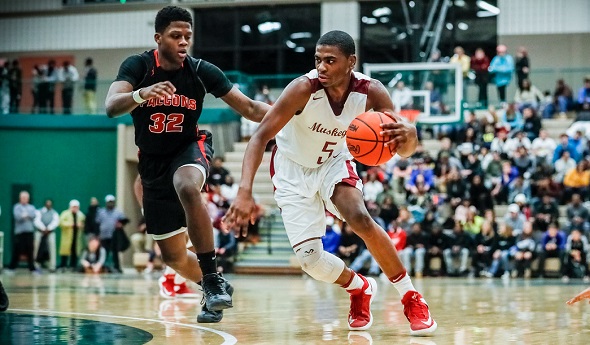
Jermayne Golidy emerged as the “go-to” player on Saturday in Muskegon’s first real test of this young basketball season.
 But the smooth, 6-foot-4 senior wasn’t even in the starting lineup on the previous night in a lopsided win at cross-town rival Muskegon Mona Shores.
“That’s the kind of team we are – you never know who will be the leading scorer,” said Golidy, who finished with 28 points, 12 rebounds and two blocked shots as Muskegon rallied from a halftime deficit to post an impressive 68-55 win over visiting powerhouse Chicago Whitney Young in the final game of the Muskegon Showcase tournament at Redmond-Potter Gymnasium. “I came out a little shaky and nervous, but I knew I had to start playing if we were going to win.”
Defense has always been paramount for Muskegon basketball, but fifth-year head coach Keith Guy knows that in order for the Big Reds to get back and compete for another Class A championship after winning it all in 2015, it will take three other Ds:
Diversity on offense, depth and good decisions.
“We don’t have one guy on this team; we have 10 guys who can put it on the floor and score,” said Guy, whose team is off to a 6-0 start. “We have to use all of our weapons and we have to make good decisions with the ball. If we do that, we’ll be fine.”
It’s a change from recent Muskegon teams which featured a marquee player surrounded by a supporting cast. DeShaun Thrower (2014) and Deyonta Davis (2015) were back-to-back Mr. Basketball Award winners, and last year’s team relied on the senior backcourt duo of Michael Littlejohn and Linwood Lee at crunch time.
This year’s team may not have any five-star college recruits, but the sum of its parts may be better than any other team in the state.
Golidy was one of those supporting cast members the past two seasons who is still trying to adjust his mindset in his senior year.
He started off the season with a game-high 20 points in a victory at Rockford, then was relatively quiet over the next three games, seemingly slipping back into his understudy role.
So his coach benched him.
“We thought we could get more out of him,” explained Guy, who has a 96-13 record at Muskegon, where he is assisted by Maurice Sain, Louis Murray and Josh Wall. “He had a rough week of practice, so he did not start against (Mona) Shores. We put him back out there, and he responded.”
After playing just 13 minutes and scoring eight points in the win over Shores, Golidy came out with renewed purpose against Chicago Whitney Young, an elite magnet public school which boasts such distinguished alumni as Michelle Obama and Jahlil Okafor of the Philadelphia 76ers. Golidy basically never left the floor, playing 30 of 32 minutes.
 Muskegon trailed 23-21 at halftime, but it was a 3-pointer early in the third quarter which put the Big Reds ahead to stay. When defenders came out on him, Golidy drove his lean frame to the basket, while also scoring on offensive rebounds and putbacks. Golidy finished 10 of 15 from the floor (with two 3-pointers) and 6 of 8 from the free-throw line.
“I feel like I can play all-around,” said Golidy, who helped the Big Reds to the Class A Regional Finals last year, where they were upset by Hudsonville. “Each game might be different. If we are getting out-rebounded, I’ll go down in the paint. If we need a 3, I’ll take that.”
The problem for Muskegon opponents is that Golidy is just one of four extremely versatile seniors in the Big Reds’ starting lineup who all measure between 6-4 and 6-6 and can play both inside and outside, thereby creating a matchup nightmare.
Markell Jackson (6-6) is the tallest and thinnest of the four, with a massive wingspan that has allowed him to grab a team-high 9.4 rebounds per game. Anthony Bethea III (6-5) is the strongest and most natural post player, and has a nice left-handed shooting stroke. Sam Cornett Jr. (6-5), who joined the Big Reds after formerly playing for his dad Sam at Grandville, supplies speed and ball-handling skills of a guard.
One of the biggest challenges for Guy is keeping those seniors engaged and challenged throughout the long season.
Muskegon, frankly, has not been tested much in the Ottawa-Kent Conference Black since Guy came over from Muskegon Heights in 2012. Therefore, he has made it a point to seek out the best nonconference opponents he can find, often in early-season tournaments.
Already this winter, Muskegon has knocked off East Kentwood in the Muskegon Area Sports Hall of Fame Classic over Christmas break and Chicago Whitney Young at the Muskegon Showcase last weekend. Next up is a tussle with host school Grand Rapids Ottawa Hills in Saturday’s fourth and final game at the annual Floyd Mayweather Basketball Classic.
“We love these big games; that’s where we play our best,” said Golidy. “We’re trying to go 28-0, get a ring and get a state championship. Those are our goals.”
 Tom Kendra worked 23 years at The Muskegon Chronicle, including five as assistant sports editor and the final six as sports editor through 2011. E-mail him at [email protected] with story ideas for Muskegon, Oceana, Mason, Lake, Oceola, Mecosta and Newaygo counties.
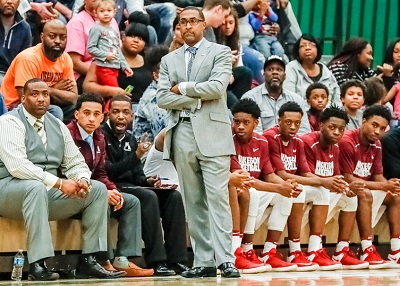
PHOTOS: (Top) Muskegon senior Jermayne Golidy looks to make a move during the Big Reds' 68-45 win over East Kentwood in the Meijer Muskegon Area Sports Hall of Fame Classic on Dec. 28 at Muskegon Reeths-Puffer High School. (Middle) Muskegon coach Keith Guy and his bench look on during the Big Reds' win over East Kentwood. (Photos by Tim Reilly.)
Starkey's Petoskey Ready to Shine Again
December 15, 2017
By Dennis Chase
Special for Second Half
PETOSKEY – Dennis Starkey remembers it like it happened yesterday.
Thirty-five years ago, at the age of 23, Starkey made his varsity head coaching debut with the Boyne City Ramblers.
 “The first game I coached was against the legendary Charlie Paige (Harbor Springs),” Starkey recalled. “I got it handed to me pretty good. I knew I had a long way to go after that ballgame.”
Starkey learned quickly. Now, starting his 31st season as coach of the Petoskey Northmen, the 58-year-old is among the winningest coaches in MHSAA history. His 536 career wins rank 18th all-time among boys coaches – with an average of nearly 16 wins a season.
Starkey should move up that list in the coming weeks as the Northmen appear poised for a promising winter.
Petoskey opened the campaign by capturing its Tip-Off Classic last weekend, beating Marquette 55-38 and Manton 66-57. Marquette won 20 games a year ago, while Manton was a Class C semifinalist.
“It’s a great start,” Starkey said. “We played two good teams. We have a lot of work to do, but we’re excited. This is a good group. These guys were really committed during the offseason. Hopefully, that will pay dividends.”
Petoskey was an uncharacteristic 12-8 a year ago. That squad was comprised of three seniors and nine juniors – and one of the key juniors, 6-foot-9 center Danny Kolp, was recovering from knee surgery.
“I’ve always said you win and lose with seniors,” Starkey said. “Our inexperience really showed last year. Luckily, we’re loaded with seniors this year. We’re hoping to get back to where we were before.”
The Northmen were 20-2 two years ago.
Motivation should not be a problem.
“We were pretty unhappy with how we did last year,” senior Joel Wilson, a two-year starter, said. “I expect a lot from this team.”
So does Kolp.
“(High school) memories last forever, and we want to make this a memorable senior season,” he said. “We want to reach our full potential. We have a high ceiling.
“We have the athleticism and skills to make a run in the tournament,” he added. “That’s our goal. Petoskey hasn’t been to a Regional (since 2012). We have a good chance to do it this year if we keep playing as a team.”
Petoskey, which returns four starters, put its size and balance on display last weekend. Seth Mann, a 6-5 guard, averaged 17 points in the two wins. Kolp, who has signed with Northwood University, came up big in the paint, averaging 16 points, six rebounds and two blocks. The athletic 6-4 Wilson contributed 13 points a game, and 6-5 Jake Lee 9.5 points. All are seniors, as is starting point guard Collin Kingma.
Petoskey not only used its length to its advantage – especially defensively and on the boards – but played with a focus.
“I think the biggest improvement thus far is mental,” assistant coach Kevin Starkey, Dennis’s son, said. “Even coach Hiller (Ryan Hiller at Manton) told me after watching the Marquette game that the guys looked locked in, ready to go. It’s visibly noticeable.”
Dennis Starkey started this season much like he has the previous 34, preaching a “team first” approach. From there, he addressed the standards his program is built on.
“It starts with being good students, good citizens,” he said. “If you have to fight issues that do not involve basketball, then you’re never going to be successful (on the court). Our guys have bought into a system that starts with everyone playing together, playing the way we expect and acting the way we expect.”
Starkey asks that his players, especially his seniors, take ownership of the team. As a reminder, after each practice, the coaches step away as the players huddle on the court to dissect that day’s effort.
“The one thing I’ve always enjoyed about coach Starkey is that he emphasizes it’s our team and we can make it how we want to make it,” Kolp, a three-year varsity veteran, said. “We’re not going to be as good if he’s the only one barking at us. He holds us accountable, and we enjoy that challenge.”
“He likes to say we’re all coaches on the court, that we should be coaching and learning from each other,” Wilson added. “He stresses that every day.”
It helps, of course, to have a team that’s already tightly woven. The seniors on this team have been playing basketball together since fifth grade and are “buddies” off the court.
 On the court, Starkey clearly sets the tone, though.
“He’s not afraid to get in your face,” Wilson said. “He pushes you hard. But it’s all for the better.”
Petoskey has long been noted for producing disciplined, fundamentally-sound teams. That’s Starkey’s style.
“We try to play up-tempo as much as we can,” he said. “But we really rely on executing offensively and defensively in the half court.”
It’s an approach that runs deep in the system. Sean Pollion, Matt Tamm and Jason Miller all have 20-plus years coaching high school basketball at the school. Pollion is an assistant to Starkey, Tamm is now the JV coach while Miller just moved over to the girls program. In addition, Kevin Starkey and Jon Flynn, a star on the school’s two Class B Semifinal teams in the late 1990s, are assisting.
“That continuity means so much in high school basketball,” Dennis Starkey said. “Some programs have a hard time keeping coaches for extended periods. It’s been an advantage for us. It’s paid dividends.”
Starkey started honing his skills at Boyne City, serving a one-year apprenticeship under Bob Taylor, who went on to coach in the Great Lakes Intercollegiate Athletic Conference. He replaced Taylor, who took the Lake Superior State women’s job, and then left Boyne City after a season to accept a head coach/athletic director position at Vanderbilt. It was there he met his wife, Karen. After three years, Starkey moved on to Petoskey. To this day, former longtime Petoskey athletic director Gary Hice calls it one of the best decisions he ever made.
Inducted into the Basketball Coaches Association of Michigan Hall of Fame in 2014, Starkey has coached teams that have won 17 Districts and four Regionals.
His 1996-98 squads featured guards Trevor Huffman, who later led Kent State to an Elite 8 NCAA Tournament appearance in 2002, and Flynn, Grand Valley State’s all-time leading scorer (2,220 points).
Starkey would later coach his sons, Kevin and Cory. Cory, who went on to earn all-state honors, played at Bucknell and then a year professionally in Ireland. After earning his master’s degree in international finance, Cory accepted a job with an investment company in Chicago. His boss? Former Charlevoix basketball standout Scott Friske, now a senior vice president at First Trust. Friske and Petoskey’s Damon Huffman, Trevor’s younger brother, were teammates at Brown. Another former Charlevoix Rayder, Jared Hunt, also works at First Trust.
“Basketball opened a door for (Cory) in the business world,” Dennis Starkey said. “He’s been blessed. When you’re involved in this sport, you have so many contacts. And a lot of the northern Michigan guys look after each other. It’s a real special bond they create, all because of high school basketball.”
But the story is not over. Trevor Huffman is also in Chicago and lives with Cory. Huffman is still involved in basketball.
“He’s using basketball as an adult workout platform,” Starkey said. “He has guys come in and they do drills, much like we do in practice. So instead of going to the gym and lifting weights and doing cross-training, his clients, most of them former players, use basketball as a form of exercise to become more fit.”
After graduating from University of Michigan, Kevin Starkey headed back north and took a teaching/coaching job at Manton, serving as an assistant to Hiller. The Rangers first game that season? Petoskey.
“That was bizarre, coaching against my dad,” Kevin admitted.
When Dennis Starkey retired as a physical education teacher, Kevin Starkey was hired to replace him. He’s now in his third year at the school.
It’s given Kevin a unique perspective on his dad. He played two years for him on varsity (2007-08 and 2008-09) and has now coached with him three years. When asked if he has a favorite story that encapsulates the type of person his father is, Kevin doesn’t have to think long.
“My senior year we were playing Charlevoix and I had just recently broken my hand,” he said. “It was my first game back. We didn’t know what to expect. When the game started, they were sagging off me because (the injury) was to my shooting hand. When I put up that first shot, I hit it. Then, all of a sudden, I hit five 3s in the first half. He never lets it go. It’s something I remember because he was so proud of me. It was my last (home) game and I was just trying not to air-ball it. Somehow, a few of them went in.
“Well, the next year when I came home from college – we sometimes watched old game films, or films of us growing up – he puts that game in first. He was like, ‘Man, that was so cool.’ I say that not because I need credit, but it was one of those things where he was more excited than I was for myself.”
 That, Kevin added, is how Dennis is with his players. He wants the best for them.
This team is no exception.
Kolp, who has had two knee operations, is finally healthy. His last surgery was in June of 2016, and he missed the first six games a year ago.
“He really wasn’t himself - until now, to be honest,” Starkey said.
In eighth grade, Kolp landed awkwardly on his right leg, tore a ligament and dislocated his kneecap.
“They couldn’t do the full operation because I was still growing,” he explained. “Two years later I blew it out again.”
Kolp, who plans to go into an entrepreneurial program at Northwood, spent this past offseason working hard in the weight room.
“I was in there five days a week, lifting to improve my upper and lower body,” he said. “Now, during the season, I’m in there two to three times a week to maintain my strength. I feel good. Everything is coming together.”
Wilson, all agree, is the most athletic player on the squad. He was a first-team all-Big North Conference pick as a quarterback and outside linebacker in football. Several colleges have expressed interest, and he is visiting Central Michigan this weekend and will miss Saturday’s game with Zeeland East. Central Michigan is recruiting him as a preferred walk-on with plans to use him at tight end.
“It’s (disappointing) to miss the game, but I have a decision to make that will (affect) the next four years of my life,” he said.
Mann is the team’s top perimeter shooter.
“Seth is a skilled shooter,” Starkey said. “He has good size and length. I think he’s going to have a great year.”
Kolp agrees.
“With our size, if we get it into the post, and (opponents are) starting to play help defense from the backside, and Seth is in the corner, he’ll punish them for it,” he said.
It could be a special season.
Starkey, though, is not one to think too far ahead. He said the best advice he ever received was to “live in the moment, coach in the moment.”
And he knows there will be challenges ahead. There are no guarantees.
“As excited as I am with all the guys we have back, every coach in the league feels the same way,” he said. “Last year there was only one senior on the first and second all-conference team. It’s going to be a very good race.”
As for the future, Starkey, who credits a strong support system at home for his success, is not saying how much longer he’ll coach.
Kevin has an opinion, however.
“It’s something he’s really good at,” Kevin said. “I look at it like this: Don’t throw it away if you’ve still got it.”
 Dennis Chase worked 32 years as a sportswriter at the Traverse City Record-Eagle, including as sports editor from 2000-14. He can be reached at [email protected] with story ideas for Manistee, Wexford, Missaukee, Roscommon, Ogemaw, Iosco, Alcona, Oscoda, Crawford, Kalkaska, Grand Traverse, Benzie, Leelanau, Antrim, Otsego, Montmorency, Alpena, Presque Isle, Cheboygan, Charlevoix and Emmet counties.
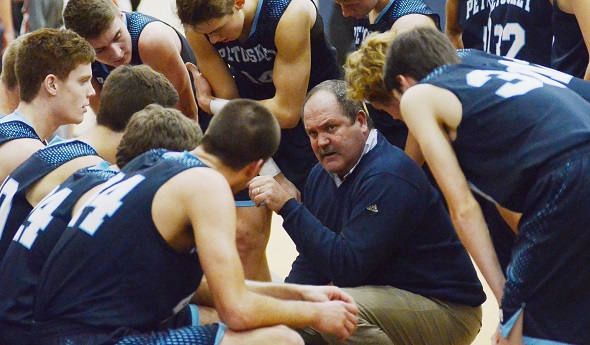
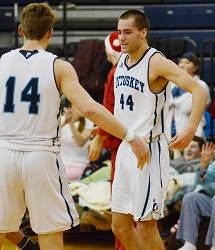
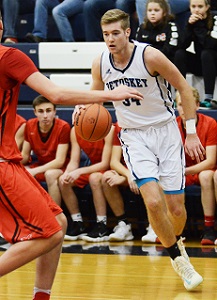
PHOTOS: (Top) Petoskey coach Dennis Starkey huddles with his team during the season-opening Tip-Off Classic. (Middle) Joel Wilson (14) and Jake Lee share a celebratory moment. (Below) Senior Danny Kolp pushes the ball upcourt during the event. (Photos courtesy of the Petoskey News-Review.)