

Bates, Lincoln Land in 1st Hoops Final
March 15, 2019
By Geoff Kimmerly
Second Half editor
EAST LANSING – Emoni Bates was here to help, he told his teammates before beginning his freshman year at Ypsilanti Lincoln in the fall.
That’s one very understated way to put what the nationally-renowned freshman has meant to the Railsplitters during their most successful season.
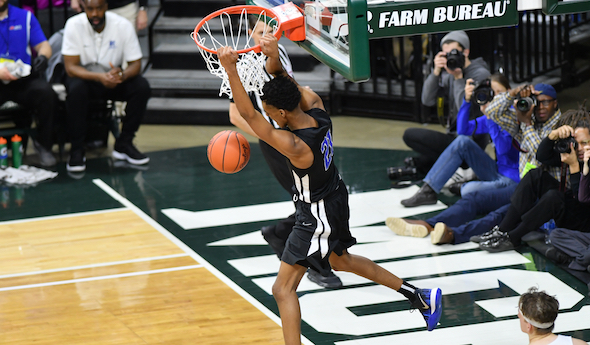
Bates, and Lincoln, played in their first MHSAA Semifinal on Friday, and the 6-foot-10 phenom showed as expected – he flashed skill and poise and brought roars with a pair of dunks, including one from a pass off the backboard.
And Lincoln continued to perform as he expected when he joined an otherwise veteran lineup, making an incredible 57 percent of its shots from the floor in a 72-56 win over Howell to earn a berth in Saturday’s Division 1 championship game.
“My teammates … when I told them I was coming (to Lincoln), I told them I was just helping them, and I told them if we just keep working hard every day we’d be here,” Bates said. “I just knew I trusted them. I trust them, and they trust me, and that’s how we got here.”
Lincoln (22-4) will play for its first championship against Detroit U-D Jesuit at 12:15 p.m. Saturday.
Playing on the Breslin Center floor for the first time, in front of a mostly full lower bowl, has derailed many an MHSAA championship hopeful.
But there might not be a player, and team, in recent memory that has been more prepared for a trip to East Lansing than Bates and Lincoln.
Buzz around the nationally-renowned freshman started high this winter and has only continued to grow as he’s keyed the Railsplitters’ run to its first Regional title, then Semifinals and now championship game.
He had 31 points – on 55 percent shooting – and 14 rebounds against Howell, and his teammates followed suit showing no effects from the big-arena atmosphere by sinking 59 percent of their shots.
“It was just fun. We battled all game, he’s taller than me and was shooting over my head, and I couldn’t really do anything about it,” said Howell senior Josh Palo, an all-state honorable mention last season and one of those charged with defending Bates on Friday. “I was definitely looking forward to guarding him. Our game plan was making him take tough shots. He was knocking them down. We couldn’t do anything about it.”
 Bates’ first basket was a 3-pointer with 3:52 left in the first quarter that made the score 10-4. The Railsplitters never led by fewer than six points the rest of the way.
Senior forward Amari Frye added 12 points while making half his shots from the floor, and senior guard Tahj Chatman made all four of his shots from the floor for 10 points to go with four assists.
“I’ve been on varsity four years, and the added pressure, I tell him all the time to put the pressure he gets and put it on me,” Chatman said. “I feel we’re here for him. We all embrace him. There’s no jealousy or none of that. We embrace him all the way.”
Lincoln starts four seniors with Bates, and after going 10-11 in coach Jesse Davis’ first season three seasons ago posted back-to-back winning records before breaking through this winter.
“I envisioned everything that we’re doing right now,” Davis said. “We just worked toward it. Of course I need these guys learning it, (buying in) to what I’m saying and what I’m doing and what I’m teaching them. But yes, I envisioned this for the program.”
Howell (20-7) took a similar step with its program this winter, with Friday’s Semifinal the team’s first since 1927. The Highlanders first won their third straight District title and finished with their highest win total of Howell coach Nick Simon’s seven seasons leading the program.
Palo, one of four seniors in the starting lineup, had 16 points in his final high school game. Junior guard Tony Honkala had 12 points off the bench, and senior forward Jake Sargeant had 11 points and six rebounds for the Highlanders.
“Our guys believed in this for a long time,” Simon said. “It’s not just something that’s happened at the end of the year.
“I knew we could do it, and they knew we could do it all year. We went through tough battles, went against tough opponents in the playoffs, and we were used to that tough competition. We respected them, but we were not fearful at all.”
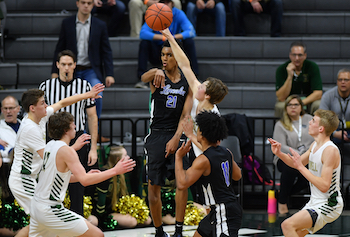
PHOTOS: (Top) Ypsilanti Lincoln’s Emoni Bates throws down one of his two dunks during Friday’s Division 1 Semifinal. (Middle) Howell players work to break up a pass.
Breslin Bound: Boys Report Week 10
February 12, 2018
By Geoff Kimmerly
Second Half editor
Aspiring boys basketball teams are taking aim at frontrunners all over Michigan as we reach the middle of February.
 The Detroit Public School League experienced this most last week as arguably the three favorites for this season’s league tournament title all were eliminated. The Upper Peninsula and northern Lower also saw undefeated powers fall for the first time.
Plenty more opportunities to re-set the pecking order are coming up; see some of them below. Breslin Bound is powered by MI Student Aid and based on results and schedules posted for each school at MHSAA.com. To offer corrections or fill in scores we’re missing, email me at [email protected].
Week in Review
The countdown of last week’s five most intriguing results:
1. Detroit Edison Public School Academy 59, Detroit Cass Tech 51 – This PSL game certainly shook up the bracket as the Pioneers eliminated the reigning league tournament champion.
2. Detroit Renaissance 66, Detroit East English 65 – This also was a bit of a PSL quarterfinal shocker, with East English the only team in the state this season to beat reigning Class A champ Clarkston.
3. Dollar Bay 51, Ewen-Trout Creek 42 – More than 3,000 fans packed Michigan Tech’s gym to see Dollar Bay emerge from this meeting of previously-undefeated Class D contenders.
4. Detroit Pershing 50, Detroit Henry Ford 44 – Despite an 8-9 record, Pershing has been mentioned as a Class C contender with its wins and losses more a reflection of its tough schedule; winning this game over a Class B contender backs up that theory.
5. Frankfort 53, McBain 48 – The Panthers should have plenty to say in Class D as well, and their play did the talking in handing Class C McBain its only defeat.
Watch List
With an eye toward March, here are two teams in each class making sparks:
CLASS A
Holland West Ottawa (14-1) – The Panthers are on a two-month winning streak since losing their opener to Wyoming Godwin Heights. They clinched a share of the Ottawa-Kent Conference Red championship, their third straight, on Friday with three league games to play. They finished 23-2 overall last year and will look to add a Regional title this time around.
Ypsilanti Community (11-1) – The Grizzlies have a slim lead in the Southeastern Conference White but can solidify it next week by avenging their lone loss, to Dexter. They have won league championships all four years since forming from the old Ypsilanti and Willow Run high schools.
CLASS B
New Haven (16-0) – The Rockets are among the least surprising successes in the state coming off last year’s Class B title and returning standout junior Romeo Weems. Saginaw Arthur Hill on Saturday was the first team to come closer than 17 points, as New Haven won 71-68.
Wyoming Godwin Heights (14-1) – The Wolverines remain among the class of the Grand Rapids area and statewide, looking to return to the season’s final week after falling in the Regional a year ago. The only loss was in overtime to Grand Rapids Forest Hills Central (now 13-2), with wins over West Ottawa and Pershing – and no other opponents coming closer than 11 points.
CLASS C
Cassopolis (12-0) – The Rangers are holding down first place in the inaugural Southwest 10 Conference standings after winning Berrien-Cass-St. Joseph division championships the last three seasons. They’ve put up at least 70 points seven times – and dropped 111 in their last game Feb 3.
Unionville-Sebewaing (12-0) – The Patriots are looking to add a second straight league title and are perfect through the first half of the Greater Thumb Conference West schedule. Last week included a win over Jack Pine Conference leader Sanford Meridian Early College, and a December victory over Detroit Douglass also is worth noting.
CLASS D
Hillsdale Academy (13-1) – With a loss only to Class B neighbor Hillsdale High, the Colts look good to improve on last season’s 17-7 overall finish. Only one other opponent has come within double digits, and Hillsdale Academy leads the Southern Central Athletic Association East after tying for second last season.
Southfield Christian (12-3) – This season has been standard Southfield Christian – play a bunch of larger powerhouses to prepare for the postseason while taking care of things in the Michigan Independent Athletic Conference Blue. A win over Detroit Martin Luther King was strong, and an overtime loss to Pershing was similarly impressive.
Can't-Miss Contests
Be on the lookout for results of these games coming up:
Wednesday – Buckley (11-3) at Frankfort (12-1) – Frankfort won the first round by 16, but the reigning Class D runner-up Bears lead the Northwest Conference by half a game.
Friday – Frankenmuth (13-1) at Bridgeport (12-1) – The Bearcats set the tone for an excellent run by downing the rival Eagles by 14 at the start of January; a sweep would all but secure the Tri-Valley Conference East title.
Friday – Troy (11-3) at Clarkston (13-1) – Aside from Detroit East English, which beat Clarkston in December, few others have come close to the Wolves; Troy, which fell only 59-54 on Jan. 9, is one of those few.
Friday – Detroit PSL Final at University of Detroit Mercy – King (9-5), Pershing (8-9), Edison (8-9) and Renaissance (11-4) will play in Tuesday semifinals to set Friday’s championship matchup.
Friday – River Rouge (15-0) at Southfield Christian (12-3) – They share some motivation; both made it to the Breslin Center last season and both lost Semifinals in overtime, in Class B and D, respectively.
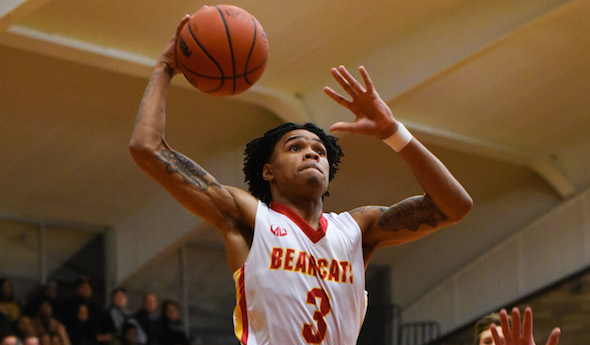
PHOTO: A Bridgeport player goes up for a dunk during a win over Saginaw Swan Valley this season. (Click for more from HighSchoolSportsScene.com.)