

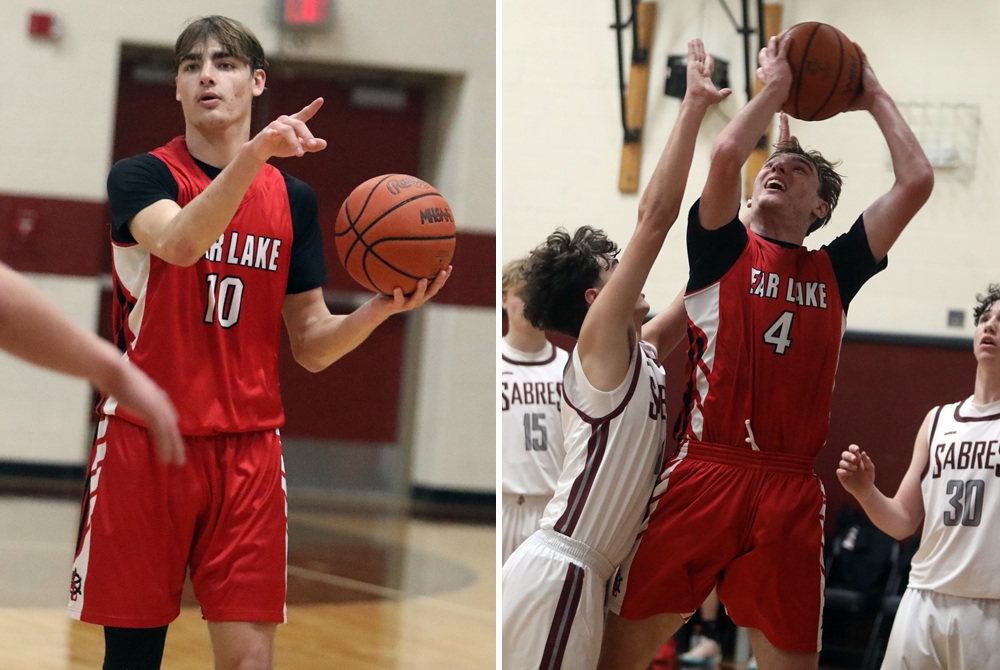
Bear Lake's Harless Twins Both Eclipse 1,000 Points, Have More Milestones in Mind
By
Tom Spencer
Special for MHSAA.com
January 30, 2026
Grady and Myles Harless will end their high school basketball careers among the highest scorers in Bear Lake history.
 The twin brothers are the latest Lakers to join the 1,000-point club, but scoring is not how either one of them wants to be remembered. Their preferred legacy, as they look to play at the next level, is a strong work ethic.
“You can be athletic as you want, but if someone outworks you they'll be better than you,” Grady Harless said, noting his message is to current and future high school basketball players. “If you're from a small school, hard work will get your name out there.”
Myles Harless has a similar message for those competing on the hard court.
“Even if you come from a small school or a small community, you can be great,” he said. “It doesn't matter what part of the state you're from – if you're good, you're good.”
With the Harless twins leading the way, the Lakers are off to a 13-4 start and share first place in the West Michigan D League at 8-1. Grady Harless is scoring 23 points per game while also averaging six rebounds, 2.5 assists, 2.7 steals. Myles Harless is averaging 20.7 points per game while dominating the boards with almost 18 rebounds per contest.
“Those two have been the definition of what I view Bear Lake basketball is and should be going forward,” said fifth-year Lakers coach Christian Novak. “I've seen some pretty solid twins that have played together and what not, but I've not seen any accomplish the same thing these two have.”
Myles Harless pulled down 25 rebounds and scored 28 points Tuesday night as the Lakers stayed in first place with an 87-49 win over Mesick. Grady Harless added 27 points and six assists.
 Joining the 1,000-point club had been the twins’ goal since they first played for Bear Lake as eighth graders. With an enrollment far fewer than 100, Bear Lake applied for and was granted an MHSAA waiver to permit eighth graders like the Harless boys to compete in junior varsity and varsity play.
The twins played sparingly on the varsity as eighth graders, mostly benefiting from the fifth-quarter rule.
“Myles and Grady are the exact definition of what Bear Lake basketball is — show up, go to work, put in the extra time with grit and all the extra stuff,” Novak said. “I would say from their eighth-grade summer until all the way up till now, they did the work and I doubt they missed more than a handful of training opportunities.”
The Lakers are riding a five-game winning streak and have four league games remaining. They’ll finish the regular season at Baldwin, a team they topped 66-48 at home. Baldwin currently shares the league lead.
Senior Easton Nowak has been on a tear of late for Bear Lake as well. He had 13 points, four steals, two assists and a blocked shot against Mesick and is now averaging almost 10 points per game. Just prior to playing Mesick, Nowak had double-digit games of 20, 16 and 10 points.
“Easton started off slow this year, but he's been picking it up a lot recently,” Novak pointed out. “He is looking to score, and everything has just opened up the twins so much to where it's made everything so much easier for them.”
Mesick was the opponent earlier this season when Myles Harless, who has also topped 1,000 rebounds in his career, joined the 1,000-point club. The milestone point was scored with a slam dunk.
“The coolest part was when Myles was at the point of reaching 1,000, he got a steal and got a dunk,” said Novak, himself a past all-state player for Bear Lake. “That's the perfect way to cap your thousand – go throw it down.”
 Prior to the first meeting with Mesick, the 1,000-point club recognized just one Harless, Grady. The Lakers were prepared to immediately recognize Myles’ accomplishment.
It was an extra special moment for the twins and not just because the pressure of both getting into the club had been lifted. They were both on the court during the second quarter as the game was temporarily halted.
“It was pretty special — they unveiled the banner during the game,” recalled Grady Harless. “Having both of our names on those banners back-to-back, it really shows it’s worth putting in so much time and effort into one thing.”
Myles Harless admitted it was quite a relief the moment he joined his brother in the club. He started the season 91 points shy.
“My goal was to hit it before Christmas break, and thankfully I did,” Myles acknowledged. “I kind of just wanted to not really think about it and just play because if you just play, you'll score and just play hard and do the work. But once I did hit it, all the pressure went away.”
Myles’s Harless was quick to point out there is more to achieve for the Lakers moving forward. And no one knows that more than Novak.
Bear Lake hopes to win the District championship – which has eluded the Lakers since 2008 – in addition to a first conference title since 2018. They had both in their sights as the season tipped off, and they have not wavered despite a tough loss to Marion early that reminded the Lakers they have to show up every night.
“It's been a while for both so it was just kind of let's get a conference title – we're kind of the favorites – and then let's go into Districts, handle business there and try to get that and then move on to Regional,” Novak said. “So it's always been kind of the goal to accomplish as much as we can with all the guys we have and put the work in.”
 Tom Spencer is a longtime MHSAA-registered basketball and soccer official, and former softball and baseball official, and he also has coached in the northern Lower Peninsula area. He previously has written for the Saginaw News, Bay County Sports Page and Midland Daily News. He can be reached at [email protected] with story ideas for Manistee, Wexford, Missaukee, Roscommon, Ogemaw, Iosco, Alcona, Oscoda, Crawford, Kalkaska, Grand Traverse, Benzie, Leelanau, Antrim, Otsego, Montmorency, Alpena, Presque Isle, Cheboygan, Charlevoix and Emmet counties.
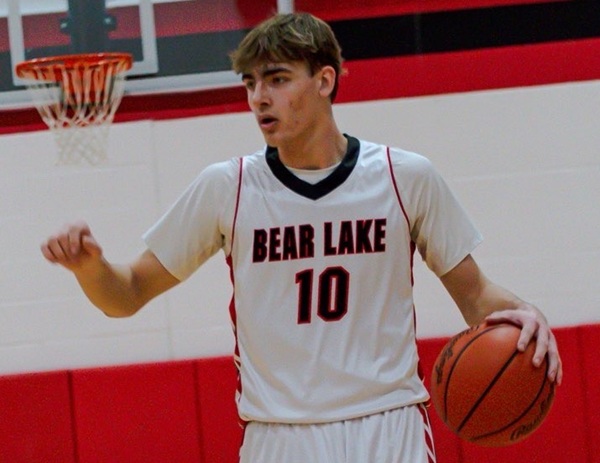
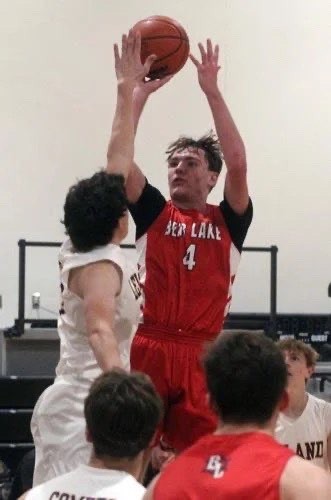
PHOTOS (Top) Grady Harless (10) brings the ball up for Bear Lake against Traverse City Christian, while Myles Harless (4) puts up a shot against the Sabres. (Middle) Grady Harless directs the offense against Mason County Eastern. (Below) Myles Harless elevates for a jumper against Leland. (Traverse City Christian and Leland game photos courtesy of the Traverse City Record-Eagle. Mason County Eastern game photo courtesy of Miles Joseph/milesflics.)
Muxlow Family Has New All-Time Leading Scorer; Brown City May Soon As Well
By
Paul Costanzo
Special for MHSAA.com
March 8, 2023
When Gaden Muxlow talked to his sister Kendal after passing her career point total, he received a congratulatory response – with a caveat.
 “She gave me the speech about how she had to miss so many games because of her ACL injuries,” Gaden said with a laugh.
Passing a family member in the Muxlow house – regardless of how many games that family member had to miss – is quite an accomplishment, as the family is all over the Brown City basketball record books. Kendal is the all-time leading scorer in the girls program, with 1,419 points. Mom, Shari, isn’t far behind at 1,363, and dad, Doug, had 1,327.
Gaden sits at 1,481, atop his family ranks and 22 behind the school’s all-time leading scorer Justin McPhail.
With the postseason starting tonight for Brown City, it’s not a guarantee Muxlow will catch McPhail – but it’s a pretty comfortable expectation.
He’s scored at least 22 points in 18 of the Green Devils’ 22 games this season, averaging 27.6 points per game on his way to a school-record 607. The person he had to pass to break that record? Dad.
“Ever since I was a kid, basketball has always been a big focus in our family,” Gaden Muxlow said. “I remember watching my sister in AAU tournaments as a kid, it’s always on the TV. Since I was a kid, I always had goals to beat my siblings. It always gave me a little bit of fire, and I started getting a little more into the season, and as I got closer, we started talking about it a little more in my family. (Passing Kendal) actually felt really good, because my sister was pretty talented, and I grew up watching her play.”
It’s not just family records that Muxlow has been breaking, as he and his teammates enjoyed a 21-1 regular season, which included a Greater Thumb Conference East title.
Muxlow scored a school-record 45 points in a game against Ubly. He has hit 187 of his 222 free throws, smashing the previous mark of 127. He’s also made 62 3-pointers on the season, 13 behind the school record, but not out of reach if the Green Devils make a run.
 “He’s a great player,” Brown City coach Bob Hatten said. “He elevates the players around him. He does a good job of staying unselfish, but he also knows in key moments when to take over.”
Muxlow has signed to play at Rochester University, making him the fourth player in his family who will play college basketball.
Kendal is currently at Purdue University-Fort Wayne, Shari played at Dayton and Doug played at Cornerstone.
Gaden’s older brother, Caleb, played football at Concordia.
“I guess it wasn’t as much pressure as it was a lot of people were telling me they were expecting big things from me, and they were excited to watch me play,” Gaden said. “I guess it was a little bit of pressure, and a bit of excitement, as well. I wanted to do as well as I could to live up to the hype or the name, or whatever.”
He’s certainly done that. And when opposing teams were throwing every exotic defense they could think of at him this season, it wasn’t because of his name. It was because of his track record.
“Early in the season, we saw everything,” Hatten said. “Box and one, triangle and two where both guys were on Gaden. We saw teams full court deny him with two guys. We trailed in the second half in seven of our first nine games, and we had to find a way to win some close ones. It was probably midseason when a lot of our guys started falling more in line with their roles and started being more comfortable.”
Thanks to those players fulfilling their roles, and playing well around Muxlow, the Green Devils have thrived, and teams can be punished for focusing too much attention on him.
Fellow senior captains Clint Ford and Callen Hagey have excelled in leadership roles, while also providing some scoring cover for Muxlow. Senior Brandon Kohler has been a threat from the outside, keeping teams honest.
As a team, the Green Devils are holding the opposition to just 39.3 points per game. They’re also executing in areas that win big games, shooting 72.5 percent from the free throw line and turning the ball over fewer than 10 times per game.
The cohesiveness and success make sense when you realize most of these players have been playing with one another since elementary school.
“I think that’s probably the biggest piece to our success; we never have to worry about any drama,” Muxlow said. “Everybody gets along, everybody’s goal is the same thing – just to win. Everybody is buying into their roles. I don’t really feel like I’m doing this in a ball hog way, it’s just a piece to the puzzle that we’ve built along the way. Everybody bought into their role, and everybody knows what they’re doing. I know my role is to put the ball in the bucket, and I do whatever I can to help us win.
“It feels more special that it’s helping and leading to wins.”
 Paul Costanzo served as a sportswriter at The Port Huron Times Herald from 2006-15, including three years as lead sportswriter, and prior to that as sports editor at the Hillsdale Daily News from 2005-06. He can be reached at [email protected] with story ideas for Genesee, Lapeer, St. Clair, Sanilac, Huron, Tuscola, Saginaw, Bay, Arenac, Midland and Gladwin counties.
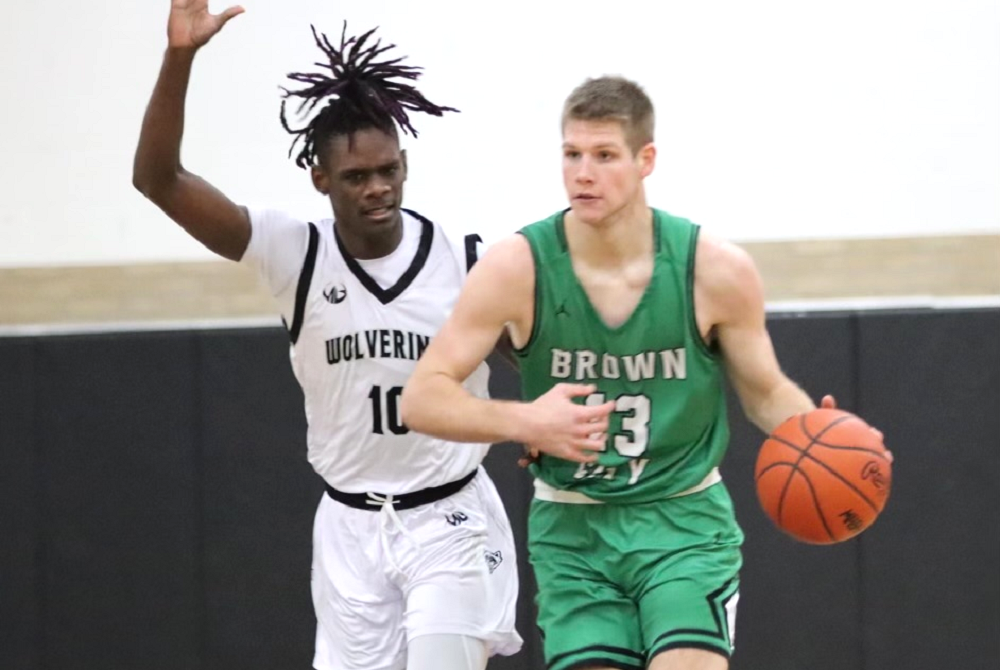
PHOTOS (Top) Brown City’s Gaden Muxlow, right, brings the ball upcourt during a win over Burton Atherton this season. (Middle) The Muxlows celebrate Gaden’s signing with Rochester University. (Photos courtesy of the Muxlow family.)