

Benton Harbor Back in Breslin Spotlight
March 21, 2014
Geoff Kimmerly
Second Half editor
EAST LANSING – Benton Harbor’s players came off the court Friday night to their band playing and fans who had filled most of the horseshoe at the north end of the Breslin Center.
It’s hard to believe the Tigers hadn’t played in an MHSAA Semifinal since 1993. But Benton Harbor basketball is back in a big way – and one win from the school’s first title since 1965.
Led by coach Corey Sterling – who played on that 1993 team – the Tigers continued their longest run in more than a decade with a 69-52 win over Cadillac to earn a spot in Saturday night’s Class B Final.
“What Benton Harbor is known for is basketball,” Tigers senior guard John Robinson, Jr., said. “For us to come back in 2014 and make a run is really big for the community and for the Benton Harbor program.”
Benton Harbor will face either Milan for Detroit Douglass at 6:30 Saturday night.
Sterling is in his second season leading his alma mater, guiding it to a 17-9 record this winter after the Tigers went 17-7 a year ago. That 1993 team was the last to make a championship game as well, where it fell in a heartbreaker 67-64 to Detroit Pershing.
Benton Harbor had won two Regional titles since, the last in 2001. But the Tigers’ reputation as a basketball power has faded only a bit, getting a boost in part during the middle of last decade when Wilson Chandler starred before moving on to DePaul and now the NBA’s Denver Nuggets.
“One thing we try to do is have the guys come in who played back in the day,” Sterling said. “(These players) are aware that the last champion was in 1965. They’re aware that I played here at Breslin in ’93 and lost by three. We remind them that Benton Harbor is a basketball school with a rich tradition. And they’re just really hungry. They don’t want their season to end.”
It took only about a quarter Friday to realize it wouldn’t end until the final day.
 Benton Harbor took its first double-digit lead 1:09 into the second quarter and kept it for good over the final 18 minutes. Four players scored in double figures, led by senior forward Cortez Moore with 18 points plus 11 rebounds.
Sophomore forward Jaton Gunn added 13 points and nine rebounds, Robinson had 11 points and sophomore point guard Curtis Dawson had 10 points, six rebounds and four assists.
Senior forward Jalen Brooks led Cadillac with 30 points despite constant attention from one or multiple defenders. But the next highest Vikings scorer totaled only five points.
Brooks was the team’s second-leading scorer last season when it fell to Detroit Country Day also in a Semifinal.
“It’s really exciting, especially for our juniors and after what we came off of from football (Cadillac finished 11-1 and won its District),” Brooks said. “That translated to the basketball court. People look at our team, and we’re not the biggest. Most people wouldn’t think we’d get where we’ve gotten. But we have a lot of heart, and I think that has a lot to do with it.”
Both teams entered the postseason unranked. Cadillac finished 19-7, with two losses by two points or fewer.
Five of Benton Harbor’s losses were by three or fewer points, which no doubt has helped as the Tigers have taken down two top-five teams over the last two weeks.
“We might’ve lost nine games this year, but we play in one of the toughest conferences in the state,” Sterling said, referring to the Southwestern Michigan Athletic Conference West. “All our losses built character. So when teams make a run on us, we overcome it. We know how to finish games.”
Click for a full box score and video from the press conference.
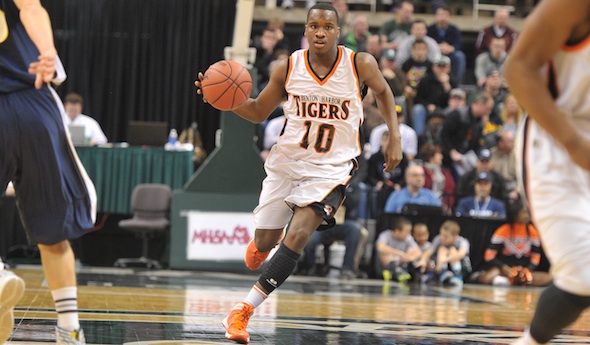
PHOTOS: (Top) Benton Harbor's John Robinson, Jr., brings the ball upcourt during Friday's first Class B Semifinal. (Middle) Cadillac's Jalen Brooks dunks for two of his 30 points.
HIGHLIGHTS: (1) Cadillac's Jalen Brooks led all scorers in the Class B Semifinal against Benton Harbor with 30 points. Here he drives the lane for a basket and the foul - a 3-point play! (2) Cortez Moore led Benton Harbor with 18 points and 11 rebounds. Here he scores on a putback.
Breslin Bound: Boys Report Week 1
December 12, 2012
By Geoff Kimmerly
Second Half editor
Michigan’s top boys basketball teams traditionally waste little time each December seeing how they match up against the rest of the elite.
And last week proved no different, as major matchups and a few upsets in the Detroit and Grand Rapids areas no doubt caused some re-ranking in those regional pecking orders.
Below is a look at 10 teams who stuck out with their play last week. It isn't a state ranking – merely one of the week's notable performances.
Records and results are based on what has been reported to the MHSAA.com Score Center.
1. Detroit Pershing (2-0) – The Doughboys have been considered by most one of the top two teams heading into the season, along with Romulus. Pershing beat Romulus 83-76 and also downed River Rouge – another elite team – 68-48 during opening week.
2. Muskegon Heights (2-0) – Heights may have gone through a number of changes over the last year, but it remains elite on the court. The Tigers opened with a 74-50 win over Way Point, then defeated reigning Class A runner-up Rockford 60-59.
3. Grand Rapids South Christian (2-0) – The Sailors opened with a 54-42 win over Wyoming before notching a solid upset of 2012 Class A Quarterfinalist Grand Rapids Christian, 69-63.
4. Romulus (1-1) – The Eagles may have fallen to Pershing already. But they also opened with a 69-67 win over Dearborn Heights Robichaud – which earlier in the week beat Westland John Glenn, another considered among the elite heading into the season.
5. Holt (2-0) – The Rams have been more spoiler than contender of late in the powerful Capital Area Activities Conference Blue, but they could be back in the hunt. Holt opened with a 54-51 win over Lansing Waverly and followed by beating Lansing Eastern 69-60.
6. St. Joseph (2-0) – The Bears were a middling 11-10 last season, but opened this winter with two solid victories. They beat usual power Kalamazoo Central 73-65 and followed with a 53-37 win over Portage Northern.
7. Brown City (2-0) – Dan Blemaster was the point guard on the DeWitt team that made a surprise run to the 2004 Class B Final, and he has opened his coaching career with a pair of wins. Brown City beat Peck 37-33 and Armada 70-56.
8. Bloomfield Hills Andover (2-0) – Andover is playing its final season before merging with Lahser next fall. And after finishing 10-11 last season, the Barons got it going right last week with a 51-46 win over Farmington and a 78-48 victory over Cranbrook-Kingswood.
9. Muskegon (2-0) – The Big Reds are expected to do big things under coach Keith Guy, who came over from Heights this fall. So far, so good, with a 60-45 win over Holland West Ottawa and a 70-67 victory over Benton Harbor.
10. Grand Rapids Catholic Central (1-1) – The Eagles lost a tough one at the end of the week, 69-66 to Zeeland West. But they opened with a 77-67 win over Grand Rapids Christian.
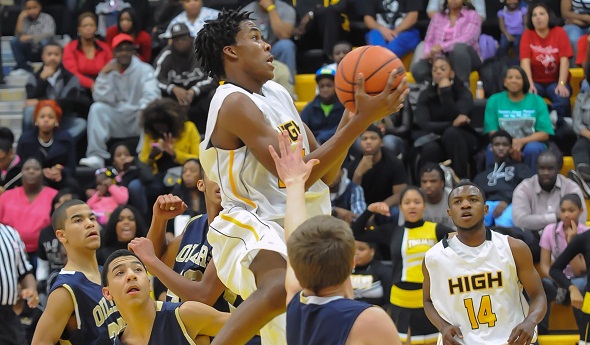
PHOTO: Saginaw, last season’s Class A champion, opened last week with a 78-60 win over Mount Pleasant. (Click to see more at HighSchoolSportsScene.com.)