

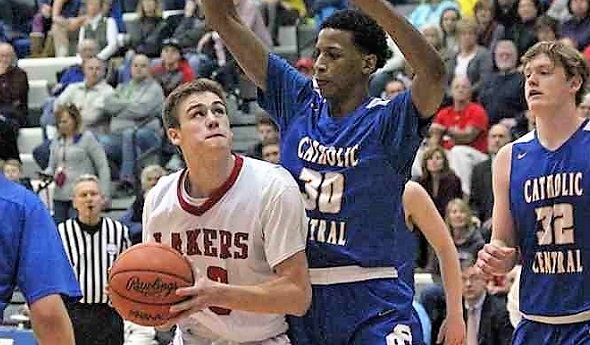
Bingham's Game Grows with Size, Skills
December 20, 2017
By Dean Holzwarth
Special for Second Half
GRAND RAPIDS – Standing 6-foot-10, Grand Rapids Catholic Central’s Marcus Bingham, Jr., has a rare combination of size, length and skill.
 However, another asset in his overall game has come to the surface during the early weeks of this season.
“He’s leading our team in 3-point percentage,” Catholic Central coach TJ Meerman said.
For Bingham, who has averaged 27 points and 16 rebounds during the Cougars’ 3-0 start, the improved range has come through his time in the gym.
“It all ties in with the work I’ve put in on my shot,” Bingham said. “And I’m just going to keep getting better and better, so why not? I can shoot, so why not use it, and Coach likes it when I shoot it.”
Meerman has no qualms about Bingham hoisting up 3-pointers, especially when he makes the commitment away from practice.
“He loves to be in the gym, and on our days off he’s still in the gym working on his handles, working on his shot,” Meerman said. “You don’t get to shoot it that well without putting in a lot of time outside of practice time, and he does that. It’s exciting for me, and it’s exciting I’m sure for Coach (Tom) Izzo and the Michigan State staff as well.”
Bingham, who recently signed with the Spartans, also possesses abilities that sets him apart from other high school players.
“He handles it well, he passes well and then he has a seven-foot reach to go with that height,” Meerman said. “With his skill and length, he’s capable of doing things that not a lot of people can do in basketball.”
It’s been an incredible rise. Bingham didn’t play high school basketball at all as a freshman. He played only half a season last year after transferring to Catholic Central, but averaged 16 points and 10 rebounds per game. That was followed by a successful AAU season, and the Division I college offers began rolling in.
A growth spurt didn’t hurt either. He sprouted up eight inches over the past two years.
 “I’ve grown, but I’ve also gotten a lot stronger and bigger,” Bingham said. “I’ve just been working, and being bigger I can do things easier. It has been a blessing.”
Meerman has seen a big difference in Bingham from a year ago, and admitted that the end of a frenzied recruiting process also has helped.
“I think he’s more comfortable playing structured basketball,” Meerman said. “He hadn’t played a lot of basketball in his life outside of his sophomore year, and the distraction with the mass recruiting wave that came his way toward the end of the season is gone. It has been a nice relief for him to just focus on school and ball.”
Bingham also added 12 pounds of muscle to his frame.
“He has a ways to go with that, but you can see the difference in his play and with his pace of play,” Meerman said. “He’s understanding the system and the way we want to play, and becoming a senior he understands he has to play at a higher level that he did last year.”
The Cougars claimed conference and District titles a year ago, but are striving for more with a talented nucleus surrounding Bingham.
Senior Jacob Polakovich, along with junior guards Austin Braun and Darrell Belcher, and sophomore guard Devon Boyd are main contributors, too.
“We have a great group of guys, and they like to share the ball,” Meerman said. “I like how dynamic we are, and we have good guard play and very good bigs.”
Catholic Central recorded 25 assists in its season-opening win over Detroit Country Day – a positive early sign.
“We’ve been playing good and sharing the ball more than we did last year,” Bingham said. “We’re just working hard as a team to do what we have to do to get wins.”
Meerman scheduled an early-season gauntlet of the top teams to help measure where the Cougars stand.
Three of their first five games included or will include teams that competed in last year’s MHSAA Finals, and the first two were on the road. Catholic Central downed reigning Class A runner-up Grand Rapids Christian 73-49 on Dec. 12, reigning Class C runner-up Grand Rapids Covenant Christian 62-58 on Friday, and hosts reigning Class B runner-up Ludington on Dec. 29 as part of its invitational.
“We wanted to find out right away who we are and what we need to work on,” Meerman said. “That’s what we’re working on right now, and we have our last early test on the road against one of the best teams in the state.”
Catholic Central will travel to Wyoming Godwin Heights tonight for a highly-anticipated showdown between elite teams.
The undefeated Wolverines feature Division I recruits Lamar Norman and Markeese Hastings.
Tickets sold out Monday afternoon.
“It’s going to be exciting to be a part of that, and gyms don’t sell out like that unless players have put in a lot of time in the gym,” Meerman said. “It’s an opportunity for us to compete against the best and see where we’re at, and it’s going to be fun. It will be a game and crowd they will remember their whole lives.”
Bingham is looking forward to matching skills against Hastings, who has committed to Butler, and Norman, who recently reopened his recruitment after previously committing to Texas-El Paso.
“I’m really excited just knowing that everyone is going to be there to see Catholic Central and Godwin play,” he said. “Godwin is a good team, and we’re just going to go out and fight and do what we have to do to win.”
 Dean Holzwarth covered primarily high school sports for the Grand Rapids Press and MLive for 16 years and more recently served as sports editor of the Ionia Sentinel and as a sports photojournalist for WZZM. Contact him at [email protected] with story ideas for Allegan, Kent and Ottawa counties.
PHOTOS: (Top) Grand Rapids Catholic Central's Marcus Bingham (30) defends in the post against Spring Lake last season. (Top photo courtesy of the Grand Haven Tribune; middle photo courtesy of the Grand Rapids Catholic Central boys basketball program.)
Class D Preview: Next Contenders Line Up
March 21, 2018
By Geoff Kimmerly
Second Half editor
A team that appeared in last season’s Class D championship game will be back at the Breslin Center this weekend – but not three-time reigning champion Powers North Central, which was eliminated in a District Semifinal earlier this month.
Instead, 2017 runner-up Buckley will return with nearly an identical cast to the one that lost only one game a season ago – in the Final. Back as well is Southfield Christian, an annual power which put a huge scare into North Central – the Jets beat the Eagles on a buzzer-beater in last year’s Semifinal.
But to play for a championship, those two repeat contenders will face tough challenges. Southfield Christian takes on another Upper Peninsula power in Dollar Bay, while Buckley faces Hillsdale Academy and its formidable frontcourt.
Class D Semifinals – Thursday
Dollar Bay (26-0) vs. Southfield Christian (21-4), 5:30 p.m.
Hillsdale Academy (24-2) vs. Buckley (20-5), 7:30 p.m.
Class D Final – Saturday, 10 a.m.
Tickets cost $10 per pair of Semifinals and $10 per two-game Finals session (Class D and Class A). All Semifinals will be streamed live on MHSAA.tv and viewable on a pay-per-view basis. The Class D, A and C championship games will be broadcast live on Fox Sports Detroit, while the Class B Final will be shown on Fox Sports Detroit on a delayed basis at 10:30 p.m. Saturday. All four championship games will be streamed live on FoxSportsDetroit.com and the FOX Sports Go! app. Free radio broadcasts of all weekend games will be available on MHSAANetwork.com.
Below is a glance at all four semifinalists. Click on the name of the school to see that team’s full schedule and results from this season. (Statistics are through teams' Regional Finals.)
BUCKLEY
Record/rank: 20-5, No. 8
League finish: Tied for first in Northwest Conference
Coach: Blair Moss, fifth season (73-24)
Championship history: Class D runner-up 2017.
Best wins: 67-50 over No. 3 (tie) Hillman in Quarterfinal, 79-34 and 68-40 over honorable mention Onekama, 73-59 and 68-51 over Class C No. 5 Maple City Glen Lake, 62-60 over Class C honorable mention Manton.
Players to watch: Austin Harris, 6-3 sr. F (17 ppg, 4.8 apg); Denver Cade, 6-3 sr. F (16.5 ppg, 7.0 rpg, 4.1 apg); Joey Weber, 5-11 sr. G (14.4 ppg, 6.0 rpg, 3.5 apg, 3.0 spg).
Outlook: A trio of 1,000-point career scorers (listed above) have Buckley back at Breslin after they led the Bears to their first Semifinal and championship game run a year ago. In fact, senior forward Brock Beeman and junior forward Ridge Beeman fill out a starting lineup identical to the one that took the floor against Powers North Central in last year’s Final. Buckley started 3-3 this winter against a loaded schedule and shared the Northwest Conference title with Glen Lake and No. 6 Frankfort. During the postseason, Hillman is the only opponent that has come closer than 20 points of catching the Bears.
DOLLAR BAY
Record/rank: 26-0, No. 2
League finish: First in Copper Mountain Conference Copper Country
Coach: Jesse Kentala, 11th season (85-132)
Championship history: Has never appeared in an MHSAA Final.
Best wins: 74-68 over honorable mention Cedarville in Quarterfinal, 63-60 over No. 10 Rapid River in Regional Semifinal, 51-42 over No. 5 Ewen-Trout Creek.
Players to watch: Devin Schmitz, 6-0 sr. G; Jaden Janke, 6-5 sr. C. (Statistics not submitted).
Outlook: Dollar Bay has made quite a march to emerge as a possible heir apparent after North Central’s three straight Class D titles coming down from the Upper Peninsula. This will be the Blue Bolts’ first trip to the Semifinals after they played in their first Quarterfinal since 1979. Only 10-10 two seasons ago, Dollar Bay improved to 19-5 last year before falling to North Central by two points in a Regional Semifinal. Schmitz is considered arguably the top player in program history and broke the career scoring record this winter.
HILLSDALE ACADEMY
Record/rank: 24-2, No. 9
League finish: First in Southern Central Athletic Association East
Coach: Tim Wells, fourth season (72-24)
Championship history: Has never appeared in an MHSAA Final.
Best wins: 56-49 over honorable mention Adrian Lenawee Christian in Regional Final, 56-46 over No. 3 (tie) Bellevue, 58-42 (District Final), 60-39 and 57-40 over Camden-Frontier.
Players to watch: Peter Kalthoff, 6-7 sr. C (21.9 ppg, 8.2 rpg, 1.7 bpg); Michael Craig, 5-11 sr. G (13 ppg, 2.6 apg).
Outlook: Hillsdale Academy’s first trip to the Quarterfinals and now Semifinals has included the win over Lenawee Christian – to avenge one of the Colts’ two losses – and no other game closer than 16 points. Their only other defeat this winter came to neighbor Hillsdale High, a Class B school. Kalthoff is a force, making 67 percent of his field goals tries, but six players have scored at least 13 points in a game this season. Senior forward Nolan Sullivan and sophomore forward Lukas Tharp both add about eight points per game.
SOUTHFIELD CHRISTIAN
Record/rank: 21-4, No. 1
League finish: First in Michigan Independent Athletic Conference Blue
Coach: Josh Baker, seventh season (132-23)
Championship history: Class D champions 2014, 2013 and 2012.
Best wins: 88-53 over Flint International Academy in Quarterfinal, 79-50 (Regional Semifinal), 72-22 and 56-39 over honorable mention Auburn Hills Oakland Christian, 68-45 over Class B No. 4 River Rouge, 65-60 over Detroit Martin Luther King.
Players to watch: Bryce Washington, 6-3 jr. G (21.6 ppg, 8.0 rpg); Harlond Beverly, 6-4 jr. G (16 ppg, 6.5 rpg, 5.4 apg).
Outlook: Southfield Christian’s return to the Semifinals last season after a two-year hiatus ended with a one-point overtime loss to eventual champion North Central. The Eagles’ return three starters from that game – Washington, Beverly and junior guard Caleb Hunter (13.2 ppg, 4.3 apg, 3.4 spg, 57 3-pointers.). Again playing a schedule loaded with larger schools, Southfield Christian lost this winter only to Class A West Bloomfield, Class B Detroit Country Day and Class C Detroit Edison and Detroit Pershing; all but West Bloomfield won at least District titles this month.
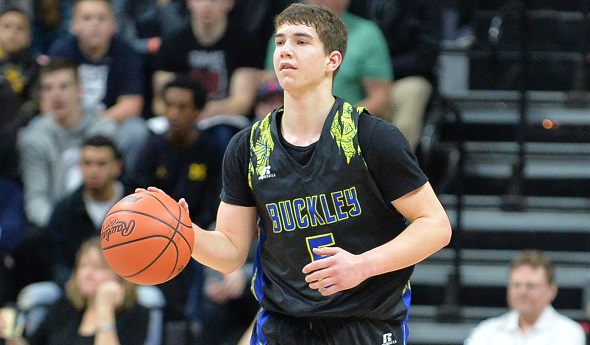
PHOTO: Buckley’s Joey Weber brings the ball upcourt during last season’s Class D championship game at the Breslin Center.