


Bingham's Game Grows with Size, Skills
December 20, 2017
By Dean Holzwarth
Special for Second Half
GRAND RAPIDS – Standing 6-foot-10, Grand Rapids Catholic Central’s Marcus Bingham, Jr., has a rare combination of size, length and skill.
 However, another asset in his overall game has come to the surface during the early weeks of this season.
“He’s leading our team in 3-point percentage,” Catholic Central coach TJ Meerman said.
For Bingham, who has averaged 27 points and 16 rebounds during the Cougars’ 3-0 start, the improved range has come through his time in the gym.
“It all ties in with the work I’ve put in on my shot,” Bingham said. “And I’m just going to keep getting better and better, so why not? I can shoot, so why not use it, and Coach likes it when I shoot it.”
Meerman has no qualms about Bingham hoisting up 3-pointers, especially when he makes the commitment away from practice.
“He loves to be in the gym, and on our days off he’s still in the gym working on his handles, working on his shot,” Meerman said. “You don’t get to shoot it that well without putting in a lot of time outside of practice time, and he does that. It’s exciting for me, and it’s exciting I’m sure for Coach (Tom) Izzo and the Michigan State staff as well.”
Bingham, who recently signed with the Spartans, also possesses abilities that sets him apart from other high school players.
“He handles it well, he passes well and then he has a seven-foot reach to go with that height,” Meerman said. “With his skill and length, he’s capable of doing things that not a lot of people can do in basketball.”
It’s been an incredible rise. Bingham didn’t play high school basketball at all as a freshman. He played only half a season last year after transferring to Catholic Central, but averaged 16 points and 10 rebounds per game. That was followed by a successful AAU season, and the Division I college offers began rolling in.
A growth spurt didn’t hurt either. He sprouted up eight inches over the past two years.
 “I’ve grown, but I’ve also gotten a lot stronger and bigger,” Bingham said. “I’ve just been working, and being bigger I can do things easier. It has been a blessing.”
Meerman has seen a big difference in Bingham from a year ago, and admitted that the end of a frenzied recruiting process also has helped.
“I think he’s more comfortable playing structured basketball,” Meerman said. “He hadn’t played a lot of basketball in his life outside of his sophomore year, and the distraction with the mass recruiting wave that came his way toward the end of the season is gone. It has been a nice relief for him to just focus on school and ball.”
Bingham also added 12 pounds of muscle to his frame.
“He has a ways to go with that, but you can see the difference in his play and with his pace of play,” Meerman said. “He’s understanding the system and the way we want to play, and becoming a senior he understands he has to play at a higher level that he did last year.”
The Cougars claimed conference and District titles a year ago, but are striving for more with a talented nucleus surrounding Bingham.
Senior Jacob Polakovich, along with junior guards Austin Braun and Darrell Belcher, and sophomore guard Devon Boyd are main contributors, too.
“We have a great group of guys, and they like to share the ball,” Meerman said. “I like how dynamic we are, and we have good guard play and very good bigs.”
Catholic Central recorded 25 assists in its season-opening win over Detroit Country Day – a positive early sign.
“We’ve been playing good and sharing the ball more than we did last year,” Bingham said. “We’re just working hard as a team to do what we have to do to get wins.”
Meerman scheduled an early-season gauntlet of the top teams to help measure where the Cougars stand.
Three of their first five games included or will include teams that competed in last year’s MHSAA Finals, and the first two were on the road. Catholic Central downed reigning Class A runner-up Grand Rapids Christian 73-49 on Dec. 12, reigning Class C runner-up Grand Rapids Covenant Christian 62-58 on Friday, and hosts reigning Class B runner-up Ludington on Dec. 29 as part of its invitational.
“We wanted to find out right away who we are and what we need to work on,” Meerman said. “That’s what we’re working on right now, and we have our last early test on the road against one of the best teams in the state.”
Catholic Central will travel to Wyoming Godwin Heights tonight for a highly-anticipated showdown between elite teams.
The undefeated Wolverines feature Division I recruits Lamar Norman and Markeese Hastings.
Tickets sold out Monday afternoon.
“It’s going to be exciting to be a part of that, and gyms don’t sell out like that unless players have put in a lot of time in the gym,” Meerman said. “It’s an opportunity for us to compete against the best and see where we’re at, and it’s going to be fun. It will be a game and crowd they will remember their whole lives.”
Bingham is looking forward to matching skills against Hastings, who has committed to Butler, and Norman, who recently reopened his recruitment after previously committing to Texas-El Paso.
“I’m really excited just knowing that everyone is going to be there to see Catholic Central and Godwin play,” he said. “Godwin is a good team, and we’re just going to go out and fight and do what we have to do to win.”
 Dean Holzwarth covered primarily high school sports for the Grand Rapids Press and MLive for 16 years and more recently served as sports editor of the Ionia Sentinel and as a sports photojournalist for WZZM. Contact him at [email protected] with story ideas for Allegan, Kent and Ottawa counties.
PHOTOS: (Top) Grand Rapids Catholic Central's Marcus Bingham (30) defends in the post against Spring Lake last season. (Top photo courtesy of the Grand Haven Tribune; middle photo courtesy of the Grand Rapids Catholic Central boys basketball program.)
Buckley Ends Wait with 1st Semifinal Win
March 23, 2017
By Geoff Kimmerly
Second Half editor
EAST LANSING – Buckley’s boys basketball team waited a long time to make this history – more than 100 years on the court, and then through a double overtime Semifinal on the other side of the Class D bracket Thursday.
But however long it took to earn the program’s first MHSAA championship game berth, it was going to be worth it.
The Bears’ best run ever will reach this season’s final day, as they won their first Semifinal in team history 68-61 over Lansing Christian at the Breslin Center to advance to Saturday’s 10 a.m. Final against two-time reigning champion Powers North Central.
Only twice previously had Buckley made the season’s final week, playing in Quarterfinals in 2010 and 1998. But the Bears have built a dominating 26-0 run this winter keyed by a talented group of juniors who have brought plenty of attention to their small town tucked 20 miles south of Traverse City.
“Speechless. Unbelievable. (I’m sad) it’s over, but I’m glad we’re here,” junior Austin Harris said.
“Sometimes like tonight, I’m just standing out there watching these guys shoot free throws,” junior teammate Denver Cade added, “and I’m like, ‘Man, we did it. We’re here. Let’s just keep winning.’”
That toughest task is next to come. Buckley takes its perfect season into the championship game against the Jets, who needed double overtime in their Semifinal to get past Southfield Christian and extend their nation-best winning streak to 82 straight victories.
That 40-minute classic left Buckley and Lansing Christian waiting a little longer to finish the night. But the Bears were more than ready when they got their chance.
Buckley led for all but 16 seconds during the final 27 minutes against the Pilgrims (19-7), yet by only two after senior Nick Jamieson’s 3-pointer pulled them to within 61-59 with 1:03 to play. But the Bears closed on a 7-2 run making 7 of 8 free throws while Lansing Christian connected on only one shot in four attempts while trying to catch up over that final stretch.
“I thought that might be a problem,” Buckley coach Blair Moss said of the delay. “But these guys came right out. I said let’s go get them, let’s attack them. We’re not scared of anybody. We’ve been doing it all summer long, all fall, and I’m so proud of these guys because they took it right to them.”
 Harris led with 28 points, 10 rebounds and six assists, and Cade added 13 points and nine rebounds. Guard Joey Weber, another junior, added 10 points and six boards.
Lansing Christian said good-bye to a strong senior group, with center Preston Granger leading one more time with 15 points and eight rebounds, Forrest Bouyer adding 13 points and Matt Havey scoring 10. All five starters will graduate this spring, but having brought the Pilgrims to their second Semifinal in five seasons.
“I met with them in August … and said what do you want to do?” Lansing Christian first-year coach Chris Mustaine said. “I’m brand new, this is a senior-heavy team. What do you want to do? What do you want to accomplish? Do we want this to be fun, or what are our goals?
“And they laid it out. They said we want to play at Breslin. We want to be the best possible team we can be, and they have spent every day since that day in August trying to do that, all the way up to today. Even in the middle of the fourth quarter, we said how can we get better? And they did; we just came up a couple shots short, a couple missed free throws short of having a shot at it at the end.”
For Buckley, the biggest test is yet to come. But the Bears were looking forward to that challenge already late Thursday night.
“We came down here and we talked,” Moss said, “and we said we’re not going to go home yet.”
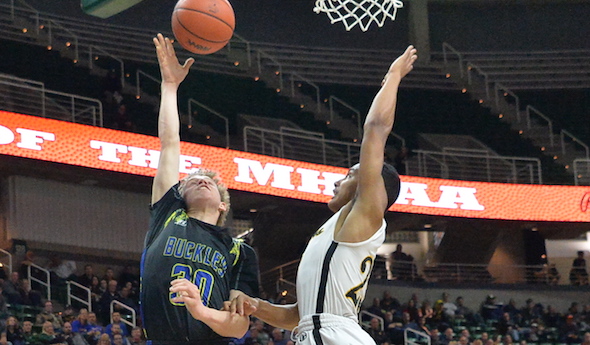
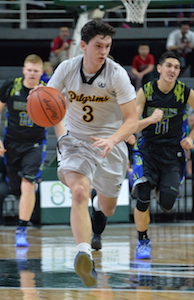
PHOTOS: (Top) Buckley’s Ridge Beeman (30) tries to direct a shot around the outstretched arms of Lansing Christian’s Forrest Bouyer. (Middle) The Pilgrims’ Matt Havey (3) pushes the ball upcourt.