

Breslin Bound: Boys C-D Semis Preview
March 19, 2014
By Geoff Kimmerly
Second Half editor
One contender at Thursday’s MHSAA Class C and D Semifinals is hoping to finish this weekend with a third straight championship. Another is hoping to begin a three-season winning streak at the Breslin Center.
Two-time reigning Class D champion Southfield Christian returns four starters and a top sub from its 2013 title team. And Detroit Consortium is seeking its first championship – but led by sophomore Joshua Jackson, arguably the state’s top player regardless of class or grade.
Below is the schedule for all four Thursday Semifinals and four Saturday Finals, plus broadcast information and a look at all eight C and D semifinalists. (Class A and B previews and Friday’s schedule will be posted later Thursday.)
Semifinals - Thursday
Class C
Pewamo-Westphalia (22-2) vs. Muskegon Heights (20-3), 1 p.m.
Detroit Consortium (23-2) vs. Negaunee (24-1), 2:50 p.m.
Class D
Frankfort (20-6) vs. Southfield Christian (24-1), 6 p.m.
Cedarville (23-2) vs. Adrian Lenawee Christian (20-4), 7:50 p.m.
Finals - Saturday
Class A - Noon
Class B - 6:30 pm
Class C - 4:30 pm
Class D - 10 am
Tickets cost $8 per pair of Semifinals and $10 per two-game Finals session. All Semifinals will be streamed live on MHSAA.TV on a pay-per-view basis. All four Finals will be broadcast live on Fox Sports Detroit-PLUS. Free radio broadcasts of all weekend games will be available on MHSAANetwork.com.
And now, a look at the Semifinalists in Class C and D.
Class C
DETROIT CONSORTIUM
Record/rank: 23-2, No. 2
League finish: Does not play in a league.
Coach: Tobias Tuomi, first season (23-2)
Championship history: Has not played in an MHSAA Final.
Best wins: 67-61 over No. 1 Mount Clemens in Quarterfinal, 64-48 over No. 5 Detroit Allen in Regional Semifinal, 72-57 over Class A No. 5 Saginaw Arthur Hill, 58-43 over Class A No. 7 Detroit Southeastern, 79-72 over Class A No. 6 Romulus, 87-70 over Class B No. 9 Detroit Country Day, 67-52 over Class B honorable mention Detroit Douglass.
Players to watch: Joshua Jackson, 6-8 soph. G/F (25 ppg, 14.7 rpg, 5.2 apg, 3.9 spg, 3.7 bpg); Ronald Booth, 5-9 sr. G (12.1 ppg, 8.2 apg, 3.2 spg).
Outlook: Consortium has beaten a schedule loaded with top teams from Classes A, B and C, similar to how Johnson loads up a stat sheet in every category – he also had 30 3-pointers entering the week making 46 percent of those attempts and 70 percent from the field as a whole. Two more guards, senior Rudy Smith (9.7) and sophomore Luster Johnson (10.5), add to the potent offense.
MUSKEGON HEIGHTS
Record/rank: 20-3, No. 9
League finish: Does not play in a league.
Coach: Dalrecus Stewart, second season (39-8)
Championship history: Six MHSAA titles (most recent 1979) eight runner-up finishes.
Best wins: 59-57 over honorable mention Hillsdale in Quarterfinal, 72-59 over Saugatuck in District opener, 67-66 over Benton Harbor, 92-52 over Class D No. 7 Baldwin.
Players to watch: Eddrick Tornes, 6-1 sr. G (12 ppg); Aaron Sydnor, 6-3 sr. G/F (10.6 ppg).
Outlook: Muskegon Heights’ return to Breslin comes after it finished Class B runner-up in 2011, closed in spring 2012 and reopened that fall as a public school academy. The Tigers have one of the longest traditions of success in MHSAA history, with their first championship game appearance in 1939. Their losses this season are as notable as their best wins: by only one to No. 6 Shelby, just four to Class A Rockford and 12 to Class A Grand Rapids Ottawa Hills.
PEWAMO-WESTPHALIA
Record/rank: 22-2, No. 10
League finish: First in Central Michigan Athletic Conference
Coach: Luke Pohl, 17th season (312-75)
Championship history: Class C runner-up 1993.
Best wins: 42-41 over Flint Beecher in Quarterfinal, 59-55 over No. 6 Shelby in Regional Final, 57-46 over honorable mention Hillsdale, 66-19 over Class D honorable mention Fulton.
Players to watch: Lane Smith, 6-5 sr. C (11.3 ppg, 6.5 rpg); Nick Spitzley, 6-2 sr. G (18.7 ppg, 5.5 rpg).
Outlook: This run has been a career quest for a group of nine seniors, including five who start. The Pirates have won four straight league titles and Regional championships two of the last three seasons. Spitzley is a four-year standout and one of the top scorers in school history – he also had 61 3-pointers entering the week. As a team, P-W has shot an impressive 47 percent from the floor, with six players drilling at least 10 3-pointers. They are a combined five points from perfection, falling only to Detroit Loyola by two in the third game this season and Fulton by three before avenging with a 47-point win over the Pirates.
NEGAUNEE
Record/rank: 24-1, No. 3
League finish: First in Mid-Peninsula Athletic Conference
Coach: Michael O’Donnell, ninth season (173-47)
Championship history: Three MHSAA titles (most recently 2000), two runner-up finishes.
Best wins: 63-42 over honorable mention East Jordan in Quarterfinal, 64-48 over Ishpeming in District Final, 61-55 over Class A honorable mention Marquette.
Players to watch: Tyler Jandron, 6-1 sr. G (17.5 ppg, 4.2 apg, 3.3 spg); Eric Lori, 5-10 sr. G (16.6 ppg, 3.6 apg).
Outlook: Negaunee was played closer by a lot of its opponents compared to during last season’s run to the Breslin, but the results were the same. The Miners have rattled off 21 straight wins since falling to Marquette and beat the Redmen along the way. Jandron and Lori are back as the team’s top-two leading scorers and with junior Robert Loy make up a strong three-guard backcourt. Total the trio had combined for 92 3-pointers heading into this week.
Class D
ADRIAN LENAWEE CHRISTIAN
Record/rank: 20-4, honorable mention
League finish: Does not play in a league.
Coach: Scott McKelvey, second season (39-8)
Championship history: Has not played in an MHSAA Final.
Best wins: 56-51 OT over No. 5 Battle Creek St. Philip in Quarterfinal, 44-42 over Morenci in District Final, 46-44 over Class B honorable mention Monroe St. Mary Catholic Central.
Player to watch: Grant Holbein, 6-2 sr. G (11.1 ppg).
Outlook: Lenawee Christian avenged its lone loss to a Class D team, Morenci, with a close win in the District Final, and has taken a few more steps after finishing 19-4 and as Regional runner-up in 2012-13. The Cougars’ other losses this season were to Class B No. 1 Jackson Lumen Christi, Class C No. 5 Detroit Allen and Class C honorable mention Addison.
CEDARVILLE
Record/rank: 23-2, No. 6
League finish: First in Eastern Upper Peninsula Conference
Coach: Dave Duncan, 24th season (404-168)
Championship history: Class D champion 2007, three runner-up finishes.
Best wins: 60-53 over honorable mention Frankfort, 63-57 over No. 8 Hillman in Regional Final, 81-79 over No. 2 Powers North Central in Quarterfinal.
Player to watch: Joey Duncan, 6-0 jr. G (21 ppg).
Outlook: Cedarville is plenty familiar with the season’s final week having won Regional titles eight of the last nine seasons, but is back at the Semifinals for the first time since finishing Class D runner-up in 2009. Joey Duncan was named all-state Tuesday and leads a squad with only three seniors. The Trojans scored at least 80 points in 11 games.
FRANKFORT
Record/rank: 20-6, honorable mention
League finish: Second in Northwest Conference
Coach: Reggie Manville, third season (41-23)
Championship history: Has never played in an MHSAA Final.
Best wins: 47-44 over honorable mention Mount Pleasant Sacred Heart, 75-71 over No. 7 Baldwin, 47-45 over Class C honorable mention Traverse City St. Francis.
Players to watch: David Loney, 6-3 jr. C (20.1 ppg, 11.2 rpg); Brandon Schaub, 5-10 sr. G (9.5 ppg, 2.3 apg).
Outlook: Frankfort played in its second straight Quarterfinal on Tuesday and advanced to its first Semifinal since 1969. The Panthers got that chance in part because they were able to get past Suttons Bay, which beat Frankfort twice during the regular season to finish on top of the Northwest Conference. Loney was named all-state Tuesday and keys an offense that is otherwise balanced, with six more players averaging 4-6 ppg. Manville formerly coached at Flint Southwestern for 14 seasons and then Big Rapids for one during the 1980s and 90s.
SOUTHFIELD CHRISTIAN
Record/rank: 24-1, No. 1
League finish: First in Michigan Independent Athletic Conference Blue
Coach: Clennie Brundidge, first season (24-1)
Championship history: MHSAA champion 2013 and 2012.
Best wins: 61-44 over No. 4 Peck in Quarterfinal, 54-51, 68-56 and 67-62 (Regional Final) over No. 9 Allen Park Inter-City Baptist, 75-62 and 66-47 over Auburn Hills Oakland Christian.
Players to watch: Bakari Evelyn, 6-1 jr. G (16 ppg, 4.6 apg); Lindsey Hunter IV, 5-10 sr. G (14.8 ppg); Damarco White, 6-6 sr. F (8.9 ppg, 8.4 rpg), Eugene Brown, 6-5 soph. G (11.4 ppg, 9.4 rpg).
Outlook: Southfield Christian is playing for its third straight MHSAA title, this time under promoted assistant Brundidge – who also has coached at Southfield and Troy. Hunter and White were named all-state and Brown received an honorable mention, and Evelyn joined Brown, White and junior guard Kameron Garner among starters in last season’s Final. The only loss this winter came to Class A No. 5 Saginaw Arthur Hill.
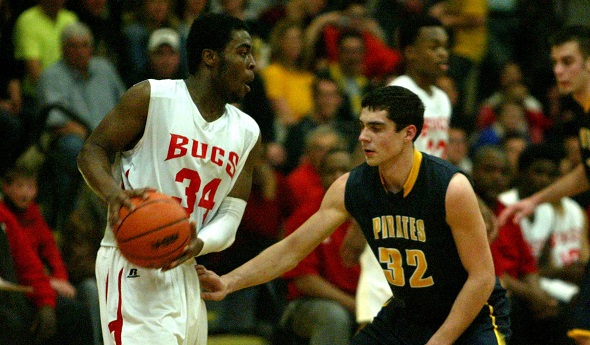
PHOTO: Pewamo-Westphalia's Nick Spitzley (right) matches up with Aquavius Burks during the Pirates' comeback win over reigning Class C champion Flint Beecher in Tuesday's Quarterfinal. (Click to see more from High School Sports Scene.)
Breslin Bound: Boys Report Week 5
January 9, 2017
By Geoff Kimmerly
Second Half editor
How quickly can a lackluster season become a distant memory?
 Ask a few of the teams we’ve highlighted in this week’s Breslin Bound Boys Report, powered by MI Student Aid.
Two of the eight on our “Watch List” this week have already won more games this winter than in all of 2015-16, and a third team could equal last season’s total by the end of this week.
Week in Review
The countdown of last week’s five most intriguing results:
1. Clarkston 60, Flint Carman-Ainsworth 47 – The Wolves remain undefeated at 8-0 after handing Carman-Ainsworth its first loss (and later in the week doing the same to Walled Lake Western).
2. Detroit U-D Jesuit 71, Romulus 58 – The Cubs finished nonleague play at 5-2 and with one more solid win over a Class A power heading into the Detroit Catholic League schedule.
3. Ann Arbor Skyline 74, Belleville 71 – Skyline is tied for the lead in the Southeastern Conference Red, but handing Belleville its first loss may have surprised a few even though Skyline has broken 70 points five of the last six games.
4. Grand Rapids Forest Hills Central 55, Grand Rapids Forest Hills Northern 51 – This neighborly rivalry game hadn’t meant this much in a while, with both now in the Ottawa-Kent Conference White and Central handing Northern its first loss of the season.
5. Holt 59, Okemos 49 – This gave the Rams an early co-lead with East Lansing in the Capital Area Activities Conference Blue and added to a 4-2 start with those losses by a combined seven points.
Watch List
With an eye toward March, here are two teams in each class making sparks:
CLASS A
Davison (6-1) – After watching the football team make a nice jump in the fall, the basketball team is doing the same coming off a 5-16 finish. The only defeat was to one-loss Carman-Ainsworth.
Bloomfield Hills (6-1) – The Black Hawks are two wins better than at this point a year ago, with their only loss to Orchard Lake St. Mary’s. They should provide a nice challenge to Clarkston in the Oakland Activities Association Red.
CLASS B
Hillsdale (6-0) – The Hornets are always in the mix, and got off to another fast start this winter after ending last year’s 18-win campaign with a three-point loss in their first District game. Last week’s double-overtime win over Onsted might be the best so far.
Wyoming Kelloggsville (5-0) – The Rockets could be in the midst of another of the most significant turnarounds in the state this winter, going 7-15 a year ago but most recently handing a one-point loss to reigning Class C runner-up Grandville Calvin Christian.
CLASS C
Maple City Glen Lake (5-0) – The Lakers opened this season by avenging last year’s season-ending loss to Traverse City St. Francis, and since they’ve played to a first-place tie in the Northwest Conference with rival Frankfort. Thursday opponent Buckley will provide another major test.
Munising (6-0) – After finishing 11-10 and falling in its first postseason game last winter, Munising is more than halfway to a better finish. This start included an avenging of that season-ending loss to Rock Mid-Peninsula and three victories total by five or fewer points.
CLASS D
Bellevue (4-0) – The Broncos have been riding a nice run the last few seasons, winning 18 games a year ago. They already own a win over Climax-Scotts, the team with which they shared the Southern Central Athletic Association West title last winter.
Marcellus (4-1) – The Wildcats also are on the rebound, having already surpassed last season’s three wins. The lone loss was a three-pointer to Constantine during the season’s first week.
Can't-Miss Contests
Be on the lookout for results of these games coming up:
Tuesday – Grand Rapids Christian (4-0) at Wayland (4-1) – These two and Wyoming look like the contenders in the O-K Gold, with Christian one to chase both in the league and Class A statewide.
Tuesday – Bellaire (5-1) at Gaylord St. Mary (5-1) – These two are contenders in the Ski Valley Conference, but also stand to be among Class D’s best from just below the bridge.
Friday – Saginaw (6-1) at Saginaw Arthur Hill (4-2) – One of the oldest rivalries in state history remains one of the best, with this and the Feb. 3 matchup likely to decide the Saginaw Valley League North title winner.
Friday – Holt (4-2) at East Lansing (6-0) – The Trojans have high hopes in Class A this season, but first comes taking care of the CAAC Blue and a strong field including the Rams (also mentioned above).
Saturday – Detroit East English (5-0) vs. Kalamazoo Central (5-0) at Grand Rapids Ottawa Hills – Arguably the top matchup of the Floyd Mayweather Classic, this one pits two of the best in Class A.
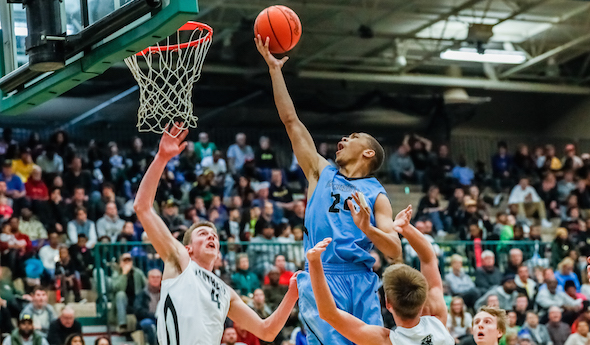
PHOTO: Grand Rapids Christian, driving to the basket, downed Holland West Ottawa on Dec. 28 as part of its 4-0 start. (Photo by Tim Reilly.)