


Breslin Bound: Boys C-D Semis Preview
March 19, 2014
By Geoff Kimmerly
Second Half editor
One contender at Thursday’s MHSAA Class C and D Semifinals is hoping to finish this weekend with a third straight championship. Another is hoping to begin a three-season winning streak at the Breslin Center.
Two-time reigning Class D champion Southfield Christian returns four starters and a top sub from its 2013 title team. And Detroit Consortium is seeking its first championship – but led by sophomore Joshua Jackson, arguably the state’s top player regardless of class or grade.
Below is the schedule for all four Thursday Semifinals and four Saturday Finals, plus broadcast information and a look at all eight C and D semifinalists. (Class A and B previews and Friday’s schedule will be posted later Thursday.)
Semifinals - Thursday
Class C
Pewamo-Westphalia (22-2) vs. Muskegon Heights (20-3), 1 p.m.
Detroit Consortium (23-2) vs. Negaunee (24-1), 2:50 p.m.
Class D
Frankfort (20-6) vs. Southfield Christian (24-1), 6 p.m.
Cedarville (23-2) vs. Adrian Lenawee Christian (20-4), 7:50 p.m.
Finals - Saturday
Class A - Noon
Class B - 6:30 pm
Class C - 4:30 pm
Class D - 10 am
Tickets cost $8 per pair of Semifinals and $10 per two-game Finals session. All Semifinals will be streamed live on MHSAA.TV on a pay-per-view basis. All four Finals will be broadcast live on Fox Sports Detroit-PLUS. Free radio broadcasts of all weekend games will be available on MHSAANetwork.com.
And now, a look at the Semifinalists in Class C and D.
Class C
DETROIT CONSORTIUM
Record/rank: 23-2, No. 2
League finish: Does not play in a league.
Coach: Tobias Tuomi, first season (23-2)
Championship history: Has not played in an MHSAA Final.
Best wins: 67-61 over No. 1 Mount Clemens in Quarterfinal, 64-48 over No. 5 Detroit Allen in Regional Semifinal, 72-57 over Class A No. 5 Saginaw Arthur Hill, 58-43 over Class A No. 7 Detroit Southeastern, 79-72 over Class A No. 6 Romulus, 87-70 over Class B No. 9 Detroit Country Day, 67-52 over Class B honorable mention Detroit Douglass.
Players to watch: Joshua Jackson, 6-8 soph. G/F (25 ppg, 14.7 rpg, 5.2 apg, 3.9 spg, 3.7 bpg); Ronald Booth, 5-9 sr. G (12.1 ppg, 8.2 apg, 3.2 spg).
Outlook: Consortium has beaten a schedule loaded with top teams from Classes A, B and C, similar to how Johnson loads up a stat sheet in every category – he also had 30 3-pointers entering the week making 46 percent of those attempts and 70 percent from the field as a whole. Two more guards, senior Rudy Smith (9.7) and sophomore Luster Johnson (10.5), add to the potent offense.
MUSKEGON HEIGHTS
Record/rank: 20-3, No. 9
League finish: Does not play in a league.
Coach: Dalrecus Stewart, second season (39-8)
Championship history: Six MHSAA titles (most recent 1979) eight runner-up finishes.
Best wins: 59-57 over honorable mention Hillsdale in Quarterfinal, 72-59 over Saugatuck in District opener, 67-66 over Benton Harbor, 92-52 over Class D No. 7 Baldwin.
Players to watch: Eddrick Tornes, 6-1 sr. G (12 ppg); Aaron Sydnor, 6-3 sr. G/F (10.6 ppg).
Outlook: Muskegon Heights’ return to Breslin comes after it finished Class B runner-up in 2011, closed in spring 2012 and reopened that fall as a public school academy. The Tigers have one of the longest traditions of success in MHSAA history, with their first championship game appearance in 1939. Their losses this season are as notable as their best wins: by only one to No. 6 Shelby, just four to Class A Rockford and 12 to Class A Grand Rapids Ottawa Hills.
PEWAMO-WESTPHALIA
Record/rank: 22-2, No. 10
League finish: First in Central Michigan Athletic Conference
Coach: Luke Pohl, 17th season (312-75)
Championship history: Class C runner-up 1993.
Best wins: 42-41 over Flint Beecher in Quarterfinal, 59-55 over No. 6 Shelby in Regional Final, 57-46 over honorable mention Hillsdale, 66-19 over Class D honorable mention Fulton.
Players to watch: Lane Smith, 6-5 sr. C (11.3 ppg, 6.5 rpg); Nick Spitzley, 6-2 sr. G (18.7 ppg, 5.5 rpg).
Outlook: This run has been a career quest for a group of nine seniors, including five who start. The Pirates have won four straight league titles and Regional championships two of the last three seasons. Spitzley is a four-year standout and one of the top scorers in school history – he also had 61 3-pointers entering the week. As a team, P-W has shot an impressive 47 percent from the floor, with six players drilling at least 10 3-pointers. They are a combined five points from perfection, falling only to Detroit Loyola by two in the third game this season and Fulton by three before avenging with a 47-point win over the Pirates.
NEGAUNEE
Record/rank: 24-1, No. 3
League finish: First in Mid-Peninsula Athletic Conference
Coach: Michael O’Donnell, ninth season (173-47)
Championship history: Three MHSAA titles (most recently 2000), two runner-up finishes.
Best wins: 63-42 over honorable mention East Jordan in Quarterfinal, 64-48 over Ishpeming in District Final, 61-55 over Class A honorable mention Marquette.
Players to watch: Tyler Jandron, 6-1 sr. G (17.5 ppg, 4.2 apg, 3.3 spg); Eric Lori, 5-10 sr. G (16.6 ppg, 3.6 apg).
Outlook: Negaunee was played closer by a lot of its opponents compared to during last season’s run to the Breslin, but the results were the same. The Miners have rattled off 21 straight wins since falling to Marquette and beat the Redmen along the way. Jandron and Lori are back as the team’s top-two leading scorers and with junior Robert Loy make up a strong three-guard backcourt. Total the trio had combined for 92 3-pointers heading into this week.
Class D
ADRIAN LENAWEE CHRISTIAN
Record/rank: 20-4, honorable mention
League finish: Does not play in a league.
Coach: Scott McKelvey, second season (39-8)
Championship history: Has not played in an MHSAA Final.
Best wins: 56-51 OT over No. 5 Battle Creek St. Philip in Quarterfinal, 44-42 over Morenci in District Final, 46-44 over Class B honorable mention Monroe St. Mary Catholic Central.
Player to watch: Grant Holbein, 6-2 sr. G (11.1 ppg).
Outlook: Lenawee Christian avenged its lone loss to a Class D team, Morenci, with a close win in the District Final, and has taken a few more steps after finishing 19-4 and as Regional runner-up in 2012-13. The Cougars’ other losses this season were to Class B No. 1 Jackson Lumen Christi, Class C No. 5 Detroit Allen and Class C honorable mention Addison.
CEDARVILLE
Record/rank: 23-2, No. 6
League finish: First in Eastern Upper Peninsula Conference
Coach: Dave Duncan, 24th season (404-168)
Championship history: Class D champion 2007, three runner-up finishes.
Best wins: 60-53 over honorable mention Frankfort, 63-57 over No. 8 Hillman in Regional Final, 81-79 over No. 2 Powers North Central in Quarterfinal.
Player to watch: Joey Duncan, 6-0 jr. G (21 ppg).
Outlook: Cedarville is plenty familiar with the season’s final week having won Regional titles eight of the last nine seasons, but is back at the Semifinals for the first time since finishing Class D runner-up in 2009. Joey Duncan was named all-state Tuesday and leads a squad with only three seniors. The Trojans scored at least 80 points in 11 games.
FRANKFORT
Record/rank: 20-6, honorable mention
League finish: Second in Northwest Conference
Coach: Reggie Manville, third season (41-23)
Championship history: Has never played in an MHSAA Final.
Best wins: 47-44 over honorable mention Mount Pleasant Sacred Heart, 75-71 over No. 7 Baldwin, 47-45 over Class C honorable mention Traverse City St. Francis.
Players to watch: David Loney, 6-3 jr. C (20.1 ppg, 11.2 rpg); Brandon Schaub, 5-10 sr. G (9.5 ppg, 2.3 apg).
Outlook: Frankfort played in its second straight Quarterfinal on Tuesday and advanced to its first Semifinal since 1969. The Panthers got that chance in part because they were able to get past Suttons Bay, which beat Frankfort twice during the regular season to finish on top of the Northwest Conference. Loney was named all-state Tuesday and keys an offense that is otherwise balanced, with six more players averaging 4-6 ppg. Manville formerly coached at Flint Southwestern for 14 seasons and then Big Rapids for one during the 1980s and 90s.
SOUTHFIELD CHRISTIAN
Record/rank: 24-1, No. 1
League finish: First in Michigan Independent Athletic Conference Blue
Coach: Clennie Brundidge, first season (24-1)
Championship history: MHSAA champion 2013 and 2012.
Best wins: 61-44 over No. 4 Peck in Quarterfinal, 54-51, 68-56 and 67-62 (Regional Final) over No. 9 Allen Park Inter-City Baptist, 75-62 and 66-47 over Auburn Hills Oakland Christian.
Players to watch: Bakari Evelyn, 6-1 jr. G (16 ppg, 4.6 apg); Lindsey Hunter IV, 5-10 sr. G (14.8 ppg); Damarco White, 6-6 sr. F (8.9 ppg, 8.4 rpg), Eugene Brown, 6-5 soph. G (11.4 ppg, 9.4 rpg).
Outlook: Southfield Christian is playing for its third straight MHSAA title, this time under promoted assistant Brundidge – who also has coached at Southfield and Troy. Hunter and White were named all-state and Brown received an honorable mention, and Evelyn joined Brown, White and junior guard Kameron Garner among starters in last season’s Final. The only loss this winter came to Class A No. 5 Saginaw Arthur Hill.
PHOTO: Pewamo-Westphalia's Nick Spitzley (right) matches up with Aquavius Burks during the Pirates' comeback win over reigning Class C champion Flint Beecher in Tuesday's Quarterfinal. (Click to see more from High School Sports Scene.)
Jets Firing as North Central Seeks Repeat
March 21, 2016
By Dennis Grall
Special for Second Half
POWERS – A second straight Class D boys basketball championship. A third straight MHSAA title covering two sports. A 52-game winning streak.
 Toss in an approaching individual scoring record for good measure.
Talk about a massive target on the back of the North Central Jets during the final week of the high school winter sports season. Or you can talk about goals they are close to attaining.
Or talk about pressure. Not, however, for the Jets (25-0), who face Onaway (21-4) on Tuesday in a Class D Quarterfinal at Sault Ste. Marie High School.
Coach Adam Mercier said his squad is just following a game-by-game approach, with the next game always the most important. As for a target on their collective backs, Mercier said, "it is not any bigger than the one they give themselves. They have high expectations, and we expect everyone's A game.
"They treat every game the same. They don't pack it in. They play as hard as they can. They follow every game plan we have."
The Jets are also busy re-writing the MHSAA record book. They already own the mark of 82 wins over three seasons, surpassing the record 79 shared by two Flint schools, Northwestern and Beecher. If the Jets win their final three games of this season, they will tie the mark of 55 wins set over two years by those two schools and would equal Saginaw Buena Vista for fourth place with 55 straight wins. (Chassell has the state mark of 65 straight).
North Central, which has not lost since falling to Cedarville 81-79 in a Quarterfinal game on March 18, 2014, is an astounding 82-1 over the past three years. Mercier is 162-79 in 10 seasons, after starting 6-37 over the first two at his alma mater.
Outstanding team chemistry, created in part through family connections in this small Upper Peninsula community, is perhaps as important for North Central's athletic success as having outstanding talent.
Junior Jason Whitens, an all-state selection on last year's championship team, is just 10 points shy of the school's career scoring record of 1,350 points owned by his uncle, Tom Granquist. Whitens took over the helm of this year's team after the graduation of his cousin, Rob Granquist. The two Granquists and Whitens also played quarterback for the Jets, with Whitens directing North Central to the 2015 8-player title in the fall.
Mercier became head coach of the boys basketball program in 2006 after Gerald Whitens left after a four-year stint.
"They're loose and they keep everything in perspective," Mercier said of his squad. "They have fun, they don't complicate things with egos or individual accolades. It is very similar to last year (basketball) and football. They are able to joke around, and they are able to critique one another. The perspective they have on each other is neat to see."
The system has worked wonderfully for the Jets, who also won the Class D title in 1983. A member of that team was Gerald Whitens, who is Jason's father and serves as an assistant coach on this squad.
Opposing coaches have a solid perspective on the Jets. Joel Schultz of neighboring Bark River-Harris said, "they combine size and athleticism you don't see in Class D. Couple that with the fact they are gym rats, it is just a perfect storm. They are above a level that is typical in Class D. They are better than a year ago."
Rock Mid Peninsula coach Mark Branstrom, who also coached against that 1983 title team, said, "they are about the most talented group of young men I've seen. It is hard to understand who will ever beat them. They are like a college team, and we are like a high school team.
 "They have it all. They are so strong. I don't know where there weakness is."
Chris Nocerini of Crystal Falls Forest Park has been deeply frustrated by the Jets. The Trojans finished 22-3 this season, with all three losses provided by the Jets, including a 75-45 conquest Wednesday for their fourth straight Regional crown. Forest Park, always one of the peninsula's top quintets, is 0-10 against North Central the past four seasons.
"They are a good team, they are deep, they have a nice rotation," Nocerini said. "They have played together for a long time. What makes North Central good is their players understand their roles and when they get their chances, they take advantage of it."
Whitens is averaging 22 points but is also a tremendous distributor and rebounder. Teammates Dawson Bilski (15 ppg) and Bobby Kleiman (11) are also in double digit scoring, while Troy Ekberg and Morgan Cox provide excellent scoring and rebounding inside. Seth Polfus and Marcus Krachinski provide the prime bench support.
"The key for us is having guys off the bench who are willing to accept their roles. It is rare to find those kind of teams nowadays to find kids willing to take a lesser role," said Mercier, who helped out on the sidelines during the team's football playoff run last fall.
The Jets, with six juniors, are averaging 78 points a game while permitting just 41. They also boast a team grade-point average near 3.5.
North Central was seldom threatened this year, trailing at halftime in one game against Mid Peninsula, escaping Crystal Falls with a 61-57 victory March 1 and coming from behind late in the fourth quarter Feb. 9 at Class B Menominee to win 64-60.
Mercier said the game at Menominee, on one of the hardest floors for visiting teams to play, "gave us a good idea where and what we needed to improve. That was our biggest win. We had to respond and Jason Whitens took over. That was our signature win of the year."
While Whitens is the team leader, BR-H coach Schultz said, "Bilski is their best ball player. Cox may be one of the top players in the U.P. on any other team. He is a real unique piece of the team. He is a beast, strong and explosive." While Whitens is the primary focus for opponents, Schultz said if you can slow him down "you get killed by someone else."
Branstrom said of Whitens: "His first step is so quick. He has all the tools. He can hit shots from anywhere. He can do about anything he wants to do (including dunks and triples). He is long and tall and looks like a greyhound on a fast break."
Branstrom says Kleiman "is the glue of that team" and that Bilski "has all the tools. He is a natural. Cox inside is an animal and Ekberg is long and tall and can shoot from anywhere."
It is also tough to defend the Jets because Branstrom said "their passing skills are spectacular. Not just good; spectacular."
The North Central-Onaway winner advances to East Lansing and will meet the winner of Fulton (18-6) and Bellaire (24-1) in Thursday's semifinal at 7:50 p.m.
 Denny Grall retired in 2012 after 39 years at the Escanaba Daily Press and four at the Green Bay Press-Gazette, plus 15 months for WLST radio in Escanaba; he served as the Daily Press sports editor from 1970-80 and again from 1984-2012. Grall was inducted into the Upper Peninsula Sports Hall of Fame in 2002 and serves as its executive secretary. E-mail him at [email protected] with story ideas for the Upper Peninsula.
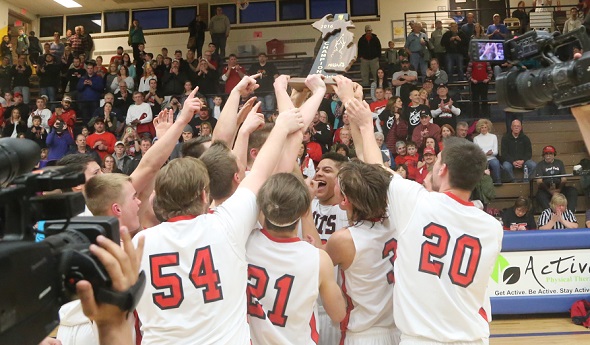
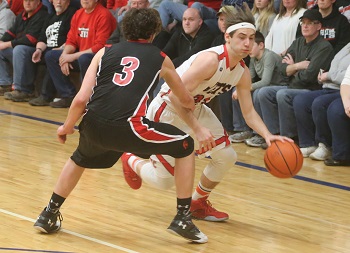
PHOTOS: (Top) Powers North Central celebrates its Class D Regional title win over Crystal Falls Forest Park on Wednesday. (Middle) The Jets downed the Trojans 75-45 in front of a packed crowd. (Photos by Paul Gerard.)