

Breslin Bound: Boys District Preview
March 6, 2017
By Geoff Kimmerly
Second Half editor
In less than three weeks, 16 boys basketball teams will converge on Michigan State University’s Breslin Center to determine four MHSAA titles.
 Today, more than 700 teams remain in the hunt.
Our final winter tournament begins tonight as boys hoops Districts tip off all over the state. Switching up the format a bit for our Breslin Bound reports – powered by MI Student Aid – we look below as usual at some of the most eye-catching results from last week, but also three Districts in each class shaping up as the most attention-grabbing heading into our first round.
Week in Review
The countdown of last week’s five most intriguing results:
1. New Haven 108, Flint Beecher 104 (3 OT) – It would be hard to find a more exciting regular-season finale than this one between Class B and C favorites; Beecher’s Malik Ellison scored 63 points in trying to reverse the eventual outcome.
2. Grand Rapids Christian 72, Wyoming Godwin Heights 58 – As it’s often said, someone had to lose, and Christian moved on to eventually finish 20-0 while dealing Godwin Heights its only loss this season. The Eagles got their scare Thursday with an overtime two-point win over Kalamazoo Central.
3. Wayne Memorial 47, Walled Lake Central 44 – Wayne closed a nail-biting Kensington Lakes Activities Association Tournament run with this championship game win, its second in three playoff games by three points.
4. Dollar Bay 54, Painesdale-Jeffers 46 – With a loss to the second-place Jets, Dollar Bay still would’ve clinched the Copper Mountain Conference Copper Country title, reportedly its first championship since 1994, but this capped a perfect league run.
5. Morley Stanwood, 59, Big Rapids 56 – The champions of the Central State Activities Association Silver and Gold faced off, with the Silver title winner emerging victorious in this unofficial league final.
Districts at a Glance
These could be among our most competitive brackets. Host sites are in bold:
CLASS A
Grosse Pointe South
Detroit Cass Tech (16-4), Detroit East English (13-5), Detroit Martin Luther King (15-4), Detroit Western International (8-11), Grosse Pointe South (10-10), Hamtramck (13-5).
This could be a remix of the Detroit Public School League Tournament, where Cass Tech beat East English in the semifinal 73-71 and then King in the championship game 59-47. That came after Cass Tech split with Western during the league regular season – and King and East English split this winter as well.
Lansing Everett (at Don Johnson Fieldhouse)
DeWitt (11-9), East Lansing (20-0), Grand Ledge (7-13), Lansing Everett (12-8), Lansing Waverly (13-7).
East Lansing would look to be the strong favorite, and rightfully so especially coming out of the same league as Grand Ledge and Everett. But the Trojans also were undefeated heading into the postseason last winter and were upset in the Regional by Everett, which went on to make the Class A Semifinals.
Walled Lake Western
Milford (12-8), Walled Lake Central (14-6), Walled Lake Northern (14-6), Walled Lake Western (14-6), White Lake Lakeland (7-13).
Similar to above in the PSL, this could be a redo of the KLAA North race, won by Western by a game over co-runners-up Central and Northern, which both split with Western in league play. Central ended up winning the Lakes tournament championship with a five-point win over Western, which had beaten Northern by one in the semifinals.
CLASS B
Bridgeport
Birch Run (7-13), Bridgeport (18-2), Carrollton (10-10), Frankenmuth (18-2), Saginaw Swan Valley (14-6).
The Tri-Valley East championship was split by the host Bearcats and Frankenmuth, with Bridgeport winning their first meeting by 10 and the Eagles winning the second also by 10. Frankenmuth lost only once more over its final 19 regular-season games – in fact, both TVC East champs also lost to Flint Hamady. Swan Valley and Carrollton were third and fourth, respectively, in the TVC Central, and the winner of their opener should provide a challenge.
Marysville
Algonac (2-18), Armada (9-11), Marine City (3-15), Marysville (14-6), New Haven (19-1), Richmond (16-4), St. Clair (14-6).
New Haven won the Macomb Area Conference Blue title and lost this season only to 2016 Class A semifinalist Macomb Dakota, by six in December. Richmond also is formidable after finishing second in the Blue Water Area Conference but with two painful losses by a combined three points at the end of February that cost the Blue Devils the league title. Marysville was co-league champion in the MAC Silver and runner-up in the MAC Silver-Bronze Tournament.
Onsted
Adrian (9-11), Brooklyn Columbia Central (10-10), Chelsea (13-7), Hillsdale (20-0), Onsted (15-5), Tecumseh (2-18).
Hillsdale won the Lenawee County Athletic Association with a sweep of Onsted, the first victory in double overtime and the second by only two points. The Wildcats were District champs a year ago. Chelsea finished only fourth in the Southeastern Conference White, but four of six teams in that league won at least 11 games during the regular season, and the Bulldogs are 9-4 since Jan. 7.
CLASS C
Bloomingdale
Bangor (0-20), Bloomingdale (14-6), Gobles (14-6), Hartford (9-11), Kalamazoo Christian (13-7), Kalamazoo Hackett (19-1).
Rivals Hackett and Christian would meet in a District Semifinal after Hackett swept the series with three and six-point (in overtime) wins on the way to a shared Southwestern Athletic Conference Valley title. Hackett reached the Quarterfinals a year ago. The host Cardinals won the SAC Central after going only 2-18 last season. And Gobles enters as the fourth-place finisher out of the strong SAC Lakeshore.
Flint Hamady
Burton Atherton (13-7), Burton Bendle (14-6), Burton Bentley (9-11), Flint Beecher (15-5), Flint Hamady (14-6), Montrose (11-9), New Lothrop (13-7).
Considering Flint Beecher has won back-to-back Class C championships and four of the last five, it’s easy to lean toward the Buccaneers heavy this week. But this District is stacked with successful teams – as noted above, Hamady handed Class B hopefuls Bridgeport and Frankenmuth losses and fell to Beecher by only four in their second meeting Feb. 3. All of Beecher’s defeats this season came against Class A or B opponents.
Napoleon
Concord (15-5), East Jackson (7-13), Hanover-Horton (17-3), Jackson Lumen Christi (3-17), Michigan Center (20-0), Napoleon (15-5), Vandercook Lake (12-8).
Hanover-Horton has won 15 straight District titles, the longest streak in Michigan, but will have plenty of challenges beginning tonight against Vandercook Lake. Michigan Center is perfect for the regular season reportedly for the first time – and beat Hanover-Horton by 19 and 13 this winter. Even then, Michigan Center would have to get through whichever wins between Napoleon and Concord just to reach the championship game.
CLASS D
Baraga
Baraga (0-20), Chassell (11-9), Dollar Bay (16-4), Lake Linden-Hubbell (6-14), Ontonagon (12-8), Painesdale-Jeffers (16-4)
With two-time reigning Class D champ Powers North Central roaming a similarly-stacked District at Stephenson, this might be the most competitive in the Upper Peninsula this week. Dollar Bay and Painesdale-Jeffers would meet in a Semifinal – as noted above, Dollar Bay won the Copper Country title this season with victories of seven and eight over the Jets. The Bays did lose to Ontonagon at the start of January (and win the rematch in February), and play them first in an opener tonight.
Brethren
Bear Lake (14-6), Brethren (11-9), Buckley (20-0), Fife Lake Forest Area (11-9), Mesick (1-18), Onekama (9-11).
Buckley, of course, would be considered the favorite and won a District title a year ago. But Bear Lake, Brethren and Forest Area all have winning records and are on the other side of the bracket, and will try to take advantage of any possible letdown. Bear Lake finished second in the West Michigan D League.
Byron Center Zion Christian
Byron Center Zion Christian (12-8), Holland Calvary (14-6), Wyoming Potter’s House Christian (13-6), Wyoming Tri-unity Christian (12-8)
The Alliance League title was shared by Calvary and Potter’s House, with Zion Christian a close third only a game back – but Tri-unity Christian plays in the league only for girls basketball, not boys. The Defenders own an 11-point win over Potter’s House from the start of the season and a 10-pointer over Calvary two weeks ago, and took most of its losses from schools in the other three classes. They made the Class D Semifinals in 2016.
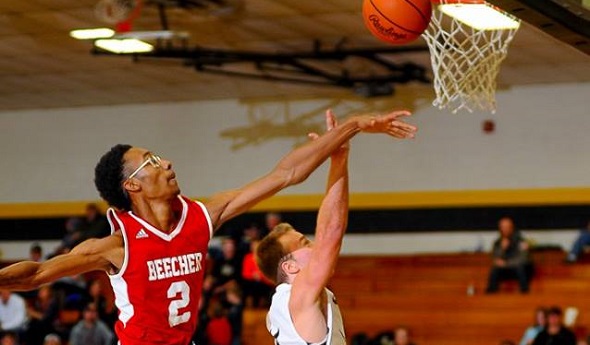
PHOTO: A Flint Beecher player deflects a Corunna shot during their matchup earlier this season. (Click to see more from Varsity Monthly.)

Class B Preview: Can't-Miss Matchups
March 21, 2018
By Geoff Kimmerly
Second Half editor
Class B could feature the most entertaining matchups of this weekend’s Boys Basketball Finals at Michigan State University’s Breslin Center.
From one side of the bracket will emerge a longtime power – Benton Harbor, seeking its first title in more than a half century, or 14-time winner River Rouge.
On the other side, reigning champion New Haven is coming off its first MHSAA title and looking to repeat led by star junior Romeo Weems – who will surely get some time facing Grand Rapids Catholic Central standout Marcus Bingham, Jr., as the latter works to lead his team to its first Finals championship in this sport.
Class B Semifinals – Friday
Benton Harbor (25-1) vs. River Rouge (23-1), 5:30 p.m.
New Haven (26-0) vs. Grand Rapids Catholic Central (23-2), 7:30 p.m.
Class B Final – Saturday, 6:45 p.m.
Tickets cost $10 per pair of Semifinals and $10 per two-game Finals session (Class C and Class B). All Semifinals will be streamed live on MHSAA.tv and viewable on a pay-per-view basis. The Class D, A and C championship games will be broadcast live on Fox Sports Detroit, while the Class B Final will be shown on Fox Sports Detroit on a delayed basis at 10:30 p.m. Saturday. All four championship games will be streamed live on FoxSportsDetroit.com and the FOX Sports Go! app. Free radio broadcasts of all weekend games will be available on MHSAANetwork.com.
Below is a glance at all four semifinalists. Click on the name of the school to see that team’s full schedule and results from this season. (Statistics are through teams' Regional Finals.)
BENTON HARBOR
Record/rank: 25-1, No. 3
League finish: Does not play in a league.
Coach: Corey Sterling, sixth season (112-37)
Championship history: Three MHSAA titles (most recent 1965), seven runner-up finishes.
Best wins: 71-51 over No. 8 Williamston in Quarterfinal, 67-52 over honorable mention Hudsonville Unity Christian in Regional Semifinal, 77-49 (District Semifinal) and 55-46 over honorable mention Coloma.
Players to watch: Carlos Johnson, 6-6 soph. F (18.3 ppg, 13.1 rpg, 5.2 apg, 3.1 bpg); Shawn Hopkins, 6-4 sr. F (15.7 ppg, 11.4 rpg, 3.1 apg).
Outlook: Benton Harbor was Class B runner-up in 2014 and made the Semifinals a year ago, and Johnson and Hopkins starred for last season’s team as well. Senior guard Elijah Baxter (9.7 ppg, 6.7 apg) also started last season. Senior guards Dennie Brown and Devan Nichols both average just above 10 ppg as well, and total six players this winter average at least 8.8. The only loss was to Class A Hazel Park, which finished 18-3.
GRAND RAPIDS CATHOLIC CENTRAL
Record/rank: 23-2, No. 7
League finish: First in Ottawa-Kent Conference Blue
Coach: T.J. Meerman, fifth season (73-43)
Championship history: Has never appeared in an MHSAA Final.
Best wins: 63-52 (Regional Semifinal), 80-39 and 59-40 over honorable mention Spring Lake, 73-49 over Grand Rapids Christian, 90-84 over Detroit Country Day.
Players to watch: Marcus Bingham, Jr., 6-11 sr. F (16.8 ppg, 10 rpg, 3.7 bpg); Jacob Polakovich, 6-8 sr. F (14.2 ppg, 10.5 ppg).
Outlook: GRCC has won at least 20 games for the second straight season and upped its win total the last four under Meerman on the way to its first Semifinal since 1992. Bingham was a Mr. Basketball Award finalist and is plenty to handle – but he has lots of help as well. In addition to Polakovich in the post, junior guard Darrell Belcher is putting up 14 points per game, and junior guard Austin Braun is averaging 7.8 points and 7.5 assists per game.
NEW HAVEN
Record/rank: 26-0, No. 1
League finish: First in Macomb Area Conference Blue
Coach: Tedaro France II, 10th season (185-57)
Championship history: Class B champion 2017.
Best wins: 78-72 over No. 5 Bridgeport in Quarterfinal, 92-74 over Detroit Country Day in Regional Final, 81-70 over Class C honorable mention Flint Beecher, 82-62 over Warren DeLaSalle, 74-57 over St. Clair Shores South Lake.
Players to watch: Romeo Weems, 6-7 jr. G/F (23.5 ppg, 11.8 rpg, 5.7 apg, 5.1 spg, 2.5 bpg), Tavares Oliver, Jr., 6-0 sr. G (16.8 ppg, 3.2 apg, 65 3-pointers).
Outlook: New Haven is in the Semifinals for the second straight season and second time ever – and has won 52 straight games. Weems nearly had a quintuple-double this season and will be one of the most anticipated players for fans this weekend. Senior forward Ashton Sherrell (15.7 ppg, 8.5 rpg) and junior guard Ronald Jeffery III (12 ppg, 3.1 apg) round out the majority of an offense outscoring opponents by 32 points per game.
RIVER ROUGE
Record/rank: 23-1, No. 4
League finish: First in Michigan Metro Athletic Conference Blue
Coach: Mark White, second season (47-3)
Championship history: 14 MHSAA titles (most recent 1999), five runner-up finishes.
Best wins: 50-43 over honorable mention Detroit Old Redford in Regional Final, 59-44 over Dearborn Divine Child in Quarterfinal, 75-32 over St. Clair Shores South Lake in Regional Semifinal, 48-42, 56-45 and 77-45 over Harper Woods. Players to watch: Jayvien Torrance-Jackson, 6-1 sr. G; Bralin Toney, 5-10 jr. G. (Statistics not submitted.).
Outlook: River Rouge is back at the Semifinals for the second straight season and after a one-point overtime last time loss kept it from a first championship game berth since 1999. Torrance-Jackson not only is the only starter back from that team, but also the only senior on this one. Toney also saw time off the bench in last season’s Semifinal and joins him in the backcourt, while the frontcourt includes two 6-6 post players. The lone loss this winter was to Class D semifinalist Southfield Christian.
PHOTO: New Haven’s Romeo Weems puts up a block as Bridgeport’s Charles Garrett drives during Tuesday’s Quarterfinal. (Photo by Terry Lyons.)